Clever—?
life—and in his wake came doubt and uncertainty.
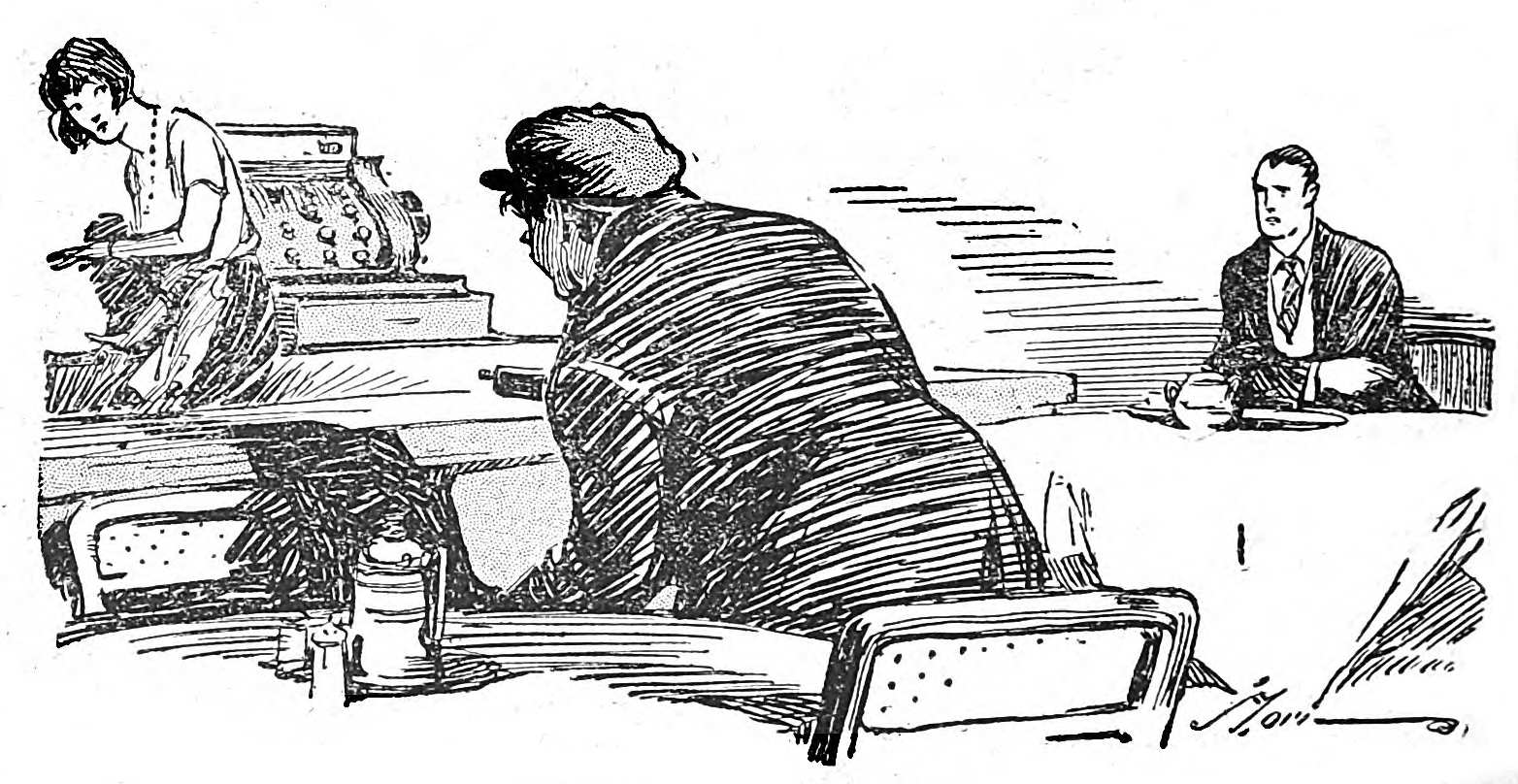
Janice was just about through for the evening. Only one customer tarried over his salad sandwich and tea in the small shop, just around the corner from Lawrence Avenue.
The customer somehow disturbed Janice. That she had never seen the man before this evening she was quite positive. There were things about him that she instinctively disliked, for no reason that she could put into words.
He was so smooth-looking, so altogether immaculate and theatrical.
Glancing at him again, out of the corner of her eye, she judged him to be about thirty-five.
There was a bluish, clean look about his smoothly shaven firm chin. His teeth were even and white, and his black eyes matched the slick black sheen of his hair, which was brushed smoothly back from his forehead. He had long, dark lashes, and a way of looking lazily out from under them that was disconcerting.
Possibly he was an actor, Janice thought. Certainly he dressed much as did the younger among the occasional vaudeville actors who drifted in now and then from the theater over on Wilson Avenue.
When he had ordered, Janice had been struck with the deep, musically vibrating tone of his voice. Soft and liquid it was, a rich barytone, with just the tinge of some foreign accent. Altogether, she told herself, he was too “pretty.” Prettiness, in a man, did not appeal to her.
Just as she was deciding that she disliked the man heartily, because of his bold, appraising glances, another man, short, swarthy, and rough-looking, entered the shop.
“Too late to get a cup of tea and a sandwich?” the newcomer asked.
“Certainly not,” returned Janice courteously, mindful that the woman who owned the shop needed every cent. “Won’t you be seated?”
The newcomer glanced out of the window, then suddenly swung around and, facing her, with his back to the window, pointed a stubby black automatic her way.
“Shell out, kiddo,” he said. Janice’s heart nearly leaped out of her mouth. It was Saturday night. The neighborhood banks had closed at noon. There was a comparatively large amount of money in the cash register.
“Move!” the man snapped throatily, “or I’ll let the light through you, sure as—” She quickly went to the register and punched the “No Sale” key; the drawer slid open. Tremblingly she handed all of the bills to him. He snatched them, tucked them into a pocket, and said:
“Come out into the kitchen, baby. I’m going out the back way—I happen to know that the cook’s gone home, so don’t try to string me. You’re a sweet mamma, any way a guy looks at you, an’ I’m going to let you kiss me good-by—if you hurry.”
Janice backed away from him, but he jammed the gun into his coat pocket and, still covering her with it through his pocket, urged her along toward the kitchen door.
Before the door she halted, but the intruder gave her one final push and she bumped against the swinging door and stumbled through into the kitchen. A momentary blackness rushed to her head. Her knees suddenly doubled beneath her, and she slipped to the floor.
At this juncture she heard the sound of a scuffle. Almost helpless with fright, but not unconscious, she lay supine upon the floor. Presently the back door opened and then immediately closed.
Gathering strength to rise, Janice struggled to her feet and turned on the light. As she did so the back door opened again.
She was about to scream when, to her amazement, not the stocky man, but the customer whose looks she had disliked, came back through the door.
“Here,” he said, holding out his hand, “is your dough. I got it out of his pocket. Here, also, is his gun. You ought to keep one around the place.”
Mechanically, Janice took the weapon and the wad of bills.
“But how—” she began. “What on earth—”
“I crawled behind the tables to the kitchen door while you were handing him the money, figuring I’d go out the back way and come around front to nail him when he came out.
“He was so interested in you he must have forgotten all about me. When I heard him say he was going out the back door I decided to wait for him out there.
“He’ll never succeed. A young man who doesn’t keep his mind on his business any more than he does ought to take a correspondence course in bookkeeping and settle down to a life of thrift, rather than one of bold, bad enterprise!
“Still, I ought not to criticize. Had I been about to rob you, when I saw you I’d forget all about my plans too.”
She blushed and was about to rebuke him, but thought better of it, in view of what he had just done. After a pause and a bold smile he returned to his subject:
“When you two came out into the kitchen, I waited until he let go of the gun in his pocket, in order to kiss you, and then jumped him. Outside he got away while I was getting his gun and your money from him.”
“Oh!” breathed Janice. “How can I ever thank you? You endangered your very life!”
“Where would one find a worthier cause?” he asked, with a graceful shrugging movement of his shoulders and arms. “You’re white as a sheet,” he went on. “Sit down at one of the tables.” She obeyed him mechanically.
“Now I’ll play waiter,” he told her. Going to the service counter he secured a napkin, draped it over his arm, drew a glass of water from the cooler, and returned to put the glass down before her with a flourish.
“Do try our excellent water!” he advised, standing at her elbow. Despite the fact that her heart was still hammering, Janice laughed aloud and drank the water.
“Isn’t it about time you were closing now?” he asked a moment later. “It’s pretty late, and nobody except holdup men are likely to come in this time of the evening.”
“Yes,” she admitted. “I was just going to close up and go home when you came in—and stayed so long—thank goodness you did—there’s no telling—”
“I suppose you never suspected, or dreamed, twenty minutes ago,” he went on with a twinkle in his bright eyes, “that you were going home escorted by no less a person than the customer whom you eyed so frostily when he presumed to stare at you—he not being able to remove his eyes from the contemplation of such an exquisitely pretty girl.”
“Now, please,” objected Janice, “don’t talk like that. You’ve been so wonderful—don’t spoil it.”
He became comically solemn, drawing down the corners of his mouth and knitting his fingers across his stomach as he stood across from where she sat at the table, in ludicrous imitation of the comic supplement conventional ministerial type.
“I promise to be good,” he told her, “if you’ll let me see you safely home.”
“It’s only a short way—and it will be ever so kind of you. I’d be afraid to go alone now—after what nearly happened; especially as I have to carry nearly two hundred dollars that’s here.”
She glanced down at the wad of bills now reposing on the table before her, with the revolver beside them.
Rising, she put on her coat and hat, shoved the bills into her purse, gingerly carried the revolver over and put it behind the counter, and turned off the lights within the store. In the street, after she had locked the door, he took her arm possessively.