LETTER OF TRANSMITTAL.
THE COMMISSION FOR THE INVESTIGATION AND
CONTROL OF THE CHESTNUT TREE BLIGHT
IN PENNSYLVANIA
1112 Morris Building, Broad and Chestnut Streets
Philadelphia, December 9th, 1913.
HON. JOHN K. TENER, Governor,
Harrisburg, Penna.
Sir: We have the honor to transmit herewith our report of the
operations of this Commission for a portion of the year 1913, this
being also the final report of the Commission.
Eastern Asia, the home of the San Jose scale, has been found to be also
the home of the chestnut blight. The disease has been found definitely
in northeastern China; probably it is also present in Japan. There is
no reason to doubt that it found its way to this country in the same
way that the San Jose scale did, on nursery stock, and at about the
same time, or perhaps somewhat later. Any system of strict inspection
of imported nursery stock could have kept it out of this country,
but no such system was then in use. It would probably not have been
possible at that time to secure a law authorizing such inspection
because of the lack of public appreciation of the seriousness of
imported fungous and insect epidemics.
The oldest known spots of chestnut blight infection are in the
neighborhood of New York City. Here again the disease could have been
checked at an early date and never found its way into Pennsylvania,
but nothing of the sort was even attempted. In fact, even up to 1911,
no official work was done in New York upon the disease. In 1908
Murrill[1]
advocated cutting out all chestnut trees within half a mile
of diseased trees, but this plan was never put into practice in New
York. In general, the greatest conservatism has prevailed regarding
the seriousness of the disease. The view that the fungus was native
to America, and its great virulence due to winter injury and other
temporary climatic effects upon the trees, has been strenuously
advocated. The Commission from the first, however, adopted the theory
of the Department of Agriculture that the disease was of foreign origin
and hence to be considered in the light of a dangerous invader. This
view has since been amply justified. Pennsylvania was the first state
to treat the epidemic seriously, but by the time the Commission was
able to begin work the disease was spread over the eastern half of the
State too completely to make its eradication there possible.
Twenty years ago such an epidemic as the present one would have
attracted little attention, but now the prices of all classes of
timber have been for some years increasing, and promise to continue to
increase indefinitely. It is obvious that every possible care must be
taken of the present forest stand; upon this point there is no longer
disagreement. In Pennsylvania the chestnut is especially valuable,
standing in intimate relation to many of the leading industries of the
State. It is distributed throughout the State, comprising at least
one-fifth, possibly one-third, of the timber. It is naturally adapted
to poor, hilly land not suited for agriculture, and will produce
profitable yields of extract wood, fence posts, rails, etc., in 25 to
30 years; and ties, poles, and saw timber in 40 to 50 years. Because
of its comparatively rapid growth, its superior ability to perpetuate
itself by means of sprouts, and the great variety of its uses, the
chestnut may be considered the most important forest tree in the
State. The ease with which chestnut can be managed according to the
principles of forestry made it, before the appearance of the blight,
one of the principal species depended upon to solve the problem of the
future timber supply of the State. On steep slopes, where the per cent.
of chestnut is high, serious deterioration, washing of the soil, and
reduction in water supply will undoubtedly follow the destruction of
the chestnut trees.
The complete loss of the present commercial stand of chestnut in
Pennsylvania, which, now that the Commission has ceased work, seems
absolutely certain, is a calamity which will be fully realized only in
the future. In matters of this kind we have obligations to the future,
aside from the particular emergency in hand. This is not the last tree
disease that will sweep over the State. All efforts to control this
disease would be justified even if we only learned how to control the
next one. Methods which may not be practicable now will be highly
practicable twenty years from now on account of the steady increase
which is bound to come in timber values. The mere fact that this
campaign against the chestnut blight has been undertaken at all shows a
great advance of thought over that of previous years.
With these facts in mind, it is obvious that three courses were
possible, when the extent and seriousness of the chestnut blight was
first realized in Pennsylvania.
First,—Do nothing.
Second,—Conduct scientific investigations
of the disease with the hope of determining by laboratory methods and
very small field experiments some method of control.
Third,—Conduct scientific investigations,
and at the same time immediately attack the epidemic by any and every
means that seemed to afford any possibility of checking or even
delaying the course of the disease. To follow the first method would
have been to emulate simply the example of New York and New Jersey.
The second course had many points in its favor, but it was obvious
that such a course would yield no results in time to be used on the
present epidemic, though possibly of the largest ultimate value. The
third course appealed to the Commission as the only one possible under
existing circumstances. The greatest handicap was the extent to which
the disease was already present in the State.
In the eastern half of the State the disease was obviously beyond
control. In the western half the best course available, and in fact the
only method that has been proposed at all for control of the disease,
was that of cutting out the advance infections. While this method
is open to many criticisms, nothing better has been proposed even
to the present time. The Commission adopted the cutting out methods
advocated by the U. S. Department of Agriculture with two exceptions:
(1). Spots of considerable size were cut out in some cases; that is,
the cuttings were not limited to strictly advance infections. (2). No
immune zone was established at first, although this might have been
done later. The method was essentially that advocated by Murrill in
1908, except that trees were not cut to as great a distance as half
a mile from the source of infection. Detailed reports of the cutting
out work are appended. It is sufficient to say here that the progress
of the disease in the western half of the State has been set back
five years, and west of the line extending from Bradford to Somerset
counties there is little infection, and what infection there is dates
from 1913. There is no reasonable doubt that the disease could have
been kept instatu quo indefinitely, had the work of cutting out
continued. As set forth in the appended reports, the methods of cutting
out have been improved, the cost determined and reduced, and winter
scouting established as a practical method. These methods developed by
the Commission are now in active use in the States of Virginia and West
Virginia, where the campaign of eradication is being vigorously pursued.
One of the most valuable results of the Commission’s work was the
establishment of the fact that the wood of a blighted tree is entirely
fit for use, and if utilized soon after the death of the tree from
blight, can be disposed of in the regular way and at normal values. The
Commission has advocated the cutting out of all diseased trees, since
on account of the prejudice against blighted poles and timber, and the
possibility of the market becoming glutted, this is the best plan. Also
the cutting of diseased trees was urged because it would reduce the
sources of infection. Since utilization was all that remained to be
done in the eastern half of the State, the Commission secured a special
reduced freight rate on blighted lumber, determined what demand there
was in and out of the State for chestnut lumber and other chestnut
products, and proceeded to bring owners and dealers together. This
work had just reached the point of its highest efficiency when the
Commission ceased work. As there is no longer any means of inspection
and certification of diseased lumber, the reduced freight rate is no
longer available.
When the Commission began work but few investigations had been made of
the chestnut blight, and other States, as well as the U. S. Department
of Agriculture, were working on the disease without special funds.
The Commission by its example and by its direct efforts, assisted in
securing Congressional and State appropriations, and practically all of
the scientific work and all of the practical work which has been done
on this disease since 1910 was made possible by the efforts of this
Commission. A National law was passed which requires strict inspection
of all imported nursery stock and the prohibition from entry of certain
classes of stock, and which makes the repetition of such an event as
the importation of the chestnut blight impossible, or at least highly
improbable. The work of this Commission was one of the greatest factors
in bringing about the passage of this law.
Not only has the work of the Commission aroused public attention
throughout the Eastern States regarding this disease, but the public
is awakened as never before by the example of the destruction of one
species to the necessity of conservation of all timber resources. In
this State the Commission has carried on a liberal educational campaign
in which it has had the hearty co-operation of the State Forestry
Department, the Conservation Association, such organizations as the
Boy Scouts, various lumber and trade associations, and many other
organizations, institutions, and individuals.
In conclusion, it seems necessary to call sharp attention to the real
lesson to be learned from the chestnut blight epidemic—viz.: the
necessity of more scientific research upon problems of this character;
to be undertaken early enough to be of some value in comprehending, if
not controlling the situation. We have seen that the blight might have
been kept out of the country in the first place by inspection, or once
in, that it might have been destroyed, or at least checked before it
had gotten widely distributed. But instead it was permitted to enter,
and to spread for many years without scientific notice, and for several
more years without any organized attempt to control it, or even to
study it seriously. Are we doing any better now with reference to the
future?
China has been shown to be the home of the chestnut blight. China,
then, would seem to be the obvious place to study it; but no
pathologists are there, and state and federal parsimony has so far
failed to provide for any investigations of the disease on its home
ground by American pathologists.
It has been proposed to replace the chestnut in southern New England
by plantings of white pine, in itself the most important eastern
timber tree; but the white pine is in turn subject to a newly imported
disease, the blister rust. It is not certain that very serious and
united efforts are being made to investigate and control this disease
even in the States that introduced it. As in the case of the chestnut
blight, scepticism has even been expressed as to its seriousness.
Again, it would seem that the obvious place to determine the
seriousness of the blister rust was in Europe, its home; yet to date
neither state nor National government has dispatched a scientist on
this errand. In this connection it may not be amiss to call attention
to the fact that in Pennsylvania there is, aside from the employees
of this Commission, only one professional plant pathologist! Yet the
preventable damage which this one plant disease—chestnut blight—has
done, would pay for the work of more plant pathologists than are now at
work in the entire world.
The Commission closes its work with regret, knowing well that the
blight will now spread over the State without hindrance. There is
some satisfaction in knowing, however, that the work left undone in
Pennsylvania has been actively taken up in Virginia and West Virginia,
and that the States of Ohio and North Carolina are making studies
preparatory to combatting the disease as soon as it appears in those
States. The scientific research carried on by the Commission will be
continued by the U. S. Department of Agriculture. We may be certain
that the war against this and other foreign epidemics will not cease
until science is so far advanced in both theory and practice that they
can be controlled.
Very truly yours,
WINTHROP SARGENT,
Chairman.
Report of
Hon. I. C. Williams
Deputy Commissioner of Forestry, Collaborator

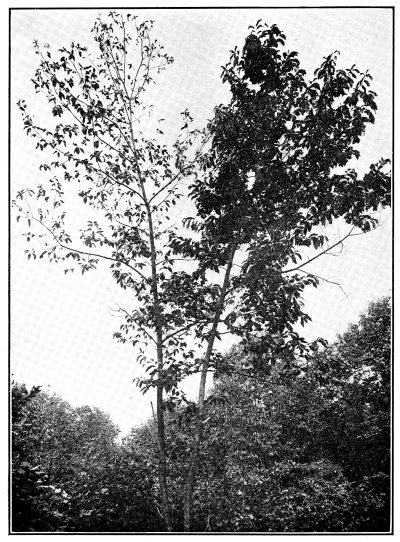
A common mark of the blight. Small leaves
which developed in the early spring on a top recently girdled
by the blight, showing midsummer condition. Withered leaves
above the canker; sprouts below.
A HISTORY OF THE EARLY PENNSYLVANIA EFFORT
TO COMBAT THE CHESTNUT BARK DISEASE.
BY HON. I. C. WILLIAMS,
DEPUTY COMMISSIONER OF FORESTRY,
COLLABORATOR,
HARRISBURG, PA.
Preliminary to the final report of the Chestnut Blight Commission,
it is thought desirable to make a statement detailing the history of
the chestnut bark disease in Pennsylvania so far as known, and of the
efforts to combat it, leading up to the formation of the Commission
under the law of 1911, and the extended work of repression begun at
that time.
The attention of the Pennsylvania Department of Forestry was first
attracted to the appearance of the chestnut bark disease in this
State by a letter from Mr. Harold Peirce, of Haverford, dated July
18, 1908, reporting its presence in Lower Merion Township, Montgomery
County, and by an article appearing in the November, 1908, number of
“Conservation,” from the pen of Dr. John Mickleborough, of Brooklyn.
Subsequent correspondence with Dr. Mickleborough revealed the fact
that he had been a student of the disease for over a year and had
become familiar with it in all of its ordinary aspects. To these
two gentlemen, therefore, the State is primarily indebted for the
subsequent efforts made to study more particularly, and to attempt to
control this vicious tree disease.
The facts relating to the discovery of the disease in America and
its identification are pretty well known. It was first detected by
Dr. Hermann W. Merkel, in the Bronx Zoological Park, New York City,
in 1904, although it is almost certain that it existed in that
neighborhood for probably more than a year prior to Dr. Merkel’s
discovery. Referred for identification to Dr. W. A. Murrill of the New
York Botanical Garden, he published a description of it in
1906[2],
and by him the fungus was named Diaporthe parasitica, so called
because it was believed to be the only parasitic species of the genus.
The naming of the fungus has since been corrected by means of the
researches of Anderson, Clinton, Farlow, Shear and Stevens, and it is
now known systematically as Endothia parasitica.
Some controversy has been had over the origin of the disease and the
case is probably not yet settled. Dr. Clinton’s contention is and has
been, that it is a native fungus, which, by means of weather conditions
and possibly other factors, has taken on new attributes. Dr. Metcalf,
his co-worker Prof. Collins, Dr. Shear, and others believed and still
maintain that it is of foreign origin, introduced into America by the
importation of horticultural stock. Its first known appearance in the
region of New York City and its spread in concentric zones from that
point as a centre of infection, lent much plausibility to this theory.
The recent discovery made by Mr. Frank N. Meyer, of the same fungus
in northeastern China, where it is parasitic on Castanea, and
where, it appears, the host trees have become rather highly resistant
to its attack, leads further probability of correctness to Metcalf’s
theory.
Possibly a great hope for America lies in this Chinese discovery.
Pathologists and foresters are anxiously looking forward to the results
of experiments now being made and which will be attempted, we hope, on
a much larger scale in the future. The regrettable, ever-present fact
is that this disease is with us here and now, and must be reckoned with
from every angle of attack. There seems to be no present diminution
sufficient to warrant the belief that it is likely to wear itself out,
or that our trees will become sufficiently resistant to ward off the
attack prior to the destruction of the trees themselves.
Subsequent correspondence between Dr. Mickleborough and the Department
of Forestry culminated in a letter from him under date of March 9,
1909, in which he outlined a definite plan for the examination of
a supposedly infected territory in southeastern Pennsylvania, and
offered his services to the Commonwealth for carrying out plans of
investigation. The proposed inspection was approved by the Department
on March 17, 1909, and the services of Dr. Mickleborough thus enlisted.
The first inspection visit was made by him in company with the writer,
March 29, 1909, at Mt. Holly, in Cumberland county, but where no
evidence of the disease was found at that time.
Prior to the beginning of this work in 1909, Dr. Mickleborough had
been invited by Dr. Jane Baker, physician in charge of the Chester
County Insane Hospital, to speak before an educational conference at
Embreeville, Chester county. At this time the disease was not generally
prevalent in that region, but a number of infected chestnut trees were
found.
The work of inspection over the southeastern portion of the State thus
undertaken under the direction of the Department of Forestry, as stated
above, was conducted by Dr. Mickleborough, and carried through or
into almost every county east of the Susquehanna. During the progress
of this examination the chestnut blight was not found north and west
of the South Mountain, although prior to this time the United States
Department of Agriculture had reported the existence of two spot
infections in the western portion of the State, near Altoona, and a
re-examination of the material relating thereto by Dr. Metcalf and his
assistants, seemed to leave no doubt as to the correctness of this
report. Certain it is that in May, 1909, there was no large or extended
infection west of the Susquehanna. Had there been in existence at that
time the means to carry on work of control along both sides of the
Susquehanna River, who can tell what the result might have been, looked
at in the light of our present knowledge?
The report of Dr. Mickleborough’s inspection and study was published
by the Department in the autumn of 1909. This is a 16 page pamphlet
illustrated by drawings showing a portion of the structural formation
of the fungus, and by a Lumiere color photograph of a stem section
of chestnut covered externally by the fruiting fungus. This specimen
of infected chestnut wood was sent in from Pike county, in the upper
Delaware valley, and was incubated and developed in a moist cell in the
Department of Forestry during the summer of 1909.
In the early part of the study of this bark disease, it was believed
that the Japanese species of Castanea was either immune or
highly resistant to attack. Several specimens of Japanese chestnut were
under observation on Long Island, and fairly gave rise to this belief.
One grove examined near Westbury, in June, 1909, showed the Paragons and
common chestnuts badly attacked. The Japanese showed no attack at all.
Through the courtesy of the Hicks nursery at Westbury, forty-five
young chestnut trees supposed to be Japanese, and one hundred grafting
scions were sent to the chestnut orchard of Mr. Levi Wise, at Gap,
Lancaster county, Pennsylvania, and distributed among four persons of
the neighborhood for planting and testing out for immunity. The bark
disease was at that time particularly prevalent in the chestnut woods
at this place. Some of the newly planted trees died from other causes,
but enough of them were attacked and killed by the blight to show that
these particular trees, at least, were not immune.
On the 29th day of March, 1910, Dr. Mickleborough delivered a lecture
on the subject of this tree disease before the Main Line Citizens’
Association at the Merion Cricket Club, Haverford, Pa. This meeting was
arranged largely through the efforts of Mr. Peirce, who at that time
was the owner of several acres of chestnut woodland, and of which
tract Dr. Mickleborough made a rather extended examination, finding the
chestnut blight present in a number of trees. This discovery and the
lecture delivered on the subject brought the matter prominently to the
attention of the citizens of that neighborhood, and later led to some
very important developments with respect to studying and combating the
disease.
Following this address by Dr. Mickleborough, Mr. Peirce was in
correspondence with the Department of Forestry, calling attention to
the inroads being made upon the chestnut trees by this disease in the
neighborhood of his residence, requesting the Department to render such
help as it might be able in assisting the people to understand the
situation better, and, if possible, to eliminate or at least attempt
to control the trouble. This correspondence culminated in the calling
of a meeting on May 23, 1910, at the house of Mr. Robert W. Lesley, at
Haverford, which was attended by a number of the residents and land
owners of the neighborhood, by Dr. John W. Harshberger, the botanist,
representing the University of Pennsylvania, and by the Deputy
Commissioner, representing the Pennsylvania Department of Forestry.
The preliminary arrangements for beginning an extensive survey of this
region were discussed at this meeting. The Department representative
made his report to the Forestry Commission at its meeting held on
June 3, 1910. On motion of Dr. Rothrock, the Commission directed
that the Department render the desired help, and on the same day a
letter to this effect was sent to Mr. Peirce, the secretary of the
citizens’ meeting. On September 1, 1910, a corps of inspectors from the
Department in charge of the Deputy Commissioner, arrived at Haverford
and Ardmore, prepared to begin their work. Offices were speedily
fitted up in the building of the Merion Title and Trust Company at
Ardmore, and the first inspection of trees was made on the property
of Mr. Lesley on Saturday, September 3rd. From this date forward
until December 19, 1910, the work was vigorously carried on, and a
close inspection made of 296 properties, covering most of the region
extending from Overbrook to Paoli, and from the Schuylkill River on the
north, to a considerable distance south of the Pennsylvania Railroad.
A draft of each property was prepared showing the location of all
chestnut trees and indicating those which at that time were apparently
free of disease, as well as those showing the infection. Each property
owner was then furnished with a copy of the report and draft relating
to his own land.
To show the interest taken in this work by members of the Main Line
Citizens’ Association, it is necessary only to state that the work
was carried on almost entirely at the expense of the association. The
individual contributions for the purpose amounted to $2,707.70.
During the progress of this inspection, a second public meeting was
held in the auditorium of the Merion Cricket Club, at which time a
preliminary report was submitted and discussion had with respect to
the situation as it then existed. This meeting was attended by a large
number of ladies and gentlemen, members of the association, and much
interest was shown in the progress reported. The final report of the
committee of the association having the work in charge was printed and
rendered to the members under date of May 8, 1912. This committee was
as follows: Messrs. Harold Peirce, Chairman; Theodore N. Ely, Allan
Evans, Edgar C. Felton, William Righter Fisher, Alba B. Johnson, and
Robert W. Lesley.
In a letter bearing date the 12th day of March, 1909, addressed to the
Commissioner of Forestry at Harrisburg, Dr. Mickleborough used this
language. “As to remedy, the best that can be suggested by anyone at
present is Control and not Extermination, for various
reasons. This I think is also true of the San Jose scale.” It will thus
be seen that the original idea involved in the attack on the chestnut
blight in Pennsylvania was control, just as the Department
of Agriculture of this State has always aimed at control of
the San Jose scale, suggested in the letter just quoted. After the
preliminary studies were completed, no one believed that extermination
or eradication could be accomplished with the means at hand; but it was
thought then, and is still the belief of those who are most closely
associated with the work, that a control is possible, and that
it was much more possible then than now, after the lapse of a period of
five years.
During the progress of the inspection along the Main Line, it became
apparent that more than a local effort was demanded if any substantial
progress were to be made towards preventing the spread of the disease.
Steps were taken to enlist the active interest of the Governor and
the Legislature, (then in session). On the evening of April 10,
1911, Governor Tener sent a special message to both houses of the
Legislature, calling direct attention to the situation, and asking the
help of the General Assembly to combat the disease. The Governor’s
message was as follows:
“Commonwealth of Pennsylvania,
“Executive Chamber,
“Harrisburg, April 10, 1911.
“Gentlemen of the Senate and House of Representatives of the
Commonwealth of Pennsylvania:
“I have the honor to call your attention to a new and virulent
disease of the wild chestnut tree, commonly known as chestnut blight,
recently discovered near New York City, and hitherto unknown in
America. The disease has continued to spread, destroying the chestnut
trees in the neighborhood of New York City and well up the Hudson.
It has invaded Long Island, beginning at the western end, sweeping
eastward, practically covering the island. It has progressed to the
southwest, through the whole of the State of New Jersey, and all the
chestnut trees there appear to be doomed to destruction. It has entered
Pennsylvania and is prevalent in the Delaware Valley. It has been
discovered in the following counties: Pike, Monroe, Northampton, Bucks,
Montgomery, Chester, Philadelphia, Delaware, Lancaster, and southern
Berks. In isolated places it has crossed the Susquehanna, and is now
detected in eastern York, eastern Perry and one portion of southwestern
Perry. Other points of infection have been found near Altoona and
Greensburg.
“Experiments made by the Department of Agriculture at Washington
demonstrate that it is possible to prevent the spread of the disease
by removing spot appearances as they are detected, and destroying the
trees in which the disease occurs. By this means the region around
Washington has been freed from the blight for at least two years,
and it has not re-invaded this area. In the southeastern portion of
Pennsylvania, where the infection is severe and almost complete, little
hope exists for saving the trees, but in that portion of the State west
of the Susquehanna and north of the Blue Mountains, it is hoped, by
prompt action on the part of the State, to prevent further damage. If
this disease can be held within the southeastern portion of the State,
it will mean the saving of the wild chestnut trees in the other parts
of the Commonwealth, the value of which extends into the millions of
dollars.
“I therefore recommend that the Legislature give immediate attention
to this important subject and that a Commission be created with
sufficient power and appropriation of moneys to determine upon and
employ efficient and practical means for the prevention, control, and
eradication of this disease, and that said Commission be authorized, in
conjunction with the Department of Forestry, or otherwise, to conduct
scientific investigations into the nature and causes of such disease
and to adopt such means to prevent its introduction and spread as may
be found necessary.
“JOHN K. TENER.”
The next day, April 11, 1911, a bill having this purpose in view, and
which had been previously carefully drawn and vigorously criticised,
was simultaneously introduced in both House and Senate. This bill
became a law by the signature of the Governor, June 14,
1911[3].
The law creates a Commission of five members and vests them with almost
plenary power to carry out its mandates. An appropriation of $275,000
became available at once. The appointment of the members of the
Commission followed after an interval of about two weeks. Organization
was effected, officers and assistants chosen, and on August 23, 1911,
the Commission was prepared to proceed with its work.
While the major effort of the Commission from the beginning was to get
a control, the subject of eradication was vigorously debated, and, as
will be seen in subsequent pages, determined efforts at eradication
were undertaken under the advice and direction of the Commission. The
feeling was that if there be any merit in such effort, opportunity
ought not to be lacking to prove it. The early announced and decisive
plan involving the cutting-out method, proposed and outlined by Dr.
Murrill, contributed very considerably toward the decision to try out
this method.
The Murrill plan ([4])
was as follows:
“Owners of standing chestnut timber within the affected area are
advised to cut and use all trees, both old and young, that stand within
half a mile of diseased trees, unless protected from infection through
wind-blown spores by dense forest growth or some other natural barrier.
This may not prevent the spread of the disease through the agency of
storms, birds and squirrels, but it will at least retard its progress.
Old weathered chestnut trunks that have been dead several years have
no power to spread the disease, and these may be cut at leisure for
the tannic acid factory or for firewood. Trees of good size recently
killed should be turned into lumber as soon as possible; the fungus
affects only the bark, but other fungi may afterwards impair the value
of the wood if allowed to stand too long. Discarded branches and young
trees of no value that are cut near the edge of the infected area
should be burned at once in order to destroy the spores they contain;
but if they are well within the zone of infection, such precaution is
useless.”
Every element in the Murrill plan has been employed both by the
Commission and by the State Department of Forestry. The fact that
subsequently Dr. Murrill partially shifted his ground[5],
did not seem sufficient reason to warrant the abandonment of a plan of
attack which in many cases was productive of satisfactory results.
The history of what work the Commission did, and of the results
accomplished form the substance of several preliminary reports submitted
to the Governor from time to time. The final report is what follows.
PROGRESS OF FIELD WORK. — EFFECTIVENESS OF THE CUTTING OUT METHOD. — BENEFICIAL INSECTS. — NURSERY INSPECTION. — DISCOVERY OF THE CHESTNUT BLIGHT IN CHINA. — PROTECTION OF ORCHARDS AND NURSERIES. — PREVENTION OR REMEDY. — CONTROL OF THE DISEASE IN ORCHARDS. — FAKE TREATMENTS, THEORIES OR CAUSES, ETC. — EXAMINATIONS OF INDIVIDUAL TREES. — PUBLIC PARKS AND FARMS. — BLIGHT-EATING BEETLES. — CORDWOOD AND THE SPECIAL TARIFF. — PROMPTNESS IN UTILIZING CHESTNUT. — INTENSIVE LOCAL UTILIZATION. — RESISTANCE AND IMMUNITY. — CHESTNUT BLIGHT EXHIBITS. — PUBLICATIONS. — CO-OPERATION. — MUCH IMPORTANT WORK UNFINISHED. — FIELD OPERATIONS. — REDUCTION OF FORCE. — BETTER WORK IN WINTER. — FIELD WORK IN THE WESTERN DISTRICT. — A HARMLESS SAPROPHYTE. — FIELD WORK IN THE EASTERN DISTRICT. — SUGGESTIONS FOR TIMBER OWNERS. — LOCAL INTENSIVE FIELD WORK. — DISEASE INVESTIGATIONS AND NURSERY INSPECTION. — GERMINATION OF SPORES. — PRODUCTION OF PYCNOSPORES IN WINTER. — BIRDS DISSEMINATE THE FUNGUS. — “SHOOTING” OF ASCOSPORES. — EFFECT OF TEMPERATURE. — RESISTANCE OF PYCNOSPORES. — EFFECT OF DRYING ON ASCOSPORES. — ENTRANCE OF BLIGHT IN GALLS. — INSECTS AS CARRIERS OF THE DISEASE. — OTHER DISEASES OF THE CHESTNUT. — FIELD INVESTIGATIONS. — NURSERY INSPECTION.
Report of
Mark A. Carleton
General Manager
Pennsylvania Chestnut Tree Blight Commission

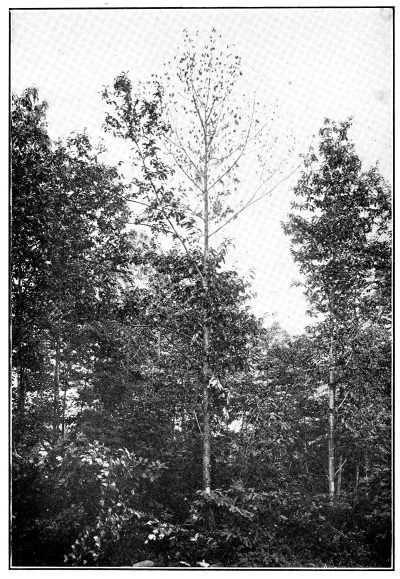
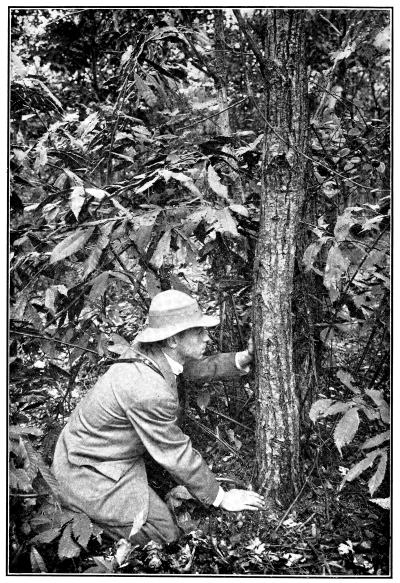
Summer condition of a blighted tree.
The withered leaves of the top above the canker, and the
vigorous sprouts below the canker are characteristic signs.
THE FIGHT TO SAVE THE CHESTNUT TREES;
FINAL REPORT OF THE
GENERAL MANAGER.
By MARK A. CARLETON,
GENERAL MANAGER,
PENNSYLVANIA CHESTNUT TREE
BLIGHT COMMISSION.
In closing the active work of this Commission, it is a great
satisfaction to be able to report constant progress to date, and the
attainment of good, practical results. The work began two years ago in
the midst of much skepticism as to its possibilities, but the optimism
of the Commission and the wisdom of its methods of operation have in
the main, been amply confirmed by the results since obtained.
A more or less definite division has been maintained between the
slightly infected Western portion of the State and the badly infected
Eastern portion, known respectively as the Western and Eastern
districts. In a previous report it was stated that in the Western part
of the State the blight had been eradicated to the extent covering
nearly one-half of the area of the State. This area so far as is known
to date has been maintained free from the disease. In a few cases new
infections were found which have been removed. It is important to note
in this connection not only the fact that the progress of the disease
has been checked in Western Pennsylvania, but that we have without much
doubt prevented the blight from gaining a foothold in Ohio, and nearby
portions of New York and West Virginia.
In the Eastern District since January first of this year, the field
work has developed almost entirely into a campaign of utilization, no
rigid sanitation work having been conducted except for the protection
of chestnut orchards and nurseries.
In the two years work no facts have yet been obtained which would
indicate the advisability of any change in our present method of
“cutting out” diseased trees and thorough cleaning of the stumps for
the eradication of the disease. A number of tracts where the disease
has been eradicated by Commission employees have again been inspected
recently, giving results, which are in the main, favorable. Of course,
improvements have been made as to details all along. It is not a
pleasant prospect to consider the serious results likely to follow
after this method of eradicating the disease, conducted by the
Commission, is obliged to cease.
It will be of interest to quote here the words of the Forest
Entomologist, of the U. S. Department of Agriculture, in his comment on
a widely disseminated press notice of that Department, November 22nd,
1912, apparently based on the work of F. C. Craighead.
“The beneficial work of these insects can, however, be greatly
encouraged if the owners of the timber will dispose of the diseased
trees in the principal centers of infection, as recommended by the
Chestnut Blight Commission of Pennsylvania, and other State and Federal
officials. Thus, if the large majority of the infection is disposed of,
the beneficial insects will concentrate on the remaining scattering
and isolated infections, and thus more completely destroy the fruiting
bodies and contribute to the protection of the remaining living trees.
In fact, it is a question of the owner securing the greatest benefit
from the natural agencies of control by doing his share of the work.”
The inspection of nursery stock has been made even more rigid than
before. Not only has it been required that every individual tree
should be inspected by a competent employee of this Commission, but in
shipping it has been required also that every individual tree should be
tagged. A copy of the revised regulations governing the inspection and
shipment of nursery stock is appended to this report, which shows the
form of tags required to be attached both to individual trees and to
bundles of trees. The fact that several of the most serious infections
in the State have been caused heretofore by the planting of diseased
nursery stock in new localities is sufficient reason for so rigid an
inspection.
It has recently been proved by authentic specimens and artificial
cultures of the material transmitted by the Explorer of the U. S.
Department of Agriculture, that the chestnut blight exists in Eastern
China.[6]
This fact makes it all the more probable that the beginning
of the disease in this country may have come about by the introduction
of such diseased stock from China or Japan. That new centers of
infection are often started by the introduction of diseased nursery
stock, is a common observation.
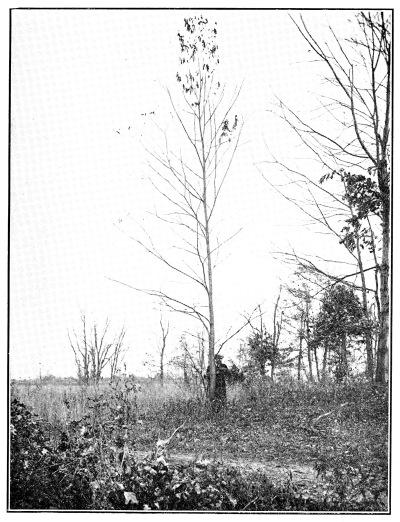
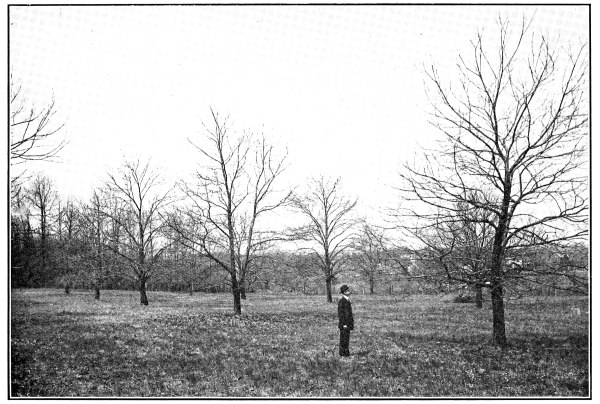
Winter condition of a chestnut tree
with
a blight-girdled top.
It has been the policy of the Commission for sometime to protect
orchards and nurseries from outside infection in all cases where the
owners have expressed a desire for such protection, and have themselves
taken care to control the disease as much as possible. This work has
been successful much beyond our expectations. The largest and most
important orchards thus protected are located at Sunbury, Paxinos, and
Berwick. The owners of neighboring forest tracts have been required to
remove all diseased chestnut trees within one-half mile of the nearest
point of the orchard in each case. An interesting result in one of
the most important of these cases is the fact that these owners have
been able to sell the products of their diseased trees for an amount
considerably above the entire cost of removal, sanitation work, etc.
At this writing no specific remedy has been found for the disease.
However, later information confirms the statements previously published
that the disease may be largely prevented from entering healthy trees
by constant and regular spraying with Bordeaux Mixture made up in
proportions of 5 pounds of lime, 5 pounds of copper sulphate, and 50
gallons of water. The application of this mixture simply prevents any
new germination of spores, but has no effect whatever, in cases where
the disease has already started in the tree. Because of the cost, it
is, of course, not applicable in forests.
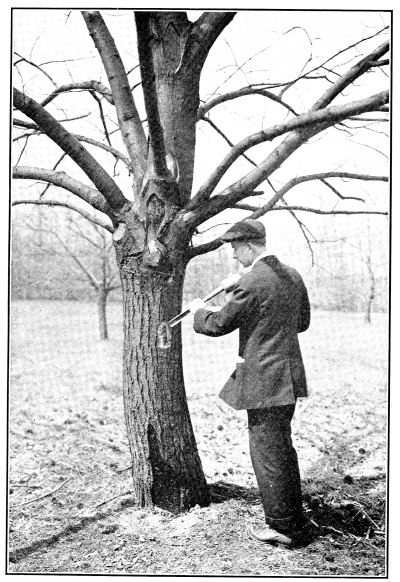
By cutting out the cankers and coating with antiseptic solutions and
water proofing afterwards, the blight can be fairly well controlled
in chestnut orchards and in certain valuable lawn or park trees. In
connection with this treatment a spray of the Bordeaux Mixture as above
noted should be used occasionally. Excellent results along this line of
experiment are shown in a large orchard at Paxinos, and in several of
the public parks of the State.
As often happens in the case of a public campaign against a serious
epidemic, we have been constantly besieged by the gratuitous offers of
various and sundry remedies for the blight, which include applications
of fertilizers to the soil, insertions of flowers of sulphur and
other compounds in holes bored in the trees, applications of coatings
of different chemicals to the body of the tree, and numerous other
treatments, all of which we believed in the beginning to have no value.
However, all parties having theories to advance or remedies to propose
have been given a chance to prove their claims by experimenting on
trees controlled by the Commission for such purposes at Emilie, Bucks
county. A number of parties have taken advantage of the opportunity.
Recently, an examination was made of the various treatments by a
competent Board of Reviewers, whose conclusion was that not one of the
treatments tried had any deterrent effect upon the chestnut blight.
Many of the persons above mentioned were apparently sincere in the
claims they made, and were simply ignorant of the true cause of the
disease. Instances have come to our attention, however, of parties
practicing certain methods of treatment and charging for the same,
who are plainly impostors. Employees of the Commission have no doubt
benefited many people by exposing the methods of these impostors.
Excellent opportunities have been afforded the tree surgeon of the
Commission and his assistants to counteract the influence of false
theories and worthless remedies such as above mentioned, in responding
to the numerous requests for the examination of individual trees. These
requests have continued to come to the Commission headquarters right
up to the time of closing our work. No other line of work has been so
effective in arousing the personal interests of the people. No request
from any part of the State has been ignored. In this connection much
incidental advice has been given to property owners as to the general
handling of lawns and orchards, and the management of small woodlots.
In co-operation with the officials of Wildwood Park, at Harrisburg, the
Commission has completely eradicated the blight from that Park, about
150 diseased chestnut trees having been removed or treated out of
a total of 1,290 trees. Here in a few cases the peeled stumps were
creosoted to show that method of sanitation. Considerable help has also
been given to the management of Fairmount Park. Arrangements have also
been made for the entire removal of blighted chestnut trees from the
State Live Stock Board’s Farm, in Delaware County. In the event of the
continuation of our work, it was also planned to eradicate the blight
thoroughly from the Valley Forge Park grounds.
It has been announced by the Bureau of Entomology, U. S. Department of
Agriculture, that several species of beetles have been found eating
the spores of the blight fungus, and it is stated that “should these
insects prove as beneficial as the observations indicate, they are
certain to be an important factor in the natural control of the dreaded
chestnut blight disease.” It is worthy of note in this connection that
the insect investigations of this Commission have shown that a number
of insects also carry large quantities of blight spores, and may thus
indirectly assist in the dissemination of the blight. One of these
insects which was found to carry an enormous number of spores is one of
the beetles above mentioned as eating the fungus.
Since writing the last report, there has been a considerable shipment
of chestnut cordwood, shippers taking advantage of the special tariff
issued by the Pennsylvania Railroad. At last accounts the prospects
were that there would be much business in this line right along in the
future, being encouraged by the special low rates.
Observations made by Commission employees in company with commercial
lumbermen have shown that already in certain localities, diseased
chestnut has been dead so long that deterioration is beginning. We
have, therefore, made it plain to owners of such chestnut and have
advertised the fact as much as possible, that promptness is necessary
in getting rid of the diseased trees, if the owners wish to obtain the
most value possible from the trees.
Our most difficult line of work has been that of utilization. Facts as
to the conditions could easily be obtained, but the difficulty has been
in bringing the buyer and seller together. Recently a plan was adopted,
which if we would be able to continue its operation, would without
question, hasten very rapidly the utilization work. This plan, the
details of which are given elsewhere, is to canvass particular
localities thoroughly, finding out just what can be offered in the way
of different chestnut products, ascertaining the local market for the
same, and then determining so far as possible, where else the surplus
may be marketed. In connection with the carrying out of this plan, up
to this writing as many as a dozen portable saw mills have been located
in one county, and in other localities many practical operations had
already been started, thus tending to rapid and clean cut work in
utilizing blighted chestnut.
The discovery of the chestnut blight in China makes it now all the
more probable that resistant chestnut stocks may be obtained in that
country. It was, therefore, a wise movement last fall when we took
advantage of the opportunity to obtain a considerable amount of seed
of what is probably the most important chestnut in Eastern China. A
large quantity of the nuts were planted at Paxinos, and the seedlings
at this date which are from six to fifteen inches high, are looking
well. From the nuts sent also to the State Forest Nursery at Greenwood,
75 seedlings are at present growing, and from those sent to Asaph,
Pa., there are now 182 plants, averaging ten inches in height. All of
these seedlings will be of much value in cross-breeding and other ways
in the important future work of developing blight resistant orchard
trees. In this connection it should be noted that in a recent bulletin
issued from the Arnold Arboretum a considerable discussion is given of
the possibilities in developing blight resistant chestnut trees from
Chinese introductions, a number of the latter now being grown at the
Arboretum. The two mentioned as the most important include the one of
which we now have seedlings. So far these Chinese chestnuts grown at
the Arboretum have not become blighted.
According to the Kew Index, there are seven species of chestnut and
twenty-one of the chinquapin in the world. From all these species there
should be many other chances of obtaining blight resistant trees that
may be used in breeding and making our own stock better.
Several exhibits of specimens showing the work of this Commission have
been placed in public institutions which will remain as monuments of
our work. An excellent exhibit has been placed at the Carnegie Museum
at Pittsburgh. Another has been finally completed in the State Museum
at Harrisburg, and a third one at the Commercial Museum in Philadelphia
is not yet finished, but has been planned on rather a large scale.
It was contemplated also to place another exhibit in the Everhart
Museum at Scranton, which may yet be done. An excellent exhibition of
specimens and illustrations of our work was made in connection with the
State Forestry Exhibition at Horticultural Hall, Philadelphia, in May.
When this final manuscript is published, there will have been issued
the following publications of this Commission:
- Report of The Pennsylvania Chestnut Blight Conference. (Unnumbered).
- Bulletin No. 1—The Chestnut Blight Disease.
- Bulletin No. 2—Treatment of Ornamental Chestnut Trees Affected
- with the Blight Disease.
- Report of the Pennsylvania Chestnut Tree Blight Commission,
- July 1st to December 31st, 1912. (Unnumbered).
- Bulletin No. 3—Field Studies in Blight.
- Bulletin No. 4—Chestnut Blight Fungus and a Related Saprophyte.
- Bulletin No. 5—The Symptoms of Chestnut Tree Blight and a
- Brief Description of the Blight Fungus.
- Bulletin No. 6—The Chestnut Tree. Methods and Specifications
- for the Utilization of Blighted Chestnut.
- Bulletin No. 7—Morphology and Life History of the Chestnut
- Blight Fungus.
- Final Report of the Chestnut Tree Blight Commission. Numerous
- descriptive and educational circulars, charts, etc.
Very effective co-operation has continued to be maintained with the
Office of Forest Pathology, of the U. S. Bureau of Plant Industry.
Recently the salaries of all pathologists connected with the Commission
have been carried by that office, and there has been constant
communication and co-operation in reference to all research work.
Much excellent help has continually been given by the State Forestry
Department at Harrisburg, the Deputy Commissioner, Hon. I. C. Williams,
being assigned as a collaborator with this Commission.
The authorities of the University of Pennsylvania have been exceedingly
courteous in granting ample space for laboratory work in the new
Zoology Building. Room has also been given for laboratory work in tree
medication in the Botanical Building. Franklin and Marshall College, at
Lancaster, and the State College of Pennsylvania, have also provided
room for laboratory work in the field investigations.
There has been a liberal interchange of ideas and helpful suggestions
through correspondence with the State Conservation Commission at
Albany, N. Y., the State Forester and State Pathologist of New Jersey,
the State Forester of Maryland and of Massachusetts, and with officials
in Virginia, West Virginia, and Maryland.
The cessation of the work at this time is particularly unfortunate
because so many important investigations, not yet finished, would
likely have had a very practical and beneficial bearing upon the actual
eradication of the disease.
First.—Very little is known about the bast miner—the insect which, as
stated in another place, is probably one of the most important carriers
of blight spores. A full knowledge of the life history of this insect
would probably very soon have been completed, and which would be a most
interesting contribution to science[7].
Second.—The Chemist and Physiologist in tree medication had planned to
use a new solution for injection into diseased trees, which according
to chemical work already done, promises to check the growth of the
blight.
Third.—The local intensive work in utilization had just begun, and as
stated elsewhere, bids fair to solve largely the difficult problem of
utilizing rapidly the diseased chestnut.
Fourth.—The discovery of the blight in China and the possession by the
Commission of a large number of seedlings of one of the most important
Chinese chestnuts, as well as immune and resistant Japanese stock,
opens a field for breeding experiments which would without question
have been of the greatest benefit to the owners of chestnut orchards.
Fifth.—Although not demonstrated before, it is now proved that birds
and insects carry enormous quantities of spores of the blight fungus,
which necessarily changes our viewpoint considerably with respect to
the eradication of the disease.
Sixth.—In a number of forest tracts and several orchards, thorough
“cutting-out” work and up-to-date surgery treatments have been started
by expert employees of the Commission, which are just now beginning to
show evidences of the value of this kind of work.
Brief statements of the results of the different lines of work
conducted by the Commission follow, credited to the respective parties
in charge.
As heretofore, all field work has been conducted under the immediate
direction of the General Superintendent, Mr. S. B. Detwiler. In the
following statements some of the principal features of the work to date
are pointed out by him, and also suggestions given to timber owners who
may wish to clear their woods of blight on their own responsibility.
A statement in detail of the effectiveness of sanitation cutting in
controlling the blight, by Mr. Detwiler, is appended to this report.
A majority of the field agents of the Commission were dismissed in
January, 1913, because it was believed that very little work could
be done during the inclement months of winter and spring. However,
the unusually open winter made it possible for the small field force
retained to accomplish more for the time and money expended than at any
previous time since our work was organized. An average force of 36 men
in the western district and 11 men in the eastern district were in the
field from the first of the year to July 25th, 1913, when all field
work was discontinued.
The experience of the past two years has demonstrated that more can be
accomplished in locating and destroying the blight after the leaves
have fallen than while the trees are in full foliage. Girdled twigs and
branches bearing withered leaves are prominent at great distances in
winter, and the increased amount of light admitted through the tops of
the trees makes it easier to see cankers on the trunks and branches.
The proper treatment of the infected trees is no more difficult in
winter than in late summer or fall, unless the snow is very deep. In
the badly blighted region in the eastern part of the State, field men
are able to accomplish better results because most timber owners prefer
to cut their timber in the winter, when they can spare the time from
their farming operations.
Thorough scouting in 1912 has shown that no blight exists west of a
line drawn through central Somerset and Cambria counties, along the
extreme eastern border of Cameron County, to the northeast corner of
Tioga County. West of this line, nine isolated spot infections were
found in six counties, but all of these infections were eradicated as
soon as found, and have been under careful surveillance since. These
infected spots were located in Fayette, Elk, Warren, Potter, Clarion
and Indiana counties, and five out of the nine spots were found to be
due to the planting of diseased nursery stock purchased from nurseries
in the infected region. In April, 1913, the infection in Indiana County
was discovered in a shipment of three chestnut trees purchased from a
nursery in New Jersey. These examples show very strikingly the ease
with which the blight is widely distributed through the shipment of
nursery stock. Persons who have planted nursery grown chestnut trees in
regions free from the blight, should watch these trees carefully for the
first appearance of the disease, and promptly destroy all infected trees.
Field work in the Western District during the period covered by
this report has been confined to Tioga, Clinton, Lycoming, Centre,
Huntingdon, Blair, Bedford, and Somerset counties. Tioga, Clinton,
Centre, and Blair counties have been scouted and most of the diseased
trees removed, but a considerable amount of infection still remains
in Lycoming, Huntingdon, Bedford, and Somerset counties. In addition,
Fulton and Mifflin counties still have a large amount of infection
remaining, since with the small field force it was impossible to
continue the work in these counties.
The accompanying map shows the progress of the control work in the
Western District, and the location of infected areas. The following
tabulation is a statement of the number of infected trees found and cut
out in the Western District from the time the work was begun until
July 1st, 1913:
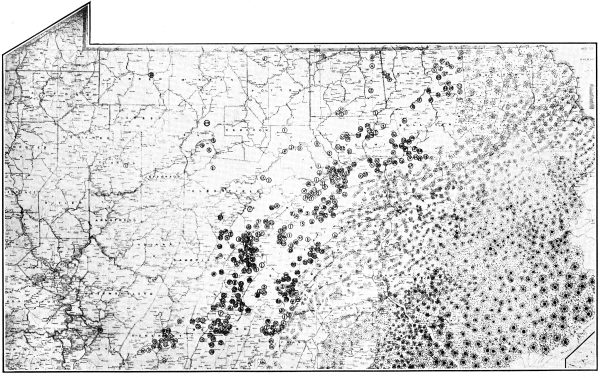
Map showing spot infection in the western
half of Pennsylvania to July 1, 1913, indicated by circles. Figures
inside the circles indicate the number of diseased trees found
in each locality.
Inspection in eastern half of the State is generalized
from the best information available.
STATEMENT OF CHESTNUT BLIGHT INFECTION
IN THE WESTERN DISTRICT.
| County. |
Number of tracts
on which
infection was
found. |
Total number
of infected
trees found. |
Total number
of infected
trees removed. |
| Allegheny, |
|
|
|
| Armstrong, |
|
|
|
| Bedford, |
147 |
4,027 |
2,787 |
| Bradford, |
91 |
1,048 |
829 |
| Blair, |
225 |
1,884 |
1,680 |
| Beaver, |
|
|
|
| Butler, |
|
|
|
| Cameron, |
|
|
|
| Centre, |
142 |
2,556 |
1,763 |
| Clinton, |
169 |
3,481 |
2,704 |
| Clearfield, |
9 |
117 |
117 |
| Clarion, |
1 |
1 |
1 |
| Cambria, |
9 |
450 |
450 |
| Crawford, |
|
|
|
| Elk, |
6 |
377 |
377 |
| Erie, |
|
|
|
| Fayette, |
2 |
11 |
11 |
| Fulton, |
90 |
1,902 |
900 |
| Forest, |
|
|
|
| Greene, |
|
|
|
| Huntingdon, |
233 |
5,287 |
4,771 |
| Indiana, |
1 |
1 |
1 |
| Jefferson, |
|
|
|
| Lycoming, |
259 |
5,015 |
4,486 |
| Lawrence, |
|
|
|
| Mifflin, |
95 |
1,976 |
1,468 |
| McKean, |
|
|
|
| Mercer, |
|
|
|
| Potter, |
1 |
1 |
1 |
| Somerset, |
92 |
9,110 |
8,093 |
| Sullivan, |
22 |
207 |
207 |
| Tioga, |
12 |
43 |
43 |
| Venango, |
|
|
|
| Westmoreland, |
|
|
|
| Washington, |
|
|
|
| Warren, |
3 |
16 |
16 |
| Total, |
1,609 |
37,510 |
30,705 |
Persons familiar with the appearance of the chestnut blight fungus may
easily confuse it with another fungus found in Washington, Greene,
and Fayette counties. This fungus (Endothia radicalis Schw.),
(Denot.) is related to the blight fungus (Endothia parasitica
Murr.) (And.), but is found only on dead wood and bark and does not
attack living tissues. It has been thoroughly studied by the field
pathologist, since at first it was feared that it might have parasitic
tendencies. Continued investigation proves beyond doubt that this
fungus is a harmless saprophyte which need not be feared. It need
not be confused with the parasitic species by those who have the
opportunity to compare them.
Field work in the Eastern District has been conducted mainly on the
plan outlined in the previous report. Inspections were made on the
request of timber owners and advice given as to the best method of
procedure in each case. Particular attention was given to assisting
owners of blighted chestnut in finding the best markets for the
products. On the request of owners desiring to take advantage of the
reduced freight rates on blighted chestnut cordwood, inspections were
made and necessary certificates issued. Supervision of enforced cutting
of all blighted chestnut trees within a half mile of chestnut orchards
in which the owners are endeavoring to keep the disease under control,
was continued.
As the evidences of the blight become more noticeable and the
seriousness of the situation forces attention, owners of chestnut
timber in eastern Pennsylvania have shown an increasing interest in the
work of controlling the blight, and more requests for assistance were
received than could be given individual attention. For the guidance
of owners who wished to clean their woods of blight, either by doing
the work themselves or having it done by contract, the following
suggestions were made by the Office of Utilization. These suggestions
are for use in eastern Pennsylvania only, where the blight is general.
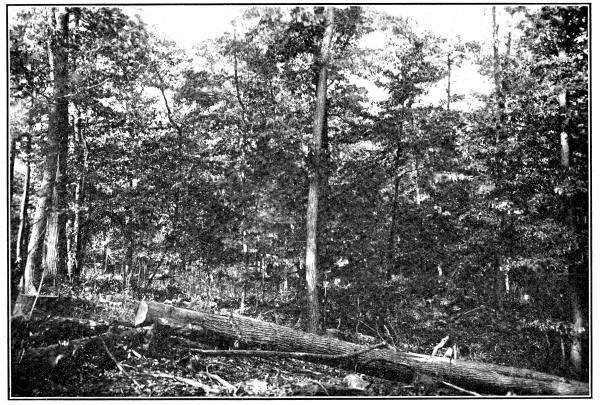
Cutting out a spot infection among large trees.
1. It is always advisable in cutting blighted chestnut to clean up the
ground thoroughly and burn all infected material, for the sake of the
future crop and the community as a whole. Even if financial reasons
make it impossible to treat the stumps properly, the brush and refuse
should be burned, and all merchantable material removed from the tract
within a reasonable period. Where the percentage of blight is very
high, it is advisable to cut all the chestnut trees rather than attempt
to remove only the diseased trees.
2. Stumps should not be cut higher than the diameter of the tree, but
this may be impracticable in sprout growth timber. A low stump saves
the best end of the log, and causes the succeeding generation of
sprouts to be firmly rooted.
3. Where practicable, all timber should be peeled. Poles, ties, posts
and rails, should be skidded to one or more convenient places. The bark
and chips collected at these points should be burned, since this refuse
is very frequently the breeding place of the blight fungus.
4. It is advisable to remove all bark from the stumps down to the
mineral soil, to prevent the further spread of the disease by its
growth on this bark. Unpeeled stumps, even if free from blight at the
time the tree is felled, are very apt to become infected, and the
disease will then eventually destroy the sprouts at the base. Stumps of
trees cut in winter while the bark is “tight” may be left until spring,
and peeled when the sap is ascending. Stumps made in summer should be
peeled at once.
5. All chestnut refuse, including the brush from the tops, bark from
stumps, chips, etc., should be collected and burned at as early a time
as may be done with safety from fire. Green tops of trees felled in
summer can be burned immediately by close piling over a well-started
fire. The danger of infecting the sprouts from the stump is lessened
if the fire be made over the stump after peeling. Stumps can be more
cheaply sterilized, however, by painting them with creosote, and
creosote also appears to be absolutely effective in keeping the stump
free from infection, whereas a fire seldom chars the base of the stump
sufficiently.
6. Woodsmen, while cutting and removing chestnut, should do as little
injury as possible to the remaining trees, whether large or small.
When the work is done by contract, trees carelessly broken in felling
chestnut should be paid for at their market value. Merchantable
chestnut left in the woods, either cut or uncut, when contracts call
for the removal of all of the same, should be paid for at its market
value.
7. Great care should be exercised in burning material so as not to
injure other trees, or allow fires to remain unwatched in the woods.
Forest fires may result, causing much damage. Burning should not be
done when the woods are very dry, or a high wind is blowing.
Early in the spring a more extensive plan of field work in the
southeastern portion of the State was adopted. A locality was selected
where the blight is beyond control, and immediate utilization necessary
to avoid serious financial loss. The boundaries of the area selected
were so made that the timber in all of the woodlots in the area could
be handled in much the same way as though the woodlots comprised a
single tract. A map showing the exact location of all of the woodlots
was made, and a field agent detailed to estimate merchantable chestnut
in the form of saw logs, poles, ties, posts and cordwood in each
woodlot. The local market for these products was then ascertained, to
determine whether all timber on the area could be best sold locally
on in outside markets. At the same time the field agent interested
the owners of the woodlots in the prompt removal and utilization of
their chestnut trees before greater loss was occasioned by the blight.
Usually the owner of a considerable quantity of blighted trees is
anxious to follow this course, but the scarcity of competent woodsmen
makes it difficult or impossible. In such cases, the Office of
Utilization presented the data obtained by the field agent to operators
of portable saw mills, stave mills, pole or tie cutters, as the facts
warranted, and as many buyers as possible were interested in locating
on the area. So far as there was time to test this plan, it appears
that this is the cheapest and most effective way of getting results in
the eastern district, since what is desired is to get cutting started
on a sane and profitable basis, and this a mere general method of work
usually fails to accomplish. Success or failure depends on whether or
not buyer and seller can be brought together on a satisfactory basis.
The work must be profitable to both owner and dealer. A competent
and well-informed field agent can work out a comprehensive plan for
disposing of all the merchantable chestnut in a community. Through
his knowledge of prices, rates, specifications, sanitation measures,
etc., he is the means of saving timber owners from much of the loss
occasioned by the blight.
As before reported, the investigation of the blight fungus and the
nursery inspection work are under the direction of Dr. F. D. Heald.
Mr. P. J. Anderson has given special attention to certain field
investigations, including the work at Charter Oak. Statements of some
of the principal features of the work here follow:
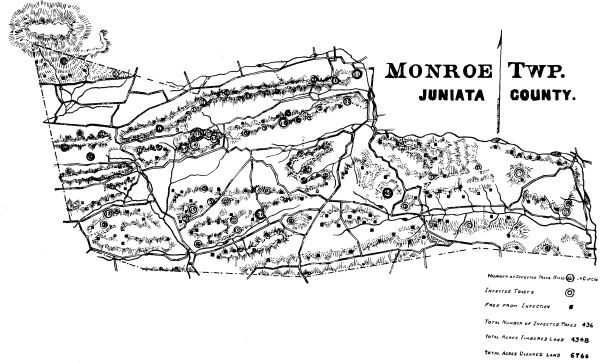
A Blight Infected District in Juniata County, Pa.
Pycnospores of the blight fungus, sometimes called summer spores,
germinate much more slowly than the ascospores, or so-called winter
spores. The type of growth and size of colonies are different in the
early stages of development on culture media.
In the case of this fungus the term “summer spores” is very misleading,
as these spores are produced at all times of the year, being washed
down in large numbers from blight cankers following each winter rain.
Careful experiments show that birds act as carriers of spores of the
blight fungus. Thirty-six birds belonging to nine different species
have been tested. Nineteen were found to carry pycnospores, the maximum
number obtained from a single bird, (Downy woodpecker), being 757,074.
The highest number was always obtained from birds shot a few days after
a rain period.
The ascospores are expelled forcibly, but this expulsion depends upon
temperature as well as moisture. No expulsion took place in the field
from November 26th, 1912, to March 21st, 1913, the temperature during
the winter rains being too low. Bark containing ascospore pustules has
continued to expel ascospores for over six months, (in the laboratory).
Pycnospores are easily killed by heat, (51°C). Ascospores are slightly
more resistant, only a few being able to survive 57°C.
Pycnospores are easily killed under certain conditions, but can survive
in considerable numbers under certain other circumstances. Their
length of life in water depends to some extent upon the temperature.
Thirty-three per cent. survived in water at 55°C, after 42 days. A
large percentage can survive freezing for a considerable period. They
are washed down to the ground from blight cankers, during every rain,
and have never been found to disappear entirely from the soil during
the longest periods between rains. As many as 12 per cent. of those
originally present in a soil sample have survived drying for 63 days.
The longevity of the pycnospores is greater in the “spore horn” stage
than when they are separated by rains and then dried. They have been
killed in twenty-four hours by drying in certain tests, while the act
of drying alone is generally responsible for the death of 50-60 per cent.
Ascospores when shot on to glass slides have been reported as being
very resistant to drying. In nature they are generally separated and
washed by the rains. Laboratory tests under such conditions indicate
that they are very sensitive to desiccation. Drying alone has been
found to kill as many as 94 per cent. in certain tests.
A small gall on the chestnut due to a lepidopterous insect (moth) has
been found to be one of the places of entrance of the blight fungus.
Twenty-eight per cent. of those tested showed young blight infections.
Insects may act as carriers of the spores of the blight fungus. Of a
total of 75 tested, many were found to be carrying spores. The maximum
number of spores of the blight fungus (336,900), was obtained from a
small beetle, (Leptostylus maculata), which has been mentioned
as a possible beneficial agent on account of its pustule-eating habits.
There is another “canker disease” of the chestnut prevalent in the
State which is entirely distinct from the blight. It is even more
important as a disease of oaks than chestnut, and is known to occur on
chestnut oak, red oak, and white oak. A dieback of the chestnut
is not uncommon. Still another fungus appears to be associated with
this trouble. A tip blight of the chestnut has also been found,
and in connection with it, a third species of fungus.
A field laboratory has all along been maintained at Charter Oak, and
much of the outdoor inoculation work and other experiments have been
conducted in that vicinity. Experiments have been conducted here on
the rate of growth of blight cankers, details of which are tabulated
in another manuscript, submitted for a bulletin. It is sufficient to
say here that the retarding influence of the winter season is shown by
these experiments. On the other hand, the cankers have continued to
spread even in the winter, though the growth is much more rapid in the
summer months.
Inoculations have been made both with ascospores and with pycnospores
during every month of the last year. No cankers have appeared as yet
from winter inoculations.
Other species of trees besides chestnut have been inoculated with the
blight fungus in larger numbers than last year, special attention
being given to the oaks. As yet there is no evidence that the blight
fungus will establish parasitic relation with any other host, although
occasionally a canker will be produced.
Careful tree surgery experiments have been conducted at Charter Oak,
and to date only three cases are reported in which the canker continued
to spread after cutting out and treatment.
The office records give the following information in regard to each
nursery inspection:—date, name and location of nursery, number of
trees inspected, number of trees rejected, fungicides used for dipping
the stock, name and location of purchaser of stock.
The nurseries from which chestnut stock was shipped during the fall of
1912 and spring of 1913, are as follows:—C. K. Sober, Paxinos, Pa.;
Hoopes Bros. & Thomas, West Chester, Pa.; Lovett Nursery, Emilie, Pa.;
Rakestraw & Pyle, Kennett Square, Pa.; Morris Nursery, West Chester,
Pa.; Cheltenham Nursery, Oak Lane, Pa.; Jos. Moore, Montoursville, Pa.;
S. L. Cummings & Co., Dewart, Pa.; and Marietta Nursery, Marietta, Pa.
In the fall of 1912, 6,538 trees were inspected. Of these 81 were
rejected, and the remainder 6,457, distributed. In the spring of this
year 5,305 trees were inspected, of which 195 were rejected and the
remainder 5,110 distributed. The trees rejected were either infected
with chestnut blight, or showed doubtful incipient infections. In case
of doubt the inspectors were instructed to reject the tree. The number
of rejected trees, however, is no indication of the percentage of
blight in any nursery, since many diseased trees are removed from the
nurseries previous to the time of making shipments, and only those
thought to be healthy trees are offered for inspection.
Probably the greater portion of the trees went to purchasers in either
Pennsylvania or New York. In case of re-distribution by other dealers,
however, the final destination of the stock is not known. According to
available records, the trees were sold to purchasers in the following
States.—California, Colorado, Connecticut, District of Columbia,
Georgia, Idaho, Illinois, Indiana, Iowa, Kansas, Kentucky, Maryland,
Michigan, Missouri, Nebraska, New Hampshire, New York, North Carolina,
Ohio, Pennsylvania, Tennessee, Texas, and Wisconsin.
INSECT INVESTIGATIONS. — INSECTS CAUSING DIRECT INFECTION. — INSECTS CARRYING SPORES BUT CAUSING NO DIRECT INFECTION. — INSECTS MAKING WOUNDS IN TREES THUS OPENING THE WAY FOR INFECTION. — CICADA STINGS. — THE BAST MINER. — LARVAL EXIT HOLES AS POINTS OF INFECTION. — CROTCH INFECTIONS. — EXPERIMENTS WITH ANTS. — INFECTION IN GALLS.
The investigations to determine what part, if any, insects take in
the transmission of the chestnut blight have been continued under the
immediate direction of Prof. A. G. Ruggles. A number of interesting
facts have been determined, but several important studies were just
well under way when the work was suspended.
The relation of insects to blight dissemination comes under three
headings; first, insects that carry the spores of the fungus and
actually start new infections at the time; second, insects that carry
the spores but do not directly start infections; and third, insects
that make wounds in which infection readily takes place through spores
carried by some other agency.
To the present time very little definite data have been obtained on
this point, but the longer the subject is studied, the more probable
it appears that ordinary insects traveling over a tree, although they
may carry hundreds of spores on their bodies, do not directly start new
infections.
Ants were allowed to run over cankers showing pycnidial pustules or
“spore horns,” and also cankers where ascospores were shooting, and
then placed in flasks of sterile water and washed from two to
twenty-four hours. Plate cultures made from this material showed in
many instances the presence of blight spores on the bodies of the ants.
In the same way it was determined that other insects to the number of
about twenty species also carry the spores of chestnut blight. The
number of spores carried in each instance varied from a very few to
the enormous number of 336,900. The particular insect, (Leptostylus
maculata), carrying the 336,900 spores mentioned, is one of the
beetles named in a recent press notice of the U. S. Department of
Agriculture, as being very active in eating spores of the blight
fungus. Therefore this beetle while destroying spores of the blight is
at the same time covering its body with thousands of other chestnut
blight spores which it carries from tree to tree, making it probably an
injurious insect, instead of a beneficial one in this respect.
This is probably the most serious way in which insects are related to
blight dissemination. Among the most serious of wound making insects
are the seventeen-year cicadas, tree-hoppers, bark borers, and bast
miners. Of these only two have been studied closely,—the cicadas and
the bast miners.
In 1911 there was a brood of seventeen-year cicadas in several counties
in the eastern part of Pennsylvania. The relations that these stings
bore to blight infection have been studied near Lehighton. Many counts
were made on trees and sprouts. While only 4.3 per cent. to 10.4 per
cent. of all stings were found to be infected with chestnut blight,
from 86 per cent. to 93.8 per cent. of all infections were in stings.
This cicada injury was studied where the blight seemed most abundant.
In the same tract where blight was less prevalent, other counts were
made with less striking results. These observations would seem to show
that blight infection is influenced considerably by the number of
wounds made, but that infection many times does not take place through
a wound although seemingly appropriate openings for catching blight may
be present.
The work of the bast miner was first called to our attention by Mr. S.
B. Detwiler. It is believed to be the most important insect causing
wounds in the chestnut. Experiments and studies up to the present time
make it probable that the bast miner is responsible for much blight
infection. To understand thoroughly the relationship of this insect to
the blight fungus, the life history has to be known. Much time has been
spent upon this subject, but unfortunately to date, the work has not
been completed.[8]
The injurious period of its life history has been obtained, but the
period that would have to do with its suppression, namely the adult
period and time of egg laying, has not been discovered.
Hundreds of sticks of smooth bark trees of chestnut were examined
during the past winter and spring to determine the number and nature
of the larval exit holes of the bast miner. Every piece a foot long
and over two inches in diameter had bast miner burrows present. The
lowest number for a linear foot was one burrow while the highest was
fifteen. The number of exit holes for a small tree, therefore, would
vary from ten to one hundred and fifty. In one acre of chestnut trees
the number of these exit holes would be enormous. In the light of what
we now know, recent observations show that 50 per cent. of this class
of infections originated in bast miner exit holes.[8]
Many infections are known to start around crotches, and we speak
of them as crotch infections. The eggs of the bast miner are laid
near crotches and the newly hatched larvas may make entrance holes
sufficiently large to allow spores of blight to enter. Here again
the bast miner may be responsible, and if such proves to be a fact,
this insect would be the indirect cause of 90 per cent. instead of 50
per cent. of the infection on smooth bark trees. All other insects
mentioned as making wounds, with perhaps the exception of the tree
hoppers, are local or else the number of wounds is not appreciable;
but in the case of the bast miner, the insect is found wherever the
chestnut grows.
Ants being found so commonly around blight cankers on chestnut trees,
it has been claimed that in some instances they are responsible for as
much as 90 per cent. of blight dissemination. To obtain information on
this matter, it was decided during the winter to experiment with ants
in the greenhouse. Two rooms were set off as an insectary. The inner
of these two rooms being thoroughly sterilized, was called the sterile
room, and the outer room was called the blighted room. In the latter as
much blight material of the kind required as could be obtained was kept
and placed on the ant table, where three colonies of ants made their
homes. From the table in this room the ants were allowed to run through
a glass tube to sterile seedling trees in the sterile room. The ants
were of the same species as those suspected of carrying the blight,
and were the common mound-builders, (Formica integra), being
obtained in the region of Lewisburg, Union County.
The result of the experiment was that with the exception of a few dried
leaves on each tree which were chewed or worked on by the ants, the
trees in the sterile room are as healthy as when first placed on the
table to be run over by the ants. The indication, therefore, is that
ants are not responsible for blight infection.
A more or less cylindrical gall is found on the tips of branches and on
sprouts of chestnut, caused by an insect claimed to be a moth. At West
Chester and Valley Forge, these galls are very numerous. Out of 161
galls examined by the plant pathologist, forty-five of the 28 per cent.
showed the presence of blight, while 49 per cent. showed the presence
of another fungus. A gall that shows the presence of chestnut blight in
such a large percentage of cases should be given careful study.
GEOGRAPHIC WORK. — WEATHER CONDITIONS. — RELATION OF SOILS TO BLIGHT OCCURRENCE. — LOCATION OF OBSERVATIONS. — RESULTS OF OBSERVATIONS. — RELATION OF ALTITUDE TO BLIGHT DISTRIBUTION. — UTILIZATION. — PRELIMINARY WORK. — CONCLUSIONS OF UTILIZATION CONFERENCE AT TRENTON. — LOCAL INTENSIVE UTILIZATION. — RESULTS OF THE LOCAL WORK. — DIFFICULTY OF OBTAINING LABOR. — WORK IN OTHER LOCALITIES. — DETERIORATION EXPERIMENTS. — CHESTNUT EXTRACT CHIPS FOR PAPER PULP. — TESTS IN CO-OPERATION WITH MANUFACTURERS. — BLIGHTED WOOD NOT INJURED. — KINDLING AND FUEL TESTS. — MOVEMENT OF CORDWOOD. — CO-OPERATION WITH THE U. S. FOREST SERVICE.
A brief statement of some additional work by the Geographer, Dr. F. P.
Gulliver, follows:—
Since the last report very few definite facts have been obtained as to
the relation of rainfall to the spread of the blight, but nothing has
yet been learned which would contradict the opinion previously stated
that blight dissemination increases much more rapidly during rainy periods.
Considerable time has been given recently to a study of the character
of the soils in different localities in the State where there is more or
less chestnut blight, to determine whether there is any real relation
between the nature of the soil, and the amount of the disease in any
locality.
After a careful survey of the State, it was decided to conduct this
study in—(1), Chester Valley; (2), The Kutztown Valley, Berks County,
and (3), Center County. To date, there has been time only to make
observations in the first two localities. In the Chester Valley these
studies have been much facilitated because of the constant occurrence
of limestone toward the base of the mountains, and of shales toward
the top. Usually, more chestnut blight was found near the tops of the
mountains, and less, as one descends towards the valley.
The results of these observations on the relation of limestone or
other alkaline soils to blight distribution, are as follows, which are
simply, however, what appear to be the facts obtained from studies to
date, and are not put forth as absolute conclusions.
(1)—In every series of tracts taken from limestone to overlying shale
soils, the percentage of blight is least at a comparatively short
distance (50 to 200 ft.), from the edge of the limestone.
(2)—Tracts on soils derived from limestone which show the highest
percentage of blight seem to be those where the soil has become acid
from underground drainage, and consequent leaching out of the alkalies.
(3)—Chestnut trees on soils derived from other alkaline rocks show
less blight than is found in the trees on shale soils with limestone
underneath.
(4)—Where the rocks have been faulted, and an older crystalline rock
has been brought up to the level of the later formed limestone, there
does not appear to be any less blight on the crystalline rock near the
limestone.
On about 200 tracts examined, there does not seem to be any relation
between the percentage of blight and the elevation above sea level.
At the time of the last report, the work of “Utilization” was in charge
of Professor J. P. Wentling. He continued to direct this work until
March 1, 1913, when his leave of absence expired, and he resigned to
resume his duties in the Forest School of the University of Minnesota.
From that date, Mr. W. M. Kirby acted in charge of the office work,
while Mr. J. R. Wilson was made directly responsible for the field
operations. Until a suitable specialist could be obtained, the
General Superintendent, Mr. S. B. Detwiler, has had general direction
temporarily, of all the utilization work.
For sometime, naturally, a great deal of information had to be obtained
as to timber owners, purchasers of chestnut products, portable saw
mills, demands for various kinds of products, etc., besides working
out a general plan of active procedure. This had been largely done
by Professor Wentling, before leaving, and he had already pointed
out the importance of the portable mill operator, the necessity of
experiments in deterioration of blighted chestnut, and of making tests
of certain chestnut products through reputable manufacturers, and also
the desirability of a trial of intensive local utilization in a few
localities, and showed that it was desirable to keep in close touch
with the important lumber associations.
At a Utilization Conference between various State and National
officials held at Trenton, New Jersey, certain conclusions were arrived
at as to special lines of work in utilization. Among these, it was
recommended that the individual States take up local market studies.
In accordance with the conclusions of the Utilization Conference above
mentioned, and in line with the suggestion of the Forester of this
Commission previously in charge of Utilization, it was decided to try
such local work at one or two points in this State, the work being
under direction of the General Superintendent. The first place selected
was in the vicinity of West Chester, Chester county. The local market
for various chestnut products was thoroughly exploited to determine
what amount could be taken care of in local consumption, and afterwards
it was determined so far as possible, how much of the surplus could be
disposed of at more distant markets. The results of the work have been
very interesting, and bid fair to solve largely the entire problem of
utilization.
In the short time that has been given to this work, up to the date of
closing, remarkable progress has been made, as the following statement
shows:—
(1)—Careful estimates of timber were made of 14 tracts, in the
vicinity, ranging in size from 2 to 26 acres each.
(2)—Various satisfactory interviews were obtained with the timber
owners, and in this connection, it was found that there has been much
change in the sentiment of owners, favorable to a rapid disposal of
blighted chestnut.
(3)—All local timber operators were interviewed.
(4)—It was found that the owners themselves could use a large amount
of their own timber for fencing.
(5)—Lists of buyers of chestnut products were obtained at West
Chester, Downingtown and vicinity, and along the Pennsylvania Railroad
main line.
(6)—After getting the confidence of timber owners, they were quite
willing to place the disposal of their chestnut wholly in the hands of
Commission employees.
(7)—One thousand ties were sold to a street railway company, and
orders were expected for 5,000 more.
(8)—Arrangements were made for installing a saw mill in the area.
(9)—At the time of closing the work, efforts were being made to obtain
20,000 poles for a firm in New Jersey.
In the particular local work above referred to, the difficulty of
obtaining labor was encountered, as in all other cases of work of this
kind. Here again, however, the Commission employees were able to aid
timber owners and operators greatly by obtaining hands from a distance,
until finally eight different timber owners were on the waiting list to
use wood-cutters who had been imported through our efforts.
No doubt results similar to those mentioned above could be obtained in
the same way in other localities. Such work was successful in Lebanon
County, to the extent of being able to locate ten different portable
saw mills in active work in that county inside of one month.
An experiment, probably the first of its kind, has been installed by
this Commission in co-operation with the United States Forest Service,
at Mt. Gretna, Lebanon County, Pennsylvania, to determine accurately
the effect of the chestnut blight on the quality of chestnut wood
products, and upon the durability of such products. Chestnut telephone
poles, some diseased and some from healthy wood, have been set. Thirty
standard railroad ties, partly diseased, and partly not, were placed
in a siding of the Cornwall & Lebanon Railroad. A fence was made with
mortised posts and rails, some of them from diseased trees, and others
from healthy trees. To determine the direct effect of blight lesions
in telephone poles, cross arms were placed through these lesions; also
some fence posts were set with lesions at the ground line. The complete
results of this experiment will not be possible for several years, but
it was expected to take records at regular intervals each year.
Spent extract chips from blighted chestnut wood which had been run
through the leaches of a tannin extract company, were sent to the U. S.
Forest Products Laboratory at Madison, Wisconsin, where experiments are
being carried on to determine whether or not these chips can be used in
the manufacture of paper pulp.
In connection with the above mentioned experiment, an attempt has been
made to make similar tests in a practical way through co-operation
with manufacturers. A small shipment of chestnut chips was made to a
company in New York State, to test its value for the manufacture of
plaster board. A similar shipment was made to a company in Ohio which
manufacturers special machinery for reducing wood, the idea being to
test these chips for the production of paper pulp.
Careful studies to date have shown decidedly that blighted chestnut is
injured very slightly, if at all, for use as lumber. The blight lesions
extend to only a fraction of an inch below the bark, and even this
portion is taken off in the slabs. To illustrate this fact, small hand
samples of blighted chestnut in board shape, have been prepared and
distributed to different chestnut users throughout the State.
There has always been considerable prejudice against the use of
chestnut for fuel, and investigations have shown that most likely this
prejudice is to a large extent unwarranted. It was intended therefore,
at the time of closing our work, to make practical tests of chestnut
for kindling, in comparison with the common kindling woods now in the
market.
The movement of cordwood under the special reduced tariff has made an
excellent beginning. Several hundred cords have already been shipped,
and a number of parties were preparing to ship large amounts when our
inspection work ceased. The discontinuance of this inspection work will
be a financial disadvantage to many timber owners, who were expecting
to take advantage of the special tariff, unless some arrangement can be
made to continue such inspection under other auspices.
A list of pole and tie dealers has been furnished by the U. S. Forest
Service. This list is being combined with a corresponding list of
wood-cutters prepared by this Commission, the whole to be made out in
duplicate, which will be of great use for future workers in utilization
in this State.
OBSERVATIONS ON SANITATION CUTTING IN CONTROLLING THE CHESTNUT BLIGHT IN PENNSYLVANIA. — INTRODUCTION. — HOW THE BLIGHT SPREADS. — STUDY OF BLIGHT CONDITIONS IN THE MAHONING VALLEY. — INFECTION POINTERS. — STUDY OF BLIGHT CONDITIONS ON TOPTON MOUNTAIN, BERKS COUNTY. — RESULT OF OBSERVATIONS. — RATE OF INCREASE OF BLIGHT IN EASTERN PENNSYLVANIA. — INFECTION CENTERS ON THE ADVANCE LINE. — PROCEDURE IN ERADICATING SPOT INFECTIONS. — SCOUTING. — METHOD OF ERADICATING A SPOT INFECTION. — COST OF ERADICATION. — EFFICIENCY OF THE CUTTING-OUT METHOD OF CONTROL. — NOTES OF RE-INSPECTION. — RECOMMENDATIONS. — REGULATING SHIPMENTS OF CHESTNUT NURSERY STOCK. — THE AMENDED CHESTNUT TREE BARK DISEASE ACT.
Report of
Samuel B. Detwiler
General Superintendent
Pennsylvania Chestnut Tree Blight Commission
By SAMUEL B. DETWILER,
GENERAL SUPERINTENDENT OF THE
PENNSYLVANIA CHESTNUT
TREE BLIGHT COMMISSION.
In view of the continued rapid spread of the chestnut blight, and
the great damage sustained through this relentless parasite, it is
important at the present time to have more complete information on the
possibility of controlling its spread. It is now an established fact
that the disease exists in China, and that it was probably introduced
into America from the Orient. This disposes of the theory that the
blight is caused by a native fungus, originally a saprophyte or weak
parasite, which gained vigor, or appeared to gain vigor because of
the decadence of the native chestnut trees from the effects of drouth
and winter injury. It is evident that it would be difficult, if not
impossible, to control a native fungus of wide dissemination, with
predisposing factors in its favor. But even the most severe critics
have acknowledged that foreign origin of the parasite affords “at least
some basis for the fight for control.”[9]
The pathological investigations of the Commission have shown that wind,
water (rain), and birds are the principal agencies in disseminating
the blight. A single spore thread may produce from 100,000,000 to
200,000,000 pycnospores, and even a small canker produces dozens of
spore threads in a season. A single perithecium has been observed to
eject ascospores almost continuously for a period of 26 days, at the
rate of 4.7 spores per second. Insects assist by making wounds through
which the spores of the fungus enter the bark, and also, to some
extent, by distributing the spores locally. The ejection of ascospores
into the air following rain, and the washing of pycnospores down the
trunks and into the soil during rain, appear to be the principal
agencies in spreading the disease. Birds have been proved to carry
spores in great numbers, and undoubtedly are responsible for a certain
proportion of infections, at least, of advance infections.
The planting of diseased nursery stock in regions free from the blight
appears to be one of the principal agencies in spreading the disease to
great distances. The disease was probably introduced into this country
on nursery stock, and in the early years, nursery stock apparently
played the most important role in getting the disease quickly and
firmly established. This point is well illustrated by a shipment of
three chestnut trees sent from a New Jersey nursery into Western
Pennsylvania in 1912. Through a misunderstanding, these trees were not
held at the State line for inspection, but were carried direct to their
destination. When the inspection was made, the disease was found at two
places on one of the trees, although the nurserymen claimed to have
carefully examined the trees before shipment. At Warren, Warren county,
Pennsylvania, 11 out of a shipment of 12 nursery trees purchased in
1910 were found affected with the blight in 1912. In Elk County, 34
diseased nursery trees were found in a young chestnut orchard, and
the disease had already reached adjoining native chestnut trees. In
Somerset County, there is evidence to support the belief that an
infected area covering about one-third of the county spread originally
from diseased scions grafted on native trees. There are many similar
occurrences outside of Pennsylvania.
All observers have noted that the blight advances by attacking widely
separated trees far ahead of the generally infected territory.
In Pennsylvania, the main spread of the blight has been from the
southeastern corner of the State. During rains and immediately
following, when the spores are being ejected, the wind is usually from
the south or east, thus tending to carry the spores north and west.
At least, it is a matter of common observation that the southern and
eastern edges of woodlots very frequently show the first infections.
In order to learn more about the spread of the blight, two areas in
the region of general infection, one in the Mahoning Valley in Carbon
County, and the other in the vicinity of Topton Mountain, in Berks
county, were studied in the spring of 1913 by Mr. J. Wesley Sitler, a
field agent of the Chestnut Tree Blight Commission.
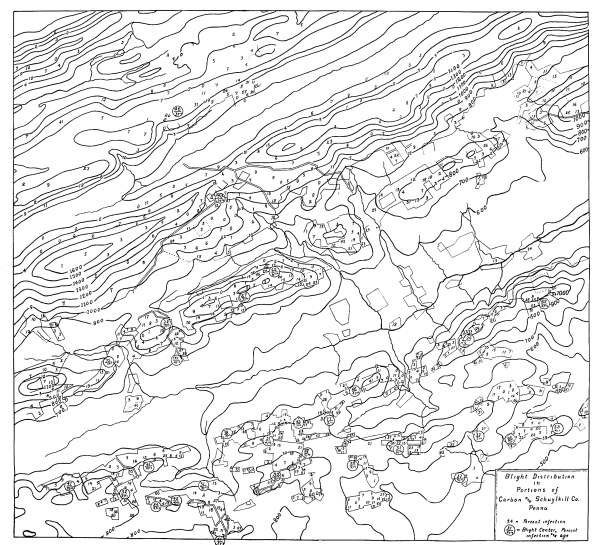
Sketch map showing blight centers and
percentage of infection in a portion of the Mahoning Valley,
Carbon and Schuylkill Counties, Pennsylvania
By J. Wesley Sitler,
June, 1913.
In the Mahoning Valley, all timber tracts on an area about 7 miles
square were mapped on a large scale topographic sheet, (Fig. 1).
In round numbers this investigation covered about 50 square miles of land
which varied widely as to elevation and geological formation. Spot
infections of blight were accurately located on the map, and each spot
was studied in detail as to the percentage of surrounding infection,
slope, exposure, soil, character of the stand of timber, and surface
features. Originally chestnut oak and yellow pine occupied the steeper
upper slopes, while the more gentle and fertile lower slopes were
covered with a stand consisting of 50 to 70 per cent. chestnut, with a
mixture of red oak, maple, and white pine. Very little chestnut grew in
the valleys where the forest consisted of heavy stands of white oak,
white pine, red oak, and maple. All of the flat bottom land and much
of that along the lower slopes has been cleared for farming, so that
part of the area studied consisted of woodlots with trees varying in
size from small coppice to 20 inches in diameter. The area is traversed
by several ridges extending northeast and southwest, and the poor
rocky soil of these ridges, particularly north of the Mahoning Valley,
is covered with young coppice of oak and chestnut, or with scrub oak
brush. Forest fires frequently burn over the ridges and the young
growth is therefore in poor condition.
At present no tract can be found on the area studied that is entirely
free from blight, but the chestnut trees south of Mahoning Valley are
diseased more than the stand north of the valley. The southern slopes
of the ridges, also the south and east portions of exposed woodlots,
are more seriously infected than the northern exposures. There are
thousands of cicada wounds in twigs of all species growing in these
woods. These wounds were made during the invasion of 1911. It is
very common on chestnut to find such wounds infected, and the cicada
has thus undoubtedly aided in the general distribution of the blight
throughout this region.
Every tract of chestnut timber showing the presence of blight, when
carefully examined, shows that the disease appears in spots. By careful
observation, the source of infection for the entire spot can be traced
to one or more badly infected trees which evidently bore the original
infection of that particular area. Such a tree or group of trees is
commonly referred to as an infection center, because from such centers
the disease advances in all directions. The age of these centers can
be determined quite accurately from the appearance of the original
infection, by the concentric rings of cankers and by the age of water
sprouts and shoots at base of cankers. Generally, the older the
infection, the further it has spread from the center.
Many of these infection centers have been carefully worked over, but
nothing definite can be said as to characteristic elevation, soil
conditions, exposure, or character of woods. Probably 90 per cent. of
these centers are found in the shallow depressions at the heads of
gullies; or, where a ridge slope forms a terrace-like flat. However, it
is evident from a large number of observations, that such centers
develop under any surface conditions favorable to the growth of
chestnut. They are found on well drained gravel slopes, dry knolls,
steep rock slopes, and in low fertile flats.
The spread of the blight seems more rapid in young coppice growth
of nearly pure chestnut, than in a chestnut stand of large trees.
In old stands the percentage of infected trees decreases abruptly
from the infection center outward. Often, a distance of twenty rods
will take one from an area of 40-50 per cent. infection to a zone of
one-fourth per cent. and beyond that no infection may be found. In
coppice growth the decrease is more gradual and a zone showing less
than 8-10 per cent. infection can seldom be found on a tract with an
infection center. The abundance of bast miner galleries in the bark
of young smooth-barked chestnuts probably explains the wide and even
distribution of the blight in such stands.
The importance of wind as an agent in disseminating blight cannot be
positively stated, but from observations made in this locality there
seems more evidence favoring wind distribution than any other factor.
The result of a large number of comparative observations show that:—
1. A large number of infections are in wounds made by cicadas and are
usually uniformly distributed around a blight center.
2. New infections are generally scattered through areas of young shoots
growing up after fire.
3. Freshly cut stumps with their new sprouts show a high per cent. of
infection even where the surrounding woodland is little affected.
4. Trees standing in exposed places, such as isolated trees in fields,
and trees along southern edges of timber tracts, show a high per cent.
of infection.
Very little can be said about birds as carriers of blight. Numerous
scattered spots of infection show signs of having been started by bird
distribution. However, the observations gave little reliable evidence
on this point. Many spots have a large, dead-topped tree standing near
the center. Often these trees have been infected on the lower branches,
longer than any of the surrounding trees. The dead, snaggy tops show no
evidence of death from blight. There is reason to believe that birds
were attracted by the open snag and carried the spores which later
started the infections in the lower branches.
This locality furnishes numerous opportunities for comparing the
percentage of infected trees on the north and south slopes. The stand
of chestnut is similar on the two slopes. The results of detailed
examinations show that there is more blight on the south slopes. Also,
many of the woodlots show a higher per cent. of infection on the
southern borders. To strengthen these observations several miles of
the Blue Ridge, (lying north of the Mahoning Valley, and not included
in the area studied), were also worked over, (Fig. 2.)
This ridge is higher than any other within the limits of area studied, and
shows the typical high percentage of blight on the south slopes, up to
the summit. Immediately across the summit, northward, the number of
blighted trees decreases. However, at the base of the north slope in
almost pure chestnut, it increases but does not average more than
60 per cent. of the amount of infection at the base along the south
side. There is a general decrease in the amount of infection on each
successive ridge to the north.
There are distinct differences in the moisture conditions in this
region. The stream valleys often have a clay loam soil too heavy and
moist to support chestnut. We find all variations in soil and moisture
from these valleys to the dry, rugged ridges where chestnut oak and
scrub oak form most of the stand. The amount of infection apparently
does not depend on soil moisture, as is shown by the percentages on the
infection map. Tracts lying in the valleys show similar percentages of
infection to those on higher ground. The theory that chestnut trees
growing on or near limestone soils are resistant to blight is not
supported by these observations. A belt of limestone borders Lizard
Creek Valley on the south, and the per cent. of infection is as high
in that region as elsewhere. Infection centers have been found near
limestone quarries, where the roots of the chestnut penetrated to bed rock.
1. Each successive ridge shows a decrease in the number of old
infections, from the Blue Ridge northward.
2. There is more blight along the south slopes than on the adjacent
north slopes.
3. Recently cut stumps with their sprouts show a high per cent. of
infection even where adjacent tracts are clear of blight.
4. Centers of infection are found under all conditions. Slope,
exposure, drainage, rock formation, and fertility of the soil seem to
have no relation to origin of infections.
5. A large number of infections one and two years old began in wounds
made by cicadas in 1911.
6. Wind appears to be the most important factor in the dissemination of
the blight. Birds may be factors as carriers of the original infecting
spores, but cannot be blamed for the local distribution of the blight
around an infection center. This distribution is very uniform, which
presumably would not be the case had birds been the principal carriers
of the disease. In young coppice growth much wounded by cicadas, the
wounds on the twigs are the chief points of entrance for the disease.
Results of accurate counting show that on certain tracts 80 to 90
per cent. of new infections began in such wounds made by the 17-year
cicadas during their invasion of 1911. Many new infections are at and
near the bases of young sprouts, and there is little cause to believe
that these were due to birds, since they are usually about the same
age and at points that birds are not likely to frequent. Also, this
condition exists on exposed north slopes little visited by birds. The
most plausible explanation seems to lie in the hypothesis of wind
dissemination. This explains the numerous infections starting in cicada
stings; also the rapid spread over a tract of young sprouts; the common
occurrence of new infections on trees standing alone, in exposed
places. The greater quantity of infection on south slopes appears to be
due to the fact that the prevailing winds are southerly and easterly
during the periods when ascospores are extruded in greatest numbers.
The highest point of this mountain rises about 600 feet above the
base, the summit being 1,230 feet above sea level. The long axis of
the ridge runs about 15 degrees north of east, the east end of the
ridge terminating abruptly. The area studied comprises about 2,000
acres, about 600 of which are cleared, and the balance bears a dense
stand of timber which is mainly coppice growth between 10 and 25 years
old. On the summit, and the upper and middle slopes, chestnut is the
predominating species, forming 80 to 90 per cent. of the stand. Below
this is a zone in which chestnut and chestnut oak constitute the stand
in about equal proportions. At the base of the mountain there is a
narrow, irregular belt of tulip, butternut, red oak, and ash, with a
very low per cent. of chestnut.
Strips four rods wide were run north and south across
the mountain, and also in an east and west direction over the top and
along the sides. Observations were made of all the chestnut trees on
each strip acre. In this way the tract was gridironed, and a fairly
comprehensive idea obtained of the relative amount of blight in the
various portions of it. (Fig. 3).
By J. Wesley Sitler,
July, 1913.
Scale 2.75 inches—1 mile.
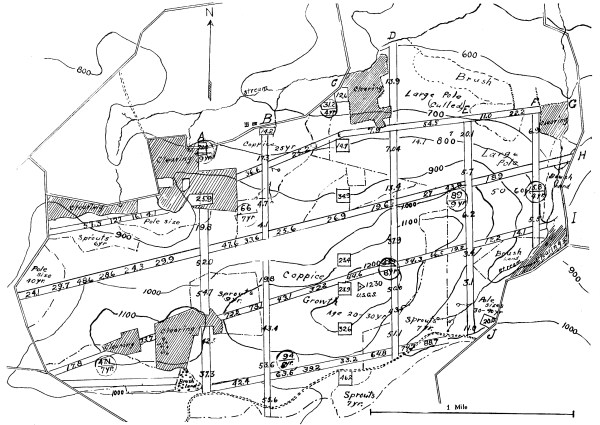
6/6-yr blight center, upper figure is per cent.
of infection on an area
within 50 feet radius or more of the center.
Lower figure is the approximate age of the original infection.
The infection nowhere runs less than 3 per cent., and it was impossible
to find an acre with less than this amount of blight on it. On most of
the ridge the percentage of diseased chestnut runs from 17 to 30 per
cent., although there are spots where it is much higher. The centers of
infection are not confined to any characteristic slope or environment.
Generally, the blight has spread over larger areas on the summit and
south slope than on the north slope. The centers along the south
slope and summit show more trees killed by the blight than those of
any other part of the mountain. This is doubtless due to a more rapid
spread of the blight in these situations. Scattered dead trees are less
common along the north slope than elsewhere; however, several centers
containing a dozen or more large trees entirely killed are found on the
north slope.
The blight is so uniformly distributed between the centers that it
was difficult to determine the facts relative to the dissemination of
the disease by wind. However, most of the infected areas show a wider
zone of distribution east and north of the infection center, giving
the areas of thick infection an egg-shaped outline, with the oldest
infections nearest to the western boundary. No definite information
was obtained on this tract concerning the part played by birds as
disseminators of the disease.
The south slope of the ridge is more dry and barren than the north
slope. The only springs found there are near the eastern end of the
ridge, and a few small springs are scattered along the lower portions
of the south slope, but these are below the zone of chestnut growth.
The north slope is a more gradual incline, and there are numerous
shallow dips resembling miniature gullies. Some of these are moist
enough to support alder bushes and several species of moisture loving
ferns; also trees of the lowland types, such as tulip and maple,
are quite common in these depressions. Most of these dips contain
springs, but not all of them; however, there are numerous small springs
scattered all along the north slope of the ridge. Most of these are
well down toward the base, but several are well up toward the summit.
So far as could be ascertained, no relation exists between the thickly
infected areas and moisture conditions.
The data collected lead to the belief that the infection is distributed
without any regard to elevation. For instance, along the base of the
north slope high percentages of infection are found. Similarly, an
increase in the percentage of blight is found half-way toward the
summit. While the summit seems to support more infection than any other
portion of the mountain, there is no reason to suppose that this is due
to elevation. The stand here is almost pure young chestnut coppice, and
the conditions appear to be more favorable to the rapid spread of the
disease in such stands. The base of the south slope supports coppice
growth similar to that found at the summit, and here the per cent. of
infection compares very closely with that along the summit.
No definite cause for the areas of high and low per cent. of infection
was determined. The highest percentages of infection are found on the
summit and on the south slope of the ridge. Also this portion of the
area supports more old infection than any other part of the mountain.
In part, this may be due to the higher percentage of chestnut on the
summit and south slope, and to the fact that most of it is young
coppice. Such stands appear very susceptible to the disease. The theory
that varying chemical elements, derived from the rock strata, affect
the amount of infection is not supported by any evidence gathered in
this work, for on the three general rock formations of this tract, as
well as along the edge of the adjacent limestone, high and low per
cents. of infection seem equally common. No evidence sheds any light
upon the belief that the distribution of disease is along any definite
compass direction. If there is any proof at all toward this end, it
lies in the fact that infections on the south are more uniformly
distributed than on the north. It is probably true that the advance
infections came from the south and crossed the mountain northward,
but areas of thick infection are not confined to any character of
topography, slope, or elevation.
The accompanying maps give in detail the percentages of blight found in
the Mahoning Valley and Topton Mountain areas.
The southeastern corner of the State has a higher percentage of
infection than any other portion of the State. The rapid increase of
the blight is well shown in this section by the record of 1,637 trees
on tracts in the vicinity of Philadelphia, which were examined for
blight in October and November, 1910, December, 1912, and August, 1913.
In 1910, 31 per cent. of these trees were infected with the blight, and
29 per cent. were doubtful. In 1912, 79 per cent. were infected, and in
1913, 88 per cent. If we include the 29 per cent. doubtful trees with
the 31 per cent. certainly infected in 1910, the total becomes 60 per
cent. This makes the annual increase in infection approximate 10 per
cent. per annum. In this connection it is interesting to note that on
the du Pont estate at Kennett Square, Pa., where tree surgery methods,
supplemented by spraying with Bordeaux mixture, have been in use for
the past two years, the progress of the blight has been materially
delayed. Mr. R. E. Wheeler, forester for the estate, believes that
these methods will save the trees under treatment for at least five
years more, and probably for a much longer time.
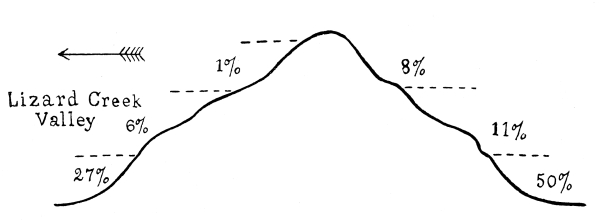
Figure 2.
Cross section of the Blue Ridge Mountain,
showing altitudinal
distribution of the chestnut blight
on north and south slopes
Tree surgery without spraying has had little effect in delaying the
progress of the blight after it attacks a tree. In a large orchard
of Paragon chestnuts, in Northumberland County, in a block of 9,612
trees, 4 to 15 years old, thoroughly examined in the winter of 1911-12,
194 infected trees were found, (2 per cent. infection), 103 of which
were so badly diseased that they were cut out and burned, and 91 trees
were treated by surgical methods. In the winter of 1912-1913, this
same block was again carefully gone over, and 1,064 infected trees
were found, (11.2 per cent. infection), 325 of which were marked for
removal, and the balance for surgical treatment. The rate of increase
in this case was over 500 per cent.
In applying sanitation measures for the control of the blight, it is
not practicable to use tree surgery methods and spraying, (except
possibly in orchards), but only to cut out bodily every infected tree
and to sterilize the stumps. When the blight is generally distributed
through a region, as is the case in southeastern Pennsylvania, it is
manifestly impossible to eradicate the disease by sanitation methods
without also practically eradicating the host. A detailed study of spot
infections as they occur on the western advance line of the disease
is therefore of more interest than the conditions which exist in the
generally infected territory.
On the advance line, as in the eastern part of the State, there is no
rule for the location of an infection center, nor is there any rule as
to the part of the tree which is attacked first by the disease. It is
true, however, that on the western advance line more infections occur
on isolated trees and on the edges of timber tracts than elsewhere,
and that the majority of infections first appear in the tops of
trees. Likewise, in its spread from tree to tree around a center,
the blight shows no general rule, except that the trees immediately
adjoining a primary infected tree are most apt to show the first
secondary infection. The following tabulation gives the details of 175
infected trees in a spot infection of 271 trees, located at Orbisonia,
Huntingdon County, Pennsylvania, studied in 1911 by Mr. R. C. Walton.
TABLE I.
DETAILS OF INFECTION AT ORBISONIA, PA.
| |
|
Number. |
| Origin of tree, |
Coppice, |
136 |
| |
Seedling, |
89 |
| Slope, |
Gentle to medium steep, |
5 |
| Gentle to steep, |
24 |
| Gentle, |
6 |
| Steep, |
79 |
| Very steep, |
0 |
| Medium steep, |
61 |
| Aspect, |
North, |
108 |
| Northeast, |
16 |
| Northwest, |
41 |
| North to northwest, |
7 |
| North to northeast, |
3 |
| Location, |
Lower slope, |
23 |
| Middle slope, |
152 |
| Along road, |
76 |
| Near road, |
28 |
| Away from road, |
71 |
| Moisture, |
Dry, |
28 |
| Damp, |
37 |
| Dry to damp, |
69 |
| Medium dry, |
13 |
| Medium damp, |
20 |
| Windy, dry, |
8 |
| Density of forest, |
Dense, |
72 |
| Medium dense, |
97 |
| Rather open, |
6 |
| Infection on benches, |
|
36 |
| Orientation of lesions, |
North, |
34 |
| East, |
29 |
| South, |
14 |
| West, |
21 |
| Northeast, |
29 |
| Southeast, |
10 |
| Northwest, |
9 |
| Southwest, |
5 |
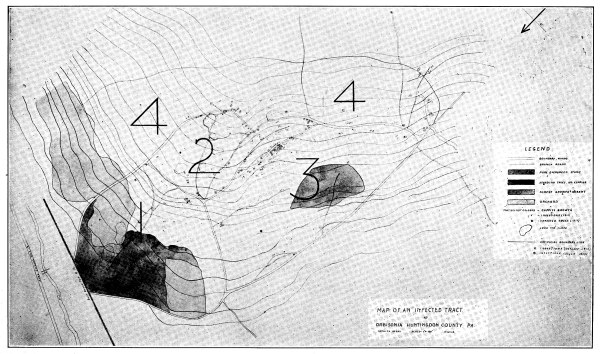
Blight Infected District at Orbisonia,
Huntingdon County, Pa.
The most important practical point in the study of spot infections,
however, is the location of the secondary diseased trees with reference
to the original center of infection. Where a careful study has been
made, it has always been apparent that the disease spreads from an
original center of one or two trees to trees in the immediate vicinity,
as illustrated in the accompanying diagram, which is an example of a
typical small spot infection, (Fig. 4).
The principal obstacle met in applying sanitation methods for the
control of the chestnut blight is the high cost of locating spot
infections. The cause of this lies in the great extent of territory
which must be covered, and difficulty in securing competent and
reliable scouts at reasonable salaries. Experience has proved, however,
that thorough scouting can be done at a moderate cost under efficient
supervision. Rapidity and efficiency in scouting vary with the size
and density of the stand, the proportion of chestnut, the topography
and location of the tract, and the prevalence of blight. The records
of the Chestnut Tree Blight Commission show that between October 3 and
June 30, 1913, it required 11,651 days of labor to scout 738,881 acres
of timber, notify timber owners of infections found, and supervise the
work of removal. This is at the rate of 63.41 acres per man per day,
with the average of 2.07 infections found, and 1.49 infections removed
per man per day. The average day, (not including time consumed in
going to and returning from work), consisted of 8.2 hours spent in the
field, .4 hour lost on account of rain, and .4 hour lost on account of
sickness and leave. With thoroughly experienced and practical men under
competent crew leaders, an average of 100 acres or more per day can be
covered, unless the spot infections are very large and numerous. In
thick infection, one man can make thorough tree to tree examinations of
from 2 to 5 acres, depending on the character of the timber. However,
on the basis of past experience, it appears to be more practical
and economical to locate the boundaries of the spot infection, and
eliminate all of the chestnut trees within and immediately adjoining
the spot infection, instead of eradicating only the diseased trees.
This plan reduces the amount of tree to tree inspection required, and
one man should be able to scout at least 50 acres per day, even when
spot infections are numerous. It has been found that a crew of two or
more men can accomplish more and obtain better results than in the case
of men scouting alone, except in a country where the woodlots are very
small and scattered.
In scouting, rapid and thorough work depends upon the experience and
capability of the crew leader. The size of the crew depends on the
character of the timber to be scouted and the ability of the crew
leader to handle men. Except in a very heavily timbered area, three men
constituting a crew will usually accomplish more than a larger crew.
There is an added advantage in a small crew in that two or three men
can find accommodations near to their work where a larger number of men
cannot, and must consequently spend more time on the road to and from
work. In large tracts of woodland, the best plan is to establish a camp
as headquarters for several crews. A camp is too expensive for a small
crew, but for a number of men it is economical, and has the advantage
of keeping the men close to their work.
The tracts must be scouted systematically. The best plan is to go back
and forth parallel to the backbone of the ridges, each man inspecting
a strip 50 to 100 feet wide. In large bodies of timber four or five
men can work together advantageously, each man being separated by the
distance best adapted to viewing all the trees in the strip between
himself and the men on either side of him. The man on the outside marks
the edge of the strip either by breaking branches on the underbrush
of species other than chestnut, or by marking tree trunks with yellow
lumber crayon. Unless eradicated as found, diseased trees are located
by pacing to the strip boundary at right angles and marking a tree on
the line with crayon to indicate the location of the diseased tree.
If a cutting-out crew closely follows the scouting crew, there is
less waste of time and effort than where the scouting crew attempts
to eradicate the infections as found, unless infections are very few
and limited to single trees. With the cutting-out crew following the
scouting crew, there is the additional advantage that they may locate
diseased trees missed by the first crew.
The greatest aid to efficient scouting is a pair of good field glasses.
They often make it unnecessary to climb doubtful trees, and are of
further usefulness in the hands of an experienced scout, because they
enable him to locate many diseased trees from a high point of land or
from tree tops. In such cases compass sights are taken on the diseased
trees, and an assistant is dispatched to locate them. Such scouting,
however, cannot entirely take the place of more detailed examination.
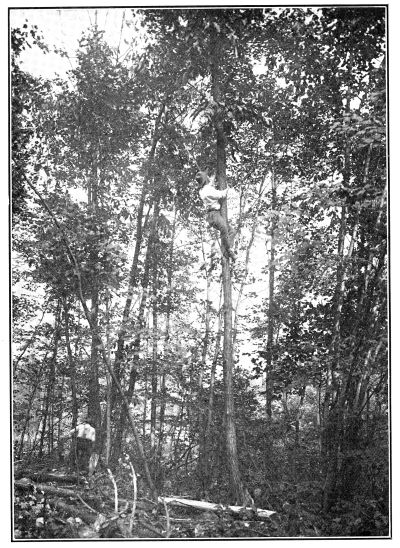
Thorough scouting for the blight is necessary.
It has also been demonstrated that more and better work in scouting can
be done in the fall and winter, after the leaves have fallen. In August
and September the majority of new infections become plainly visible on
isolated trees, but in dense woods the foliage makes it difficult to
locate small infections. After the leaves have fallen, however, more
light is admitted, and a scout can see for comparatively long distances
through the bare tops, even in dense woods. The dead leaves on girdled
branches are conspicuous throughout the winter and early spring, and
where cankers have not yet girdled the parts, the increased light
makes them much more prominent than in summer. Winter scouting has the
disadvantage of fewer hours of daylight and occasional loss of a day
or two on account of snow storms that tend to hide the cankers on the
trunk and branches. If the snow becomes very deep it is not easy to
examine the bases of the trees sufficiently, and the snow also greatly
interferes with the proper treatment of the blighted trees.
In the work done by the Commission, the law required that the owner
of diseased trees be notified to remove them within 20 days. A map or
written description giving the location of the diseased trees on the
tract, was also required by law. On private land the scouts kept field
notes on the location of all diseased trees, blazed each tree to the
wood and marked a serial number on it with black lumber crayon; on the
side opposite from the blaze, a yellow manila tag was attached to the
tree. These tags bore a printed notification that the tree to which
one was attached must be cut in 20 days, with directions for treatment
and a warning against starting forest fires; they also bore the serial
number of the tree, the name of the scout, and the date when attached.
In this way the trees were easily identified later when approached
from any direction, and by means of the “location sheet” giving the
direction and distance of each diseased tree from some fixed point, it
was not difficult to find the trees. The “location sheet” was made out
in duplicate, one copy being handed to the owner of the tract, with a
written request to remove the trees within the 20 days granted by law.
The duplicate copy was sent to the field office, the scout retaining
his note book. Some system of this sort is necessary when the cutting
out is not done by the scouting force, but it is cumbersome and very
expensive. Frequently, it required more time to fulfill the requirement
of the law than would have been necessary to treat properly the
diseased trees on a tract. Much time was consumed also in very detailed
inspection of the trees around a blight center, so that apparently
healthy trees would not be cut, since the law provided that
healthy trees ordered to be cut, must be paid for. Not only was
this very detailed scouting a waste of time in the light of recent
investigations, but it resulted in decreased efficiency of control
because so many of the trees permitted to remain, in reality were
infected. Although no disease could be found on them at the time, the
disease developed fully after the spot was treated, necessitating
several re-examinations before all infections could be removed.
There are many points to be observed in removing diseased trees in spot
infections, if the disease is to be permanently wiped out. The main
point to keep in mind is the fact that the fungus propagates itself
more readily as a saprophyte than as a parasite, so that unpeeled logs,
strips of healthy bark and chips from diseased trees or nearby healthy
ones, if left in the woods, are almost certain to become infected. The
principal object is to do the work in a thoroughly sanitary manner at a
reasonable cost. An experienced man acquired “tricks of the trade” that
enabled him to do the work much more thoroughly and in less time than
an inexperienced hand can do even a poor job. Great care was necessary
in supervising the work of removal carried on by the individual owners,
since each spot infection practically meant training a new man to do
the work, and unless an experienced man was constantly on the spot,
the work would seldom be done properly. On State forest reserves and
in cases of forced removals, the work was done by employees of the
Commission, and it was found that it was done at less cost and much
more effectively than was usually the case elsewhere.
The removal of an infected tree is best done as follows: First: Where
the ground beneath the tree is covered with a dense growth of brush,
this growth should be cleared away so that the chips and branches may
be easily picked up. Small chestnut or chinquapin trees or sprouts
should be cut flush with the surface of the ground and the tops burned.
The stump should be made as low as possible. The bark should be first
removed from the lower 3 or 4 feet of the trunk to an inch or more
below the surface of the soil. If felled by sawing, peeling may be done
after the tree has been cut down. During the fall and winter the bark
is difficult to remove, and if the stumps are cut low, it is easier and
cheaper to split off the sap wood and attached bark with an axe. In any
case the stump and all exposed roots must be cleared of every particle
of bark, and all bark removed must be carefully collected and burned.
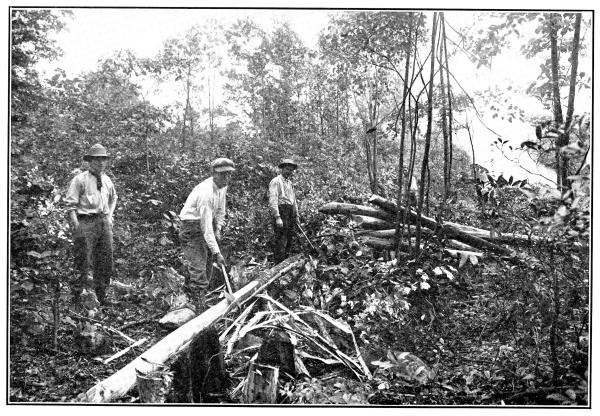
Peeling blight infected trees in a spot infection.
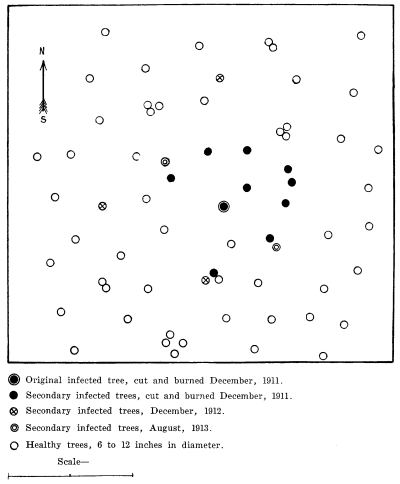
Figure 4.
Typical small spot infection, near Dry Run,
Franklin County, Pa., showing original center and secondary infected
trees. If all chestnut trees within 35 feet of the nearest diseased
tree cut in 1911 had been removed at the time of the first cutting,
and all stumps properly sterilized, it would have prevented the
appearance of the new infections of 1912 and 1913.
After the tree is felled, all portions above the stump which show
mycelium or pustules of the blight must be peeled of bark or the entire
piece cut out. This diseased material, the brush from the tops, the
bark, and portions of the felled chestnut trees which are not peeled
and which it is not intended to utilize must be burned.
After the stump is peeled, if fire can be made over it without injuring
the surrounding trees, and without danger of forest fires, the brush
and refuse is best piled over the stump and burned. The fire must
entirely consume or deeply char all of the material; no uncharred ends
of branches and small twigs can be allowed to remain without grave
chances of reinfection. If it is impossible to make the fire over the
stump without injuring the surrounding trees, the sides and top of the
stump and exposed roots should be thoroughly coated with creosote.
Portions of infected trees which show no evidence of the blight should
not be permitted to lie unpeeled in the woods over twenty days, but may
be safely handled and shipped with the bark on, if shipped as soon as
cut. If the logs from the diseased trees are not removed from the woods
within twenty days from the time the trees are felled, they should be
peeled and the bark burned, or else the entire trees burned. Wood from
diseased trees to be used where exposed to the weather must be peeled,
or the fruiting bodies are almost sure to appear on the dead bark and
become a source of infection. Fire wood, if kept under dry cover, need
not be peeled.
One of the most important time saving items is to peel the lower
portion of the tree before felling, and it is still more important to
cut the stumps as low as possible. Bark remaining between buttresses
and deep crevices of stumps can be removed very readily by chipping
down from a position directly over the low stump, which is not possible
in the case of high stumps. A rake and a large coal-burner’s basket
included among the tools used in burning, are very useful in cleaning
the chips from the ground. Before starting the fire, all the leaves
and debris for a considerable distance around the place where the
material is to be burned should be raked into a pile on which the fire
is started. The bark and small particles of wood are raked together
as soon as the brush is piled, instead of waiting until all the tops
are burned. In this way, no large quantity of leaves and fine rakings
are left until the end to smoulder for a great length of time before
burning, and thus increase the danger of forest fire.
All possible care should be taken to prevent injury to surrounding
chestnut trees and sprouts in felling the infected trees. Observation
has shown that nearby trees are too frequently injured through
carelessness, and the wounds are very apt to be a point of reinfection.
Experience has also shown that unbarked stumps of blighted trees and
green tops which are permitted to lie for a month or two on the ground
are almost certain to become infected. The spores germinate on the
sappy surface of the stump, and the mycelium grows downward through
the cambium, and in the course of a year or two reaches the sprouts
which come up around the base of the stump. In the case of the tops
and particles of bark and wood, the decaying bark appears to be a very
favorable seed-bed for the development of the spores that reach any
portion of this material. It must be impressed on the workmen that the
stumps must be peeled clean, and every particle of the diseased tree
must be either burned or utilized in such manner that no opportunity is
given for the saprophytic growth of the fungus.
It has been found that painting the thoroughly peeled stumps with
creosote is effective in keeping the stumps free from the pycnidia of
the blight fungus, but is not so desirable as hard burning over the
stumps. In an experimental cutting at Wildwood Park, Harrisburg, 55 per
cent. of burned stumps later showed blight, while only 23 per cent. of
the creosoted stumps showed any signs of it. However, it is possible
that in the future, many of the creosoted stumps will become diseased.
The results of an extensive experiment at Anderson Station, Mifflin
County, are given below. This experiment deals with the efficiency of
burning over stumps as compared with creosoting stumps. The stumps in
Table II were peeled at various times during
January, February, and March, 1913, and cold creosote applied with a
brush. The cost of creosote and labor of application was approximately
one-fifth of a cent for each six-inch stump, cut low. The data given
below are the result of an inspection of these stumps made December 12,
1913.
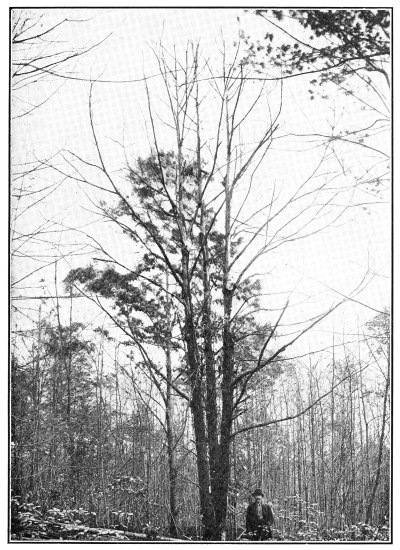
Center of spot infection at St. Mary’s, Elk County, Pa.
This tree was infected at least four years prior to
the time the picture was taken.
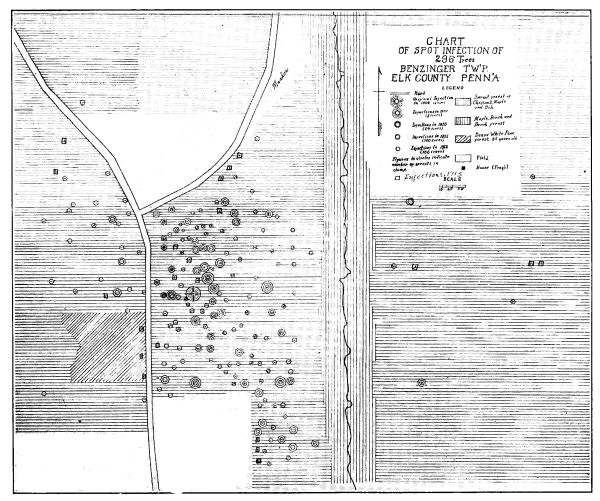
A Spot Infection in Elk County, Pa.
TABLE II.
RESULTS OF CREOSOTING PEELED STUMPS.
| Number. |
Number
of
vigorous
sprouts. |
Average
height of
vigorous
sprouts.
(feet). |
Number
of
diseased
sprouts. |
Point of
disease
on
sprouts. |
Diseased
bark on
stump. |
Pycnidia
on wood
of stump
(creosoted
portion). |
| 1, |
14 |
5 |
|
|
Yes |
|
| 2, |
8 |
5 |
1 |
Base |
Yes |
|
| 3, |
8 |
5 |
|
|
|
|
| 4, |
6 |
6 |
|
|
|
|
| 5, |
4 |
4 |
|
|
|
|
| 6, |
4 |
5 |
|
|
|
|
| 7, |
5 |
6 |
|
|
|
|
| 8, |
3 |
3 |
|
|
|
|
| 9, |
12 |
5 |
1 |
Base |
Yes |
|
| 10, |
7 |
7 |
|
|
|
|
| 11, |
4 |
6 |
|
|
|
|
| 12, |
3 |
5 |
|
|
|
|
| 13, |
1 |
3 |
|
|
|
|
| 14, |
6 |
6 |
|
|
|
|
| 15, |
2 |
5 |
|
|
|
|
| 16, |
5 |
3 |
|
|
|
|
| 17, |
2 |
4 |
|
|
|
|
| 18, |
6 |
5 |
|
|
Yes |
|
| 19, |
2 |
4 |
|
|
|
|
| 20, |
4 |
3 |
|
|
|
|
| 21, |
4 |
6 |
|
|
|
|
| 22, |
6 |
7 |
|
|
|
|
| 23, |
10 |
7 |
|
|
Yes |
Yes |
| 24, |
3 |
5 |
2 |
Base |
Yes |
|
| 25, |
1 |
4 |
|
|
|
|
| 26, |
3 |
4 |
1 |
Base |
Yes |
|
| 27, |
8 |
5 |
|
|
|
|
| Average, |
5.2 |
5.2 |
0.035 |
|
|
|
| |
|
|
of sprouts |
|
|
|
| |
|
|
|
|
|
|
| |
|
|
0.148 |
|
|
|
| |
|
|
of stumps |
|
|
|
No pycnidia were found on wood of peeled stumps after creosoting,
except in one case, where a large area of inner bark adhered to the
stump at time of creosoting, and later raised up, exposing an untreated
wood surface. The inner side of this bark and the uncreosoted area of
wood were covered with pycnidia. Creosote painted on thick bark at the
base of stumps or on an exposed root does not appear to hinder the
growth of the fungus. Hence, since stumps can be peeled but a very
short distance below the soil, especially in winter, it is believed
that creosoted stumps are more apt to have infected sprouts after a
few years than burned stumps. The danger point is at the ground line,
and exposed roots and the crotches at the collar between roots are
especially liable to have areas of bark that are missed in peeling. If
this bark becomes affected, it brings the disease very close to the
young sprouts that spring up around the stumps, and sooner or later
causes infection.
The stumps in Table III were burned in
December, 1912. The data given below are the result of an inspection
made December 12, 1913.
TABLE III.
RESULTS OF BURNING OVER PEELED STUMPS.
| Number. |
Number
of
vigorous
sprouts. |
Average
height of
vigorous
sprouts.
(feet). |
Number
of
diseased
sprouts. |
Point of
disease
on
sprouts. |
Diseased
bark on
stump. |
Pycnidia
on wood
of stump |
| 1, |
4 |
3 |
0 |
|
|
|
| 2, |
8 |
6 |
3 |
Base |
Yes |
|
| 3, |
2 |
2 |
0 |
|
Yes |
|
| 4, |
4 |
4 |
0 |
|
|
|
| 5, |
6 |
6 |
1 |
Base |
Yes |
Yes |
| 6, |
7 |
4 |
0 |
|
|
Yes |
| 7, |
3 |
3 |
0 |
|
|
|
| 8, |
2 |
4 |
0 |
|
|
|
| 9, |
5 |
4 |
0 |
|
|
|
| 10, |
0 |
0 |
0 |
|
|
|
| 11, |
3 |
4 |
0 |
|
|
|
| 12, |
4 |
3 |
0 |
|
|
|
| 13, |
1 |
1 |
0 |
|
|
|
| 14, |
4 |
3 |
0 |
|
|
|
| 15, |
4 |
7 |
0 |
|
|
|
| 16, |
3 |
6 |
0 |
|
|
|
| 17, |
4 |
4 |
1 |
Base |
Yes |
Yes |
| 18, |
4 |
4 |
0 |
|
|
|
| 19, |
4 |
5 |
0 |
|
|
|
| 20, |
1 |
6 |
0 |
|
|
|
| 21, |
3 |
5 |
0 |
|
|
|
| 22, |
2 |
3 |
0 |
|
|
|
| 23, |
4 |
4 |
0 |
|
|
|
| 24, |
2 |
2 |
0 |
|
|
|
| 25, |
3 |
5 |
0 |
|
|
|
| 26, |
0 |
0 |
0 |
|
|
|
| 27, |
2 |
4 |
1 |
Base |
Yes |
|
| 28, |
6 |
4 |
0 |
|
|
|
| 29, |
6 |
6 |
2 |
Base |
Yes |
Yes |
| Average, |
3.5 |
3.9 |
[10]0.078 |
|
|
|
| |
|
|
[11]0.17 |
|
|
|
One very heavily burned stump, cut close to ground, had an area of
diseased bark at crotch between roots, and a diseased sprout (No. 27).
The least charring was always in crotches between roots at or near
the soil line. Heavily burned stumps have weak sprouts or none, as a
rule, about one stump out of twenty having no sprouts. Creosoted stumps
usually have more and stronger sprouts than burned stumps.
Creosoting is cheaper than burning over the stump, on account of the
labor saved. While it is apparently effective where the peeling and
creosoting are well done, burning is safer, although more expensive. A
gallon of creosote costs about 15 cents and will treat from 50 to 100
medium sized (10”-15”) stumps, varying with the height of the stump and
the temperature of the air and creosote. The creosote may be profitably
used where other trees will be injured by fire or where there is great
danger of starting forest fires. Other methods of treating the stump
have been tried, such as spraying the stumps with crude oil or kerosene
and then burning them, after peeling. The stumps have also been buried
under a mound of soil through which the sprouts had to penetrate. These
treatments are less efficient and more expensive than creosote and
cannot be recommended.
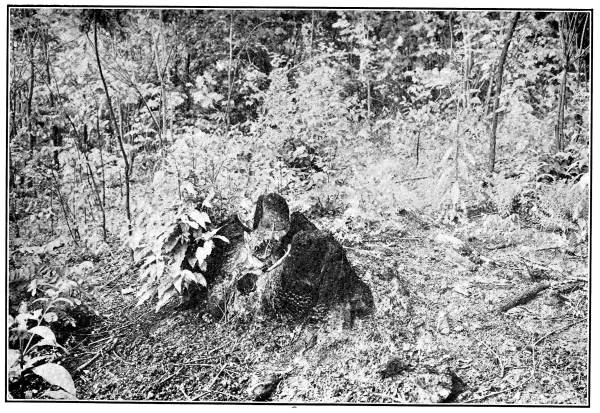
Heavily burned stump showing very few sprouts;
also shows
remnants of improperly burned tops, bearing growth of
blight fungus, (on right).
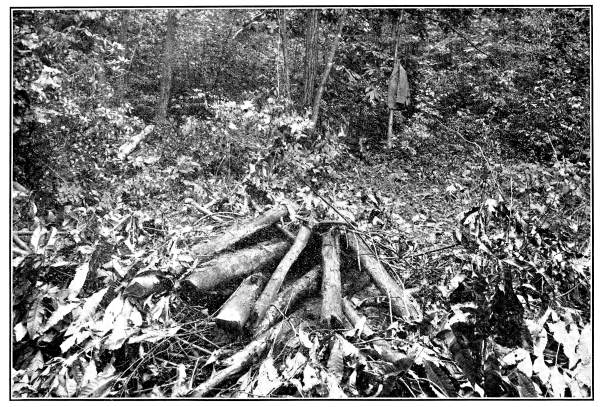
Improper piling and burning of parts of an infected
tree. The brush from the tops must be piled, and the
edges of the pile pushed on the fire from time to time.
The cost of eradication will vary greatly according to the conditions.
If an average of 50 acres is scouted per day per man, at a labor
charge of $2.50 per day to include the cost of supervision, the cost
of scouting an acre is 5 cents. In a region of much blight, the
cost of efficient scouting will run four or five times this amount
unless the plan is adopted of determining only the edges of a spot
infection, and then cutting out all of the chestnut trees inside of
the area regardless of whether or not they show visible signs of the
blight. This seems to be the most sensible plan, since the results of
reinspection show that it is the trees inside of the edges of the spot
infection which in almost every case show reinfection. It will save
money not only in scouting, but in future control. On the Pennypacker
forest reserve in Perry County where the infections were thickly
scattered, the cost of scouting and removal in 1911 and 1912 on 1,620
acres was 73 cents per acre, or 52 cents per diseased tree, and this
is probably the lowest figure for which the work can be done. The most
expensive part of the work is the peeling of the stumps, and here a
great deal can be saved by following the proper methods. In a large
spot infection, the cost can be reduced considerably because of the
concentration of the work. A spot infection of 822 trees, ranging up to
18 inches in diameter on the stump (average 6 inches) was cut out at a
cost of $70.50 or 8.58 cents per tree. This included peeling not only
the stumps; but all merchantable portions of the trees, burning the
brush, sterilizing the stumps, and cleaning up thoroughly. This cost,
however, does not include scouting, which in this case can be figured
at 2 cents per tree. The total area of this spot was about three acres,
so that the total cost of scouting and eradication was approximately
$29. 00 per acre. In all but very small spot infections, enough
material is produced to pay for doing the work.
In Mifflin County, three men treated 2,341 clumps of six-year-old
chestnut sprouts at an average cost of 20.3 cents per clump. Each man
averaged 15 clumps per day; cutting, peeling, cleaning up and burning
were very carefully done at a cost of 16.3 cents per clump. Scouting,
creosoting, and loss of time from bad weather cost an additional 4
cents per clump. The average acre contained 205 clumps of chestnut
sprouts, with an average of 5 five-inch sprouts per clump; 29 clumps
per acre or 14 per cent. were diseased. The cost of thorough sanitation
thus amounted to $5.89 per acre. The average daily wage was $2.40,
including the cost of board and supervision.
To determine the efficiency of sanitation in controlling the disease,
a careful reinspection of 67 spot infections which had been treated
a year or more previous to the examination, was made in the fall of
1913. The results of these investigations are shown in the following
tabulation:
TABLE IV.
RESULTS OBTAINED, IN ONE YEAR, IN
CUTTING OUT 20
ADVANCE SPOT
INFECTIONS OF CHESTNUT BLIGHT.
- (A) = Number of infected trees removed.
- (B) = Number of infected trees.
- (C) = Number of treated stumps with infected sprouts.
- (D) = Probable age of oldest infection.
- (E) = Distance of furthest infection from center (yards).
Tract
no. |
County. |
First
Inspection. |
(A) |
Second
Inspection. |
(B) |
(C) |
(D) |
(E) |
| 1 |
Blair, |
April, 1913,[12] |
1 |
Feb., 1914, |
1 |
0 |
1913 |
10 |
| 2 |
Clearfield, |
Nov., 1912,[12] |
1 |
Jan., 1914, |
0 |
0 |
|
|
| 3 |
Tioga, |
Dec., 1912,[12] |
1 |
Jan., 1914, |
0 |
0 |
|
|
| 4 |
Tioga, |
Sept., 1912,[12] |
1 |
Jan., 1914, |
0 |
0 |
|
|
| 5 |
Tioga, |
Nov., 1912,[12] |
1 |
Jan., 1914, |
0 |
0 |
|
|
| 6 |
Tioga, |
Sept., 1912,[12] |
1 |
Jan., 1914, |
0 |
0 |
|
|
| 7 |
Bradford, |
Jan., 1913,[12] |
1 |
Jan., 1914, |
0 |
0 |
|
|
| 8 |
Bradford, |
Jan., 1913,[12] |
1 |
Jan., 1914, |
0 |
0 |
|
|
| 9 |
Bradford, |
Jan., 1913,[13] |
1 |
Jan., 1914, |
0 |
0 |
|
|
| 10 |
Bradford, |
Jan., 1913,[12] |
1 |
Jan, 1914, |
0 |
0 |
|
|
| 11 |
Blair, |
Dec., 1912,[12] |
2 |
Aug., 1913, |
0 |
0 |
|
|
| 12 |
Cambria, |
Jan., 1913,[12] |
3 |
Jan., 1914, |
0 |
0 |
|
|
| 13 |
Tioga, |
Jan., 1913,[12] |
3 |
Aug., 1913, |
0 |
0 |
|
|
| 14 |
Tioga, |
Dec., 1912,[12] |
4 |
Jan., 1914, |
4 |
0 |
1913 |
30 |
| 15 |
Huntingdon, |
Jan., 1913,[12] |
6 |
Jan., 1914, |
5 |
0 |
1912 |
70 |
| 16 |
Blair, |
Feb., 1913,[14] |
7 |
Aug., 1913, |
10 |
0 |
1912 |
50 |
| 17 |
Blair, |
Jan., 1913,[12] |
8 |
Aug., 1913, |
1 |
0 |
1913 |
|
| 18 |
Blair, |
Jan., 1913,[13] |
22 |
Aug., 1913, |
4 |
0 |
1912 |
50 |
| 19 |
Blair, |
Jan., 1913,[12] |
26 |
Aug., 1913, |
3 |
0 |
1912 |
|
| 20 |
Huntingdon, |
March, 1913,[12] |
30 |
Jan., 1914, |
7 |
0 |
1912 |
5 |
| |
Averages, |
|
6.05 |
|
1.75 |
0 |
|
35.8 |
TABLE V.
Results Obtained, in Two Years, in Cutting Out
35 Advanced Spot Infections of Chestnut Blight.
Tract
number. |
County. |
First Inspection. |
Number of
infected
trees
removed. |
| 1 |
Blair, |
August, 1912,[15] |
1 |
| 2 |
Blair, |
August, 1912,[15] |
1 |
| 3 |
Blair, |
June, 1912,[15] |
1 |
| 4 |
Blair, |
July, 1912,[15] |
1 |
| 5 |
Huntingdon, |
April, 1912,[15] |
1 |
| 6 |
Huntingdon, |
November, 1912,[15] |
1 |
| 7 |
Warren, |
October, 1912,[15] |
1 |
| 8 |
Huntingdon, |
January, 1912,[17] |
2 |
| 9 |
Elk, |
July, 1912,[15] |
2 |
| 10 |
Elk, |
June, 1912,[15] |
3 |
| 11 |
Clearfield, |
June, 1912,[17] |
3 |
| 12 |
Blair, |
August, 1912,[15] |
3 |
| 13 |
Blair, |
July, 1912,[15] |
3 |
| 14 |
Blair, |
April, 1912,[16] |
4 |
| 15 |
Blair, |
May, 1912,[15] |
4 |
| 16 |
Blair, |
June, 1912,[15] |
4 |
| 17 |
Warren, |
July, 1912,[15] |
4 |
| 18 |
Blair, |
July, 1912,[15] |
5 |
| 19 |
Blair, |
June, 1912,[16] |
6 |
| 20 |
Blair, |
July, 1912,[15] |
6 |
| 21 |
Blair, |
July, 1912,[16] |
6 |
| 22 |
Huntingdon, |
April, 1912,[17] |
6 |
| 23 |
Blair, |
July, 1912,[15] |
7 |
| 24 |
Blair, |
April, 1912,[16] |
7 |
| 25 |
Blair, |
August, 1912,[15] |
7 |
| 26 |
Clearfield, |
July, 1912,[15] |
7 |
| 27 |
Clearfield, |
September, 1912,[15] |
7 |
| 28 |
Clearfield, |
June, 1912,[16] |
9 |
| 29 |
Warren, |
October, 1912,[15] |
11 |
| 30 |
Blair, |
July, 1912,[15] |
11 |
| 31 |
Blair, |
June, 1912,[16] |
15 |
| 32 |
Blair, |
July, 1912,[15] |
17 |
| 33 |
Clearfield, |
September, 1912,[16] |
19 |
| 34 |
Blair, |
August, 1912,[15] |
25 |
| 35 |
Blair, |
August, 1912,[17] |
27 |
| |
Averages, |
|
6.8 |
Tract
number. |
Second Inspection. |
Number of
infected
trees
removed. |
Number of
treated
stumps
with
infected
sprouts. |
| 1 |
December, 1912, |
0 |
0 |
| 2 |
December, 1912, |
0 |
0 |
| 3 |
December, 1912, |
0 |
0 |
| 4 |
December, 1912, |
0 |
0 |
| 5 |
December, 1912, |
0 |
0 |
| 6 |
March, 1913, |
0 |
0 |
| 7 |
April, 1913, |
0 |
0 |
| 8 |
November, 1912,[15] |
0 |
0 |
| 9 |
May, 1913,[15] |
2 |
0 |
| 10 |
April, 1913,[15] |
3 |
0 |
| 11 |
December, 1912,[17] |
1 |
0 |
| 12 |
December, 1912, |
0 |
0 |
| 13 |
April, 1913,[16] |
3 |
0 |
| 14 |
December, 1912, |
0 |
0 |
| 15 |
March, 1913,[15] |
4 |
0 |
| 16 |
March, 1913,[15] |
7 |
0 |
| 17 |
April, 1913, |
0 |
0 |
| 18 |
December, 1912, |
0 |
0 |
| 19 |
March, 1913,[16] |
1 |
0 |
| 20 |
December, 1912, |
0 |
0 |
| 21 |
December, 1912, |
0 |
0 |
| 22 |
May, 1913,[16] |
5 |
0 |
| 23 |
April, 1913,[16] |
1 |
0 |
| 24 |
March, 1913,[17] |
2 |
0 |
| 25 |
March, 1913,[17] |
3 |
0 |
| 26 |
December, 1912,[15] |
2 |
0 |
| 27 |
December, 1912, |
0 |
0 |
| 28 |
December, 1912,[17] |
8 |
0 |
| 29 |
April, 1913, |
0 |
0 |
| 30 |
March, 1913,[17] |
5 |
0 |
| 31 |
April, 1913,[17] |
10 |
1 |
| 32 |
April, 1913,[17] |
9 |
0 |
| 33 |
December, 1912,[17] |
11 |
1 |
| 34 |
March, 1913,[15] |
3 |
0 |
| 35 |
March, 1913,[17] |
9 |
0 |
| |
Averages, |
2.5 |
.06 |
Tract
number. |
Third Inspection. |
Number of
infected
trees. |
Number of
treated
stumps
with
infected
sprouts. |
Probable
age of
oldest
infection. |
Distance of
furthest
infection
from
center
(yards.) |
| 1 |
February, 1914, |
0 |
0 |
|
|
| 2 |
February, 1914, |
0 |
0 |
|
|
| 3 |
February, 1914, |
1 |
0 |
1913 |
12 |
| 4 |
February, 1914, |
0 |
0 |
|
|
| 5 |
January, 1914, |
0 |
0 |
|
|
| 6 |
August, 1913, |
0 |
0 |
|
|
| 7 |
December, 1913, |
0 |
0 |
|
|
| 8 |
August, 1913, |
7 |
0 |
1912 |
20 |
| 9 |
January, 1914, |
0 |
0 |
|
|
| 10 |
January, 1914, |
3 |
0 |
1912 |
13 |
| 11 |
December, 1913, |
4 |
2 |
1912 |
37 |
| 12 |
February, 1914, |
0 |
0 |
|
|
| 13 |
February, 1914, |
1 |
0 |
1913 |
6 |
| 14 |
February, 1914, |
1 |
0 |
1913 |
4 |
| 15 |
February, 1914, |
2 |
1 |
1913 |
3 |
| 16 |
February, 1914, |
3 |
0 |
1913 |
10 |
| 17 |
December, 1913, |
0 |
0 |
|
|
| 18 |
February, 1914, |
3 |
0 |
1913 |
20 |
| 19 |
February, 1914, |
0 |
0 |
|
|
| 20 |
February, 1914, |
1 |
0 |
1911 |
300 |
| 21 |
February, 1914, |
1 |
0 |
1913 |
10 |
| 22 |
January, 1914, |
1 |
1 |
1912 |
0 |
| 23 |
February, 1914, |
0 |
0 |
|
|
| 24 |
February, 1914, |
1 |
0 |
1913 |
0 |
| 25 |
February, 1914, |
1 |
3 |
1913 |
5 |
| 26 |
December, 1913, |
10 |
0 |
1912 |
15 |
| 27 |
December, 1913, |
0 |
0 |
|
|
| 28 |
December, 1913, |
5 |
2 |
1912 |
7 |
| 29 |
December, 1913, |
0 |
0 |
|
|
| 30 |
February, 1914, |
7 |
5 |
1913 |
|
| 31 |
February, 1914, |
6 |
2 |
1913 |
35
|
| 32 |
February, 1914, |
9 |
9 |
1912 |
200 |
| 33 |
December, 1913, |
8 |
1 |
1913 |
50 |
| 34 |
February, 1914, |
3 |
0 |
1913 |
5 |
| 35 |
February, 1914, |
4 |
9 |
1913 |
35 |
| |
Averages, |
2.3 |
1.0 |
|
37.5 |
TABLE VI.
RESULTS OBTAINED IN CUTTING OUT 8 LARGE
SPOT INFECTIONS OF CHESTNUT BLIGHT.
Tract
number. |
County. |
First Inspection. |
Number of
infected
trees
removed. |
| 1 |
Elk, |
August, 1912,[19] |
34 |
| 2 |
Clearfield, |
September, 1912,[20] |
36 |
| 3 |
Blair, |
November, 1912,[20] |
93 |
| 4 |
Huntingdon, |
March, 1913,[20] |
100 |
| 5 |
Huntingdon, |
March, 1912,[20] |
271 |
| 6 |
Elk, |
November, 1912,[18] |
296 |
| 7 |
Cambria, |
November, 1912,[18] |
480 |
| 8 |
Huntingdon, |
October, 1912,[19] |
822 |
| |
Averages, |
|
266.5 |
Tract
number. |
Second Inspection. |
Number of
infected
trees
removed. |
Number of
infected
stumps
with
infected
sprouts. |
| 1 |
May, 1913,[19] |
4 |
0 |
| 2 |
December, 1912,[20] |
12 |
0 |
| 3 |
August, 1913, |
14 |
0 |
| 4 |
January, 1914, |
46 |
0 |
| 5 |
November, 1912,[19] |
82 |
0 |
| 6 |
April, 1913,[18] |
23 |
0 |
| 7 |
June, 1913,[18] |
5 |
0 |
| 8 |
June, 1913,[20] |
24 |
0 |
| |
Averages, |
26.2 |
0 |
Tract
number. |
Third Inspection. |
Number of
infected
trees. |
Number of
infected
stumps
with
infected
sprouts. |
Age of
oldest
infection. |
| 1 |
January, 1914, |
2 |
2 |
1912 |
| 2 |
January, 1914, |
36 |
0 |
1912 |
| 3 |
|
|
|
1912 |
| 4 |
|
|
|
1912 |
| 5 |
August, 1913, |
88 |
6 |
1910 |
| 6 |
December, 1913, |
51 |
0 |
1911 |
| 7 |
August, 1913, |
9 |
0 |
1913 |
| 8 |
August, 1913, |
91 |
0 |
1912 |
| |
Averages, |
46.2 |
1.3 |
|
Over 60 spot infections located on the western advance line were
examined between August, 1913, and February, 1914. The spots were
located in 7 counties on the extreme western advance line of the
disease, and also some distance back of this line. The cutting out had
been done by practically as many owners as there were spots, under
supervision of various field men, so that the conditions were averaged
in every way. The point which was brought out most prominently by the
re-examination was the fact that where the stumps were well peeled and
thoroughly charred and where the tops and refuse were well cleaned up
and burned, and the merchantable material promptly removed from the
vicinity of the spot infection, there was no reinfection of the stumps
or sprouts of the treated trees. Where the work was carelessly done,
there was more or less reinfection. However, there were exceptions in
both cases. In some cases where the work was done only fairly well or
even poorly, there was less infection than might naturally be expected.
In some other cases where the work was done as well as it can be
expected under field conditions, there was a considerable reinfection.
This variation is probably explained by other factors which undoubtedly
enter into the effectiveness of sanitation cutting. Probably the age of
the original infection center is one factor governing the number of new
infections which appear after the first cutting out. If the original
infection is still so young that there is a comparatively small
canker, or if the condition of the growth has been unfavorable for
the production of ascospores, a small amount of new infection may be
expected, since the wind apparently distributes most of the infection
to the surrounding trees. On the other hand, if the diseased area of
bark at the center of an infection is large and has produced a great
number of perithecia, and the climatic conditions have been favorable
for the ejection of ascospores, a large number of incipient infections
are very apt to be left in the surrounding trees at the time of the
first removal cutting.
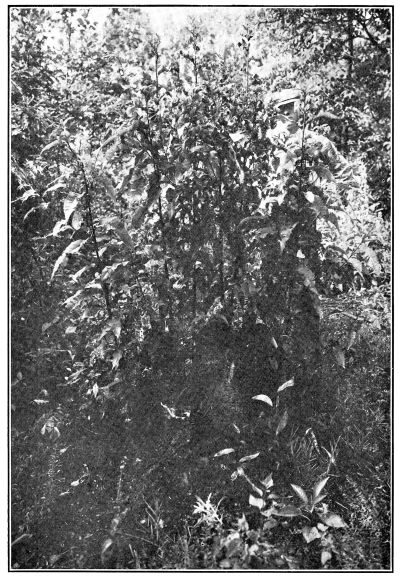
Healthy sprouts growing around a burned stump.
Just how long after cutting it takes these incipient infections to
develop so that they can be detected in scouting depends on a number
of conditions, such as the location of the diseased area on the tree
and the height above ground where infection occurs, size of the tree,
season of the year and climatic conditions following the occurrence
of infection, location of the spot infection relative to topography,
etc. Probably the most important factor governing the number of new
infections after a removal cutting is the character and quality of
the man who scouted the area. Certain men have much better scouting
ability than others, and in some of the spots examined, at least, this
factor alone is sufficient to account largely for the conditions found
on reinspection. However, even the best scout cannot detect small twig
infections in the tops of tall trees before they have girdled the
twigs, and it is frequently very easy to miss well developed cankers
either at the base of large trees when no fruiting bodies have been
produced, or on the upper trunks of tall trees before the tops have
been girdled.
It was very noticeable that new infections appearing in a spot where
the original infection had been properly removed were almost always
within a short distance of the original infection. Probably half of the
new infections found, even after the second inspection, were on trees
that grew on the same stump or in the same tree group as an original
infected tree, and 90 per cent. of the newly infected trees were so
close that their tops interlocked or were directly exposed to the tops
of the previously infected trees. The accompanying diagram illustrates
the characteristic manner in which new infection appears. In several
cases the farthest infection as noted in the tabulated data was an old
infection which was missed at the time of the first inspection, and
which really constituted a separated spot infection.
Blight spots in northern Pennsylvania seem to be smaller, more widely
scattered, and to spread less rapidly from the center than spots in
the southern part of the State. One reason for this may be that there
is, as a rule, a much lower percentage of chestnut in the forest and
the chestnut appears to be sounder and in better health than much of
the chestnut in the southern part of the State. Further south along
the advance line, greater injury is noticed on young trees from the
bast miner; damage from ice storms and hail storms also appears to be
greater. Another possible factor is that the climate is warmer, and
favorable to the copious formation and ejection of ascospores over a
longer period than in the northern part of the State. Another possible
factor is differences in topography which favor the carrying of spores
long distances along regular “air lanes.” This may be the explanation
for long chains of spot infections which occur along the lower edges
of timber of the long, forested ridges, and on benches half way up
mountain sides. This is put forth merely as a suggestion and not as a
fact, although there is some evidence to warrant a hypothesis of this kind.
The results of the investigation show clearly that the chestnut trees
immediately within and adjoining a spot infection (say 25 feet beyond
the outermost infected trees), should be cut out and the stumps
sterilized whether the trees appear to be infected at the time the
cutting is done, or not (Fig. 4). The investigation
proves that these trees in the majority of cases will become infected
later on, and it means extra expense and less effective control to
wait until the infection appears. In very small spot infections or
even those of considerable size, it is believed that such treatment
will avoid a recurrence of the blight in the majority of cases.
However, to cut out these apparently healthy trees is not sufficient;
the sanitation work must be done as thoroughly as if the trees were
diseased. Even though the merchantable portions are taken out of the
woods and the tops burned, the unpeeled stumps are very apt to become
infected, especially if nearby diseased trees have been ejecting
ascospores. Four treated spot infections were examined which proved
this very conclusively. The following facts relative to these spots are
interesting:—
Spot 1. Five infected trees in Huntingdon County were treated in
April, 1912, by digging up the trees, stumps and all, and burning them
in an open field. In March, 1913, the spot was re-examined and three
infected trees found. The stumps were peeled and the tops burned, but
not over the stumps. At the same time all of the chestnut trees on a
half acre surrounding the spot that were large enough for fence posts
were cut out, the tops burned and the rest of the trees removed. The
stumps were left unpeeled and in January, 1914, 6 new infections were
found on small saplings that remained after the cutting, and all but 4
out of 75 stumps from which the bark was not peeled showed pycnidia on
the cut surface of the wood or bark, pustules in the dead bark on the
side of the stump, and usually, mycelium growing downward toward the
base of the stump through the live bark.
Spot No. 2. Seven infected trees cut March, 1913; stumps well
peeled but not burned over. In January, 1914, 9 new infections were
found on adjoining trees and 50 new infections were found on the stumps
of healthy trees cut in close proximity to the spot in March, 1913.
These stumps were not peeled and the pustules appeared in the bark
on the side of the stump, and in many cases showed mycelium running
through the live bark of the lower part of the stump.
Spot No. 3. Seven trees cut June, 1912; stumps peeled and well
burned. March, 1913, 7 infections were cut out, the stumps poorly
peeled and not burned. At this time 17 healthy trees were cut within
a radius of 30 yards and the bark was not peeled from the stumps. In
January, 1914, no new infections had appeared on any of the surrounding
trees, but 8 of the stumps were infected.
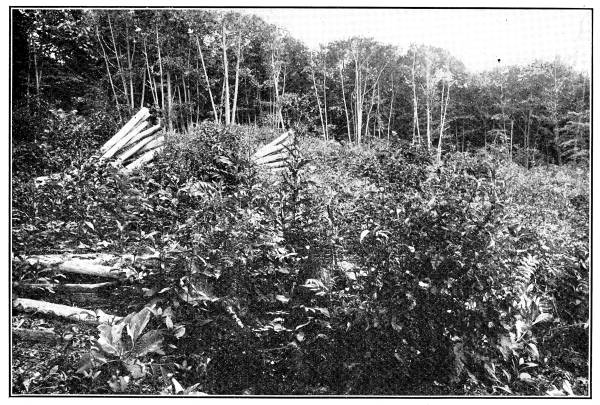
Healthy sprouts in spot infection where blight
was cut out by sanitary methods.
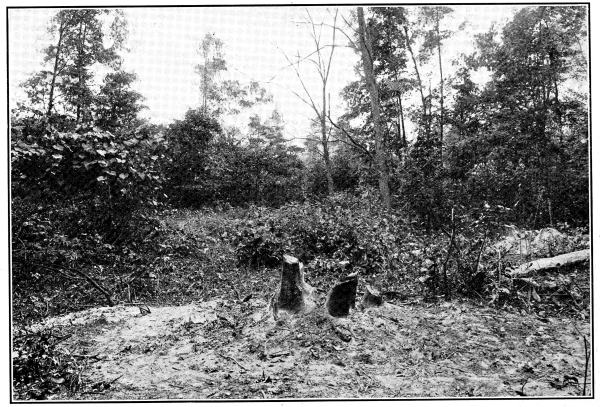
Properly burned stump; stump on the left
cut too high.
Spot No. 4. One infection cut July, 1912. Stumps peeled and
burned. In April, 1913, 16 new infections were found on stumps cut at
the time the original infection was removed and immediately surrounding
the infected trees. These stumps were located as follows: One stump 3
yards west of center; 3 stumps northwest of center (farthest 35 yards);
3 stumps north of center (farthest 20 yards); 5 stumps northeast of
center (farthest 12 yards); 2 stumps east of center (farthest 3 yards);
2 stumps southeast of center (farthest 8 yards); these stumps were
peeled and not burned over. In February, 1914, 4 additional infected
stumps were found, the farthest being 12 yards from the center.
East of the advance line sanitation has proved effective in hindering
the progress of the disease, but not in eradicating it. Inspections
made of a tract of blighted chestnut at Haverford, Pa., cut in 1910 and
the stumps peeled, but not burned, showed both in 1912 and 1913, that
only about 20 per cent. of the stumps and sprouts were reinfected. On
a nearby tract where the trees were cut at the same time and stumps
left unpeeled, the reinfection was approximately 80 per cent. At
Hummelstown, Pa., on several acres of diseased chestnut, cut in the
winter in 1911-12, a portion of the stumps were peeled and lightly
burned. In the spring of 1913, 80 per cent. of the peeled stumps and 90
per cent. of the unpeeled stumps were reinfected. The reasons for the
high per cent. of reinfection was the fact that the peeled stumps were
not well burned, and the nearness of disease on trees in the adjoining
woods and on the adjoining unpeeled stumps. This is shown by the
location of the infection on the sprouts as follows:
TABLE VII.
INFECTION ON SPROUTS AROUND STUMPS OF
BLIGHTED TREES CUT AT HUMMELSTOWN, PA.
PEELED STUMPS.
Stump
Number. |
Number of
sprouts. |
Infected Sprouts. |
Infected
on
crotches. |
Infected
in insect
galls. |
Basal
infection. |
| 1, |
42 |
5 |
11 |
0 |
| 2, |
28 |
0 |
0 |
0 |
| 3, |
35 |
4 |
7 |
0 |
| 4, |
20 |
4 |
1 |
0 |
| 5, |
11 |
0 |
3 |
0 |
| 6, |
12 |
2 |
0 |
0 |
| 7, |
50 |
0 |
2 |
0 |
| 8, |
10 |
0 |
2 |
0 |
| 9, |
15 |
1 |
3 |
1 |
| 10, |
28 |
0 |
0 |
0 |
| Average, |
25.1 |
1.6 |
2.9 |
0.1 |
| UNPEELED STUMPS. |
| 1, |
15 |
4 |
3 |
0 |
| 2, |
24 |
0 |
4 |
1 |
| 3, |
30 |
1 |
0 |
1 |
| 4, |
10 |
0 |
2 |
1 |
| 5, |
2 |
0 |
0 |
0 |
| 6, |
46 |
0 |
4 |
0 |
| 7, |
54 |
1 |
3 |
0 |
| 8, |
55 |
1 |
1 |
0 |
| 9, |
23 |
0 |
1 |
0 |
| 10, |
40 |
1 |
3 |
0 |
| Average, |
29.9 |
.8 |
2.1 |
.3 |
The investigation at Hummelstown shows that there is little or no
difference in the number and vigor of the sprouts produced by peeled
and unpeeled stumps. In many cases, the sprouts reached a height of six
feet or more in a single year’s growth. The sprouts from peeled stumps
frequently spring from the roots, 2 to 4 inches from the stump, and
push through three inches or more of soil. This will undoubtedly aid
in keeping them free from disease, and the new growth will be better
rooted than ordinary stump sprouts.
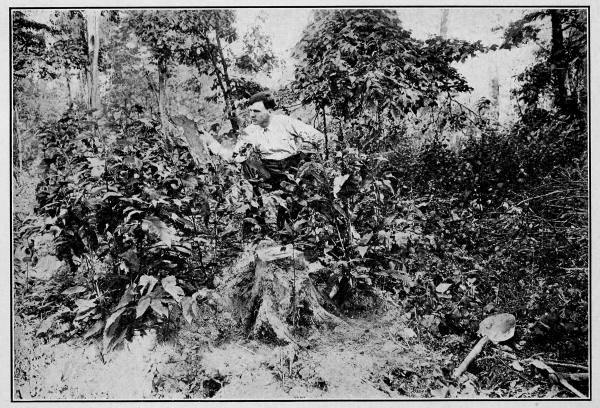
Peeled stump uncovered after burial.
Showing piece
of diseased bark buried with stump.
On this bark the fungus was still alive.
It has been shown that with the less effective methods of cutting out
spot infections used in the beginning of its work by the Pennsylvania
Chestnut Tree Blight Commission, the amount of blight has been
substantially reduced. It is reasonable to suppose that much more
efficient results will be obtained by using the methods which have been
developed by experience, and which are recommended in this report:
(1) Cutting out all chestnut trees inside the limits of a spot
infection, also immediately beyond, regardless of whether or not they
all show visible signs of the blight.
(2) Great care in peeling the stumps and in burning or removing from
the woods all felled portions of the treated trees.
(3) Thorough disinfection of the peeled stumps, preferably by burning.
(4) A force of well-trained and experienced men to do both the scouting
and sanitation cutting.
The Commission issued the appended official regulations for the better
protection of buyers of chestnut nursery stock, and to aid in the
effort to prevent the spread of the chestnut tree bark disease. So far
as could be learned, the railway and other transportation companies
generally complied with these instructions, recognizing their meaning
and importance, knowing that diseased nursery stock was a serious menace.
REGULATIONS RESPECTING CHESTNUT NURSERY STOCK;
ADOPTED BY THE CHESTNUT TREE BLIGHT COMMISSION,
MARCH 4, 1913.
Whereas, It is found necessary to make certain regulations in
order to provide efficient and practical means for the prevention,
control, and eradication of the chestnut tree blight; therefore, in
pursuance of the powers conferred by Act of Assembly, it is resolved by
this Commission that the following regulations be adopted, and as
occasion may arise, such other and further regulations, and the
altering or amending of the same, as it may seem necessary.
Regulation No. 1. Railroad companies, express companies, and other
common carriers must not accept for shipment, until further notice, any
chestnut nursery stock which does not bear the official inspection tags
of this Commission. Chestnut nursery stock shipped from without the
State and intended for delivery within the State not being accompanied
by an official inspection tag issued by the proper authorities of
the State or Country wherein such shipment originated, certifying
apparent freedom from chestnut blight, must be held at a convenient
place within the State, and this Commission immediately notified. Every
such shipment must be retained in its original package, unopened, and
must not be delivered to the consignee until after an examination
shall have been made by an inspector representing this Commission, and
then not until the inspector shall have attached thereto the official
inspector’s tag of this Commission.
The official inspection tag of the Commission bears the official seal
of the Pennsylvania Chestnut Tree Blight Commission, and reads as
follows:
COMMONWEALTH OF PENNSYLVANIA
The Commission for the Investigation and Control of the
Chestnut Tree Blight Disease in Pennsylvania.
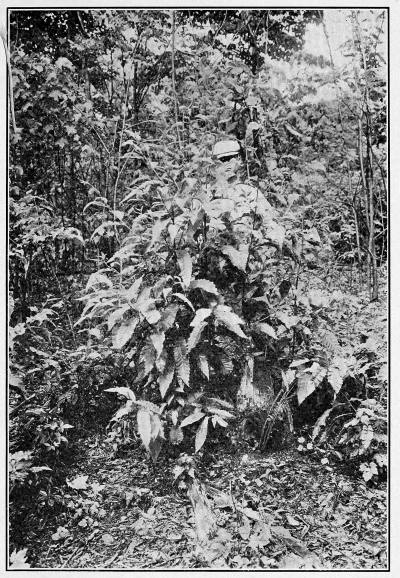
Large sprouts growing around creosoted chestnut stumps.
CERTIFICATE OF INSPECTION
This is to Certify that the chestnut nursery stock to which
this certificate is attached, under my supervision, was carefully
examined, and at the time of shipment was found to be apparently
free from any infection by blight caused by the fungus Diaporthe
parasitica.
Dated ...................... 191 ...... at
................................. Pa.
.................................... Inspector.
For the Chestnut Tree Blight Commission.
Each bundle, bale, or package of chestnut nursery stock
shall bear the above tag, and in addition each tree shall have attached
thereto a numbered and signed tag of which the following is a copy:
COMMONWEALTH OF PENNSYLVANIA
The Commission For the
Investigation and Control of the Chestnut
Tree Blight Disease in Pennsylvania.
Certificate of Single Tree Inspection.
Tree Number ....
This is to Certify that the chestnut tree to which this tag
is attached, under my supervision, was carefully examined, and at
the time of shipment was found to be apparently free from any
infection by blight caused by the fungus Diaporthe parasitica.
Dated ...................... 191 ...... at
................................. Pa.
.................................... Inspector.
Regulation No. 2. No chestnut tree nursery stock
shall be removed from any nursery or other place where the same may
be growing, for the purpose of sale or shipment until said trees
shall first have been inspected by this Commission and the official
inspection tag attached thereto. “Removed” is here construed to
mean the final tying up into an original package, transporting from
the premises where grown, or offering same to a common carrier for
shipment.
Regulation No. 3. All chestnut tree nursery stock intended for sale
or shipment must first be dipped into an approved fungicide prior to
delivery or shipment. The official inspection tag will not be attached
to stock unless first so treated.
Regulation No. 4. All chestnut tree nursery stock found to be infected
with the chestnut bark fungus must be immediately destroyed. This
regulation applies to diseased stock found at the time of inspection
for shipment, and also to inspections in the nursery before stock is
marketed.
Regulation No. 5. Nurserymen and common carriers, who, after receiving
notice of the above regulations, negligently or willfully fail to
refuse to be governed thereby, will, without further notice, subject
their chestnut stock and shipments to quarantine, which will be
maintained by this Commission.
All correspondence relative to nursery inspection should be addressed
to Dr. F. D. Heald, Pathologist, Zoology Building, University of
Pennsylvania, Philadelphia, Pa.
The work of the Chestnut Blight Commission was suspended not because
of the lack of a desire to proceed, or lack of opportunity to render
most valuable services, but for reasons stated in the letter at the
beginning of this report. While the legislation recognized the need of
continuing active work of this character by providing for a
continuation of the Commission, it did not see its way clear to
have the work advance with that vigor which the Commission believed
necessary in order to achieve the most marked success.
The original Act of Assembly approved June 14, 1911, provided that the
Commission should continue operations for a period of three years from
the date of the approval of the Act. This period would have expired by
limitation, June 14, 1914. To continue the Act in force, and to provide
for a Commission to take up the work at any time, should it be thought
in the future desirable to do so, the original Act of Assembly was
amended by extending the term of the original Commission to a period
of five years from the date of their appointment, and to continue
thereafter for so long, as in the judgment of the Governor, it might
be necessary to have work done in accordance with the terms of the
law. This makes the Commission a continuing one to be revived at the
pleasure of the Governor. Section one, of foregoing Act,
as amended[21]
by the 1913 Legislature, reads as follows:
“Section 1. Be it enacted, etc., That a commission, to consist
of five members, to be appointed and commissioned by the Governor
for a period of five years from the date of their appointment, and
to continue thereafter for such period as, in the judgment of the
Governor, may be necessary to enable them to complete the work to
be done under this Act, and to be called The Commission for the
Investigation and Control of the Chestnut Tree Blight Disease in
Pennsylvania, is hereby created; with power to ascertain, determine
upon and adopt the most efficient and practical means for the
prevention, control, and eradication of a disease of the chestnut
tree, commonly known as the chestnut tree blight disease; and for
this purpose, in collaboration with the Department of Forestry, or
otherwise, to conduct scientific investigations into the nature and
causes of such disease and the means of preventing its introduction,
continuance, and spread; to establish, regulate, maintain, and enforce
quarantine against the introduction and spread of such disease; and,
from time to time, to adopt and prescribe such regulations and methods
of procedure as to it may seem necessary and proper for carrying into
effect the purpose of this Act, and exercising the powers and authority
hereby conferred: Provided, That in the work of collaboration by the
Commission with the Department of Forestry, said Department may employ
such means, and make detail of such men, and do such other things, as
may seem to be necessary or expedient to accomplish the purpose of this
Act. Provided further, That if the fungus causing the aforesaid disease
be found to attack other species of trees, such trees shall be deemed
to come within the purview of this act.”
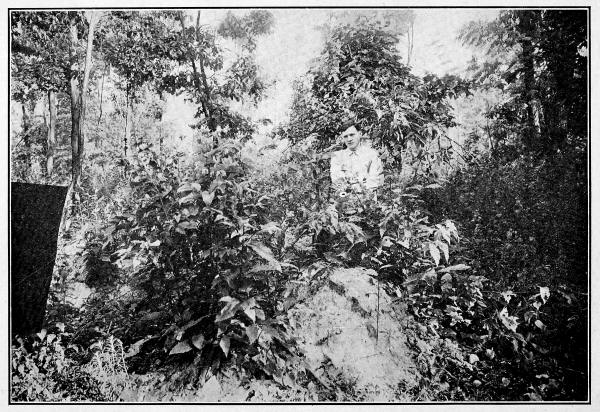
Peeled chestnut stump buried, showing sprouts.