B. PULLEN-BURRY AUTHOR OF “JAMAICA AS IT IS, 1903,” “ETHIOPIA IN EXILE,” ETC.
FELLOW OF THE ROYAL ANTHROPOLOGICAL INSTITUTE
OF GREAT BRITAIN AND IRELAND
WITH EIGHT ILLUSTRATIONS AND TWO MAPS
METHUEN & CO.
36 ESSEX STREET W.C.
LONDON
First Published in 1909
PREFACE
Since very little information has so far
appeared through the medium of the
British press concerning those possessions in
the Pacific, included under the comprehensive
title of the Protectorate of New Guinea, it
has seemed to me that to shape my voluminous
notes into book-form may be of use to
future travellers. With that end in view, it
also appears desirable to explain that much
in these remote islands remains to be discovered.
Speculative theories therefore,
however tempting the data, have been
scrupulously avoided.
In the compilation of this work a simple
description of conditions, which came under
the writer’s notice, is all that is attempted.
It is, moreover, hoped that the reader will
not be severe to mark amiss the latitude
of expression which the authoress has permitted
herself, in the belief that she has not
thereby exceeded those limits of discursiveness
which may justly be extended to confirmed
globe-trotters.
B. P.-B.
London, 1909.
CONTENTS
PAGE
LIST OF ILLUSTRATIONS
FACING PAGE
THE GERMAN PROTECTORATE
OF NEW GUINEA.
IN A GERMAN COLONY — CHAPTER I
INTRODUCTORY REMARKS—ON THE PRINZ WALDEMAR—INCIDENT
IN THE GERMAN CONSULATE AT SYDNEY—THE
MAORIS—THEIR PRESENT CONDITION—DIFFICULTIES IN THE
GERMAN COLONY
This little span which we call life has
been aptly described as a mere parenthesis
between the vast eternities of
whence? and whither? and in this age of
breakneck speed if we would live, and not
vegetate, we must be men and women of the
hour, keen to note, swift to record.
In the case of the writer of these pages
the call comes to testify to the virtues of a
nation which, from circumstances apparently
beyond its control hitherto, it has become
the fashion to decry, for latterly, has not our
literary provender teemed with nebulous and
speculative matter anent the esoteric meaning
of a Monarch’s utterances! Indeed the
fertility of the British press leaves little to be
desired. In the same way our parliamentary
leaders provide food for mental digestion in
which the quantity, hardly the quality, should
satisfy the most omnivorous politician.
Raw stuff in the form of undiscussed
clauses thrust before the astonished gaze of
the Electorate of Great Britain, are professedly,
the “considered judgment of the
Commons of England.” Accustomed as we
are to the growth of “terminological inexactitudes”
we would remind, before we pass on,
even those who frequent the precincts of
Westminster, that a fashionable sin remains,
as heretofore, one of the Lord’s abominations.
Now my travels have taken me beyond
the parish pump, my views of men and things
have long since failed to coincide with that
respectable orthodoxy which to the rural
mind is represented by squire and parson,
and I venture to believe that reading, marking,
and learning whilst we globe-trot
amounts nearly, to the sum of what we can
acquire on this planet. Therefore it appears
not inopportune, for one who has experienced
hospitality and courtesy in no small degree
during a visit to Germany’s youngest colony,
to contribute her mite to that literature which
deals with the hydra-headed question of our
relations with that country. The Master’s
lesson to love our neighbours as ourselves
is possibly beyond our power, yet those of
lesser light remind us that the pen as well as
the tongue has its responsibilities.
“Every word has its own spirit
True or false that never dies,
Every word man’s lips have uttered,
Echoes in God’s skies.”
And let us remember that if there be those
who long to “thrash the English,” there is at
the same time, a growing determination on
the part of the Teuton people to restrain the
military autocracy of the Hohenzollern. The
fiat has gone forth, Germany has set her face
against Absolutism, and in the iron chain of
destiny there are no breaks. The velocity
of national movements responds in proportion
to the propelling energy at the back of them.
In the history of Europe, to-day, we may
well pause to take stock of the situation, to
measure if we can the magnitude of that
driving force, which, since the birth in 1870
of this powerful nation, has converted a race
of dreamers and idealists into a hard, practical
people. For if the will to dominate by land
and sea, to agitate restlessly for commercial
expansion and colonial possessions can be
construed into representing the matured fruit
of Teutonic spiritual aspiration, then indeed
the words of a far-seeing poetess, “Souls are
ripened in our northern sky,” have more
than mystic meaning!
Yet for our mutual comfort, let me add,
that although we are not blind as to what
united Germany may mean to this country,
and that notwithstanding the fact that our
fatuous law-givers profess to see in the fly-blown
phylacteries of Cobdenism relief for
all the woes which beset us, notwithstanding
also the perversity which causes them
to interpret Holy Writ into doing unto the
foreigner 100 per cent. more than he
would do for us in parallel circumstances, we
persist in the belief that the British bulldog
breed is not yet totally extinct, when patriots
such as Lord Roberts, and Lord Meath, rise
up to warn the country of its danger and its
weakness. And God knows, and the women
of England know, that compulsory military
training for three or five years for every
mother’s son would be a boon and a blessing
in every way desirable. In fact our legislative
muddlers are bringing us to this, that if
a healthy compulsion to learn the art of self-defence
is not soon insisted upon, the cry of
the women will not be “Give us votes!” but
“Teach us to shoot straight!”
With these introductory remarks I will
pass on to the subject-matter of these pages,
hoping that I have defined my position as
savouring neither of Teuto-phobia, or of
Philo-Teutonism.
Some twenty months ago I stood on the
deck of the Prinz Waldemar as she slowly
left her moorings and steamed at noon
through that most exquisite waterway,
Sydney Harbour, out into the Pacific Ocean
bound for Hong-Kong. Her first port of
call was Simpsonhafen, in New Britain,
where the monthly steamers of the German
Lloyd are eagerly welcomed by the officials
and planters of the Protectorate of New
Guinea as the solitary link between these
distant equatorial possessions of the Kaiser
and their beloved fatherland. Subsequently,
the Prinz Waldemar would call at Manilla
on her way to the British emporium
of the Far East. My destination was
Herbertshöhe, the seat of government of
the scattered dependency. Here it was
my intention to stay a month, proceeding
to Japan by the next steamer. The undisguised
wonder on the part, first of all,
of the German Consul at Sydney, then
of the ship’s officials, lastly of my fellow-passengers,
when they learnt my plan, was
amusing. What in the world was I going
to do in New Britain? they asked. There
was no decent hotel. I should find it
langweilich! In fact, the place was impossible!
For a lady to stay in that fever-stricken,
God-forsaken colony! unheard of!
Was I not afraid of die cannibalen? The
idea that a woman might be interested in
the vagaries of savage life was too hard a
nut for the normal Teuton to crack. An
English lady of ducal name, who had been
staying at Government House, Sydney,
endeavoured to dissuade me, picturing
vividly my plight in case of illness. I
told her that fevers never troubled me,
although prickly heat and I were sworn
enemies. To the objections of an English
gentleman who, with his large family, had
been visiting his properties in Australia,
one could only emphasize that what he
termed obstinacy, others called determination.
Though I listened to them all
with deep respect I was none the less
prepared to find a four weeks’ stay lacking
in comfort, but years of roaming train one
how to dispense with luxuries. Hitherto
I had always found sufficient nerve to face
unknown quantities. Besides, had I not
as a child, and later, in my teens, in the
most approved Methodistical fashion, literally
wrestled in my prayers to see not
only distant lands, but real live savages?
And here was a chance of beholding some
of the lowest specimens of human nature
on the globe. Would I forego it because
the hotel chairs were not upholstered, or
the milk to my tea was canned. A
thousand times No! In the quiet of my
cabin I thanked Providence that He had
not built me that way! To tell the truth,
the only thing which really occasioned
some anxiety on my part was whether I
should find the German officials courteous,
or the reverse. I had some grounds for
my doubt. The unpleasant interview I had
at Sydney, the morning previous to embarking,
when I requested the German Consul
to give me a letter of introduction to the
Governor at Herbertshöhe, lingered in my
memory. Just then feeling was by no
means friendly in Australasian circles
towards the Germans in the Pacific Islands,
owing to the extraordinary behaviour of
members of the Jaluit Company, in the
affair of a schooner sailing in Micronesian
seas, belonging to a well-known firm of
Sydney shippers, concerning which legal
measures were pending. I was told by
everybody that I should find the Germans obstructive,
discourteous, unwilling to facilitate
me in any research I was desirous of making.
As a matter of fact, my experience was
the exact opposite. However, during my
interview I gave the Consul to understand
that I was known to persons of position in
Sydney, mentioning the name of one or two
prominent members of the Federal Government.
I had also lectured for a Guild,
whereat the Lady Mayoress had presided.
To my utter surprise he completely ignored
the foregoing, declaring, that at the very
least, I should have brought a letter from
Government House stating the object of
my proposed visit, etc. Needless to say, my
anger had been roused at this official bumptiousness,
and I had risen somewhat indignantly
from my chair, expressing the wish to
trouble him no further, since had I deemed
it necessary, I could easily have procured
letters from the Governors, either of Australia,
or of New Zealand. The matter was comparatively
of small importance, and I should
not think of troubling their Excellencies!
The sequel to my interview was that the
letter I had requested was written and
received by His Excellency, Dr Hahl in
New Britain shortly before I made the call
that etiquette requires. So far as my visit
to the German Protectorate was concerned,
this was the first and only disagreeable I encountered
from German officialism. In the
island itself nothing could exceed the kindness
and hospitality extended to me on every hand.
During those eight days of blessed rest
and sunshine, gliding over smooth seas,
under brilliant skies between Sydney and
the German port, occasionally hailed by a
passer-by to look at a shark, noting the
circumstance that after Brisbane not a
funnel nor a sail did we see till we entered
St George’s Channel, which separates the
island of New Britain from New Ireland,
I had time to meditate upon the sights I
expected to witness, in a day or two, where
savage humanity, practically barehanded,
after countless ages of barbarism, had for
the last three decades come into contact with
the white man’s civilisation.
The world moves slowly where national
existence is unknown, where the intellect,
or that which does duty for it, closed in by
dead walls of monotony merely guesses in
the loftiest fashion of its sleep at Heaven.
To such conditions I was about to make
my introductory bow.
There seems to be no doubt that the low
culture and sparse populations of the islands
in the Bismarck Archipelago have been
brought about by centuries of fierce feuds
and exterminating warfare. In pre-German
days these small races were like beasts of
prey, robbing, preying upon their neighbours
until they themselves were chased, killed,
and eaten in return. Their bloody fights
always ended in complete annihilation of
the enemy, women and children included,
the victory being signalised by a cannibalistic
gorge. It was unthinkable that in less than
a generation these men-eaters had lost their
leaden instincts, so it were, according to
Herbert Spencer, vain to expect golden
conduct! Primitive peoples from one point
of view agree to differ; each, as will be seen
in after pages, appears to live and have its
being on its own special rung of the evolutionary
ladder. How far removed indeed
from the ideal savage are these South Sea
Islanders!
“I am as free as nature first made man
Ere the base laws of servitude began
When wild in woods the noble savage ran.”
From barbarism in the Pacific to the tinker,
the tailor, and the candlestick-maker of this
age and of this land is a far cry, but it is an
open question at what stage in anthropological
development man would not be
infinitely better off under the rule of parental
despotism than he is ever likely to be under
representative government, provided alway
that the despot is truly parental in his
methods.
The discipline of life, a pulpit expression,
but comprehensive, and the “base laws of
servitude,” though opposite as the poles in
their modus operandi, are, so far as we can
see, castigatory essentials to the bringing
into working order the endowments of
humanity, but the danger lies in that we,
by our western methods, risk impairing the
original deposit of true manliness, as natural
to the man-eating savage, when he brains
the enemy of his tribe, as to the latest dandy
in Piccadilly, who shows himself a lion in
courage on the battle-field. We are curious
to know what the next compromising Education
Bill will give to replace the native
grandeur of the human animal, for with all
our boasted enlightenment, we see in our
midst a slackness, as opposed to alertness,
a softness (balm no doubt to the nonconforming
conscience) incompatible with ideals
of British bravery, if not fraught with menace
to our national safety. Such qualities too
often appeal to the man in the street and
take the place of virility and common-sense.
I had passed the previous winter in New
Zealand and my thoughts during the passage
travelled across the seas to a dusky race
emerging from conditions which still characterise
the Melanesians under German rule.
No study of mankind is more full of interest
than that of the present condition of the
Maoris of New Zealand. Over one hundred
years have passed since Captain Cook, struck
by their vast numbers, first gazed upon them
as he stood upon the decks of the Endeavour
watching them follow the ship round the
coast. No finer savages ever trod the earth
than this offshoot of the great Polynesian
race. It is lamentable that contact with the
pakeha (white man) has resulted in the
dwindling of their numbers. All that is evil
they have imbibed, but for the virtues of the
European the race seemingly has no use.
It would, I thought, be interesting to compare
them presently, so far as this aspect was
concerned, with the German Melanesians.
The latest census taken in 1906 gives a total
of 47,731, and Dr Pomaré, the Government
medical officer to the Maoris, himself a half-caste,
declares that it is the only enumeration
that can be relied upon, since the returns are
now sent in by the heads of the recently-established
native village councils, for the
Maoris, like Dolly of the Playhouse, paralysed
at the evils which in the forms of
drink, disease and gambling have played
havoc with their race, have now set about
reforming themselves. The tattooed chief
in dogskin cloak and befeathered topknot is
no longer seen. If he was relentless and
fierce, he was also brave and chivalrous.
When he ate his fallen foe he believed that
in so doing he received into himself the
mana (prestige, renown,) not only of the dead
man, but that of all his ancestors. To add
thus to his own mana by conquering the
hereditary enemies of his tribe, although it
meant the perpetuation of inter-tribal feuds,
was highly desirable. His social polity was
the outcome of his views of right and wrong.
Maori-lore as expounded in the whare-kura
(house set apart for that purpose) abounded
in spells and incantations to ward off unseen,
adverse influences. It told him of a land
called Te Reinga, where he would live for
ever with his departed ancestors in peace,
from which place they would exercise their
spirit influence upon mortal affairs. Mr
Tregear in his delightful book describes the
old Maoris to have been highly educated,
good, all-round men. Before the coming of
the pakeha these savages felled trees with
the roughest of tools, built houses and seaworthy
boats, made weapons, carved ornaments,
understood the art of weaving and
dyeing. They cultivated the soil, they
stored their minds with hymns and spells
innumerable. They were poets, orators,
warriors and seamen, possessing industry,
patience, skill and artistic perception in no
small degree. Their present condition, due
mostly to the fact that nothing as yet replaces
this training, is by no means so satisfactory
as one would be led to expect, taking
into consideration all the agencies at work
making for their mental and moral uplifting.
It may be remembered that the first Bishop
Selwyn exclaimed from the pulpit, so impressed
was he by the fervour displayed by
the Christianised natives of New Zealand,
“We see here a whole nation of pagans
converted to the faith.” Subsequently, when
circumstances arose during the Maori war
which led the natives to distrust the teaching
and the teachers, and Hau-Hauism was substituted
for the creed of the missionary, there
remained but little to show as permanent
result of the marvellous turn things took,
when in 1860, mission work reached its
zenith in New Zealand. The spell of tapu
had been broken, the sacred head of the
chief was regarded with lessened veneration,
but to this day the Tohungas (witch-doctors)
retain their malign influence over the majority
of the people. With the substitution of
British rule for tribal authority the descendant
of the once formidable Maori too often
finds his dearest joy in horse-racing, and in
gambling. He spends listless days in wondering
at the marvels of the pakeha—his
motor, the phonograph, the gramophone!
He forgets the tribal legend, the glory of his
heroic ancestry. In the words of an educated
Maori, “it does not take the power of second-sight
for the ordinary observer to see that
the modern Maori is oppressed with unutterable
woe, a listless manner, a hopeless
expression and inertia which can accomplish
nothing.” If this be a true finding for the
majority, it was good to learn that a hopeful
minority of agriculturists, living in the neighbourhood
of Napier and Gisborne, present a
healthy example of what the race may eventually
become. So far as education is concerned,
I had been struck with the facilities offered to
the native children. Over one hundred village
schools were in operation, and the Government
offers one hundred and fifteen scholarships,
tenable for two years, for children of predominantly
Maori race. Yet the complaint
was universal that no definite technical training
for various trades figured in the curriculum.
To convert the aimless lives of those who
had left school into busy ones. To turn
them out into the world as carpenters,
artisans, or engineers; to give the girls
objects and interests in life in teaching them
dressmaking or laundry work, and so forth,
would prevent the going back to tribal life,
which is so discouraging a feature to the
teachers in the schools. But no sketch of
the actual condition of these people, however
humble, seems just without giving full allowance
for the fact that the insecurity of native
land-tenure, arising from the difficulties connected
with establishing individual titles to
lands formerly held in common by the tribe,
is the real cause of much of the apathy, indifference,
and idleness apparent.
In the initial stage of colonisation so far
attempted in New Britain, in the low intelligence
of its aborigines as compared with that
of the Maoris and our other subject races,
in the unhealthy climate, I was shortly to see
for myself how difficult is the task which lies
before the pioneers of civilisation in the
equatorial regions of the German Protectorate.
CHAPTER II
CONFUSING NOMENCLATURE OF THE PROTECTORATE—THE
PAPUAN TYPE—THE MELANESIAN—BLANCHE BAY AND
ENVIRONS—SIMPSONHAFEN—WALK TO MATUPI—THE CAPTAIN
OF THE SUMATRA—ON THE ADMIRALTY ISLANDS—THE
MOÁNUS—THE USIAI—THE MATANKOR
In the following brief outline of the
German colony I prefer to employ the
names with which our atlas has familiarised
us, for the nomenclature of these regions is
somewhat maddening. In addition to the
names which the islands had received from
their discoverers, who were mostly British
navigators, there are those with which the
Germans re-baptised them on the acquisition
of the colony. Then there are the native
appellations in constant use between the
planters and the kanakas (natives) who,
commonly known as “boys,” are recruited
for labour purposes from various islands in
the Archipelago. Nobody deprecates the
confusion this involves more than the officials
themselves. The difficulty in coastal surveys
of identifying this headland or that harbour
with the German name and the native term
has been frequently experienced, and natives
who have been swept away from their local
habitations in their canoes have found it
utterly impossible to explain from whence
they came, since the authorities were absolutely
incapable of understanding to which
part of the coast they referred. Herr von
Lüschan, of the Berlin Anthropological
Society, has strongly urged the retention of
the native names.
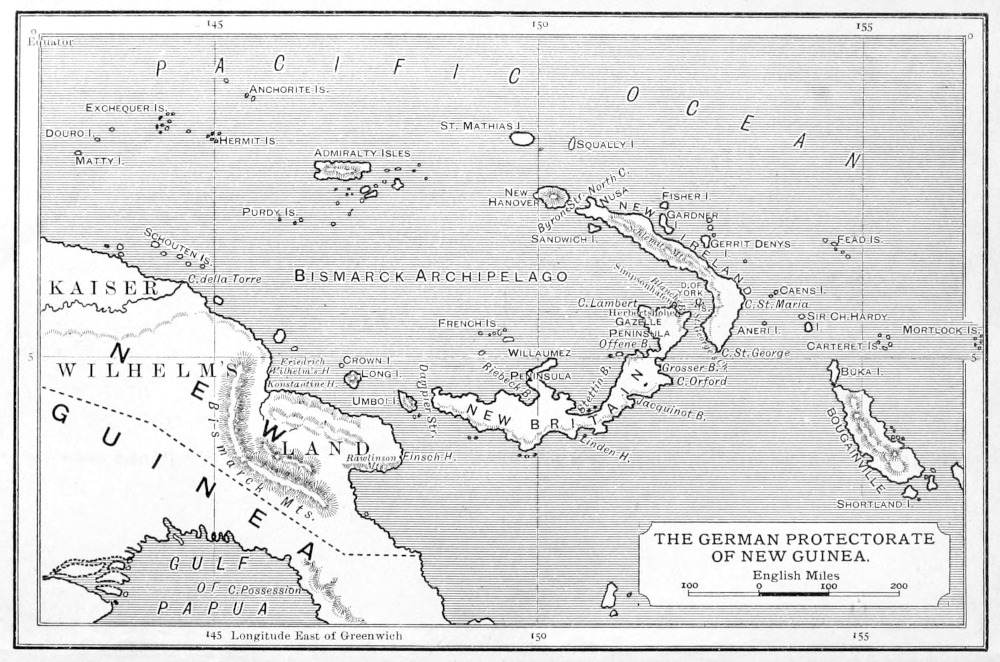
The Protectorate of New Guinea includes
not only the German portion of the island of
New Guinea, known as Kaiser Wilhelm’s
land, but also those islands in North
Melanesia known as the Bismarck Archipelago,
with Buka and Bougainville, two of
the northernmost Solomon Isles and a few
adjacent groups.
The varied and diversified inhabitants of
the Archipelago, for lack of closer knowledge,
are known as Melanesians. Anthropologically
this is a sphere of interest where angels
of the expert class fear to tread. Far be it
therefore for so humble a wayfarer as myself
to intrude! It may be well to mention that
two distinct types have been differentiated by
ethnologists. The island of New Guinea is
regarded as the headquarters of the dark-skinned,
woolly-haired Papuan, and it is
interesting to read that Huxley believed that
the aborigines of this island were more closely
allied to the negroes of Africa than they were
to any other race. The Papuan (Malay-frizzled)
has been described by competent
authorities as shorter than the European, but
taller than the Malay, smooth-skinned, in
colour deeper than the Melanesian, with thin
long limbs, small dolicho-cephalic head, prominent
nose, high narrow forehead, dark
eyes, the frizzled hair worn in a mop, sometimes
plaited with grease and mud. He
scarifies his skin, and has no knowledge of
pottery. The Melanesian closely resembles
the Papuan, but is lighter in colour, stronger
in build, coarser in feature, less prognathous.
He has a knowledge of pottery, of weaving,
practises tattooing and has initiation ceremonies
and numerous symbolic dances. Mr
Sydney Ray, whose linguistic studies of these
races entitle him to rank as an authority, considers
that Papuan and Melanesian languages,
though apparently belonging to separate
linguistic stocks, show no evidence of any
kind connecting them outside the limits of
New Guinea. He thinks that the Melanesian
immigration passing eastward round the north
of that island entered the Bismarck Archipelago.
The peculiarity of the languages of
these parts is their extraordinary diversity,
natives of villages only a few miles apart
being quite unintelligible to each other.
This fact presupposes, says he, a long period
of quite separate existence of isolated family
groups, or gens. These conclusions arrived
at by English scientists are borne out by the
evidence of German authorities on the spot,
men not purely scientists, but governors and
officials of the Protectorate.
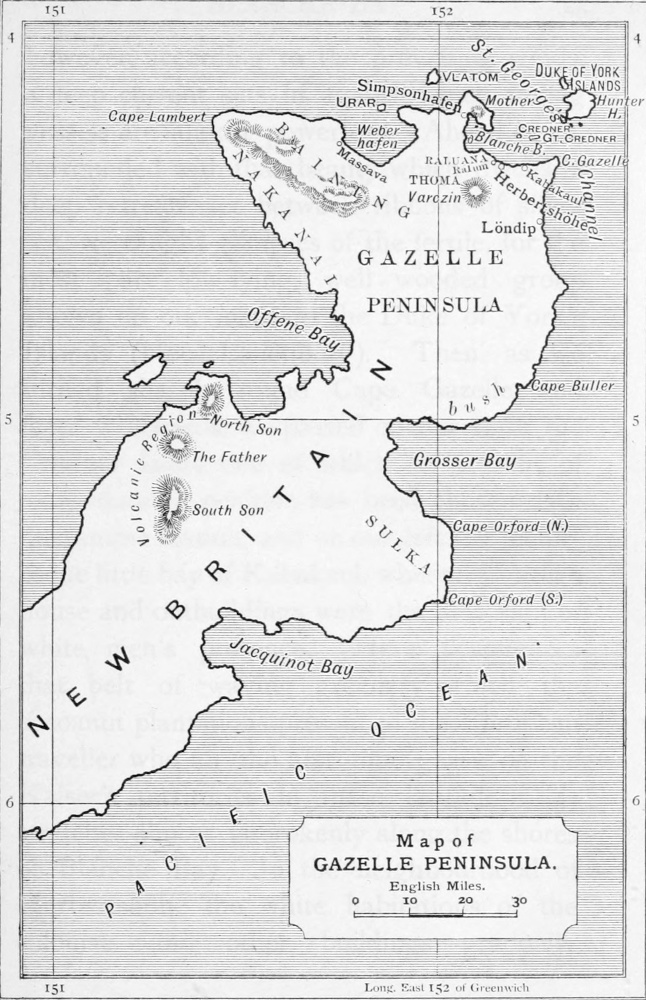
Map of
GAZELLE PENINSULA.
Under a cloudless sky, with the bold outlines
of New Ireland to my right and with
the beautifully wooded upland scenery of the
coasts of New Britain to my left, my thoughts
turned to the pioneers of these seas, to the
joy those who first broke into the silence of
this exquisite region must have experienced,
as after many days they once more beheld
terra firma. As the steamer swiftly threaded
her path along the tranquil scene, we espied
occasionally rising above the woodlands thin
wreaths of smoke, betokening human habitation.
Having rounded Cape Orford and
noted the receding shores of Great Bay
(Grosse Bai) we approached the Gazelle
Peninsula to the north of the island, parts of
which have been settled by the colonists.
Although the coastal survey is now complete,
there remains a great deal of the interior still
to be explored. Soon the fine outlines of an
isolated mountain peak appeared in bold
relief against the cloudless sky. This was
the Varczin (Vunakokor), rising to nearly
2000 feet, standing as sentinel at the entrance
of the channel, separating the two islands.
This narrow waterway, in the year 1878, was
half choked with pumice from a neighbouring
volcano, but since 1890 it has been pronounced
safe for steam navigation. At certain times,
however, according to the prevailing winds,
a deep current sets in against which sailing
vessels are almost powerless. Ahead of us,
surrounded with that beauty which dwells in
deep retreats, set between ribbons of silver
sea, we caught glimpses of the fertile, for the
most part low-lying, well-wooded group
known on our maps as the Duke of York’s
Islands (Neu Lauenburg). Then as we
turned sharply round Cape Gazelle and
faced westwards, we passed on our right the
Credner Islets, one of which on account of
its favourable position has been chosen as a
quarantine station, and on our left the picturesque
little bay of Kabakaul, where a planter’s
house and outbuildings were the first sign of
white men’s presence. Here commences
that belt of waving greenery which the
cocoanut plantations present to the European
traveller who for the first time gazes on the
Kaiser’s territories in these latitudes. It
stretches almost unbrokenly along the shores
of Blanche Bay. In the neighbourhood of
Herbertshöhe the white habitations of the
colonists and other buildings gradually
became visible between the cocoanut palm-trees.
We were now sufficiently close to
shore to watch the white surf breaking over
the coral reef, for it may be well to note in
passing, that two great agencies have for
countless ages been hard at work here, forming
and reforming the face of nature—in fact
they are still busily engaged at the work.
The first of these is the tiny coral insect.
Everywhere, excepting when precipitous
cliffs rise from great ocean depths, as on the
East Coast of New Ireland, the coasts are
girdled with reefs. Anchorage is difficult to
obtain and landings are often situated where
the coral is of raised plateau formation.
The second agent is volcanic activity. Hot
springs are found in many places, and in
extinct craters, where portions of the sides
have been blown out, letting in the sea, the
colonist finds best shelter for his ships.
Earthquake shocks are constant, and in my
visit of four weeks I experienced quite half a
dozen.
As we entered this beautiful bay we had
reefs between us and the land, whilst on the
other side a volcano, known locally as the
Mother, frowned from the end of a promontory
which on the north side semi-encircles
Blanche Bay. Thus we gained admittance
into one of nature’s busiest workshops. Our
approach had been signalled. As we stopped
in front of Herbertshöhe several canoes had
assembled to meet us. In a boat full of
natives a short distance off, I could only distinguish
flat German caps of the well-known
official type, surmounting frizzled hair, but as
it came near I perceived that the occupants
wore smart loin-cloths. Their arms showed
vaccination marks, and through their armlets
of woven grass had been thrust one, two, or
even three European pipes. Their ear-laps
hanging down to their shoulders were rich in
personal property—in fact it struck me that
the family heirlooms were thus safely
bestowed.
They seemed excited, and when some mail-bags
tumbled down the gangway my dull
perception grasped the fact that I was beholding
the transit of the Imperial mails.
The operation interested me. The ship’s
officer approaching, I asked him what these
people kept repeating to each other. He explained
that the one in charge was directing
the others to “let them sleep,” and he pointed
out that the mail-bags were being laid side
by side in obedience to this injunction. The
excitement of the Gazelle kanakas is intense
when once the ship has rounded the low-lying
wooded corner of the island (Cape
Gazelle). The cry “Sail O!” is taken up
and repeated from one to the other along the
shore. Possibly the joy lies in the prospect
of unlimited stores of tobacco, which the
advent of the monthly mail from Sydney
ensures.
ON THE SHORES OF BLANCHE BAY
I noticed that other natives not in official
dress, who approached in canoes and gazed
earnestly up at us, wore feathers or flowers
with bamboo combs in their frizzled mops.
In some cases the hair looked like a yellow
or white door-mat, according to the individual’s
taste in colour; necklaces of opossums’ teeth,
highly valued, and difficult to obtain, adorned
their dusky necks, whilst tight-fitting bangles
on their wrists and arms, curiously carved
out of the tridacna shell, together with
smart loin-cloths (or lava-lavas as they
are called), descending to the knees, completed,
in my opinion, a very smart savage
costume.
Having left her mails the steamer proceeded
along a well-marked passage between
reef-bound shores to her destination. Whilst
waiting opposite Herbertshöhe, my attention
was drawn to a church, with two spires, standing
on an eminence slightly to our left, with
adjacent European structures half hidden by
trees, whilst below, a small schooner, a steam
launch, and native craft denoted activities
which apparently centred round long shed-like
buildings. This was Vunapope, the
property of the self-supporting Mission of the
Sacred Heart of Jesus. The head of this
Roman Catholic and important community
was Bishop Coppée, a Frenchman, whose
acquaintance I happily made. Almost
opposite to where the steamer was stopping,
I was given to understand that two houses
standing in close proximity to each other
constituted the one and only hotel in the
settlement. The Governor’s residence was
just visible through the palm-trees. It is
situated on a commanding height and overlooks
the headquarters of the New Guinea
Company and the Government buildings.
Not far away a landing-pier, sheds and
store-houses belonging to the great trading
firm of Forsyth are outstanding features
along the coast-line. The senior partner of
this successful commercial enterprise, known
locally as Queen Emma, was to become one
of my most interesting acquaintances in the
Pacific. Her fine property, Ralum, with her
residence, quite the finest planter’s house in
the island, extends along the shore to the
west of Herbertshöhe. A little distance
away from the latter we passed the Wesleyan
Mission’s buildings at Raluana, with its
cluster of roofs and native huts. Thus south
to south-west of us the gradually ascending
palm-covered uplands encircled the bay.
On our left, nestling at the foot of the
Mother, lay the island of Matupi, its copra
plantations and hot springs the property of
the firm of Hernsheim & Co. It was joined
to the mainland by a picturesque wooden
bridge which claimed our admiration.
Kanakas’ huts close to the water’s edge gave
us our first impression of native life. To
remind us how near we were to those subterranean,
or perhaps in this case, submarine
fires to which I have alluded, a rock rising to
considerable height seemed to spring from
the shining surface of the water. It was
almost covered with vegetation, a few palm-trees
aspired to fuller growth, but what
was our amazement to learn that in one
night, in 1878, during a terrific earthquake,
it had been thrown up from the depths
below!
Shortly after we lay alongside the wharf
at Simpsonhafen, at the extreme end of the
bay. Here we found two smaller steamers,
one, the Langeoof, about to start shortly to
various islands in the Archipelago to recruit
native labour; the other, the Sumatra, was
a trading-vessel belonging to the N.G.L.,
which was also preparing for an inter-island
trading diversion on its way to Hong-Kong.
After making arrangements to be transhipped
early the following morning by the Langeoof
to Herbertshöhe, I accompanied some fellow-passengers
who were anxious to see as
much as they could during the few hours
they were to remain at Simpsonhafen. We
passed down the newly-constructed wooden
wharf into the shed where goods being
landed were carried by natives. We were
not prepossessed in favour of the miscellaneous,
but miserable specimens of humanity
who swarmed about that quay. One shy
youth was brought forward as the picture
of a desirable bridegroom. His teeth, which
were blackened, betokened that he was desirous
of entering the married state. Pidgin-English
is the vernacular in these parts, and
the native, half comprehending the good-humoured
banter of the ship’s officer,
wriggled away from his grasp. The German
introduced another of his pets—this was the
most repulsive little dwarf one could possibly
see—and if he had nothing better than that
to show us, we told him we would wait no
longer.
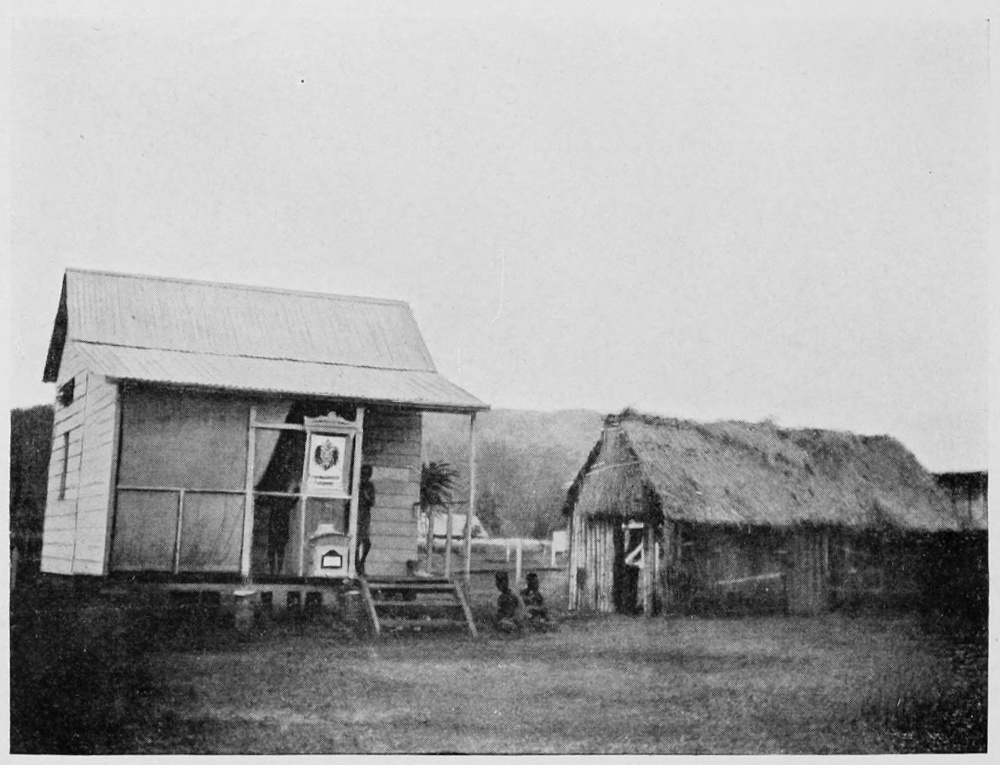
POST OFFICE AT SIMPSONHAFEN
Nothing is more dismal than Simpsonhafen
in its present stage. There are
malarial swamps in close proximity to the
wharf, and the place is fever-ridden; no
doubt on the hills above there are healthy
sites for dwellings, and probably important
buildings will be erected looking down upon
the harbour.
Leaving the long landing-stage we turned
sharply to our right, where a road led to
the post-office. We entered; it was simple
enough in its internal arrangements—a gun
with a collection of papers lay on the
table.
“How do you like the look of that?” one
of the party asked me. In view of the
general disapproval felt at my leaving the
ship, my reply was that fifty guns would not
alter my intention to “stay over.” After
buying post-cards and posting letters, we
continued our way to a rudimentary inn,
where we refreshed ourselves with lager
beer, that refugium peccatorum of these
parts, for the tropical afternoon had afflicted
us with an indescribable thirst. We thought
it possible to compass a visit to Matupi before
returning to the ship. The way was easily
found, and for a couple of miles or so, we
walked on good roads through plantations of
palm-trees, until we came to the bridge we
had seen from the ship. Here we met some
companions who had left earlier than ourselves.
They thought we could get natives
to row us back to the steamer, so we continued
our way, meeting a few kanakas
occasionally. One or two carried European
knives, which greatly alarmed a lady of the
party. We also met some small native boys
with roughly-made bows and arrows, which
they kindly showed us, illustrating the fact
that small children have in various climes
much the same fashions in amusements. It
was getting dark as we set foot on the
island. Our way led past a Roman
Catholic chapel built by native labour,
then through a village enclosed with a
split bamboo fence about four feet in
height, the huts thatched with dried banana
and palm-leaves. No surprise was shown
at our presence; the natives were evidently
accustomed to the curious glances
of white people. Then after a short
walk through more plantations we were
hospitably received by the manager of
Hernsheim’s, and sat in his verandah
chatting and partaking of his hospitality
until a boat belonging to the firm was
announced to take us back to the
steamer.
We had four natives to row us under the
bridge out into the bay, and in about twenty
minutes we were on the decks of the Prinz
Ferdinand. The excursion had been delightful
in its novelty, but after dinner we were
even more interested in a visit we paid to the
Danish Captain of the Sumatra. It was
pitch dark, but we were courteously escorted
with the aid of lanterns to the decks of perhaps
the oldest ship then in the service of
the N.G.L. The Captain, tall, well-built,
fair, with keen eyes of the deepest blue,
looked a typical Dane. For some three
years it had been his lot to visit the different
islands in the Archipelago for trading purposes.
Ghastly tales he could tell of what
had befallen white men in those seas, not by
reason of wind and wave, but from man’s
inhumanity to man. I shall never forget the
weird sight as sitting round a table on the
decks of the Sumatra, our only illumination
a badly-trimmed paraffine lamp, we forgot
the blackness of a starless tropical night, the
buzz and whirring of insects, in the interest
with which we listened, spell-bound, to
the Dane’s racy account of adventurous
days and stirring scenes. The boyish
lightheartedness and charm with which
he described in good English dangerous
encounters with the natives of the Admiralty
Islands I think we enjoyed most
of all. Whenever the Sumatra approached
the shores of these islands for trading
purposes, long canoes shot out from the
coast, each carrying from twenty to fifty
natives in the highest excitement, keen to
exchange their copra and native commodities
for knives, beads and other European articles.
The speed with which they sent their canoes
over the water was tremendous. The
Captain considered the pace they went
amounted to not less than ten knots an hour.
To our inquiry if he never landed on these
occasions, he explained how disaster after
disaster had followed upon repeated attempts
to establish trading stations on these islands,
that the warlike, treacherous natives were
not to be trusted. He always stood well out
to sea, with full steam up, ready to be off in
case of accident, and the sharpest lookout was
necessary to keep the lithe, active islanders
from swarming up on to the decks. In a few
years, said he, settlements no doubt would be
established on the island, and these picturesque
sights, probably almost identical with
those which are described by the first navigators
in the South Seas, would be things
of the past. The only person who had
ever lived amongst these fierce islanders and
still survived, was Bishop Coppée, although
several had visited the coasts. A short time
before, he had taken the prelate to an island
of the group, the object of the latter being
to see what could be done in the way of
establishing a mission. When, at the end
of a fortnight, he had called (according
to agreement) to take him back to Herbertshöhe,
to his surprise and relief the
good bishop, unharmed, had rejoined
him.
“That was just the bravest man I ever
saw,” was the sailor’s verdict after a pause.
It should not be long before I made his
acquaintance was my mental resolve. Then
we gathered that the Admiralty Islanders
were greatly superior in intelligence to any
other in the Archipelago, resembling the
Papuans of New Guinea in living in pile-built
villages over the sea. They are also not
unlike the Solomon Islanders in their knowledge
of seamanship in the handling of their
long, well-built canoes. That they are known
to take long voyages in these, is evidenced
by the fact that Mr Parkinson, in his newly-published
work entitled Dreizig Yahre in
den Südsee, states how he met, in 1897, in
the Schouten Group, off the north-east coast
of New Guinea, two canoes full of Admiralty
natives. Like the old Maoris of New
Zealand, they possess a rudimentary astronomical
knowledge, for they sail their ships
according to what they have observed of the
positions of the stars. When the Pleiades at
nightfall are visible upon the horizon, then
they know they may expect the north-west
monsoon, and when the Scorpion makes
itself visible to them at dusk of the evening,
they begin to look out for the south-east
winds. Besides naming the most brilliant
stars, they have words to define north and
south, east and west, a fact that shows that
they have mastered the first elements of
geography.
The Admiralty Islands consist of some
forty, for the most part low-lying, reef-engirdled
islands. The largest of these is,
however, mountainous and about fifty miles
in length. They are inhabited by three
tribes—the Moánus, the Usiai and the
Matankor. In the book to which I have
referred, the author describes how he
obtained insight into the conditions of
these tribes. He was able to take down
in writing from an intelligent youth, who
with several others had been brought to
Herbertshöhe from the Admiraltys some
account of each. The passages which,
I translate from the German run as
follows:—
“The Moánus build houses in the sea.
They understand canoes, the rudder, how to
propel the canoe with oars, they can swim.
They understand the wind, sailing, the stars,
and the moon and fishing. They agree with
each other concerning spirits, how to perform
magic with the pepper-leaf, with lime. The
intelligence of the Moánus is great, their
speech one and undivided.
“The Usiai live in the bush. They do not
understand how to go by sea, nor the use of
the rudder, or how to propel the canoe, nor
can they swim. In the canoe they unskilfully
permit their obsidian spears to get wet.
The Usiai are cultivators of taro, scrapers of
sago, they are eaters of snakes, they eat
men’s flesh and drink sea-water. The body
of the Usiai is filthy, the breath is unpleasant,
their teeth are covered with a crust of dirt.
Their speech is always different.
“The houses of the Matankor are by the
shore. The Matankor understand the canoe,
how to sail and can swim. They can make
large fishing-nets. The knowledge of the
Matankor is not great. They know nothing
of the stars or of the moon. They do not
understand magic with the pepper-leaf nor
with the dust of lime.”
CHAPTER III
HOTEL AT HERBERTSHÖHE—PLANTERS’ MEETINGS—DOCMAN
AND “COLLARS”—DR THURNWALD—TRACES OF GREAT VOLCANIC
ACTIVITY—THE BAININGS AND THE SULKAS—FACIAL
ORNAMENTATION OF GAZELLE KANAKAS
Late in the afternoon of the day
following, having installed myself in
the hotel at Herbertshöhe, and unpacked
what was necessary, I stood at 5 p.m. at
the top of the steps leading from the steep
cliff to the hotel-landing below, from whence
I waved farewell to my shipboard acquaintances.
It was a glorious evening, and as the
steamer passed from sight, my feelings at
seeing the only link between myself and the
outside world disappear may be imagined.
Turning back I crossed the road, mentally
determining to make the best I could out
of the next four weeks, and returned to the
hotel, or rather to that building known as
the Schlafhaus, comprising three rooms on
the ground floor and three exactly above,
all opening out into wide verandahs which
run round the house. I had engaged the
one with a south-east aspect upstairs, and
OH! the blessing and comfort of those great
covered verandahs, where one could adjust
the blinds, and in the intense heat lie at full
length in a thin wrapper on a deck-chair, for
no one in this torrid climate, if they can help
it, takes outdoor exercise at mid-day. Here I
was wont to breakfast, but unless accepting
the hospitality of the residents, I usually
took my meals in the building opposite,
which, as restaurant, completed the hotel.
From the long dining-room a few steps led
up to a portion dedicated to the cult of lager
beer and other thirst-assuaging beverages.
On the wide verandah of this Bacchanalian
haunt, the planters and officials congregated
of a Saturday evening. During these convivial
meetings the exiled sons of Germania
seriously disturbed my slumbers. Lengthy
orations, interspersed with songs of patriotic
fervour, impassioned verses to their best
girls, others in favour of the noble drinks of
the Fatherland, generally ending with thumping
choruses, sometimes excessively musical,
at others, ear-rending, boomed through the
stillness of the hot night. When music’s
golden tongue ceased, the sable goddess had
generally descended from her ebon throne,
and cheerful morn peeped in upon me, to
find my mood inharmonious, my language
imprecatory! From this verandah, which
served the purpose of the well-known beergarden,
many amusing things reached
me. One day as I was writing notes in
the corner of the opposite Schlafhaus,
screened from view by the sun-blinds
which were adjusted as a sort of protection,
not only from the afternoon sun
but from chance visitors below, I heard
myself discussed with that attention to
detail which characterises the Teuton as
the best thinker in the world. Theories as
to my possible age were brought forward,
then contemptuously snubbed by one wiser
than the rest till at last the speakers were
content to leave it not only as an unknown
quantity, but as beyond their speculative
capacity.
The manager of this hotel was a young
Bavarian of about thirty years of age. I
found him polite, desirous to make me comfortable
so far as lay in his power. He
gave me an outline of his somewhat adventurous
career. At the age of sixteen, he and
another boy found themselves as apprentices
on a sailing-ship bound for South America.
On landing, they ran away, and actually
walked from Santos to Pernambuco, taking
four months over the performance! The
hotel was the property of the New Guinea
Company. It may be worth mentioning that
my lot has been cast in more luxurious
quarters, but for such as it was, I was inclined
to be thankful—it might have been
worse! There were no European servants
at all, and the manager did not live in the
hotel. A Chinese cook, who had scalded
his foot, limped about an outhouse which
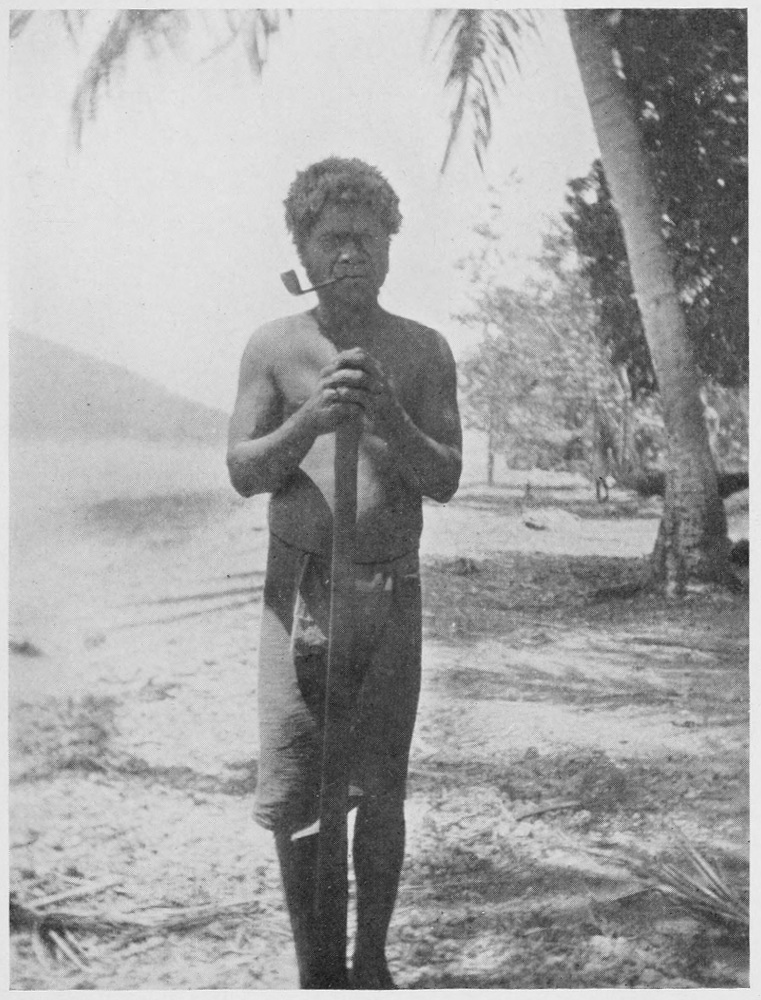
served as kitchen. A native, named Docman,
waited upon me. He swept the room
and the verandah, trimmed the lamps, and
performed many small offices; he was rather
a taciturn, though not an ugly savage. He
would come up the steps with his pipe in
his mouth; if he caught sight of me would
surreptitiously take it out, and stick it
through his armlet of woven ratang. When
in full dress, about to enjoy himself with his
fellows at a feast or dance, he adorned his
neatly-cropped hair with a bunch of double
hibiscus planted in the middle of his head,
on either side two white cassowary’s feathers
waved in the breeze, the erection being
adroitly fastened to the mop with a long-toothed
bamboo comb. His lava-lava was
of brilliant colours and clean.
Then a native girl, quite the smartest I saw
in the colony, rampaged about my quarters
continually. She and Docman had many
consultations as to the curious cut of my
garments. She demanded of me “Collars!”
in season and out of season. I had to call
the manager, who came to my rescue, for she
laid violent hands on a cashmere dress, a silk
petticoat, and other quite unwashable articles,
and I could not imagine what she wanted
with them. He explained she was to be my
laundress, and at the same time in forcible
language made her understand that her
presence at every hour of the day was undesirable,
with a few other needful instructions.
Miss “Collars,” as I henceforth dubbed her,
was a terrible nuisance, her washing during
those four weeks was a great trial, for she
had not the most elementary notion of starching
or ironing. It was too hot for me to
teach her, so I endured and learnt patience!
I picked up a few necessary phrases of Pidgin-English,
and learnt to shout to Docman from
my verandah in this wise when I required
him to bring my lunch upstairs: “Docman,
fetch kaikai belong missus on top!” An
American lady who with her Swedish husband
had occupied the same room before my
coming to Herbertshöhe, and whom I
subsequently met in Japan, told me she
had been curious as to “Miss Collars’”
marital relations, or otherwise, and had
asked the dusky beauty whether she “belonged
Docman?” “Me?” Miss Collars
ejaculated, “Me belong all boys!” After
that the lady said she had not made further
inquiries.
The first evening at dinner there were
several Germans at the table who courteously
spoke very fair English for my benefit. It
was, however, most entertaining to find that
a late comer proved to be a scientist sent out
from Berlin by Herr von Lüschan of the
Anthropological Society, whom I had met
some years before on the occasion of the
visit of the British Association to South
Africa. This gentleman, Dr Thurnwald by
name, was studying the different languages,
and the anthropological conditions generally,
of the colony. I found him somewhat despondently
grappling with the multitudinous
linguistic diversities which characterise the
Melanesian languages, but I was indebted to
him for much enlightenment in our frequent
conversations at meal-times. He was fair in
his references to my nation. In fact he spoke
highly of our successful dealings with coloured
races, and regretted that things went forward
so slowly in the Protectorate.
“We have learnt by long and sometimes
painful experience,” I said more than once.
“We have been colonising for centuries.
You have but just begun!”
“Yes, we came late into the field,” returned
he; “all the best parts of the world
were taken long ago. Look at these miserable
Gazelle kanakas. What can one do
with so lazy, so low a race?”
It was interesting to hear from one, or
another, of the interests which had kept, or
which had brought them to this remote spot.
To grow copra, to sell it at top price, seemed
to be the end and aim of the planter’s
ambition. I learnt that there were six
trading firms, with over fifty stations in the
Protectorate; that at the different harbours,
such as Wilhelmshafen in Kaiser Wilhelm’s
Land, there were post-offices, and an official
with subordinates to collect the revenue, for
the latter procured from taxes, dues, and
licences, averages yearly £5000, but the fact
which struck me as significant, when taken
into consideration with the mental attitude of
one or two whom I met, and which I may
describe as the reverse of sanguine, was that
in the whole Archipelago there are to-day
only, and never have been more than three
hundred white men, and out of that number a
large proportion are officials. When I speak
of the planters I refer to the managers of
plantations belonging to the various firms,
whose business naturally brought them often
to the centre of administration.
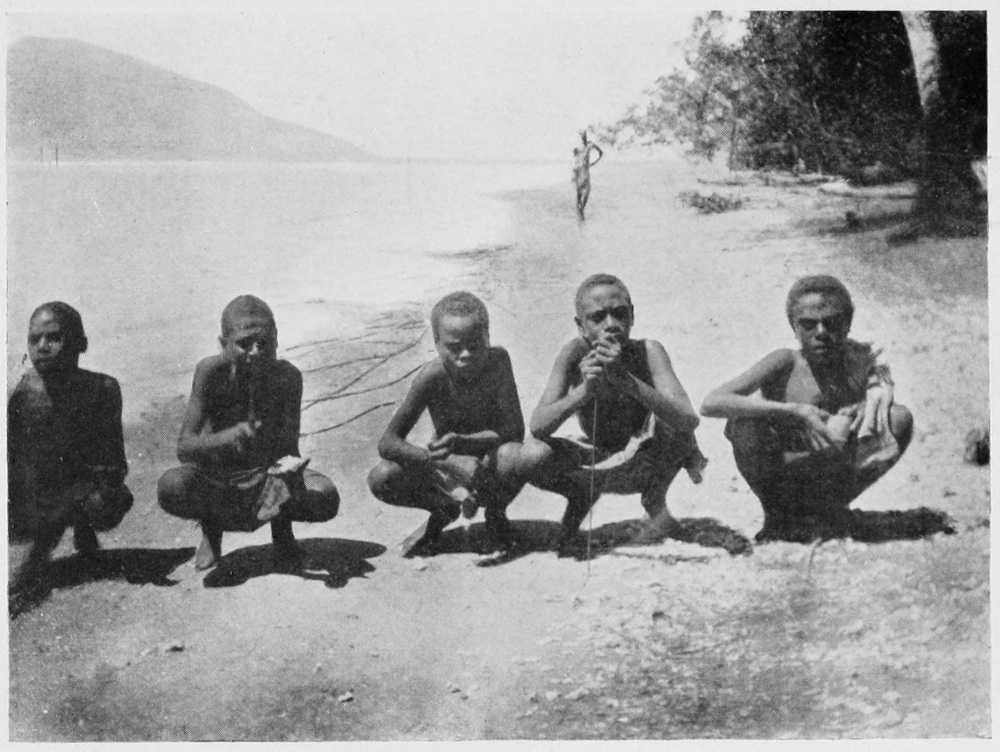
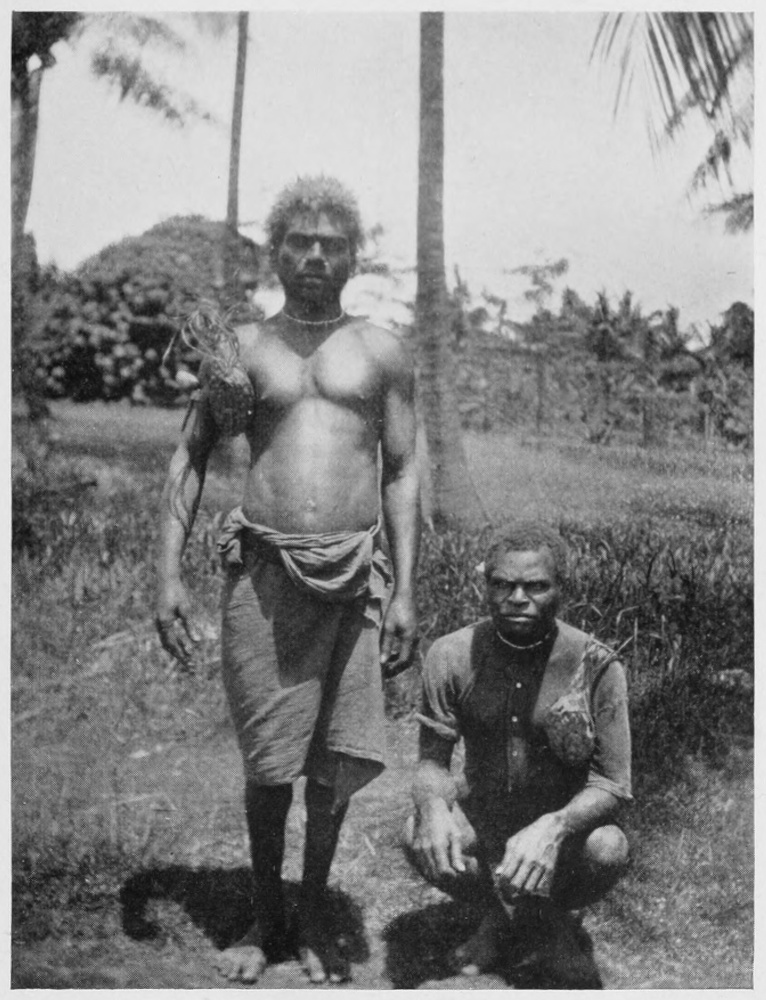
Half a dozen natives wearing red caps and
red lava-lavas waited at table. Sometimes
two or three were sufficient for that purpose,
the others meanwhile would squat out in
the sun operating upon each other’s shoulders.
I watched the process a little way off. At
regular distances the skin was cut by an
obsidian splinter, burning sand was then
rubbed into the aperture and the skin drawn
over it. The raised scars, the consequence
of this treatment, represent tattooing in a
primitive phase, and in this scarifying process
the dark-skinned Melanesians differ radically
from the tattooing of Polynesian races.
The belief is general that these kanakas
at one time or another migrated from the
neighbouring island of New Ireland
(Tombara), and brought with them this type
of ornamentation of the body. Whether
these scarified marks on the shoulders and
chest have any totemic signification, or any
magical meaning, is not clearly known. In
the Gazelle Peninsula the kanakas belong to
one of two divisions, and must marry out of
their own. In my daily conversations with
Dr Thurnwald, it dawned upon me how little
was actually known of the peoples who
inhabit the Bismarck Archipelago. With
deep interest I learnt that a race whose
existence was unknown twelve years ago,
called the Bainings, live in the mountainous
region to the west of the peninsula, and the
curious thing about them is that their
language and customs are dissimilar to those
of all other islanders in the Archipelago. In
a subsequent chapter they are described.
The ethnological conditions of this end of
New Britain seem so bound up with geological
changes, that to shed some light on
the somewhat extraordinary fact of two races
living within a few miles of each other, one
having retained in its pristine purity its
language and distinct customs, it may be
well to refer to Mr Parkinson’s explanation
of the phenomenon. He describes the
peninsula as practically divided into two
parts: a mountainous region known as the
Baining Mountains in the north-west, and a
plateau formation of volcanic origin built up
with lava, pumice, obsidian and ashes, the
result of successive convulsions of nature in
the north-east. But prior to this volcanic
outburst, a race who may be called the
aborigines of the island dwelt round the
shores of Blanche Bay. Those who survived
the catastrophe sought refuge in the
mountainous west, out of the zone of danger.
Their descendants are, he declares, the Bainings,
whose existence has lately come to light.
Cut off from intercourse with later immigrants
in the fastnesses of their mountains, they
have retained their language and customs
intact. If this be a correct inference, it
seems that all agree in the belief that the
bush and coast kanakas of the German
settled territory, so soon as the devastated
area reclothed itself once more with vegetation,
migrated from New Ireland by way of
the stepping-stones afforded by the Duke of
York’s Islands lying midway in St George’s
Channel. Finding no resistance offered
them, the new-comers apparently penetrated
further along the uninhabited coasts, pushing
slowly inland. Long before the advent of
the European, the natives on the west coast
in the neighbourhood of the three volcanoes,
the Father and two Sons, held friendly intercourse
with natives on the north coast of the
peninsula, to whom they brought a special
kind of shell, much prized by the Gazelle
kanakas.
The only other race as yet known possessing
outstanding features are the Sulkas,
living in the neighbourhood of Cape Orford.
A native at Simpsonhafen, with a curiously-shaped
head, had been pointed out to me;
the occiput had protruded in a remarkable
manner. When mentioning the fact, I suggested
it was perhaps the result of an accident?
This was considered a capital joke
by those present. They were kind enough
to enlighten my ignorance. The man, it
seemed, was a Sulka. The last few years
had brought some of them to Herbertshöhe
as labour “boys.” In earliest infancy the
child’s temples are tightly bound, as this protrusion
is considered a great beauty. The
Sulkas, I was told, amid laughter, understood
women’s rights, for the girls choose their
husbands, and in so doing they “lay their
hearts upon the men of their choice,” according
to the native saying.
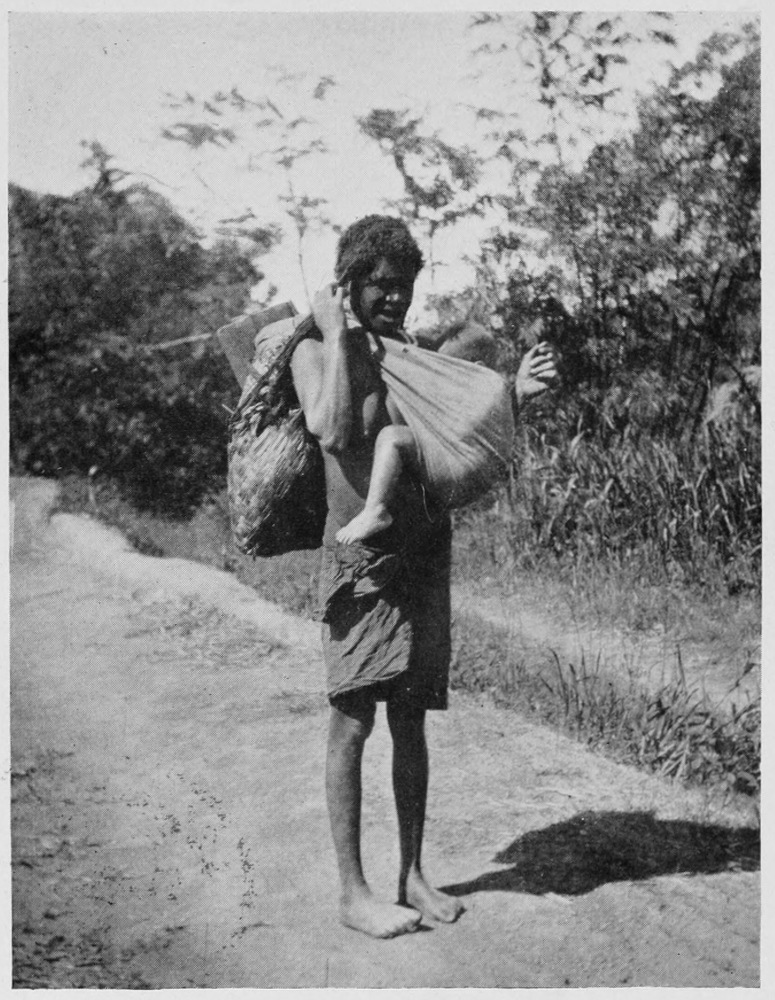
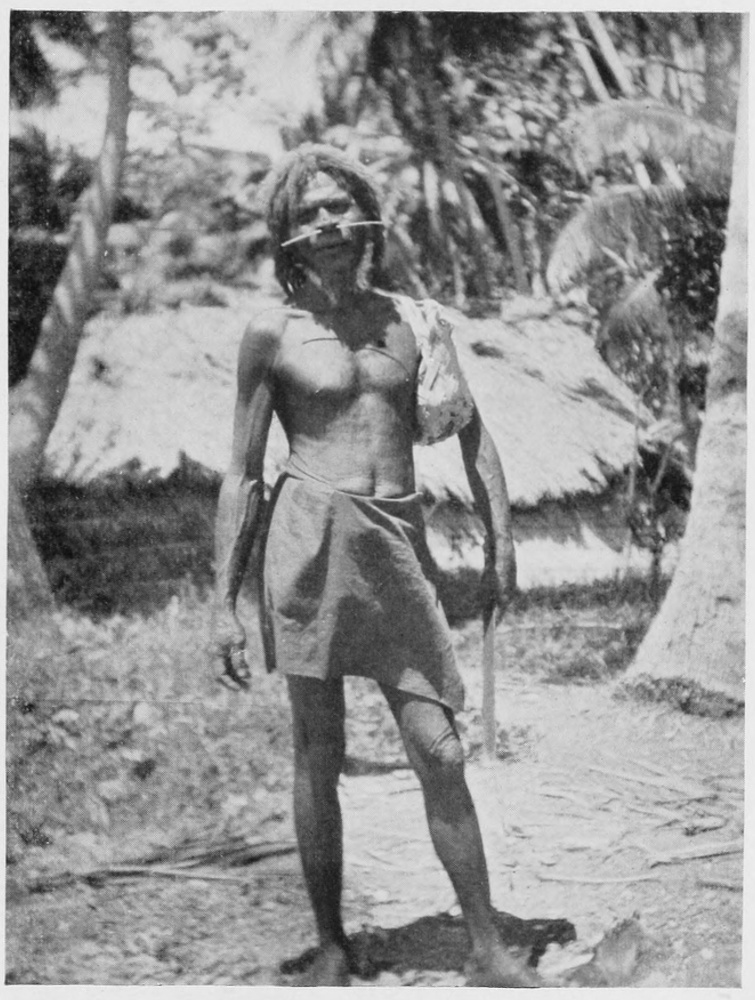
A GAZELLE KANAKA
Very different indeed, I was emphatically
given to understand, were the miserable
kanakas of the Gazelle Peninsula. Living in
communities apart from each other, their
gunans, or clans, scarcely ever numbered more
than nine or ten huts, which were always
encircled with a split bamboo fence from four
to five feet high. The matriarchate system
of inheritance prevails amongst them: thus
a chief is succeeded in his honours by his
nephew, the son of his wife’s brother.
Tamboo, (strings of shell money), is here
as in most parts of the Archipelago the
medium of exchange. Fear of unseen evil,
wrought by the magic of persons antagonistic
to them, is the dominating influence in
their lives, the mainspring of all action.
Everything they wear, all the face ornamentation,
consisting of painted circles and
lines, have their special signification. For
instance, three marks, painted respectively
black, white and red from the eyes downwards
on to the cheek, denote the shedding
of tears. Three long scars in the same
direction have the same meaning. Lines
from the root of the nose semicircling the
eyes represent a butterfly, a red spot on
each cheek means spotted. Sometimes the
whole forehead is painted white; an artistic
finish is a line drawn straight down the nose!
Coloured circles round the eyes mean that
the person so ornamented imitates the eyes
of the owl. Then certain very superior
patterns descend in families as heirlooms,
and they figure as monopolies, for if anyone
covets the design, he must pay a sum
of shell-money for the privilege of
being permitted to adopt it. Near the
Vunakokor Mountain there are natives
of such artistic taste that they paint half
the body black and red, the other half
yellow.
Nowadays when European paint can be
procured from the trader, vermilion seems
the rage, but the native still makes colouring
matter out of clay, red and yellow ochres, or
charred nuts mixed with oil. Betel-nut
chewing is greatly practised.
CHAPTER IV
CANNIBALS IN PRISON—“THE YELP OF THE BEAST”—HISTORY
OF THE BISMARCK ARCHIPELAGO—SPANISH SECRETIVENESS—DAMPIER
AND CARTERET’S VOYAGES—THE NEW GUINEA COMPANY
No truer words were ever written than
the following by Sir George Grey,
“Ignorance is the channel through which
fear attacks human life.” At Herbertshöhe
immediately the sun had set behind the
rugged outline of the mountains of New
Ireland in a wealth of crimson fleecy clouds,
whilst the volcano and the bay lay steeped in
shades of the most exquisite purple, the
kanakas, who, beneath the hotel had been
bathing or fishing on the reef, set up “Sing
Songs” of a most penetrating character,
ostensibly to ward off attacks from unfriendly
spirits who, according to savage beliefs in
this island, are prone to malevolent activity
at this hour. The noise was at times deafening.
I had been warned to be careful, not
to stray too far from habitations, for the
treacherous instinct to slink behind and brain
an unsuspecting European is a factor to be
reckoned with, so that for the first day or so
I contented myself with strolling about the
settlement and locating the different offices
and stores of the traders. The police-station
I gazed at with interest, for hither had been
brought, not long before my coming, certain
natives from the Sir Charles Hardy Islands,
two hundred miles away.
It appeared that a manager of the firm
of Forsyth saw these islanders with hacked-up
human flesh in their baskets, and had
thereupon given them to understand that
under the rule of the “mailed fist,” cannibal
practices must cease; whereupon, the
kanakas, angry at being thwarted in the
enjoyment of the prized delicacy, had
threatened to kill him if he gave information
to the authorities. The European had, notwithstanding,
apprised His Excellency of the
fact, and a ship had brought the transgressors
to Herbertshöhe. I never discovered the
exact mode in which these offenders were
punished, but this is one out of many similar
cases wherein natives have had their feet
set upon the first rung of the ladder which
leads to progress. The low status of the
various races makes colonisation move
slowly. To mentally exchange places with
these savages is an impossibility. Though
keen enough where contact with traders
has accustomed them to look after matters of
personal gain, yet their intelligence, certainly
in the Gazelle Peninsula, is of so elementary
a nature, so little removed occasionally from
imbecility, that to try to grasp the standpoint
from which the white man’s presence
is viewed, requires many years’ experience.
Some of us believe that man is toiling
slowly upwards from unknown depths.
Others, that he is pitchforked into a
solitary existence in this world, condemned
unborn, by force of an heredity insuperably
antagonistic to the attainment of the saving
ethical standard. In the first of these creeds
savage traits are to be expected in early
stages of evolution, “the yelp of the beast”
becoming fainter as he slowly works out his
own salvation. If the raison d’être of man’s
existence is that eventually he may stand on
the heights of life, with glimpses of heights
that are higher, then—
“Earth’s crammed with Heaven
And every common bush afire with God.”
The highest experience of the heirs of
all the ages is “to know ourselves part and
proportion of a wondrous whole.” The fine
insight of great poetic genius has intuitively
felt the cosmic interpretation of what we
call life, thus aiding us to solve, each for
himself, the riddle of the universe.
Few educated persons however, in these
days, deny that their ancestors rose by
evolutionary processes from the animal
kingdom, and in course of ages by slow
and painful effort attained to the rank of
human beings.
In these remote isles is a world sitting at
the feet of Christ!
“Unknowing, blind and unconsoled;
It yet shall touch His garment’s fold
And feel the heavenly Alchemist
Transform its very dust to gold.”
Having permitted myself to indulge in a
favourite line of thought, I will now retrace
my steps.
One of my first actions at Herbertshöhe
was to write to the author of the German
work recently published, who, being a
member of the British Anthropological
Society would, I thought, be a good guide
in native matters. Then I decided to call
soon upon the bishop at Vunapope, and
upon Queen Emma. Before proceeding
further, it occurs to me that an outline of
the history of this colony may be useful to
interested readers.
It is impossible to say with accuracy
when, in the dim past, the Bismarck Archipelago
was first sighted by white men.
Long before the Christian era, according to
Chinese traditions, foreigners traded with
that country, arriving in ships shaped like
animals, having two great eyes at the bows.
Some apparently were Babylonians, for they
brought with them their knowledge of the
stars and their weights and measures. As
it is believed that the coasts of Sumatra
and Java were known to those primitive
mariners, we may be led to infer that
those also of New Guinea were sighted at
an early date. Coming down to later times,
it is a matter of history how the discovery
of the Cape of Good Hope by Vasco de
Gama in 1497, acted as a stimulus to
maritime enterprise and discovery. Portuguese,
Spanish, Dutch and British crossed
trackless ocean wastes in search of gold and
glory!
In 1511, a Portuguese discovered the
Moluccas, whilst De Balboa, in 1513, from
the Spanish possessions in Central America,
first gazed upon the Pacific Ocean. In 1520
Magellan steered his ship through the strait
which bears his name. A few years later
the Spaniards had found their way across
the Pacific to the Philippines and the
Moluccas. That they had sighted the coasts
of New Ireland and of New Guinea is
certain, for Tasman relates how he found
the Cabo de Santo Maria, the eastern point
of New Ireland, on an old Spanish chart,
but the policy of the Spaniards was secretive.
In the fabulous wealth of their new possessions
they had found a good thing, and
resolved to keep it to themselves, for which
nobody can blame them, considering that
the same thing is done every day in this
land of light and learning. Notwithstanding
their silence, adventurers were keenly alert
to find the “terra Australis incognita,” which
the geographers of that date declared must
of necessity exist to maintain the equilibrium
of the universe. Somewhere in the southern
hemisphere, to counterbalance the masses
of land grouped together in the northern,
this unknown territory was supposed to be
situate. In accordance with this theory, in
the year 1566, the Spanish Viceroy fitted out
two ships to search for it. The command
was bestowed upon Alvaro Mendana who,
sailing from Callao in 1567, discovered the
Lord Howe Group. From thence, steering
in a southerly course, thinking that the
fertile islands he coasted, corresponded to
the Biblical Ophir, he named them the
Solomon Isles. Torres later on discovered
the strait separating New Guinea from
Australia, but curious to relate, this discovery
only came to light many years after,
when the British at war with Spain besieged
Manilla in 1762, found the report of Torres’
voyages in the archives of that town. In
consequence of Spanish secretiveness, and
owing to the confused and garbled versions
which were rumoured of these voyages, it
was not until the latter end of the eighteenth
century that geographers decided that the
islands discovered later by British and
French explorers were identical with Mendana’s
Solomon Islands.
Already in the beginning of the seventeenth
century the might of the Spaniard
was waning, and the Dutch were picking
up what their former captors were losing.
Nautical studies were prosecuted in the
Netherlands, the purpose being to gain possession
of the rich Spanish colonies. Nor
does this seem likely to be the only instance
in history when the world-wide dependencies
of a great power have excited the envy of
a neighbouring nation, and stimulated it to
train experts in sea-craft! At this date the
Dutch East India Company rose into being,
and acquired in a short space of time
Batavia, Amboyna, and Bantam, keeping
the trade in their own hands. This monopoly
caused much indignation in Holland,
and incited the two navigators, Le Maire
and Schouten, to further discoveries in the
far east. In 1616, after rounding the Horn,
they sighted three low-lying islands; the
coasts were steep, and there was no anchorage.
These they called Green Islands
(subsequently they were known as the
Sir Charles Hardy Group—native, Nissan).
Directing their course towards a mountainous
shore, they believed themselves to be on
the north-east coast of New Guinea, when
they were in reality off the Cape of St Maria
in New Ireland. Here fierce encounters
with natives, who swarmed on to their decks
from numerous canoes, took place. Ten
were killed, three made prisoners; two were,
however, released in exchange for a pig and
a bunch of bananas. The journal mentioning
this circumstance naively adds that they
did not seem worth more (mehr schienen sie
nicht wert zu sein). Steering northwards
they approached the shores of the present
New Hanover, but failed to note its insularity.
Passing the Admiraltys, they identified
the “High Lands” with the twenty-five
islands of a former explorer. In 1642,
Anthony van Diemen, then Governor of the
Dutch Indies, despatched two ships, provisioning
them for eighteen months, into
the unknown south. This expedition, commanded
by Tasman, discovered in the Bismarck
Archipelago the little island which
bears his name, Fisher Island, Anthony
Caerns, and Gerrit Denys, but he seems to
have fallen into the mistake made by the
earlier navigators in taking the mountainous
coast of New Ireland for that of the island
of New Guinea.
It was left for the British explorer,
William Dampier, in 1700, to establish
the geographical fact that they were two
different islands. Having visited the west
coast of Australia, this famous navigator
steered northwards and reached the island
of Timor. Sailing from thence in an easterly
direction, he missed the “High Lands”
(Admiraltys), which the Dutch navigator
had noted, and passing between Squally
Island and St Matthias, he coasted down
the eastern shores of New Hanover and
New Ireland. Between Gardner Island
and Gerrit Denys, he came into conflict
with fierce natives, who swarmed up his
ship’s decks. Passing Cape St Maria, he
penetrated southwards, named Cape St
George, and mistaking the channel which
divides the island of New Britain from New
Ireland for a bay, called it St George’s
Bay. Here he perceived clouds of smoke
issuing from the northern corner which
proceeded no doubt from the crater known
as the Mother, opposite Herbertshöhe.
Had Dampier arrived at any other time
of year, he would probably have been swept
into the Channel, to discover that his Nova
Britannia consisted of two islands. This
was left for his successor Carteret to demonstrate.
From February to April, Dampier
sailed in these seas, and at this time of year
a strong north-west wind sweeps through
St George’s Channel, in consequence of
which a powerful current, against which
sailing-ships are unable to advance, would
have deterred him from making a more
detailed survey of the supposed bay. Continuing
to skirt the southern portion of New
Britain, he discovered the passage which
bears his name dividing the island from
New Guinea. Here amongst numerous
islets he discovered and named Sir George
Rook Island. Up to his time, the Bismarck
Archipelago had been considered to be a
portion of New Guinea.
Dampier was followed in 1722 by the
Dutchman Roggeveen, who confused New
Britain with New Zealand. Again, in
1764, more British explorers sailed for the
South Seas, amongst them Commander
Wallis in the frigate called the Dolphin.
He had with him, in charge of his second
vessel, an old-fashioned sloop which had
seen thirty years’ service, the celebrated
Lieutenant Philip Carteret. In April 1767,
the latter lost sight of his commander in
the Magellan Straits, and not till the following
August did the crew of his unseaworthy
ship see terra firma. This intrepid officer
then discovered those islands which bear
his name. Of the natives he speaks as
follows:—“The inhabitants are black and
curly-headed, like the negroes of Africa;
their weapons are bows and arrows; they
possess great canoes, which they navigate
by means of sails.” The following day the
Sir Charles Hardy Islands were sighted
also; towards the south an elevated coast-line
was observed, which Carteret called
Winchelsea Island. In reality this is the
first mention of the island of Buka, the
northernmost of the Solomon Group. In a
day or two he found himself confronting
the coasts of New Britain, where he was
driven by sea and wind into Dampier’s
St George’s Bay. Here, to the joy of the
crew who had suffered many privations,
Carteret found anchorage in the little
“English cove,” where they stayed, repairing
the ship, till the 9th of September, when
they were driven further into the supposed
bay. Carteret then discovered that it was
a strait separating the two islands. He
named it St George’s Channel; the group
of islands known as New Lauenburg he
called the Duke of York Islands, and to
the present New Mecklenburg he gave the
name of New Ireland. Steering along the
western coast of the last-named, he discovered
Sandwich Island. Here the sloop
lay becalmed and was visited by ten canoes
with some one hundred and fifty natives, who
were curious, but shy and inoffensive. Proceeding
northwards he discovered the
passage dividing the islands of New Hanover
and New Ireland. On the 13th of
September he sighted Portland Island;
the day following the “Twenty-five Islands,”
to which he gave the name of the Admiralty
Isles; a day or two after, he passed
Douro and Matty.
About this date the Frenchman Antoine
de Bougainville was ordered by the King
of France to explore the South Seas. After
discovering the Louisiades he, in 1768, saw
upon his starboard the long mountainous
island which bears his name; later on,
Cloiseul, and on a northward course he
discovered the Hermits and the Exchequer
Islands.
The century following, the Bismarck
Archipelago was often visited by captains
of various nationalities. In 1849 Captain
Keppel in the Meander passed Purdy Island,
and landing on the Admiraltys found the
natives favourably disposed towards him.
Again, in 1872, the British cruiser Blanche,
under Captain Simpson, anchored behind the
island of Matupi, in the bay which bears his
name. About this time the first permanent
trading station belonging to a German firm
was established at Mioko. The year 1875
brought two scientific expeditions into the
Archipelago. Sir C. Nares, commanding
H.M.S. Challenger, visited the Admiraltys,
and Captain von Schleinitz, in the German
war-ship, Gazelle, made a close inspection of
the coasts of New Hanover, New Ireland,
the Gazelle Peninsula and Bougainville.
The 12th of October in this eventful year
saw also the foundations laid of the important
Australian Wesleyan Mission by the well-known
missionary, Dr George Brown.
The year 1879 is memorable as that in
which took place the disastrous concern
known as the Marquis de Rey’s expedition.
Under a pretence of founding a colony in
New Ireland, to be called New France, this
unprincipled nobleman induced a number of
persons to subscribe some 13,000,000 francs
towards his nefarious scheme. His dupes
sailed in the Chandernagore, to find at the
end of their voyage that they had been
grossly swindled.
In 1884 the German flag was hoisted at
Matupi, and in the year following the
Kaiser granted to the New Guinea Trading
Company, which already had plantations in
Kaiser Wilhelm’s Land, a charter constituting
it the ruling authority in the infant colony.
However, in the course of a few years, this
arrangement proved unsatisfactory, and at
the request of the Company itself, a Protectorate
was proclaimed, and New Guinea
became a Crown Colony, the Company
receiving £20,000 in compensation for having
relinquished certain privileges.
Herr von Benningsen was the first Imperial
Governor; he chose Herbertshöhe as the
future seat of government for the colony.
The present Dr Hahl succeeded him in
1901.
Whilst I was in the Pacific in 1907, new
territory was added to his jurisdiction. The
Jaluit Trading Company, who up to that
date had administered the German Islands
in Micronesia (the Marshalls, Carolines, and
Ladrones), was deprived of its privileges, and
the Governor at Herbertshöhe henceforth
is held responsible to the Crown for the
government of these islands.
CHAPTER V
A VISIT TO THE R.C. MISSION—BISHOP COPPÉE ON VARIOUS
ISLANDERS—THE NUNS—THEIR SCHOOLS—MURDER OF TEN
MISSIONARIES—CONGREGATION OF NATIVES
During the course of a lengthy visit
to the Roman Catholic Mission at
Vunapope, twenty minutes’ walk from the
hotel, I learnt much that was new to me.
As I sat in the spacious parlour of Bishop
Coppée’s two-storied residence, with its wide
entrance looking out to sea, and listened as
he spoke of the different islands he had
visited with a view to ascertaining the
practicability of establishing missions, I was
interested not only in his conversation, but
in the man himself. A tall, dignified, handsome
Frenchman, wearing a simple white
suit of clothes like everybody else in these
latitudes, with the addition of a handsome
gold chain and cross on his breast, he struck
me as a man of great character. In the
language of the modern occultist, one instinctively
sensed refinement, skill, knowledge
and power. Many years before he
became Bishop, in 1892, he had laboured
in the Archipelago, building with his own
hands schools and churches, and he was
universally respected and admired by those
who were not in accord with his views.
Producing an enormous chart, he pointed
out to me three groups of islands in the
north of the Archipelago to which he was
referring. The inhabitants of these—the
Anchorites, the Hermits, and the Exchequers—are
rapidly dying out. Intermarrying,
manifold diseases, such as elephantiasis,
scrofula and others introduced by the landing
from time to time of American or European
whalers and trading-ships, were adduced as
the causes of their rapid disappearance. On
the Anchorites the Bishop had found the
natives so low as to be eating their own
children. Only about sixty still exist, and
on the Hermits the curious circumstance of
an island possessing forty inhabitants, of
which the youngest was sixteen some two
years ago, demonstrates most forcibly
how lacking in vitality the islanders have
become, since they are too weak to reproduce
their kind. Yet, not so many
years ago, labourers were recruited from
this group to work in the plantations.
In fact everything points to the belief
that a healthy population, possessing a
social polity of their own, with a skill
in native art superior to that of many
other islands, was once in force. Portions
of very richly decorated long canoes, fitted to
carry fifty persons, are preserved by German
residents in the colony. In the year
1881 the population was between three
hundred and four hundred, to-day there are
not more than eighty.
The Exchequer Islands, which with the
two already mentioned groups are mostly
of coral formation, possessing the same
mixed type of natives, are better in this
respect; that is to say, that complete extinction
is not quite within measurable
distance. About four hundred natives live
on the group, but their number, too, is
gradually diminishing.
“What a marked contrast to the Admiralty
Islanders!” I had remarked, and
the Bishop had proceeded to tell me
how strikingly different are the conditions
which each island presents. The
intelligence of the Admiralty natives,
their populousness, virility and fierceness,
with, so far as is known, freedom
from decimating diseases, stands out in
prominent relief from the majority of the
Bismarck Islanders. On the chart I was
shown Douro and Matty lying with one or
two islets west of the Admiraltys. Here,
I was told, an ethnological problem of deep
interest lies in determining the origin of the
inhabitants. These low-lying coral islands
offering no anchorage, rich in tropical
vegetation—the cocoanut-palm, the bread-fruit
tree, bananas, taro—never visited until
a few short years ago since Carteret discovered
them, are the home of a race
altogether different from any other in these
seas. It is neither Papuan nor Polynesian,
nor Melanesian. None can understand the
language, though attempts are now being
made to study it. Some of the curious
weapons of the islanders had been sent to
Berlin, and Herr von Lüschan considered
they resembled some ancient Chinese
weapons which had passed through his
hands.
“Where do you think they came
from?” I had asked, for the Bishop
had brought away some children on his
visit, and they were in the schools I was
to visit.
“Personally, I think they are the descendants
of Malay or possibly Chinese castaways
who have been wrecked on the islands,” was
his reply. Frequently, it seems, canoes are
swept out of their course, or wrecked on
adjacent islands, when outside influence of
this kind assists materially to mix the races.
Thus, in 1899, a Buka was driven on to
one of the Sir Charles Hardy Group. In
attempting to return he was, instead, landed
on the coast of New Ireland. Sometimes it
has happened that when the natives have
successfully landed on strange shores, they
have fought with, killed and eaten the
inhabitants, taking the women as slaves,
thus affording another addition to the racial
confusion. In this way, it is not improbable
that many islands have gained their populations.
The fact that a loom was found in
the island of St Matthias, inhabited at present
by people of the lowest culture, points to
the influence at one time of a higher race.
Another factor in the situation is the endless
fighting between the islanders, leading often to
the retirement into probably uninhabited
spaces of the weaker people. Thus a few
years ago the natives belonging to two
small islands to the north of New Ireland
withdrew into far removed islets to
escape the attacks of the New Irelanders.
The same thing has occurred in the
Admiraltys.
To return to the inhabitants of Douro and
Matty. The Bishop told me that they were
deft carpenters, their skilfully built houses
unlike any other, but they too, he feared,
would shortly disappear from the Pacific.
Mentioning that the Danish Captain of the
Sumatra had remarked on the predominance
of females over males in these islands, the
Bishop remarked that the circumstance
might have been brought about by the
ravages of the fever which had wrought
such havoc in 1903. Unfortunately, this
had been followed in 1904 by a catastrophe
which had carried off full five hundred people.
It occurred in this way. The natives had
killed a manager and two Chinamen.
When the next ship was seen approaching,
they had been seized with panic and had
taken to their canoes and gone out to
sea. Unfortunately, a storm arose, during
which they, in their frail craft, had succumbed
to the fury of the waves. The natives in
these two islands, although ethnographically
related, are curiously enough quite antagonistic
to each other.
The schools which I afterwards visited
under the guidance of the sisters were very
interesting. Here I soon learnt to pick out
the different types which children brought
from several of the adjacent islands afforded—the
black-skinned Bukas, the lighter-coloured
intelligent children from New
Ireland. I was also able to identify those
which the Bishop had brought from Matty.
They were absolutely different from the
others, lighter in colour, finer in feature, and,
if I saw rightly, showed distinct Mongol
influence.
They were being taught to sing by cipher
notation, the time kept was remarkably
good. I could not fail to remark upon
the practical, well-built schoolhouses. “Die
Väter hallen alles gethan” (the Fathers
have done it all) was the explanation. The
buildings in this part of the world are all
constructed with a view to withstand frequent
shocks of earthquake. They are
generally erected on concrete blocks and
are so constructed that in case of violent
shocks the whole structure sways together.
Thinking of the intense heat, the risk of
fever, of the often inadequate supply of
good food, of the menacing volcano across
the bay, and of the dangerous, treacherous
natives, I asked the nuns if they did not
long to go home sometimes? “We are
here for life,” was the quiet reply. Then I
questioned them about a disaster which had
happened to some of their number shortly
before, and I was told that on the 13th of
August 1904, at the newly-established station
of St Paul, some forty miles along the coast
westwards, encircled by the Baining mountains,
Father Rascher, with four of his
fellow-priests and five sisters, had been
murdered. The grief of the little community
at Vunapope had been excessive,
when through a native source the awful
news had burst upon them with the suddenness
of a thunderclap. It appeared that
Father Rascher, who had the previous year
compiled a dictionary of the Baining language,
and had nearly completed a grammar, was in
the habit of shooting pigeons with a native
lad who carried his gun. Unfortunately the
latter had learned to shoot from his master,
and apparently it was preconcerted that
when he should shoot the priest the rest
of the Bainings should steal up to the
mission-house and brain the other white
people. This was done so effectually that
not one of the little band escaped. One
sister was found dead in front of the altar of
the newly-erected chapel. Fortunately their
bodies were left in situ, the native being
afraid to eat white man’s flesh, since he is
afraid of the revenge his spirit may take.
The bodies of these martyrs were collected
by their mourning friends and buried in one
large grave. To punish the natives, a
punitive expedition was sent out by the
Governor into the Baining country, when
several natives were shot, fortunately including
the ringleader.
Nothing daunted by this terrible catastrophe,
the places of those who had perished
were speedily filled, and the mission continues
its labours. In this district Bishop
Coppée has inaugurated an industry which
helps to support the community. A sawing-mill
sent out from Europe prepares timber
supplied from the Baining mountains, which
is loaded on to vessels and taken wherever
wanted.
This was the first of several visits to the
order of the “Heiligen Herzen Jesus,” which
has its headquarters at Hiltrup near Munster
in Westphalia. To see the kanakas at
their best, the nuns advised me to come
the following morning at seven o’clock,
when they walked in from all parts of the
district to attend Mass. This I resolved
to do.
That afternoon I received a visit from
Mr Parkinson, in reply to my letter, and I
arranged in accordance with his kind invitation
to spend a day at his house early the
ensuing week to witness a market held on
the verandah, when the natives bring in their
agricultural products, receiving payment in
tobacco for the most part.
It was early as I set forth the first Sunday
of my stay in New Britain to hear Mass at
the Roman Catholic church. There is no
other place of worship, so that one’s choice is
limited.
The way led across a wooden bridge to
the coast where many devotees were inverting
the apostolic admonition and taking their
dip before going to service. Women in
twos and threes peered shyly, yet curiously,
at me as I walked slowly past. Weakly
creatures they looked, ill-shapen, painfully
thin; some toiled along with children slung
on in front, whilst all carried heavily-laden
baskets on their shoulders, the weight suspended
by a cloth or bark bandage passing
round the temples. Their features were
small, and as a short, smart, tropical rain
suddenly came on, they produced coverings
of pandanus leaves fastened together to
protect their heads. As I approached the
sheds and landing-place belonging to the community,
to turn sharply on my right to ascend
the height whereon the church is built, a
motley crowd of natives followed. The church
was calculated to hold about four hundred.
Not a seat was vacant when the service
began, and outside on the grass numbers sat
who could not be accommodated within. A
chair had been placed for me on the side
where the women sat, from which I turned
to watch the congregation filing slowly into
place under the guidance of one of the
Fathers. The mats and baskets of the
women remained outside the building. The
feathers and finery had been taken out of the
men’s vari-coloured hair, also their pipes and
other personal adornments were left on the
grass outside. Their behaviour was orderly
and reverential in the extreme. It really
was a wonderful sight to see row upon row
of converted men-eaters kneeling and rising
at given signals; not but what their white,
red and yellow moppy heads, their lips
stained with betel chewing, gave them a
ferocious aspect. They sang hymns too, in
their own kanaka tongue, and listened to a
long but eloquent address also in their own
language with evident enjoyment. As I
studied them, the words of Lowell came to
my remembrance:—
“For whom the heart of man shuts out
Sometimes the heart of God takes in.”
I confess my mind was much disturbed
by worldly thoughts as the service proceeded.
Around me there was scarcely a native who
was not covered with ringworm, and the
scratching that went on continuously did not
tend to devotion.
This Mission, founded in 1885, claims to
have baptised 13,000 converts. On one
occasion, I inquired as to how much and
how little of the somewhat complicated
doctrinal teaching of the Church of Rome
was imparted to the kanaka? I was told
that the most rudimentary elements of
religion comprised the instruction given.
With the dread of evil spirits which haunts
the native from his birth to his death, it was
something to get him to believe that there
was a good spirit who controlled evil. That
which had led to the murder of the missionaries
at Baining is now believed to be the
way in which the priests had insisted upon
their converts having only one wife. This
the natives were unwilling to accede to,
though desirous of being admitted into the
Church.
On my way back to the hotel I pondered
over the interesting scene just witnessed.
All that, from the ordinary standpoint, makes
life worth living, these missionaries had
sacrificed, not temporarily, but permanently.
No one could fail to be greatly impressed
by the heroism of the life of sympathy.
“For heavy is the weight of ill
In every heart,
And comforters are needed much
Of Christ-like touch.”
CHAPTER VI
A VISIT TO MR PARKINSON—NATIVE MARKETS—THE
DISEASED CONDITION OF THE KANAKAS—CULTIVATION OF
TARO—THE ISLAND PRODUCTS—THE USES OF BAMBOO AND
COCOANUT-PALM
A drive through cool, sequestered, leafy
shades, skirting for the last part of
the way the low, picturesque shore, brought
me to the residence of Mr Parkinson. The
tropical vegetation, the plantations, the blue
sea lapping on a strand overshadowed with
the waving foliage of the cocoanut-trees,
whilst opposite the “Mother” looked menacingly
down on the placid waters of the bay,
are my recollections of the distance traversed.
The road was fair, the low pony-carriage
comfortable, and my host beguiled the way
with interesting conversation, for probably
nobody has a greater knowledge of the
colony than this gentleman whose acquaintance
with the Archipelago began as early
as 1875. He was then living at Samoa,
where expeditions to these islands were frequent,
for “boys” were procured from them
for plantation work in Samoa. His studies
of the Melanesians, however, commenced in
1882, when he settled in New Britain. At
that date, little was known of the coasts, and
the reef-engirdled shores were answerable
for many mishaps. During the last decade
the German Government has sent out a
small vessel, The Möwe, to chart the
hitherto unexplored coasts.
Knowing that my companion was fully
posted up concerning the peoples inhabiting
these islands, and as I wanted to have a clear
understanding as to how far the ethnology of
New Britain had been discovered, I asked:
“Beside the Gazelle kanakas, the Sulkas,
and the Bainings, what other races are known
in the island?”
“There are the Taulils, numbering only
three hundred souls, who are a distinct people
having a language of their own. They live
in a hilly, well-watered district, lying south-west
of the Vunakokor, between the Gazelle
kanakas and the South Bainings,” was his
reply; adding, “they are an agricultural folk,
growing sweet potatoes, taro and bananas,
at the same time sporting, for they spear
wild pigs, cassowaries, and catch fish in
the streams, which are numerous in their
country. Although they live in the depths
of the forest, probably they will die out as
the Butans before them.”
“Who were the Butans?” I inquired, as
I had never heard of them previously.
“I only know them by repute,” explained
he. “In 1880, it seems, they were completely
wiped out, but that is a common
thing in these parts.”
It appeared on further inquiry that the
Butans and Taulils were ethnographically
related, and that they also, like the Gazelle
kanakas, had migrated from New Ireland.
There were most probably successive waves
of immigrating tribes from the neighbouring
islands, extending over a large period of
time, Mr Parkinson thought. He proceeded
to explain how energetically the Fathers of
the Roman Catholic Mission had set to work
to learn the various dialects and languages
of the island. Personally, he was much
indebted to Father Eberlein for many details
concerning the Taulils. Another missionary
had been equally diligent in studying a race
who, in different but allied groups, live about
and to the west of the volcanic group represented
by “the Father and Sons,” and who
are known as the Nakanai. Further west,
very little has as yet been discovered of
the coastal natives living in the vicinity of
Wilhelm’s Peninsula. Apparently the nearer
Dampier Strait, which divides New Britain
from New Guinea, is approached, the more
noticeable is the predominance of the Papuan
type, the broad nose and coarse features
gradually giving place to what has been
called the Semitic type of New Guinea.
My informer related many of the incidents
of his frequent coastal excursions, and it
seemed clear to my mind that what with
endless fighting and the inroads of European
disease, such as the small-pox which, in
1894–96 introduced from Java, decimated the
inhabitants of the French Isles, a group
lying to the west of New Britain, that there
were many checks to over-population in
operation in these parts.
Villages, which have been known to exist,
have been wiped out a few years later, and
not a trace of them left remaining. On one
expedition, the ship in which Mr Parkinson
sailed had anchored off a large village, with
some forty huts, in the Stelliner Bay. He
had gone further along the coast, but returned
shortly to find the place completely wrecked,
the huts in ashes, and the smell of dead
bodies so offensive that he and his companions
speedily retreated from the deserted
spot. These natives never fight in the open,
each party endeavours to ambush the other;
when once taken by surprise, flight is the
only objective. Thus in the general insecurity
nothing approaching national existence
is to be found in New Britain. The
Gazelle kanakas, it seems, look down upon
the Nakanai, and “well they might,” observed
my host, for they were scarcely human.
He had seen men and women stretched in
slumber beside their beloved pigs on Wilhelm’s
Peninsula on the north coast. They
have, however, abundance of food, yams,
taro, sweet potatoes, bananas, whilst wild
pigs and dogs furnish them with animal
sustenance.
As we approached Mr Parkinson’s, I
saw that the market was already in full
swing. A crowd of bush kanakas, mostly
women and young boys, were sitting in a
semicircle, their baskets beside them, whilst
above, on the verandah, Mrs Parkinson
was superintending the proceedings. She
received me with the kindness which has
earned for her the title of “The mother of
the Archipelago.” She wore a long white
dress gathered into a yoke at the neck, but
there was no attempt to confine the waist;
a ribbon just catching the voluminous folds
together is generally all that is attempted
with this costume, which many ladies, including
Her Excellency, patronise in this
hot climate. My hostess, who is half-sister
to “Queen Emma,” was a fine woman with
amiability stamped on her comely features.
I inquired the object of the market, since
the produce purchased was far more than
the household could dispose of, and was
given to understand that those planters
who could not grow sufficient on their
provision grounds to feed their plantation
labourers, held similar markets, when the
bush people walked in to Herbertshöhe, or
its neighbourhood, to dispose of eggs, fowls
and products they cultivated, such as yams
and taro. For cocoanuts they were paid
in coin, for edible commodities, sticks of
coarse tobacco, which is dearly loved by
the natives. I saw three eggs taken from
an old woman who produced them from some
hidden receptacle in her scanty but filthy
clothing, and she was given two sticks in
return, and seemed well satisfied. There is
a regular tariff, so that there can be no discontent,
since the planters all pay alike.
Mrs Parkinson pointed out one poor
creature who looked to me exceedingly ill;
she was half crazed. Her companions on
either side seemed to be kind and sympathetic,
but it was explained that compassion
was not the motive which made them pay
her marked attention. They were kind to
her because they wanted to conciliate the
spirit that was in her. The sickly condition
of these kanakas generally, was noticeable.
Here were backs and chests covered
with ringworm, on the legs horrible wounds
and sores, the toes frequently injured.
They all looked old, haggard, weary and
half-starved, and I remarked upon their
sad appearance, for I had never seen such
a devitalised crowd of human beings.
“They are physically a weak race, the
women carry enormously heavy weights
very long distances, and that makes them
look old before they are young,” observed
Mr Parkinson. Pointing to a old withered
man, with a goat-like beard, he added:
“That man has looked exactly like that
since I have been in the Archipelago! One
cannot guess their age from their looks.”
“Oh, but they are lazy! They are born
tired,” said his wife, who in reality is most
philanthropic towards them.
Assisting her mistress on the verandah,
my attention had been attracted by a very
fine native girl, whose skin was nearly black,
and, so far as I could judge, she was one of
the indoor servants.
“What do you take her for?” I was
asked. “If she had slightly thicker lips
I should think she was an African,” was
my answer. “Many strangers have said
the same,” Mr Parkinson rejoined; “she
comes from Buka, and she is a fine sample
of a Solomon islander.”
At length the market was over. After
sitting and chatting with each other a little
while, the women slowly and dejectedly
adjusted their burdens, consisting of babies,
and now empty baskets. On the grass
below were purchased cocoanuts, bananas
and other articles heaped up separately into
goodly piles.
We then entered the house, and apparently
there is a leit motif running through
every kind of planter’s house all over the
world. A large central living-room, entered
from the verandah which surrounds the
dwelling, is the distinctive feature, leading
out of which, on either side, are bedrooms
or others, whilst at the back a number of
oddments, in the shape of outbuildings, serve
for various utilitarian purposes. They are
to be met with in both hemispheres. The
traveller knows them well!
A capital lunch, consisting of island fare,
fish freshly caught on the reef, and good
fowls, awaited us. One of the vegetables I
had never previously tasted. This was taro,
the most nutritious food of any, and the
most highly prized. Europeans soon get
accustomed to it. I confess I did not want
a second helping, but all over the Archipelago
it seems not only in great request
but the staple article of native diet. It is
placed between two red-hot stones and
baked; on the present occasion it was boiled.
This vegetable (Colocasia antiquorum, var.
esculenta) is cultivated in marshy land, but
another kind is successfully grown in the
high-lands. The natives, when an European
agricultural implement is unprocurable, use
their pointed sticks, which serve every
purpose, so far as tillage is concerned.
These are about a yard in length, and they
insert them into ground previously cleared,
working them round and round to enlarge
the aperture and at the same time to
harden the sides of the conical groove.
Into this the shoot is gently pressed and
the hole is kept open for two months, during
which time all leaves and débris are carefully
removed.
In the third month all but two or three of
the young leaves are picked off. Then the
work of the husbandman is over, and in six
or seven months the tuber is ripe. The
natives are most observant of all growing
plants. They have names for them, and for
every part of them, moreover they are
rudimentary botanists, in so far as they can
distinguish between the different species.
In the Gazelle over fifty kinds of bananas
have been recognised, the difference being
sometimes so small that an expert even has
to be careful in their classification. The
yam (Dioscorea), though second in importance,
possesses this advantage over taro,
that it can be kept for weeks, whereas the
latter spoils after four or five days’ keeping.
Sweet potatoes are also cultivated; sea-water
is used to flavour these comestibles. I was
much interested to hear of an isolated
industry my host had come across in his
expeditions. In the neighbourhood of
Möwehafen, on the south coast of New
Britain, he had found natives procuring salt
by a very simple process of evaporation and
selling it, or exchanging it, with tribes
living inland. Low huts were built, well-roofed
to keep out the rain, but having
both sides left open to permit of the introduction
of a rough framework holding dried
pandanus leaves arranged like troughs, into
which sea-water was poured which, exposed
to the heat of the sun, evaporated. This
process constantly repeated left a crust of
salt behind; when it was thick enough, the
pandanus leaves were rolled up in bundles
ready for use. The seclusion in which
isolated communities live, possibly accounts
for this being the only known locality where
the process is carried on. It was curious
that those kanakas, whom at least I had so
far seen, were such a miserable-looking set,
since there seemed an abundance of food
procurable, without the necessity of cultivating
yams, taro and sweet potatoes. Fish
was plentiful, every kind edible; the forests
furnished wild pigs, roast pork being the
dish par excellence, not only in the Gazelle
Peninsula, but all over the Archipelago, no
feasting or dancing taking place when the
delicacy is not en évidence. I had already
smelt it in my walks at Herbertshöhe.
Flying foxes are highly esteemed and in
parts where the tortoise is found, the eggs
and flesh are eaten with great relish. For
fruit, the cocoanut, the mango and bananas,
with other well-known tropical delights, grow
in the island. The dogs which help to chase
the wild pig are often eaten: they deserve
a better fate. It seems that their teeth, with
the tusks and bristles of the speared boars,
are all used in various ways to ornament the
person, also flowers. I noticed in many of
the drives I took, that frequently beside the
humble cultivations the glorious blaze of
the double red hibiscus would stand out
from a background composed of the variegated
foliage of crotons and colias. The
gardenia is also a favourite flower.
The natives, unacquainted as they are in
New Britain with the arts of pottery and
weaving, have done very well in making use
of what they found ready to hand before the
advent of the white man. When one remembers
that nothing more than a bamboo
knife, an obsidian splinter, or possibly a
sharp shell, is all they had for cutting
purposes, it is surprising to think that they
could make seaworthy canoes, capital fishing-nets,
and in some cases waterproof dwellings.
Perhaps of all the island products the bamboo
and the cocoanut-palms possess more
utilitarian uses than any other. Bamboo
poles adroitly fastened together form serviceable
rafts upon which the kanaka will
venture long distances out to sea. They
are invaluable in building his dwelling, to
construct the fence which encircles the huts
of his gunan, or clan. To cross rivers and
streams, he constructs out of bamboo poles
a fragile, but for all practical purposes a safe
bridge; the hard outer layer furnishes him
with a good substitute for a knife. Bamboo,
moreover, is used to make the primitive
musical instruments which do duty at their
Sing-Songs, often to the discomfiture of the
European. The hollow reed is also used to
carry water long distances.
It is really almost impossible to say
what in native life is not made from the
cocoanut-palm. To begin with, copra,
the hacked kernel, is the basis of the
islands’ economic conditions, the milk is
a highly esteemed beverage, the oil is
used for the anointing of their skins at
festivals, and doubtless for many other
purposes, such as mixing with soot and
coloured clays for colouring matter. There
are other fibrous plants, but for native
rope the fibre of the cocoanut is, I believe,
the strongest. For their fishing-nets the
finer threads of the Pueraria Novo Guineensis,
somewhat analogous to our flax, are
preferred. The wood of the cocoanut-tree
is, unless exposed to damp, durable and
serviceable; the husky shell is used as a
vessel to hold oil and other articles, it is
frequently carved to ornament the wooden
masks worn at native dances. The dried
leaves are used for torches when fishing
by night on the reef to attract the fish
to the surface. One sees them with
those of the pandanus palm and the banana
used to roof huts throughout the islands.
From the mid-ribs of the leaves, baskets
and mats are woven and brooms are
made.
Recently, rubber has been successfully
introduced, also the cassava plant for tapioca.
Before I left, Mr Parkinson showed me some
curious wooden masks used at festivals and
other articles which he had collected during
his long sojourn in New Britain. A huge
package was destined for the Museum of
Chicago.
I was most curious to witness some
of the dances I had heard so much of,
especially the Duk Duk, which is the
variety mostly practised in this part of the
Gazelle.
Fortunately we were approaching the
month of May, said Mr Parkinson, that
being at present the only time when
it was permitted by the German Government
to take place. I was to learn
more of these native entertainments later
on.
CHAPTER VII
QUEEN EMMA’S RESIDENCE—HER FAME IN THE SOUTH SEA—A
DIGRESSION—DETAILS OF THE COPRA TRADE—“BLACKBIRDING”—A
POLYNESIAN GROUP OF ISLANDERS—THE CARTERET
ISLANDS AND SIR CHARLES HARDY GROUP
The following morning I was destined
to undergo my first experience of an
earthquake shock, the precursor of many
which occurred during my stay in New
Britain, including the worst which had up to
that date been felt during German occupation.
Thus how often in life
“Do the spirits
Of great events, stride on before the events,
And in to-day already walks to-morrow.”
I was still in my bed when I heard an
ominous creaking; a shudder-like motion
shook the building, things rattled in the
room, but by the time I had sprung to the
door the commotion had subsided and the
early matutinal peacefulness was restored. In
a distant corner of the verandah squatted
the ever-vigilant Docman trimming my lamp,
as if nothing had occurred of sufficient
importance to cause him to look up. The
savage puffed away unconcernedly at his
pipe, unconscious of my presence, conscious
only of the bliss which that occupation
afforded. With doors and windows ever
open because of the great heat, there is, of
necessity, a publicity in domestic life somewhat
embarrassing at first to the European.
To adapt oneself to circumstances is the first
duty of the traveller, and I found that an
enormous cotton wrapper, always at hand
completely enveloping the person, was sufficient
to cope with the unforeseen; for the
circumstances in which I often found myself
were, to say the least, novel.
In this world-defying garment I ate my
kaikai (meals), wrote and slept in a sheltered
corner on my verandah, shouted my orders
to the busy Bavarian manager across the
patch of grass below, and scolded “Collars.”
Occasionally I was greatly nonplussed;
visitors unannounced would find their way
to my quarters, when my costume was by no
means fit for their reception. I then had to
dodge past the open window in frantic haste,
to retreat to an obscure corner of the room
where I could array myself invisibly to the
naked eye.
That afternoon as I sallied forth to call
on Queen Emma, I passed slowly along
the coast, admiring the view and the facial
decorations of the natives, and meeting the
curious gaze of officials and others who had
heard of my arrival. Approaching the stores
and other buildings of the Forsyth firm, I
perceived that my progress was watched by
a keen-looking, middle-aged lady, wearing a
dark, flowing cotton gown, unconfined at the
waist, standing at the door of some offices.
As I proceeded on my way through a
plantation, she passed in a dog-cart. After a
walk of about ten minutes I opened a gate,
stepped across a large open space, whence
a magnificent view of Blanche Bay and the
volcano was obtained, ascended a flight of
steps and looked admiringly at the tasteful
and comfortable furniture of the large room
inside the open doorway. I had heard much
of this lady, not only since my arrival, but
when at Sydney. She is the oldest European
resident in the Archipelago, and by far the
most successful from a financial point of
view. Half Samoan, half American by
birth, she came to these shores from Samoa
in a small trading-vessel, with a few followers
and a revolver at her belt, when she began
operations by trading with the natives in
European goods, such as Manchester prints
and Sheffield knives. With tact, bravery
and conspicuous business talent, inherited
probably from her American father, she
gradually, though not without dangerous
experiences, won the confidence of the
savages. In course of time she acquired by
purchase sundry lands in the possession of
which her claim has been legally ratified by
the present German administration.
To-day, with the exception of the New
Guinea Company’s plantations, the firm of
Forsyth, of which this lady is senior partner,
is the most flourishing concern in the Archipelago.
When I was in the Pacific the
value of the entire business was estimated at
£150,000, and it was open to offers, since
the health of the proprietors has of late
years suffered much from the climate, and
they are desirous to leave the island.
In these days of militant feminism, it is
interesting to bring before the readers of
these pages the fact that here in these
remote regions a woman’s tact, skill, capacity
and endurance have achieved commercially,
more than any of her masculine fellow-traders.
In every corner of the South Seas her
fame and renown have been the theme of
many a captains’ gossip, of many a trader’s
envious encomium.
A power to be reckoned with by the
administration, a kindly mistress to her many
European employés, a protective deity to the
ignorant native, this lady to myself, an inquiring
stranger, was kindness and hospitality
itself.
From her lips I obtained an insight into
the prevailing conditions, industrial and otherwise,
of affairs in this youthful colony. No
one could fail to admire the wisdom and
philanthropy of her conduct towards those
upon whose labour the success of her
enterprise depended. And I am led to
believe that in my own country there are
also women, lacking neither in courage nor
in knowledge, possessing qualities of heart
and head, whose sphere of labour possibly
not so prominent in the financial world, lies
more closely knit to the heart of things
human. Such women to-day are occupied in
attempting to ameliorate the sufferings and
injuries of their poorer sisters, who too truly
find life “a demd horrid grind.”
Present conditions have driven out those
home occupations which half a century ago
were in vogue. Owing to machinery, they
now have to compete with men. Women—the
exploited, the sweated, the squeezed,
more often the degraded—are defenceless,
because politically, they do not exist.
History demonstrates that political justice
precedes social and economic equity! Hence
the striving for women’s votes! I often
think that the angels must weep to see
how things are managed nowadays, in happy,
Christian England!
But man, one-sided, because he only knows
and mainly legislates for his own sex, considers,
like Lord Curzon, that in granting
women political existence, a change—the
vast dimensions of which would amount to
a revolution, never before attempted in the
history of the world!—would be inaugurated—opposed
to the best interests equally of the
female sex and of the nation!
If we were not filled with contempt for
such a speech, we should laugh at its
puerility. Are the “best interests of the
female sex” then so immaculately provided
for in a House where sit the “choice and
master spirits of the age”? Are they,
we ask, when the vast majority of the
sweated classes of this country belong to
the voiceless female sex? When men by
their labour add barn to barn, storehouse
to storehouse? Or are their “best interests”
safeguarded when hunger stalks
the land, and woman in default of a living
wage, too often sells her womanhood and
helps to swell those weary crowds of fallen
ones, for whose misery, if God be true and
no phantom of the schoolman’s theology,
man will have, sooner or latter, to atone
in tears of blood.
And what occurs when, in this Christian
land of ours, woman protests hotly against
the injustice of laws to protect the strong,
to crush the weak, vide those of divorce,
and that which constitutes it a punishable
offence for a woman to solicit when man
may do the same with impunity!
She is seized by the throat! she is thrust
into prison! she is despitefully used! And
this, in the land of so-called freedom, under
the ægis of a Government which tolerates
Graysonian orations, which winks at the
spread of the seditious gospel of Keir
Hardyism, careless of how its baneful
influence endangers the lives of our fellow-subjects,
and threatens to wreck our
supremacy in India.
Why are these things so? Apparently
because man’s conception of fairness as
regards women is on all fours with the
ordinary Anglican curate’s knowledge
of protoplasm. It simply does not
exist. That women revolt at the idea
of being his chattels any longer amazes
him!
What does the average man care
about the better side of women? The
only thing he wants of them is to contribute
to his wealth, to pander to his
selfishness.
The temptation to digress was tempting.
I will now retrace my steps to the Bismarck
Archipelago.
Not many minutes elapsed before Queen
Emma entered the central room of her
spacious residence. She proved to be
the lady I had previously seen. Now
she was differently garbed, gracious
and stately, yet keenly interested to
know what brought her visitor to the
island.
We soon fell into easy conversation.
I desired to grasp the situation
in all its bearings, and the lady, as an
authority on island trade, was worth
listening to.
“You should have called on His
Excellency first,” she said smilingly.
“But you are the oldest resident, I
think,” was my reply. It seemed that
notwithstanding my failure in complying
with the usual etiquette, she was
not displeased at the priority of my
visit.
“We were here long before the
Germans made this a Crown Colony,” she
remarked.
“And did you experience any difficulty
in establishing your claim to property
you had acquired from natives?” I
asked.
“None whatever,” was the answer.
“The Government were only too glad to
find such a respectable colonist.”
In acquiring lands from chiefs, she had
insisted on their putting their mark to
“one fellow paper,” which to the kanaka
constitutes incontrovertible proof of lawful
possession, though he knows no more of
its contents than he does of the interior of
the moon. Not only had she purchased
land in New Britain and in New Ireland,
but at different periods had bought groups
of coral islands, such as the Mortlocks and
the Fead Islands. It seems that when
the Germans took possession in 1885, the
“one fellow papers” had been examined
and the territory thus purchased was regarded
as lawfully acquired. Naturally
the price of copra is a never-failing topic
of interest. When I was in the Archipelago
it was fetching £23 a ton. Queen Emma
said it had in previous years been as high
as £25 and as low as £13. The worst of
the trade was that from eight to ten years
must elapse between planting and reaping;
in her case, trading with the natives had
occupied those lean years. When once
established, the trees represented a never-failing
source of income, since all that is
requisite is to keep the roots clean. They
calculate that about six thousand nuts go
to a ton of copra; each tree should average
a yield of sixty nuts yearly, and one hectare,
which may be bought for a few marks,
and equals two and a half acres, produces
a ton. The geographical situation leaves
nothing to be desired in the way of favourable
conditions for the cultivation of copra.
There are no raging “blows” like the
cyclones which scatter destruction over
huge areas in the West Indies. Although
the region is one of volcanic activity, destructive
storms are rare. The climate is
hot and damp. December is the rainy
month when the north-west monsoon begins.
South-east winds prevail from June to
September.
The process of collecting the copra is
simple in the extreme, the “boys” scale the
trees, collect the nuts, open them, hack up
the white part, which is then placed in the
sun to dry. When ready, it is put into
sacks, and shipped mostly to Sydney,
where it is used in many ways. The
soap factories, perhaps, take the largest
quantity.
The firm of Forsyth employs on its different
plantations twelve hundred “boys.” The
Gazelle kanakas are lazy and unfit. New
Islanders are preferable, but the black-skinned
Bukas are considered the best of
all. They are big, powerful men, and I saw
a great number of them at work. The
labourers who are brought from various
parts of the Archipelago to Herbertshöhe
are given by the officials what the natives
call “one fellow paper,” which they keep
religiously, for they know by this time its
value, should trouble arise with their employers.
This binds them to plantation
labour for three years. They receive their
food and from six to ten shillings a week;
new loin-clothes, sticks of tobacco, a knife,
and pipes at stated intervals complete the
wage.
LABOUR “BOYS”
There seems, in years gone by, to have
been a good deal of trouble connected with
recruiting native labour in the Pacific. With
the development of the sugar industries in
Queensland, especially from about the year
1875 to 1885, many cruelties undoubtedly
took place. A shameful traffic, called “blackbirding,”
was carried on, in which, to our
discredit, the British led the way. Schooners
would be fitted out in Australian ports with
a large hold, into which the unfortunate
kanakas were often pitched headlong. The
captains of these ships would obtain orders
from the proprietors of sugar estates in
Queensland, at so much per head for every
native brought home to them. Then they
would start for the islands, and at first try
by persuasion, or by barter, to induce the
natives to return with them, but these
methods were not always successful, then
they would row to the shore, carry off any
man or woman they could secure, and row
quickly away with their booty, which would
be stowed in the hold. The system was
productive of much evil; reprisals on the
lives of white men were taken by enraged
islanders, and in 1873 the scandalous business
came to the notice of the authorities.
Ghastly facts could be hushed up no longer,
public feeling was aroused, and steps were
taken by the British Government to stop
this wholesale kidnapping. The outcome
was the delimitation of their spheres of control
by the respective Governments of Great
Britain and Germany, and in 1885, an exchange
was effected, by which the latter
became possessed of the islands of Isabel,
Choiseul, the Shortland Isles, Bougainville
and Buka.
My hostess was interested in my remarks
as to the way I had been impressed by
the “market,” which I had witnessed the
previous day at her sister’s house, and we
discussed the all-prevailing ringworm.
“It comes from poor blood,” she said.
“Some say it is the result of centuries of
cannibalism, but I don’t think so, and I will
tell you why. I know sometimes I have
cured some very bad cases by just seeing
that they had regular meals and plenty of
nourishing food, yams, taro, just what they
are accustomed to.” Then she proceeded
thoughtfully, “I don’t deny sometimes they
get so diseased you can do nothing for them,
then the best is that they should die out as
soon as possible.”
She went on to tell me how that was the
case in those atolls, known as the Fead
Islands, where the firm had plantations.
Here in 1885 one hundred and sixty natives
were alive; at present there are not more
than fifty, sixteen having perished through
influenza in 1902. They were so weak that
she would send no kanakas to continue the
race, for the sooner they were extinct the
better. Now on the Mortlocks, which had
at one time belonged to the firm, she had
placed a few Gazelle natives, who had intermarried
with the remaining islanders, otherwise
by this time there would be no inhabitants
left, and then who would do the
plantation labour? In the neighbouring
island of Tasman the inhabitants are about
three hundred in number, and are fairly
healthy, this she attributed to its less isolated
position, permitting of the occasional introduction
of fresh blood.
Then the Sir Charles Hardy Group and
the Carteret Islands, where they had had a
station for twenty years, and took annually
about 120 tons of copra, were the home of
quite another race than the mixed people of
Polynesian type who inhabited Tasman, the
Fead and Mortlock Islands. They were
lazy, but they were vigorous and healthy.
Geographically, the islands formed stepping-stones
from Buka in the Solomons to New
Ireland, and ethnographically the people
were interesting, since they showed the
fusion of blood, resulting from their islands
being the meeting-place of the black Solomon
islander and the lighter-coloured Melanesian
of New Ireland.
I spent a very interesting evening at this
house, where I was much entertained by the
conversation of those who joined us later
on.
“Do you know that Queen Emma presides
over a native divorce court?” a young
Danish lady mischievously asked me, sotto
voce. “You may be shocked to hear it, but
matrimony in New Britain is not always
blessed by the missionaries.”
“What do you mean?” I asked laughing.
“You know her word is law to the
natives!” explained she. “Sometimes unhappy
Benedicts confide their married
troubles to her private ear, when she advises,
‘if Jane be tiresome, let her go to the
man she wants, and you try Dora instead.’
Her advice often turns out most satisfactorily,
and the newly-adjusted couples live
happily ever afterwards!”
CHAPTER VIII
I CALL ON THE GOVERNOR—SUN-WORSHIPPERS—THE MISADVENTURES
OF A DECADE—BRITISH COLONISTS—I INSPECT
“POLICE BOYS”—A “WHITE AUSTRALIA” POLICY CONDEMNED
It was with some misgiving that I found
my way up the steep ascent, which led
to the Governor’s residence, commanding a
magnificent view. It was a large, straggling
building; at the back of it there were a
number of outhouses which one passed on
one’s way to the main entrance. Spacious
and lofty rooms led out as usual on to a
wide verandah overlooking Blanche Bay.
Her Excellency received me cordially;
two ladies, one the wife of a Wesleyan
missionary, the other of a barrister, were
present at afternoon tea. Frau Hahl’s
English was not so good as my German, so
we conversed in the latter language. She
was a tall, handsome woman of about thirty,
belonging to the well-known family of Von
Seckendorf.
In answer to my inquiry concerning her
health, she said she was now acclimatised,
and did not suffer as did so many from fever,
probably because the house was built on
such high ground. She introduced her little
girl of three to me, and said she had only
returned to Germany once since coming
out directly after her marriage. I thought
her charming, but hoped her husband would
soon appear, for since I had no babies to
discuss and was not enthralled with the
mysteries of the culinary art, I felt somewhat
at a loose end. A young German girl, who
acted as nurse to one of the ladies, roused
my curiosity, for although she had a somewhat
striking face, she possessed the very
thickest ankles, covered with white knitted
stockings of the homeliest “bauer” type, I
have ever gazed upon. Subsequently I
learnt her history. She had come from
Germany some years previously, to join a
small band of sun-worshipping enthusiasts,
under the leadership of a man called
Engelhardt, who at one time was a well-known
musician in Berlin.
Here, in an island at the entrance of the
bay, these persons—at any rate, those of the
male sex—dressing themselves in the scanty
garments of the native, essayed to live not
only “the simple life,” but the life of the
native, minus its bloodthirst. They subsisted
on cocoanuts and bananas, had huts
for shelter in case of rain, otherwise lived
and slept under the arc of heaven, holding
the sun as the centre of life, and therefore
to be adored.
As the members of the little society
gradually died from the effects of this
change in their mode of life, the girl preferred
to return to civilisation, and eventually
to her parents in Germany.
When the Governor made his appearance,
I at once felt that I should like him. Honest,
genial, inclined to be friendly; he began at
once to speak in excellent English, and we
immediately carried on an animated conversation,
for he was only too willing to tell
me of his experiences in the Archipelago.
He was of middle height, scarcely forty,
inclining to be stout, but exceedingly active;
in fact, he seemed to carry with him an
atmosphere of latent strength. Of Bavarian
family, he told me, he had been legal adviser
to the New Guinea Company several years
before he succeeded Herr von Benningsen,
the first Governor. Though he had at
different times had severe illnesses—even
that disease nearly always fatal to Europeans
in these parts—the black-water sickness—he
was now used to the extreme heat. In
fact, only a man of good health, alert and
active, could do what was required of a
Governor in such a young and scattered
dependency, dealing with natives of such
treacherous and fierce instincts as, for
instance, the Admiralty islanders! It was
no armchair business! He had visited all
the islands in the Seestern, the German
Government yacht, and there were few
islanders with whom he could not enter into
some communication, for he had made a
point of studying the varying languages.
This was necessary, since it had frequently
been his task to lead punitive expeditions
against natives who had killed managers or
other Europeans in various parts of the
Archipelago. Had I not noticed the
barracks near the hotel, these were the
quarters of his “police boys.” And he proceeded
to explain that in former excursions
to chastise different islanders, they had found
that it was impossible for Europeans to
chase them through the dense bush along
the tiniest tracks, which, as a rule, lead to
their secluded villages.
Therefore he had, with the aid of his
officials, organised and trained a native
police for bush warfare, and hitherto they
had proved themselves a most effective
force.
The fierce Admiralty boys were the best
for this purpose. He could get any number
of them! Fighting was as the breath of their
nostrils to them! A man-hunt was their
greatest joy!
Physically robust, though not of such big
proportions as the Bukas, they were infinitely
more intelligent, their activity greater, and
their lithe, slim bodies could slip through
dense bush where the European had no
chance whatever.
“Do you get all your police boys from the
Admiralty?” I inquired.
“No, that would never do,” he laughed as
he replied; “suppose they were to combine
against us, we should be wiped out. Look
at our numbers! Our safety lies in the fact
of their being unable to talk to each other.
Some are from New Ireland, some are Sulkas,
and so on.”
Then he talked on cannibalism, which
prevails more or less in the Protectorate
where European influence as yet does not
extend. In fact, outside settled lands, no one
knows how near one may not be to a cannibalistic
orgy. It seems, however, fairly
established by this time that the savage will
brain a white man with much pleasure, but
that he will refrain from eating his flesh for
fear of revenge that the spirit of his victim
may take at such interference with his fleshy
tabernacle. Mr Parkinson relates how a
chief in the Shortland Islands, a small group
off the North Solomons, remarked to him,
“spirit belong white man no good,” whereby
he meant that the black man has nothing to
fear from the spirits of his fellows whom he
may kill and on whose flesh he may gorge
himself with impunity; but what the white
man’s spirit would do in a similar case is of
the quality of x, and best left alone. Thus
the bodies of the ten murdered missionaries
at the station in the Baining mountains were
all recovered and buried.
A list of the misadventures and disasters
since the Germans first commenced to trade
in these parts, is given by Dr Schnee in his
book on the South Seas, and to show how
necessary it is to infuse into the savage mind
a wholesome terror of the white man’s
vengeance, I select some of the chief, occurring
in one decade only:—
1885. Station at Kaboteron (Forsyth’s), trader
killed.
1886. Station in New Ireland (Hernsheim’s),
trader murdered and station wrecked.
1888. Station ruined at Kapsu (Hernsheim’s),
Captain H. and Chinaman killed.
1889. Trader killed (Forsyth’s).
1890. At the Fead Islands (Forsyth’s), trader
killed.
„ On a station (Hernsheim’s), trader killed.
1891. New Hanover station (Forsyth’s), two
Europeans killed.
„ In New Ireland, station ruined, two
whites killed.
1892. New Hanover (Forsyth’s), station ruined,
a German dangerously wounded.
1893. Trader murdered by natives of Gardner
Island.
„ At St Gabriel’s (Admiralty), two whites
and three coloured murdered.
„ Kaboteran (Deutsch Handel Co.), station
plundered, white trader killed.
1894. Captain B. attacked and wounded.
„ Station of Kabien in New Ireland, one
European, one Japanese and others
murdered.
„ A station in the Admiraltys (Hernsheim’s),
wrecked and a European
killed.
Two things are mercifully withheld from
the natives throughout the Protectorate—firearms
and European liquor—their sale is
strictly prohibited. All explosives are kept
very carefully under German lock and key.
Only sufficient ammunition for each practice is
doled out to the “police boys,” and occasionally
the little community discovers (with a
shock) that one has managed to secrete a
small quantity.
“If not for philanthropic reasons, then
on economic grounds we must preserve the
native and defend him from the consequences
of his ignorance,” declared the Governor, as
he vehemently asked what was the good
to any country of tropical colonies without
native labour? White men could not cultivate
the ground in these latitudes, nor was it
desirable they should if they could.
This was precisely the argument I had
heard in Jamaica, and I told his Excellency
that the best authorities in the West Indies
were agreed that it was not advisable that the
white man should place himself on the same
level as regards labour with the negro.
“Somebody must be top dog,” he laughed
as he spoke. He told me he had fifty-six
officials under him in the Archipelago and
twenty-eight in the Carolines.
“I see you vaccinate the kanakas,” I
remarked, having passed on the way to his
house a little crowd of natives waiting
outside a special building which served as
the Government medical department.
“Indeed we do,” replied he. “The
worst thing we dread is the introduction of
European diseases. These people would die
off like flies if we got an epidemic in the
place.”
From one subject to another we approached
that of British colonisation, which his Excellency
highly commended. Our holding of
India was to him a surpassing marvel. That
enormous hive, containing three hundred
million souls, administered by less than one
hundred thousand white men, would prove
to posterity the real greatness of England,
the administrative talent of Englishmen.
I left his residence just before dark to find
at the hotel a company of Admiralty “police
boys” awaiting my arrival. Dr Hahl had
ordered them round for my inspection. In a
few moments they tramped up on to the
verandah, gave me a martial salute, performed
a few evolutions and then lined up
in front of me.
My Pidgin-English was not equal to conversing
with their leader, but I must admit,
in the half light, their wiry limbs and wild,
dark eyes were weird to look upon. They
were of middle height, darker perhaps than
the Gazelle natives, they wore loin-cloths
and caps, and looked at me as inquisitively
as I gazed at them!
I was thoroughly pleased with my visit.
Dr Hahl had promised to show me some
villages in the hills situated some distance
inland before I left New Britain, and elated
with the prospect, I spoke of it to Dr
Thurnwald in one of our many post-prandial
conversations that evening. He had been
busy collecting island curios and despatching
them in enormous packing-cases to Simpsonhafen
en route for Berlin. Since his arrival
in New Britain, he had photographed and
taken anthropometrical measurements of
many natives, besides recording nearly a
hundred “Sing-Songs.” He had secured
the services of a boy from the Admiraltys,
and from him was learning the language.
Struck with the superior intelligence of this
savage, he often launched forth in depressing
jeremiads concerning the hopelessness of the
Gazelle people.
Another melancholy topic was the fact
that apparently Germans would settle anywhere
else on the globe than in their own
colonies. They would flock to the United
States; Sydney and South Africa were full
of them, any ready-made colony had the
preference.
To this I assented, maintaining that some
of the most useful and industrious subjects
of King Edward were plodding, prudent
Teutons.
In repeatedly pondering over this subject,
I have often wondered how it is that individual
members of admittedly the most
martial nation in the world, where one would
naturally expect courage and initiative to be
leading features, do not show the same independent
freedom of action—that impulsive,
headlong energy, heedless of risks, that neck-or-nothing
policy, with which the sons of
Albion have flung themselves against nature’s
inhospitalities, compelling her to unlock to
them the fruits of their toil and labour. One
finds them on every shore, bringing into
cultivation the waste places of earth, carving
homes out of lonely, primeval forests, confronting
savage men and wild beasts under
blazing suns, trusting to luck and chance to
pull them through. Instances are numerous
in Canada, in New Zealand, in Australia,
where high spirits and heroic hearts have
earned fortune after fortune, how young men
have left home as steerage passengers to
return in middle age in comfort and in
wealth. One is led to wonder if these
characteristics of indomitable pluck and iron
resolution are peculiar to the British race.
The French do not shine as colonists, and it
seems that the subjects of the Kaiser must
have the Government behind them, postage-stamps
and lager beer within reach, before
they will adventure themselves in unknown
lands.
My scientific friend would ascribe the
paucity of bona fide settlers in German
colonies to red-tapeism, and quote statistics
of officials versus the latter.
But, for his comfort, I told him, it was
just that minute attention to detail which
was the German’s strong point, where we
could not compete with him. Admittedly,
his countrymen were the deepest and closest
of thinkers, taking every detail into reckoning.
But, he objected, that sort of thing
was carried to excess: if you were always
bent on detail you were unfitting yourself
for broad lines of action which, after all, were
the main things in colonisation, as in life
generally.
It was a fault, he thought, which had
grown with the development of the German
nation. Before 1870, he argued, each little
state had its dukelet or its princelet, and
round the little court everything centred—nothing
could be done without the consent
of the head of the state—there was no room
for personal initiative when every pfennig
had to be accounted for to the central
authority. For centuries the men of his race
had thought in circlets.
I could not discuss this interesting point
with him for lack of knowledge, but many
daily incidents united to testify to my
humble powers of penetration that there
was something in the mental make-up of
the Teuton which constituted him less fit
than some for colonial enterprise. He takes
few risks. There is nothing, so far as I
could see, analogous to that attitude of mind
with which many an Englishman to my
knowledge faces big issues, when, metaphorically,
he shuts his eyes and jumps.
It was interesting to note in the frequent
conversations I held with one and another,
that although they upheld British colonisation,
there was a general consensus of dislike
to the Australian policy of “a white
Australia.” Why, it was urged, since the
huge continent had only five million colonists,
not define a territory in the north where
surplus Japanese might work out their
salvation from the evils of over-population.
For this too-populous country would, in the
near future, inevitably, be the menace of the
Pacific, since expand it must.
To this I would lightly suggest that the
Protectorate of New Guinea might offer
lands more attractive because more accessible
to the Japanese Government. This idea
was not pleasing, but it became clear to me
that the future of Japan, so far as one could
forecast it, her wonderful powers of receptiveness
and assimilation, the dauntless
courage and devotion to their country of
her sons, is the subject of some uneasy
speculation in these islands, as it is elsewhere
in the South Seas. Yet in the past,
during two thousand five hundred years, Japan
has only engaged in five foreign wars, though
prior to the seventeenth century conflicts
between contending chieftains disturbed the
island’s peace. The land of the Mikado had
evolved a splendid mentality long before St
Xavier reached it, and when, in recent times,
the flood of western light was turned on to its
trained and fertile brain, it was only like
leading a scholar into new museums:
whereof the moral is that proper training in
youth is the best preparation for general
adaptiveness in later years.
CHAPTER IX
SLAVERY FORMERLY PRACTISED—BAINING CHARACTERISTICS—AN
UNKNOWN RACE—THREE DEGREES OF RELIGIOUS
DEVELOPMENT—TINGENATABARAN—ETHICAL PERCEPTION OF
THE SULKAS—TAMBOO—MAGIC
I was looking forward with some
curiosity to my promised visit to bush
kanaka villages about ten miles away,
situated on the frontier of settled territory
in a south-westerly direction from Herbertshöhe.
The inhabitants I was given to
understand had a trace of Baining blood in
them. On making inquiry, I found that in
the short space of four weeks it was impossible
to compass a visit to the Baining
mountains, further west, where dwell the
people so lately discovered and ethnographically
so interesting, because so distinct
from others in the Archipelago (as yet
known). And since much speculation circles
round the Bainings, for all who know them
regard them as the probable aboriginals of
New Britain, I think it may be desirable to
outline the events which brought the fact of
their existence to the knowledge of the
German administration. In the kanaka
language it is significant that the word
“Baining” means a “slave,” or, “one
who has to run!” and very fittingly has
this name been applied, as the following
testifies:
It was in 1897 that news of a slave hunt
was first brought to the authorities by a
Wesleyan missionary from a place on the
north coast of the peninsula called Kabakada.
His report ran that in the preceding
year the natives of the small islands of
Massava, Massikunabuka and Urar had
leagued together to entice an inland people,
living in the mountains, down to a given
spot on the seashore, under the pretence that
they wanted to exchange goods for taro and
pigs. In response to their message, a goodly
number of Bainings, laden with produce,
approached the canoes of the islanders for
purposes of barter, when they were suddenly
seized by the occupants, whilst others pushed
the canoes off into deep water. The
Bainings, unable to swim, without arms,
were easily captured and fastened into the
boats, when another party, who had previously
hidden their spears in the sand,
killed the remainder.
About forty were massacred and some
thirty enslaved, the bodies of the slain being
taken to the respective homes of the
marauders and eventually eaten. On receiving
this news a punitive expedition was at
once sent to teach these evil doers that such
practices were not compatible with the white
man’s rule. They offered little resistance,
most of them delivering up their slaves when
called upon. The coast was patrolled for a
time, a few having escaped German vigilance.
In 1898, with the destruction of the
village, which was the headquarters of the
traffic, the rest of the slaves were given up
and received by the Roman Catholic Mission.
Compared with the Gazelle kanakas, this
race is still less physically developed. A
German traveller, Gustaf Fritsch, says of
them, that they are lighter in colour when
once the filth is removed. With the short
nose depressed at the root, he considers they
resemble the Australian type. Their hair,
coloured with clay or chalk, hangs in wild
locks over their faces; some wear a scanty,
goat-like beard and, says he, all have frightful
ringworm. His examination of about
fifty skulls convinced him that there were
strong resemblances to those of certain
Australian races. Only as cannibals do they
possess any affinity with other Archipelago
dwellers. They do not use shell-money; it
is unknown amongst them. Barter is their
medium of exchange, and taro, pigs and
bananas, serve that purpose. They have no
totems. In their dances, the sexes dance
together; throughout the islands the reverse
of this is the case. Water for washing purposes,
says a writer, is unknown amongst
them, water for drinking purposes being
often conveyed considerable distances in
hollow bamboo canes. Their huts, the most
miserable in Melanesia, are so small that one
must crouch to enter.
Apparently, they differ too, from surrounding
races, in that they are agricultural
nomads.
Dr Schnee, deputy governor in 1903,
during Dr Hahl’s absence in Europe, visited
the Baining country and repeatedly found
forsaken huts in ruins. It seems the custom
to build dwellings, cut down the bush in the
vicinity and plant taro, after a time to go
away, and perhaps, after a lapse of years,
return to the same spot. He relates in his
book on the South Seas that some of these
mountaineers, who, for the first time in their
lives, saw white men advancing towards
them, evinced no sign of surprise or fear,
and this not from any savage stoicism, but
from sheer stupidity. He describes how
they sat stolidly watching his approach
and, greatly to the disgust of his native
police, permitted themselves to be caught,
without offering the slightest resistance;
yet they possess rude spears into which
bone is inserted, generally at the end,
and there are also primitive stone axes in
use.
The Admiralty boys had scoffed at them
as not worth calling men, and had considered
them dirty as pigs!
In connection with this primitive race who,
whether they fled to the mountains to escape
volcanic eruptions, or whether, on the incoming
of more virile races, they withdrew to the
more secluded region, is not yet decided, it
is interesting to note that in the mountainous
interior of the southern portion of New
Ireland, there exists to-day a people whom
Europeans have never yet seen; but who,
from reports of natives living on adjacent
coasts, seem to offer the possibility of eventually
proving to be racially allied with the
Bainings. The coastals describe them as
speaking an unintelligible language and as
being antagonistic to them. Dr Thurnwald
was hoping to make their acquaintance during
his stay. It is impossible, as it would be
unwise, to speculate as to whence and at what
date the Bainings first came to New Britain
for the spread of primitive races, especially
in the Pacific, seems conditioned largely by
geographical circumstances. History, traditions,
and soundings demonstrate often that,
where was once dry land, is now ocean floor.
Geologists also declare that in the miocene
period Australia and New Guinea were
probably joined, and if the marsupial was
the highest form of vertebrate found in
Australia, it is certain man, if evolved from
mammals, must be looked for elsewhere.
As we can hardly imagine him entering that
continent by any other way than from the
north, and taking into account the volcanic
nature of the region of Dampier’s Straits,
the acknowledged resemblance of the Baining
to certain Australian types does not
seem altogether without features to commend
it to our consideration. Recollecting, too,
that Java, where Dr Dubois at Trinil, in
1891, found in pliocene strata his Pithecanthropus
Erectus, is not so far distant,
one may reasonably be led to look for some
of the oldest types of man in this portion of
the globe.
The very simplest belief in a spirit world,
unaccompanied by witchcraft of any description,
very markedly distinguishes the
Bainings from every other race in the
Archipelago.
Indeed, it appears to me most interesting,
so far as present information goes, to recognise
in the three peoples which the
German Government have differentiated in
New Britain, three distinct degrees of development
in religious belief.
The lowest form is certainly that belonging
to this lately-discovered race I have been
describing, for the Bainings, who seem
nearer the animal kingdom than any other,
have yet from the “loftiest fashion of their
sleep” evolved a kind of heaven. Here,
and Mr Parkinson is my authority, there are
no localised spirits; however, in the absence
of that dread of evil from unseen influences,
which is universal in the Archipelago, there
exists the faint glimmer of a belief in a world
surrounding them of impersonal and omnipresent
spirit life; the only thing at all
approaching an embodied spirit is a weird
belief sometimes found amongst them of a
mystic snake, which if it eats personal débris,
causes death to the possessor. These snakes,
known as chankis, live inside knotted and
gnarled trunks of trees, and are dangerous
to mankind.
In points of development the beliefs of
the Gazelle natives rank second. Here
incantations, spells, magic of all description
are part and parcel of everyday existence:
the dread of evil spirits, with a constant fear
to arouse their enmity, is ever present;
accompanying this, there is a fairly defined
belief in a heaven where it is desirable for
the soul of the departed to enter. The
following description of ceremonies attending
the burial of their chiefs in the Gazelle
Peninsula affords an insight into their ideas
of what befits a man for a future existence.
The dead body lies generally in the hut for
three days after death, during which time it
is decked out with flowers and with chains of
tamboo, the acquisition of which is the main
object of the kanaka’s life. Tamboo, then,
is wound round the neck, over the shoulders
and arms of the corpse which, in some cases,
is further and quite artistically painted with
daubs and circles of white and vermilion, the
object of this being not so much to make it
ready for heaven as to make it “dam flash”
to overawe an admiring and gaping crowd
of relations in the forthcoming Sing-Song.
The burial fires are then ignited outside the
hut, a howling crowd enter and lament
around the corpse. After a big feast, when
roast pig is enjoyed by the company, the
nearest relative hands out the much-desired
bequests of tamboo to his kindred, according
to the wishes and instructions of its former
owner, when the corpse can be buried. But
all this, exciting though it be, with the
screeching, overfeeding, and big fires,
accompanied the whole night through with
native music to facilitate and encourage the
departing spirit to enter on its new life, are
but preliminaries leading up to the culminating
moment, when at early dawn on the
following morning, the crucial moment has
arrived. For the soul of the deceased can
only enter into Tingenatabaran, that place
in the far east where souls plentifully supplied
with tamboo go, at sunrise. If a cloud
appears on the horizon then the watchers
know that the soul is safely inside. Here it
is met by the guardian of that sacred spot,
the spirit Tolamean, who asks the newcomer,
“Where is the tamboo you have brought?”
and if the candidate seeking admission cannot
meet the requirements, it goes to Jakupia,
a bleak, undesirable place. The point here
is that the quantity of tamboo forms the test
condition of entrance. The belief of the
Sulka ranks higher than the latter, inasmuch
as the admission into heaven depends not on
shell-money, but as to the way in which the
life has been spent on earth. Here we may
note the entrance of ethical perceptions into
the mind of the savage. The Sulkas have
curious burial festivities. The corpse of a
chief is sometimes placed in a sitting position
in a shallow hole dug in the ground, from
which his body from the waist is visible, over
this a hut is built, thatched with dried palm
or banana leaves, the whole enclosed within
a ring of big stones, and fires are kindled.
The kinsfolk lie close by, men on one side,
women on the other, when it is whispered
quietly from one to the other the desirable
moment when the party simultaneously, next
morning, shall drive the soul out of the
deceased. This is effected quietly, that the
spirit may not hear and prepare itself to resist.
Early next morning, perhaps at sunrise,
perhaps when the kaa (bird) pipes its first
notes, the sleepers spring up suddenly, set
up a fearful noise, pile loads of dry cocoanut
wood on to the fires, shake and rattle the
frail, temporary hut, to frighten the dead
man’s soul away from its home, and thus
speed it on its way to Mlol, a mystic,
undefined region, supposed to be somewhere
in the middle of the earth. Before the soul
arrives there, it passes two rocks named
Kilkil and Kovangal, where its progress is
stayed, and where it is asked to give an
account of its past life. If this is deemed
favourable, it proceeds on its way; if the
reverse, it must return and wander southward.
The Sulkas are afraid of some departed
spirits, who, they believe, return and prey
upon mortals. Some, they think, return to
shine by night in the fireflies!
Meteors are souls of Sulkas, hurled from
the highest heaven, to dip into the sea.
With this race, earthquakes, thunder and
lightning especially, are regarded as
avengers of crime, and proceed from the will
of Kot, who is a powerful spirit unfriendly
to men.
In the Gazelle Peninsula funereal ceremonies
vary according to the occupation and
the standing of the deceased, and in the case
of women and children are of the simplest
description.
Sometimes the skeleton of a chief will,
after a year or two, be disinterred, and the
skull, painted with vermilion and adorned
with feathers, be hung up in some prominent
place, where the neighbours will assemble,
dances and Sing-Song be held in its honour.
It might be supposed that ancestor-worship
of some kind was the motive for this homage
to the dead, but Mr Parkinson states that
this is by no means the case, since the
natives are quite ready to sell the skull for
a trifle.
The desirability of obtaining tamboo
under all circumstances is now the ruling
passion of the kanakas. Not only does this
mystic and venerated medium of exchange
pave the way to a more desirable sphere, it
also buys tobacco and wives, rights wrongs
and compensates injuries.
In olden times when a man died without
visible wounds the cry was “he has been
bewitched,” and it was the duty of the
nearest male relative to discover and kill
the enemy who threw the fatal spell, but
now that the European imposes his will and
forbids human life to be taken, matters are
amicably arranged between the contending
parties by means of tamboo.
In the same way an injured husband does
not now seek to kill the invader of his
marital rights, but the transgressor pays
instead, a sum of shell-money, which solaces
the outraged feelings of the defrauded
husband. Owing to this phase of things, those
savage virtues which existed in pre-German
days have not improved; on the contrary, a
slackening of the primitive code of morality
has been distinctly noticeable.
The origin of this shell-money was
regarded by the kanakas of inland regions,
such as the vicinity of the Vunakokor
Mountain, as mysterious. Certain finer wits
than the rest had the cunning to attribute
its manufacture to unearthly sources. By
imposture of different kinds, there have
always been natives able to turn the ignorance
of their fellows to their own advantage,
but the coastals living in the region of
Weberhafen on the north coast, know very
well whence it comes, whatever stories they
may choose to spread of its being showered
on them by spirit hands, for yearly when the
south-east winds begin to blow, canoes are
fitted out for lengthy excursions to the
vicinity of that volcanic group known as the
Father and Sons on the north-west coast.
Sometimes they venture as far as the
William Peninsula, where they trade or use
coercion with the natives there for the tiny
shells.
The value varies, the white being most
prized, but a string a yard long is worth
from two to three marks. Chiefs who
possess a good deal of tamboo have special
huts erected wherein to keep it. Much as
they love tamboo, witchcraft undoubtedly
plays a more important part in the lives of
these savages than even cupidity. The
simplest form of magic is known by the
name of Malira. It consists of a combination
of leaves, fruits, weeds, fibre, and such
like, fresh, dried or pulverised as the
special recipe dictates, which is generally
mixed with the food of the person who is
to be bewitched, or it may be introduced
with powder used in betel chewing, sometimes
the spell works when the person
simply touches the magic concoction. A
recipe known to be effective is a godsend
to its discoverer, he can sell it for much
tamboo.
The Malira is used mostly as a love-spell,
to bring about an illness, or for healing purposes.
Its uses are manifold, but the native
distinguishes keenly between witchcraft and
poison.
Another magical process is called Pepe,
but the properties of both are only the
vehicles by which the ever-present spirits
may or may not effect that which is asked of
them. The native has long since come to
the conclusion that his witchcraft is powerless
against the European, and his solution of
that problem is that the white man, whom
he recognises as greatly his superior, comes
from a land where he has his own spells and
his own special make of spirits.
The early residents at Herbertshöhe relate
how, when they first appeared in the island,
the natives gave themselves the utmost
trouble to cast the strongest spells they knew
over the new-comers; but gradually as they
found their magic unavailing, gave it up as
useless, since their spirits could not prevail
against those of the white men.
CHAPTER X
NATIVES HUMANELY TREATED—AUSTRALASIAN LADIES—VISIT
TO THE AUSTRALIAN METHODIST MISSION—NEW IRELAND
DESCRIBED—SETTLEMENT EFFECTED—HIGHER PLANE OF
CULTURE
There was sufficient material in the
daily life at Herbertshöhe to fill many
pages. I began to get accustomed to the
ways and manners of the place, although I
was often amazed at the long hours through
which the Germans would “sit” and “soak,”
to use a forcible if inelegant expression.
Still, justice compels me to admit that
British youths, generation after generation,
have shortened their lives by excessive
drinking in India. Now they have learned
their lesson and find it does not pay! Most
of them look forward to the day when they
may enjoy their hard-earned pensions in
England, and experience has shown that this
is rarely the case with those who in early
manhood gave way to drinking in hot
climates.
In my early matutinal strolls about the
little settlement I saw plenty of natives. If
alone in a plantation I always kept a good
lookout to the rear, having no wish to
be surprised unawares. When I saw
one coming along the path behind me, I
would turn to admire the view, fix a
calm but smiling gaze on the noiseless
pedestrian, which shyness, or some undefinable
savage quality, prevented him from
returning.
I would wonder at times when I studied
these elementary humans, what pleasure the
Almighty derived from the contemplation of
His handiwork. Were I not steeped in the
belief that law and order, otherwise evolutionary
processes, govern this universe, the
existence of primitive man would make me
cavil at “the goodness of God,” as glibly
expressed by some semi-educated clerics
who, incurably blind themselves, seek to lead
those whose eyes are often wide open to the
Light. Such words as the following, even
in the light of poetic licence are, to my mind,
incentives to disbelief:—
“God whose pleasure brought
Man into being, stands away
As it were a hand’s breadth off, to give
Room for the newly-made to live.”
Many a laugh we enjoyed over the jargon,
known as Pidgin-English. The kanaka’s
description of a piano his mistress had just
received, amused me greatly: “Missus have
one fellow big box, she fight him, he cry!”
The fact that personally I never witnessed
anything approaching rough usage on the
part of the Europeans at Herbertshöhe, must
not be omitted. In fact, it was repeatedly
borne in upon my comprehension that the
plantation managers and others would have
welcomed additional powers to deal punitively
with those they employed; but the protective
policy of the administration regarding the
treatment of these coloured labourers, based
on the principle that without natives torrid
lands are useless, leaves nothing to be desired
from the humane standpoint.
As each day some resident would take me
for drives or offer me hospitality, I was able
to stow away much miscellaneous information.
It should be understood that in this
remote spot no vehicle is to be hired, and
if the Germans are unfavourably disposed
towards a visitor, the latter sees nothing.
On two occasions the manager of the hotel
procured the loan of a gig from a friend and
drove me about nine miles in a south-easterly
direction to a plantation owned by
the New Guinea Company, where the wife
of the manager with much hospitality received
me. She had not been in this colony
very long, having lived in German East
Africa, where rubber constitutes a lucrative
export. She was greatly interested in the
island entymology, and had taught one or two
kanaka lads to catch the butterflies without
damaging them, and to place them carefully
between triangularly folded pieces of paper,
for which she paid them. I was given a
good selection, for which I was truly grateful.
The drive to her house led uphill,
mostly through the New Guinea Company’s
plantations, and past several managers’
houses. The first time, the youthful Bavarian
who drove me was like a boy let loose
from school the moment the hotel was
out of sight. He chatted and laughed,
and when we came upon groups of
kanakas clearing a road, his humour knew
no bounds.
“Oh! you one fellow kanakas, you work
too hard, far too hard, you’ll die too soon
for sure!” he roared at them, pointing
with his whip, and laughing loudly at their
looks of blank astonishment, as he chaffed
them over the languid ease which characterises
the movements of this physically
weak race.
In the evening, the good-natured fellow
drove all the way out again to fetch me,
and then on each occasion we took at
breakneck speed short cuts over cart
tracks, bumped this way one moment, and
with the rebound holding on for dear life
the next, but in the highest of spirits
reaching the hotel before dark in time for
dinner.
Another evening I took some lantern
slides of Jamaica to the Roman Catholic
schoolhouse, being escorted thereto and
back again by two intelligent youths. In
one of the class-rooms I held forth to
the half-caste children and the sisters
upon the beauties of the West Indies,
whilst two of the Fathers manipulated the
lantern.
Amongst the European residents at the
afternoon tennis-parties, presided over by
Queen Emma, I made the acquaintance of
two Australians and a New Zealander. The
former were from Sydney, and the husband
occupied the position of manager of the
Forsyth stores at Herbertshöhe, his wife
lived in a small house not far distant. The
latter had first made the acquaintance of the
colony and of her future husband under the
auspices of the Australian Methodist Mission.
The excitement of converting cannibalistic
natives from the errors of their way had
paled before the attractions of matrimony,
and she had espoused a German manager,
belonging to the Forsyth firm, and lived
very happily some ten miles distant. She
was kind enough to invite me to stay a
few days with her before leaving New
Britain.
The above mission, founded by Dr George
Brown in 1775, had as its first sphere of
labour the opposite coast of New Ireland,
where, at Hunter’s Harbour, the intrepid missionary
in the John Wesley first anchored.
The same year, however, saw also the
foundation of a second station at Nodup, on
the north of the Gazelle, just at the foot of
the Mother. The mission is continuing its
active work, aided by Samoan cathechists,
some of whom I saw when escorted by
Queen Emma in her steam-launch to Raluana,
a few miles along the shores of the bay westward
of Ralum, to visit two Australian ladies
who were finding the work of teaching
strenuous and the mode of life somewhat
harder, I fancy, than they had bargained
for.
The workers are not under vows to remain;
most of them return home after a few
years spent in this extensive mission-field.
The pointed meaning of Bishop Coppée’s
remark: “We are here for life,” was apparent.
It was not difficult to sum up for oneself in
which of the two rival communities lay real
heroism.
Then on different occasions I was taken
by one of the partners of the Forsyth firm
through their plantations, where besides copra,
rubber, planted three years before, was not
sufficiently established to yield handsome
returns. A German war-ship had entered
Blanche Bay, and one morning the honour
of an invitation to an official lunch from their
Excellencies reached me. Seated opposite
to Queen Emma, an imposing figure for the
occasion, the Governor, who sat between us,
proved himself a perfect host, as well as a
brilliant conversationalist.
Another day a delightful picnic was organised,
and we started from Ralum in three or
four carriages of sorts, our destination being
a newly-made reservoir built for plantation
purposes, through which a running stream
flowed, some eight miles distant. Here we
were to have a swim before lunch, when the
gentlemen were to join us. On our way we
found the way blocked by a fallen tree;
several kanakas were endeavouring to remove
it, but without success. I wondered
what would happen, for our little cavalcade
had come to a full stop on rising ground,
much to the apparent distaste of a pair of
fine horses harnessed to the high carriage
wherein I had been invited to seat myself.
Queen Emma, however, showed herself full
of resource. She sprang out of the little low
carriage she was driving, and directed the
natives to hack a way through the dense
bush which flanked the narrow roadway:
thus we circumvented the obstruction. The
drive back was exciting to the Danish lady
and myself. Our native driver who sat in
front, totally unable to control his horses,
allowed them to plunge madly down a long
hill, at the bottom of which was a brook
filled with water. We swayed and bumped
down the rough road, got splashed up to our
eyebrows, but fortunately the steep ascent
the other side quieted the creatures somewhat,
and though I am not nervous behind
good horse-flesh, certainly a special Providence
had us in His keeping as we swished
round sharp corners, arriving safely at Ralum
before the rest of the party. Late that evening
I returned to the hotel in my hostess’s
rickshaw, it being pitch dark.
At meal-time Dr Thurnwald was always
interesting; from him I learnt a good deal
of what the Germans had done in New
Ireland. This long, narrow island, 240
miles in length, where there are continuous
mountain chains, containing porphyry, basalt
and volcanic rocks, possesses altitudes rising to
10,000 feet. The approaching visitor in many
places sees nothing but virgin forests extending
from the sea-shores to the heights
beyond. Both on the east and west
coasts the mountains mostly skirt the
shores, and but little strand is visible.
In the rainy season deep intersecting
chasms and valleys are washed by mountain
torrents.
In this island, says Dr Thurnwald,
there is a marked difference between the
people of the northern part to those of
the south of New Ireland, who are considered
to be racially allied to the kanakas
of the Gazelle Peninsula. In the north
they display far superior intelligence, and
therefore are preferred for plantation labour,
but owing to its mountainous character,
the island does not present such opportunities
for cultivation as New Britain, and
another great obstacle to its development
lies in its lack of good harbours. Excepting
on the south coast there is very little
anchorage. Of the interior, as yet, not
much is known.
In 1888 Count Joachim Pfeil crossed
from east to west, opposite the Duke of
York Islands, where the mountains are
several thousand feet lower than the rest
of the chain. The region is highly volcanic,
and in the islands of St John and Caens,
with Gardner and Fischer on the east
coast, hot springs abound, and there are
many extinct craters. The coasts are now
familiar to Europeans, who constantly pass
up and down from Herbertshöhe to Nusa
in the extreme north, where after much
difficulty and several catastrophes, the
Germans have at last succeeded in establishing
settlements.
The first enterprise in this remote locality
was effected by the Hernsheim firm in
1880, and not long after a second was
established at Kapsu, some twenty miles
south of Nord Cape. The efforts of the
pioneers have been most successful, and
a network of good roads connects the
little port of Nusa with the surrounding
plantations. A few of the coral islets in
Byron’s Straits, which divide New Ireland
from New Hanover, have been placed
under cultivation, and in the south-east of
the last-named island there are level tracts
which will probably also serve for the
growing of copra.
Before the establishment of a police
station, the natives were exceedingly
troublesome, but they have now learnt to
respect the “mailed fist,” and have settled
down into an industrious people, making
roads from one village to another and
keeping them in good order. In this
locality cannibalism is a thing of the past,
though it flourishes in parts of New Ireland
where European rule does not yet extend
a salutary check.
Totemism obtains amongst the northern
inhabitants of New Ireland, polygamy is
fashionable, initiation ceremonies for youths,
with seclusion before marriage for brides,
are customs in full force. Cremation
plays an important part in the funeral
ceremonies; sometimes a figure to represent
the deceased accompanies the proceedings
which, at the conclusion of the
festivities, is flung into the flames with the
corpse.
One feature, unique in the Archipelago,
connects the inhabitants of Siara, a district
lying to the south of Cape St Maria, with
the natives of the St John and Caens
Groups, between whom there is friendly
intercourse which, in these latitudes, generally
points to more or less blood relationship.
Here Polynesian influence is distinctly
discernible in the tattooing. It is generally
practised by the women of the locality, and
their naïve fancy objects to see both sides
of the face alike; therefore on one cheek
a native will have lines depicting the fronds
of a fern, on the other circular tracings
denoting the section of a nut which grows
in the district.
CHAPTER XI
EARLY START TO VISIT BUSH KANAKAS—A TERRIBLE TRAGEDY—GOVERNOR’S
CLASSIFICATION OF ARCHIPELAGO PEOPLES—DENSE
BUSH—NATIVE VILLAGES—METHOD OF CATCHING FLYING
FOXES
One fine morning having breakfasted I
stood on my verandah listening for
the sound of wheels. Punctually at 5.45
his Excellency appeared in a little, low, pony
carriage belonging to his wife. Light gigs
are generally used, but as Dr Hahl kindly
considered my comfort, for the drive was
long and the way uphill, he had given the
preference to this vehicle.
Our destination was the police and telephone
station of Thomá, over 1000 feet
above sea-level, situated twelve miles inland, at
the extreme limit of German settled territory
inland. Energetic, alert, and emphatic, the
Governor talked as he strode along beside
the horse where the road was rough and
steep.
Ascending in a south-westerly direction,
“far from gay cities and the ways of men,”
for the most part between the plantations
of the New Guinea Company and those of
the firm of Forsyth, occasionally passing a
manager’s house, a beautiful view of Blanche
Bay, with the volcano opposite, flanked on
the east by the majestic contour of the
mountains of New Ireland, was afforded us.
On its gleaming waters, shallow over the
reefs but of great depth where the passage
for the mail steamers is indicated, a small
steam launch belonging to one of the firms
was busily hurrying to Matupi; nearer to the
shore, like tiny dots on the surface, natives in
their canoes were fishing. A small steamer
lay off the landing-sheds of the Catholic
Mission; probably it had brought a load of
timber from the station of St Paul in the
Baining country, the Governor thought, then
referring to the able and successful Bishop
Coppée, he declared that as statesman, as
settler, and as missionary, the prelate’s gifts
were of the first order. Their politics,
naturally antagonistic, had at times brought
them into collision with each other, but
that in no way had prejudiced him
against the ecclesiastic, who was in duty
bound to work for the extension of his
Church.
When we were not very far distant from
Thomá, a settler’s house was pointed out as
the scene of a terrible tragedy, in 1902,
when the inhabitants of those native settlements
we were about to visit had been
severely punished. I had heard of this in
the hotel, and indeed had met the husband
at dinner one night whose wife and child
had been murdered. It appeared that Frau
Wolf with her little boy and Miss Parkinson,
who was staying with them, was holding a
market upon the verandah in the front of
her house, when a body of natives entering
unseen from the back, passed through the
central living room and brained the poor
lady to death, also killing the boy. The
other lady was hidden in an outhouse by a
friendly native, from which she eventually,
by crawling through the bush, reached
Herbertshöhe. The reason for this outrage
seemed to be that the lady’s husband had
disturbed for agricultural purposes, some
old burying-grounds belonging to their
gunans.
His Excellency went on to explain that
although the natives were treacherous and
cruel and only understood fighting as ambushing
their foe, yet he had found them
uniformly loyal to blood relationships. He
proceeded to discuss the Archipelago races
from an ethnographical point of view,
so far as he had as yet made their
acquaintance in his frequent expeditions.
The following is an outline of their racial
affinities.
In New Britain the coast natives of the
Gazelle Peninsula, the inhabitants of the
Duke of York Islands, and the coastals of
the south of New Ireland possess affinities
in language, customs, and physique, although
they speak in many dialects. This demarcation
includes the islanders from Massava on
the north to Löndup on the east coast with
those living on the islands of Massikunabuka,
Massava, Urar, Watom, and Matupi, and
stretches inland as far as the Varczin. In
New Ireland it includes all living on the
coasts south of Gardner Island, taking
in St John’s, Caens Island and Gerrit
Denys.
The Taulils living south-west of the
Varczin, though few in number, are to be
regarded as a complete race. They resemble
their neighbours in the Gazelle
Peninsula, but have a different grammatical
language.
The Bainings living in the mountains to
the west of the peninsula differ in appearance,
customs, and speech, from any people living
in the Archipelago.
The Sulkas living round Cape Orford
are apparently a distinct race in language,
customs, and appearance. These people by
artificially binding the temples in infancy,
cause the region of the occiput to protrude,
and the peculiarity has earned for them the
name of “Spitzköpfe.” Its apparent isolation
is curious. New Hanoverians and the
natives living north of New Ireland, including
Sandwich, Fischer, and Gardner Islands,
differ from the first people described—less in
appearance than in customs and speech—but
notwithstanding the various dialects are
nearly related to each other.
Buka and Bougainville are inhabited by
almost black Solomon islanders, different in
speech and appearance to the others.
The Carteret and Sir Charles Hardy
Groups are the meeting-places of the lighter-coloured
New Irelanders with the dark
Buka.
The Admiralty islanders are different to
any others in appearance and language.
The Papuan frizzy hair is to be seen here as
well as the Polynesian curl.
The natives of St Matthias, Storm and
Hunter Islands, resemble those of New
Hanover.
The fast-disappearing inhabitants of the
Hermits, the Anchorites and the Exchequer
Islands, show very mixed traits; whilst those
of Matty and Douro point to Malay or
Mongol origin.
Having arrived at Thomá, we left the
carriage and ascending a hill obtained a
splendid view of the district and of the
mountains to the west. Then our way led
along a wide road which eventually would
join Thomá to Simpsonhafen. Here we met
several natives, who seemed to have plenty
to say to the Governor concerning the making
of this road, which is the condition upon
which they hold their reservations. Compared
with the tigerish aspect of the Admiralty
natives, these bush kanakas looked almost
imbecile. As bush natives they are different
from the coastals. The chief was pointed
out. His scanty goat-like beard and general
bearing were by no means impressive.
When Dr Hahl explained that we were
going to visit their villages, several immediately
offered to escort us. Soon we plunged
into bush shoulder-high, and followed our
guides on a well-beaten but very narrow,
tortuous track. I do not recollect how long
we were before we came, walking always in
single file (gänsemarseh) to a clearing where
bananas and cocoanut-palms, with taro, were
cultivated; but in that heat, for it was nearly
ten o’clock, it seemed a very long distance.
A circuitous path then led to the entrance of
the palisaded hillock, chosen by this family
group doubtless for its possibilities of
defence. A thick fence, made of closely-staked,
split, bamboo poles, from five to six
feet high, securely fastened to each other by
ratang grass, enclosed a space not exceeding
half an acre. Here some seven or eight
low, oval-shaped huts, thatched with dried
palm and banana leaves, clustered at the
extreme opposite to the entrance. My surprise
was great at the cleanliness of the
ground, which was indeed swept and garnished,
not in anticipation of our visit, but on
account of the ingrained fear which these
people have of magic; for if an enemy
possessed himself of some débris, like crushed
cocoanut, or of personal matter, such as hair,
nails, he would, by his incantations, weave a
spell against the possessor, who probably
would die in consequence. I learnt that
everything was collected most carefully and
safely buried. On my inquiry as to where
were their women, they replied that they
were away at market, but they pointed out a
girl, who was sick, lying on a mat of woven
palm inside a hut. We were invited to enter
a dwelling about twelve feet long and five or
six broad. It was necessary to stoop to get
inside, nor could one stand upright when
there. Excepting for native mats on the
ground, the place was bare! No pottery!
No household utensils! A compartment at
the further end served as sleeping accommodation
for the unmarried daughter. Water
was brought us to drink from a hollow
bamboo cane. In one hut I espied the
embers still hot where a fire for cooking
purposes had been kindled on the floor. We
sat upon the curved trunk of a palm-tree and
assuaged our thirst with the contents of the
chief’s cocoanuts. The latter showed us the
proper way to enjoy this beverage, pouring
the liquid down his throat without swallowing
it. We tried to imitate him, but failed
ignominiously. Not far from where we sat
the chief’s hut was situated, and immediately
in front of it, on a spot of recently turned
soil, three crotons were planted, the centre
was allowed to grow much higher than its
neighbours. The three were laced together
by twigs. At the roots some cocoanuts
which had dropped from the trees were
stacked. This betokened that they were
tabu or sacred to the chief. I saw in several
other places in the settlement this curious
sign, denoting that property thus placed was
not for the common herd. After a short
time we were then conducted to another
fenced enclosure, always through bush. Here
there was but one long hut, which belonged
to the unmarried men of the village, who
were away also.
AN ATTRACTIVE BACHELOR
We were again invited by our guides to
enter, which we did, but it was impossible
to stand upright. Suddenly I started, for a
black object suspended from the roof hit my
nose. The Governor laughed, cut it down
and, with the native’s consent, presented it to
me. It was not an inviting object, on nearer
inspection being nothing less than a dried
bat! It was explained that the bachelors
preserved them to present to their prospective
brides. Since returning to Europe it was
interesting to read in a publication issued by
an Australasian scientific society, in a paper
describing the folk-lore of the aboriginals of
New South Wales, the following statement:
“Over a very wide area of the Australian
continent, the bat is held in great reverence.”
The writer then went on to say: “In most
tribes with which I am acquainted, the bat is
considered sacred to man, and figures frequently
in their legendary lore.” Gazing
around, I noted that the men who had brought
us here were deep in conversation with each
other, and from their glances I guessed they
were remarking upon my personal appearance.
I asked Dr Hahl what they were
saying about me. He was much amused as
he listened to them, and it was evident they
were interrogating him as to my presence in
their midst. Then he smilingly explained
that I had made a great impression upon
them, and that they had asked if I were not a
queen, or a very important person in my own
country.
“I suppose the reason is that you are
piloting me round?” was my questioning
remark.
“Not at all,” replied he, “it is because
they have never seen a woman as big as
yourself!”
I asked him then to find out if these
bush kanakas venerated any special animal.
He talked a little with them and then said:
“They hold no totem in respect. They say
they are not like the coast people, who come
of pigeons or of fish, they came from the
hills, and can take wives where they
choose.”
A long walk to a distant settlement led
again through dense bush, but at one place
there were some very tall trees. Here
we saw a snare set to catch flying foxes,
always considered by the natives as a
delicacy. A tree was selected for its great
height, a long bamboo pole was fixed,
slanting outwards to the trunk as near
the top as possible. From the end of this
a string with an ingenious contrivance of
meshes was fixed, the other end being
fastened to a stake driven firmly into the
ground. When the fox alighted upon the
bamboo, it was suddenly enmeshed in the
string.
In the next village we watched natives
catch a chicken. One man squatted on
the ground with one end of his twine in
his hand, the other being fastened to a
stake about ten paces away. The string
between, lay loosely on the ground in an
oblong loop held in place by tiny twigs
stuck in the sandy earth. Another native
scattered scraped cocoanut around and called
to the chicken.
When the latter began to peck within
the loop thus made, the string was drawn
instantaneously and the fowl was thus
caught by the leg by the man squatting
some paces off on the ground.
On our return to Thomá, the natives
led us by what we were given to understand
was to be a short cut, but it proved to be
a very long and fatiguing walk. One
struggled up steep cliffs to descend them
by clinging on to shrubs and trees.
The Governor accelerated the pace, which
was fairly smart before; the heat was tremendous,
for it was approaching noon.
He explained when at last we had Thomá
in sight, that he had foolishly left his
revolver at home!
CHAPTER XII
DUTIES OF A CHIEF—UVIANA AND LULUAI DESCRIBED—KAMARA
USED BY EUROPEANS—STATUS OF WOMEN—NUPTIAL,
SYMBOLIC AND OTHER CEREMONIES—VUVUE FEAST—TREPANNING
From a study of Mr Parkinson’s lately
published work, to which I have so frequently
referred, it is clear that there are great
varieties amongst the customs and manners
of allied peoples, yet to one who looks
beneath the surface, there is a basic principle
underlying all these diversities. The same
feature applies equally to the numerous
dialectical differences. A reason for this
may be ascribed to the sparse and secluded
settlements which rarely include two or
more gunans. Generally, when the family
becomes enlarged, one or more members
separate and form a clan of their
own.
The chief (a gala), is the headman of the
family group, responsible for the good or
bad management of its possessions, and
cases have been known when failing to
perform his duties satisfactorily, he has
been superseded by his brother, or by his
sister’s son, who would respectively (in case
of death), be his heirs. He it is who buys
wives for the youths of the gunan. By
their labour in his cultivations they subsequently
repay his outlay. He is treasurer
of the highly-prized tamboo, and must be
an expert as to the value of the different
kinds of shell-money, as well as in the
methods of increasing it by obtaining good
interest for it. His hut represents the
banking house of the clan. His duty is
to provide sufficient food for the community,
to insist on the cultivations being properly
attended to. He may only alienate lands
belonging to the gunan after due consultation
with the other members. Being
generally a financial genius, he manages
to get good pickings for himself from the
treasure he guards for the rest, and often
attains the distinction of becoming known
as uviana, i.e., a very wealthy man.
Apparently the chief does not always
lead his people to battle, although he may
unite in his person the offices of financier
and commander-in-chief. Sometimes a
younger man may have earned a reputation
for prowess, and by his own merits
becomes the “first war lord!” Such a
one is called luluia and possesses many
privileges. He may manage his own concerns,
keep his own tamboo, and is not
directly under the authority of the chief.
When the trumpet signal is raised and the
gunans are summoned to assemble in an
appointed place, it is surprising how quickly
they respond to the call, to learn the cause
for which they are wanted. It may be
that one of their number has been killed,
or somebody has been robbed of his wife,
or that an enemy is known to be on the
war-path. Sometimes a gunan finds itself
menaced by a stronger foe, then men,
women and children, laden with the
treasures of the community, start quickly
into the bush to hide the tribal regalia till
the trouble is over. Nowadays, however,
most disputes are amicably settled by
payments of shell-money. After deciding
the amount, the mediators from the two
opposing parties exchange clay and betel-nut,
and thereby set the seal to, sometimes,
lasting peace.
There is a custom, called kamara, which
should be mentioned in this connection, as
it is used effectively at times by Europeans.
A resident near Herbertshöhe found that
he was constantly robbed of agricultural
produce, and was quite unable to detect
the thief till an old chief advised him to
use kamara. In accordance with his
suggestion the German took away a
canoe belonging to a kanaka, telling the
latter of the frequent losses he had sustained,
and requiring him to discover the perpetrator.
Needless to say, the stolen articles,
or others in compensation, found their
way back to the European, and the canoe
was quickly restored to its owner. It was
afterwards discovered that spies had been
placed all over the plantations and at the
markets held at the white man’s house to
facilitate the capture of the thief. Thus
kamara has often been used with success.
Woman in the Gazelle Peninsula has a
right to live only because she has a right to
work; for this purpose, if for no other, she
came into the kanaka’s world, and—
“If she be small, slight-natured, miserable,
How shall men grow?...
... let her make herself her own
To give or keep, to live and learn and be.”
She is his property, and must labour in
the fields for him. If any person injures her,
so as to render her incapable of performing
the same, he must pay a sum in compensation.
Failure to keep the matrimonial compact
is regarded as not so serious as pulu,
which is marrying or having unlawful relations
with one of the same totemic division.
This is punishable with death (unless the
missionary or Government intervene), which
is meted out to the offender by a brother or
maternal uncle. In case of disagreement or
of death, the woman returns to her relatives,
from whom she may be bought by a second
husband. Marriages are generally arranged
by the uncle of the bride and the father of
the bridegroom. The exchange of presents,
of tamboo and feasting, are the chief
features of the matrimonial ceremonies, but
the young people seem to have opportunities
given them to discover for themselves whether
the proposed union will be agreeable. For
several days before the nuptial event the
bridegroom, accompanied by a friend, visits
his fiancé, who prepares food for him. If he
does not admire her, he refuses the food she
offers, and if the girl objects to her future
spouse, it is only under compulsion that she
offers him bananas or taro, etc. As a final
test condition, a fire is made outside the hut
on a certain day. If the lady, after due consideration,
approves of her bridegroom, she
turns her face towards him; if she refuses to
look at him, it means that she insuperably
objects to him as a husband. After this, if
the relatives fail to persuade her to change
her mind, they resort to magic and love-spells,
and if that does not bring about the
desired result, the affair is at an end and the
money restored.
Etiquette demands that sons-in-law should
not eat or chew betel with their parents-in-law,
nor should they call them by name.
When an infant is entering the world the
magician is always much in request. He
appears with a basket of charred coral, and
taking pinches of it between his thumb and
forefinger, muttering spells the while, wafts
it in the air in every direction to frighten
away bad spirits. If the newcomer is a boy,
the women cry, “Hüh, hüh, hüh,” if a girl,
“Huh, huh!” The christening ceremony
takes place generally the day following;
presents of shell-money being always exchanged
between the wife’s relations and the
husband. A heap of leaves chosen from
plants of mystic virtues is set alight. If it
be a boy, a spear and sling and stone are
laid beside the fire, a stick for planting, a
bamboo knife, and other articles which he
will use in the course of his life. A woman
then takes the baby and waves it through
the smoke, saying, “Grow big. Earn much
tamboo. Throw the spear! Hurl the
stone!”
In the case of a girl the words are:
“Grow up! Grow strong to work, so that
you may compel the field to bring forth.”
The magician, who is always present, holds
his hands in the smoke, and taking some
ashes in his fingers touches the eyes, ears,
nose and mouth of the child, that it may
be guarded against evil spirits. Then the
infant is named after a relative or friend, for
which privilege the father pays a small sum.
The choice of names is limited to those
within the cognisance of the kanaka intelligence.
Bamboo, bread-fruit, and such like
are the vogue.
Symbolic ceremonies are by no means
restricted to the occasion described. At
funeral observances they play a great part.
During the obsequies of a coastal native,
whose occupation in life has been fishing on
the reef, someone present will bring sea-water
in a hollow bamboo cane and sprinkle
it upon the ground before the corpse, signifying
the farewell the deceased must now
take of that which in his life was so familiar
to him. In the same way a basket of earth
will be shaken out before the dead body of
a landsman, taro, bananas, and other products
being placed close by, denote that all
these articles must now be left behind.
Sometimes the canoe may serve as a coffin,
and be interred with the corpse. The
mourners on these occasions present ghastly
spectacles; they cover their bodies with soot
and oil mixed well together, and renew the
coating daily until the period of deepest
mourning has passed. There is one distinctive
circumstance in the life of the gunan,
of which mention should be made, especially
as it affords striking proof of that cupidity,
which is one of the greatest forces in operation
in the Gazelle Peninsula. This is the feast of
the vuvue, and its mode of procedure is as
follows: A rich man (uviana) distributes
amongst the men in his neighbourhood all
sorts of wares. Nowadays these include
European goods, and range from knives and
belts to tobacco and pipes. Formerly the
articles were weapons and agricultural products.
The receiver knows that, sooner or
later, he must pay for the goods. On the
day appointed for due payment a hut is carefully
and artistically constructed, a tempting
spread is prepared, consisting of cooked fish,
roasted fowls, roasted taro with cocoanut
sauce, and other inviting delicacies. Men,
women and children gaily bedecked with
flowers and feathers and all those articles
which constitute native full dress, assemble.
Family groups from surrounding villages
form up for the dances and Sing-Songs
which accompany every friendly gathering.
Then each gunan, so far as noise is concerned,
does its utmost to outdo those who have
gone before. Meanwhile the correct behaviour
on the part of the giver of the feast
is to assume absolute indifference to the
proceedings. After the dancing the natives
of each community pass in front of him, and
lay at his feet their payment in tamboo.
But nobody could be more alive to his own
interest, or note with a keener eye those whose
deposit is not full payment for goods received,
in an assemblage possibly numbering several
hundreds. Natives who attend the vuvue
without the needful shell-money are marked
men, and no great time elapses before pressure
is put upon them to pay up and look
pleasant.
Generally the vuvue-giver makes a very
good thing out of it. I was told that as
much as 750 marks (£37, 10s.) has been
realised on the outlay. This custom, however,
like many others, is changing its
character under the new conditions engendered
by the advent of the white
man.
Although these natives have no knowledge
of pottery and of weaving, their large
weirs for fishing and their nets show considerable
skill. Formerly women were
allowed to take no part in this industry, but
even here an improvement has taken place,
and women may be seen on the shore
adjusting fishing-tackle. These weirs, or
crate-like baskets, are sometimes visible on
the surface of the water, sometimes they lie
on the floor of the reef. Fish, besides being
netted, are occasionally speared. Off the
island of Matupi a curious custom prevails:
tiny fish are caught, opened and stuffed with
a preparation of leaves, producing a stupefying
effect. These are then used as bait
for bigger fish, which generally feed on them,
the narcotic causing them to come to the
surface of the water, when the kanaka in
his canoe easily catches them.
On the north coast of the peninsula, in the
vicinity of the islands of Urar and Massava,
the catching of tortoises is an occupation
of several days’ duration. This is only
undertaken when the south-east winds are
blowing. The eggs are greatly sought after,
and a tortoise will often lay over one
hundred.
Another island on the north coast, called
Vlatom, possesses the monopoly of a certain
make of canoe, easily recognisable by the
shape of its beak-like prow. Dug-outs
with outriggers on the left side are used in
these seas, the ornamentations varying with
different localities.
Perhaps the greatest skill displayed by
the ethnographical division to which the
Gazelle kanakas belong, is that displayed in
native surgery. Their knowledge of the
different organs of the body is evidenced
by the way in which gunshot wounds have
been treated, but in the art of trepanning
they seem to have been unusually successful.
Mr Parkinson showed me skulls bearing
traces of this treatment, and he can point to
natives still alive who in years gone by have
undergone this operation. If during a fight
a native falls, struck by a stone from an
enemy’s sling, he is taken straightway to
a man skilled in the art of trepanning, who
at once diagnoses the case. If the stone
has penetrated the temples, he immediately
declares that it is hopeless to operate, but
if the wound is in the frontal region, he
washes first his hands and afterwards the
patient’s wound in the liquid of a young
cocoanut, then with a sharpened shell or
an obsidian splinter, he makes a transverse
incision. Meanwhile two assistants gently
and slowly draw back the scalp. The next
thing is to remove the injured bone. This is
generally effected by the use of sharp pieces
of the cocoanut, until the brain is visible,
which the operator then inspects with the
utmost care. If he observes a slight pulsating
sensation, he is satisfied that a speedy
recovery will ensue; if such is not present,
he considers that something has pierced the
brain, and commences to search for it. If
he is successful and finds it, the next process
is to scrape the edges of the opening he has
made until they are quite smooth and until
the hole is round, or elliptical. He then
covers the aperture with a piece of the bark
of a certain tree or with the leaf of a special
kind of banana previously warmed. The
two sides of the severed scalp may then be
replaced, the hair in the vicinity is cut off
and the wound again washed with cocoanut
fluid. To keep the scalp in the right
position a network of ratang grass is drawn
over the upper part of the head. To conclude
the treatment without recourse to
those unseen influences which appeal so
strongly to the savage is impossible. A
species of bandage, made from leaves belonging
to plants possessing magical properties
of highly curative repute, is bound round the
temples. The psychic value of this doubtless
materially assists the recovery of the
superstitious native.
A visitor to Herbertshöhe may notice any
day lads having perpendicular furrows on
their foreheads, and may very naturally look
upon such as aids to personal adornment,
but the fact has been elicited that this
feature is intended to preserve the boy in
his future life from epileptic attacks or brain
disorders. One woman, wiser than the rest,
operates upon the children of from three to
six years of age. An incision laying bare
the frontal bone is made, which is scraped
until a furrow is formed in it, when the skin
is carefully drawn back again and a bandage
of leaves, believed to possess healing virtue,
bound round the temples, and in ten days
the wound is cured. Broken limbs with the
aid of splints are often mended. Blood-letting
in cases of various aches and pains is
considered a splendid remedy! For internal
maladies and against epidemics magic is
their unique recourse. To drive away those
unfriendly spirits who bring the latter, the
kanakas arm themselves with torches of
dried sticks and leaves with which, when
lighted, they rush screaming their loudest
through the countryside.
CHAPTER XIII
THE SHOOTING-GROUND—HORNBILL DANCE—SECRET
SOCIETIES—THE DUK DUK—INGIET
In the course of these pages reference has
often been made to the native dances
which accompany almost every event of
importance in the life of the South Sea
islanders. During the last ten days of my
sojourn in New Britain, Queen Emma
arranged a Sing-Song for my benefit. It
took place in the “shooting-ground,” where
tennis and archery are the attractions, and
where residents generally assemble about
4 p.m. for coffee and gossip. Picturesquely
situated, bounded on one side by high cliffs
covered with vegetation, the neatly-trimmed
lawns and the summer-house compare very
favourably with pleasure-gardens of the kind
in Europe. Here Queen Emma presided
over her little court, and very smart were
some of the gay muslins worn by the
planters’ wives and one or two others on
these occasions, whilst the gentlemen present
were clad in those white suits which are so
suitable for tropical wear. The programme
commenced with the dancing of New Ireland
“boys,” who were to be followed by the
kanakas of the Gazelle. All taking part
were employés of the firm of Forsyth, and
since the number of labourers employed in
their various undertakings number about
one thousand two hundred, there were
plenty at Ralum, the headquarters of the
industry, to make a goodly show.
We had taken tea when the noise and
dust made by the approaching natives
arrested my attention. Gaily bedecked
and happy, they advanced towards us, carrying
all the musical instruments which compose
the native orchestra. They soon found
a convenient spot on the grass, and the
crowd which followed on their heels grouped
themselves at the far end under the cliffs in
a semicircular ring behind the musicians,
preparing to do their part in the screeching
which accompanies the dancers’ movements.
Their countenances expressed the utmost
satisfaction with the arrangements and with
their own appearance, full dress being de
rigueur. Oiled and polished, their brown
skins shone in the afternoon light to the last
degree of fitness. My hostess, surveying the
human menagerie, remarked that they must
have raided her stores for the lubricating
medium so generously employed in embellishing
their persons.
The general impression left upon the
visitor was that scarlet was the favourite
colour. Magnificent rosettes of the scarlet
double hibiscus were fastened to the top of
neatly-trimmed heads, flanked for the most
part with cassowaries’ feathers, or those from
the domestic fowl, and their lava-lavas were
of the same brilliant hue.
Presently all eyes were turned towards the
garden entrance, and over the heads of the
bystanders masked dancers became visible
as they approached us. It was the first time
I had seen these curious figures, though they
are common enough in the Archipelago.
These New Ireland “boys,” who probably
came from the north of that island, where
the culture is on a higher plane than in the
Gazelle Peninsula, and where they excel in
pantomimic dances, had chosen for this occasion
to perform a totemic dance. It was
pointed out that the painted wooden masks
with long beaks represented the hornbill,
and probably some of those present belonged
to that locality where this bird is the sacred
emblem of their tribe, or clan. In the dance
which followed, it was decidedly interesting
to perceive how carefully the bird’s motions
had been studied by these mimics. On a
framework of bamboo, extending from the
waist to the knees, completely hidden from
view, many layers of dried fern leaves were
fastened, and the effect at a distance was
that of a ballet-girl’s skirts; the shoulders and
head were completely enveloped in the heavy
wooden mask and ornamented with feathers
and greenery. Flowers and grass were
thrust through the carved beaks, and white
circles were painted round the slits left for
the wearer’s eyes to look through.
First of all one masked dancer came
forward from a group who kept themselves
in the background, with the quick, short
running movements of the hornbill, peering
this way and that. In a few moments the bird
was supposed to espy her mate, and shook
with excitement at the glad sight of him,
remaining, however, stationary. We looked
around us, and on the opposite side of the
garden there hopped out of the bushes
another dancer, who in the same way thrilled
with delight at the sight of his lady-love.
With short, sharp movements of the head
each peered around, as if not only shy to
approach, but fearing that other hornbills
would note their movements. Then came
an advance from the one nearest us, then a
halt and another searching of the landscape,
another quick run and another stop to reconnoitre,
till finally the two dancers met,
then taking each other’s hands they danced
round and round in quick, tiny steps, until it
was time for another couple to repeat the
procedure, during which they stood with legs
apart in a semi-crouching attitude.
Compared with the vigorous, intelligent
mimicry of the hornbill dance, that of the
Gazelle kanakas was not impressive. It
consisted of a series of bodily movements
swaying backwards and forwards, to the
right and to the left, languid and graceful
perhaps, but to an onlooker there was
nothing in it. As I watched the performance,
I involuntarily recalled the words
I had repeatedly heard, to the effect that
these “natives were born tired.” After the
“boys” had danced some time they were
motioned aside, and a party of girls, belonging
to the neighbourhood, had a turn. They
wore wreaths of flowers and carried garlands,
waving them to and fro as they sang and
danced, much in the same way as the Gazelle
“boys” already described.
Then labourers from the island of New
Guinea, enveloped from head to foot in a
huge, outstanding cloak of banana leaves,
fastened also on to a bamboo framework,
completely concealed by the thick foliage,
wearing tall, pointed cocoanut masks,
painted and adorned with a high erection,
surmounted by pigeons’ and cocks’ feathers,
entered upon the scene. The back view of
these dancers was somewhat grotesque,
reminding one forcibly of an archbishop’s
cope and mitre. The dance seemed to
consist in hopping round one or two
musicians. Some said it was a devil-dance,
which others disputed. Doubtless the Sing-Song
would have been prolonged till next
day if it had been permitted, but at dusk
they were dismissed.
It was about this time that Mrs Parkinson
arranged for me to see a Duk Duk dance,
which I was also eager to witness, especially
as it may only take place in the month of
May. Perhaps it may be desirable, before
proceeding further, to give some idea of the
secret societies which are to be found
throughout Melanesia. In New Ireland
and in New Hanover apparently they are
connected with a species of ancestor worship.
In Buka, a similar institution is known as
Kokorra.
In the Gazelle Peninsula, as far inland as
Vunakokor and westwards to Weberhafen,
the Duk Duk and the Ingiet societies
include many members. The former, so far
as this locality is concerned, is not more than
sixty years old; its introduction into the
Gazelle Mr Parkinson places about 1850, and
the success it has since obtained may be
attributed to ingrained savage cupidity. As
a fraudulent system for acquiring tamboo, it
ranks as primus inter pares. The latter, a
religious society of unknown origin, has
grown with the people’s growth, and has
struck its roots deep down in the life of the
Gazelle kanaka. Little of its doings is so
far known, but it may be defined as the
home of magic.
Formerly the Duk Duk was much more
in evidence than it is to-day. Its meetings
and dances took place so continuously that
in the early days of the colony plantation
labour was often in consequence quite disorganised,
and they were the occasions of so
much extortion, with other evils, that the
administration found themselves compelled
to limit the festivities to the month of May.
The missionaries also bring their influence
to bear upon the natives, for the suppression
of these secret societies. To them the
attendant crimes are nothing less than the
work of the devil made manifest; the result
being that nowadays the Duk Duk is mild
when compared with its former character.
After thirty years’ of experience in the
Archipelago, Mr Parkinson considers that
none of these secret societies are based on
any deep underlying bond of union, or
principle of action, their chief object being
to obtain material enjoyments, better food,
greater opportunities for idleness and love-making.
By encircling their movements with a halo
of sanctity, and by creating a great impression
of their power and authority in the
minds of women and the uninitiated, as well
as by imposing upon the credulity of their
superstitious brethren, tamboo may be easily
filched from them.
The novice who enters the Duk Duk pays
a good sum for the privilege of membership.
He is taught ghastly stories of the spirit
world, of horrible apparitions. In artificially-produced
noises he is told to listen to the
spirits talking, and above all he is enjoined
to divulge none of the wonderful things he
hears.
The place of assembly where the masks
are kept is called Tariau, and it is held so
sacred that death, in pre-German days, was
meted out to the woman who profanely
stepped over it—even in these times an
intruder must pay a heavy fine. The persons
of the dancers when masked were also
possessed with the same sanctity, and in
the costume of the Duk Duk could rob or
murder, without anyone daring to stop him.
Women and children rushed into the bush at
their approach, a circumstance which points
to cannibalistic practices being formerly
associated with these dances.
A DUK DUK DANCER
The Tariau is generally so situated that
strangers would never discover it. Beside
the bushes which generally encircle the spot,
on festal occasions native-woven mats screen
it from view, and here the costumes are
arranged. Two kinds of masks are used.
The Tabuan, conically-shaped, crowned with
a tuft of parrots’ feathers, has large, white
rings painted round the eyes. The Duk
Duk mask is different; it is long and
pointed; sometimes it is as much as two
yards high; its ornamentation with feathers,
or carvings decorated with flowers, is according
to the taste of its wearer. Strangely
enough, the Duk Duk societies occasionally
include one or two old women in their
number. Those entitled to wear the Tabuan
hold the highest office in the institution,
which they have either inherited or bought,
and it takes a rich man to discharge its
duties in a satisfactory manner. The idea
connected with the Tabuan is that it represents
either a female deity or the feminine
principle, but this is not clear. The Duk
Duk are her children.
It is to the Tabuan to whom the father or
uncle applies for the admission of a son or
nephew to Duk Dukship, and a lengthy
notice beforehand is requisite to ensure the
necessary payment being forthcoming on the
day appointed. The signal which commences
the proceedings is the loud cry of the Tabuan
resounding through the bush. The candidates
are then brought to the Tariau, when
they form a circle round the presiding Tabuan
who, in full dress, howls, dances and uses the
switch he holds over the shoulders of the
neophytes, whilst others standing outside
assist in the castigation. This task completed,
the entrance fees are collected from
the parents, the lads being regaled meanwhile
with roast fish and roast taro; after
this, the Tabuan, once more the centre of an
admiring circle, takes off all his attire and
shows himself to the candidates, making them
believe that the spirits keep the leafy covering
fastened to his body.
They are now instructed in the steps and
evolutions of the Duk Duk’s dance. Then
a wide circle is formed and an official presents
everyone with three or four yards of
shell-money. This renders the birth of the
Duk Duk complete. The following day
each of these newly-made members sets out
to visit the neighbourhood and to collect
tamboo, repairing every night to the Tariau
to sleep, and this daily pilgrimage lasts for a
month. At the end of the period a great
feast is prepared, after which the Duk Duks
are all considered dead, and depart to their
respective homes.
On the shore at Herbertshöhe during
May, one of the quaintest sights is to be seen,
when a number of natives push off to accompany
a Tabuan with the newly-born Duk
Duks who, wearing their leafy dress and
heavy masks, dance from end to end of their
frail canoes.
This was what the Danish lady and myself
were invited to witness from Mrs Parkinson’s
residence. That lady being privileged to visit
the Tariau, had asked for the performance
on our behalf. Torrential rain prevented
a large gathering, and since those present
alleged that their leafy costumes would be
spoilt, we, too, thought it would be a pity to
wash the paint off the masks, and returned to
Herbertshöhe as quickly as an ancient pony
and a tropical storm permitted.
Of far greater importance, on account of its
deeply magical nature, is the working of the
society known as Ingiet, in the life of the
kanaka of the Gazelle Peninsula. Owing to
the secrecy which the native preserves with
regard to its dealings, it is difficult for the
European to gain much exact knowledge
with regard to the special kinds of witchcraft
practised.
The Government may legislate against the
Duk Duk, and the missionaries’ influence
can go a long way to lessen its criminal
extravagance; but the widespread Ingiet
societies’ magic is so firmly rooted in the
nature of these Melanesians, that it is a
problem whether time and Christianity will
ever wholly eradicate it.
Mariwot is the name of the place where
the members assemble, and it is always
surrounded with a thick hedge, so that
women and children shall not be able to
watch the proceedings, which include many
objectionable practices. These spots are
generally selected in the depths of the forest,
and figures supposed to represent sharks,
snakes, dolphins, etc., are carved out of the
bark of the trees and painted black, white
and red. A small sum of shell-money
admits to membership, and quite young boys
are admitted. The secrets of the society
may only be divulged by one of its chief
officials, and all undergo instruction from
their appointed instructor. Their dances
are accompanied by simultaneous stamping
of the feet, and such precision must be
attained, that it takes much practice to
become expert. Many of the accompanying
songs are sung in falsetto.
The mysteries of Ingiet appertain solely
to the region of witchcraft. Spells and
incantations, with the accompanying ceremonies
of gesticulation to procure material
benefit, protection from bad spirits, from
sickness, are taught, also those which bring
about the death, the illness, or ruin of an
enemy, and on these occasions, the number
of evil spirits invoked is legion, almost every
object within the native’s sphere of cognisance
being possessed with devilships of
varying degrees of malevolence.
In the Duke of York Islands, in St
George’s Channel, Ingiet is universal, and
possibly the natives are even more superstitious
than in the Gazelle, yet Australian
Methodists, with their Samoan and Fiji
catechists and helpers, have worked there
for thirty years!
There is nothing of a totemic character
about this secret society, although in the
group just mentioned the inhabitants show
more traces of totemism than those of the
peninsula, where only the most elementary
forms of it exist, firstly, in the two moieties
which in the north-east of the Gazelle are
distinguished on the one part by the use of
we, and on the other by the use of they;
secondly, in their exogamous marriages; and
thirdly, in the children always belonging to
the mother’s family.
CHAPTER XIV
I VISIT KABAKAUL—A LOVE STORY—AN EARTHQUAKE—GUESTS
FROM HERBERTSHÖHE—A NOCTURNAL DISTURBANCE—BISMARCK’S
REMARK TO BUSCH—CONCLUSION
The last few days I spent in New
Britain were passed at the house of
the New Zealand lady already mentioned in
the foregoing pages.
She came to the hotel early one morning
in her pony-carriage, in order that we might
escape the blazing noonday sun.
The house was about ten miles away, and
the plantation, named Kabakaul, of which
Herr M—— was manager, was co-terminous
with the boundary of the settled territory,
due east of Herbertshöhe. Beyond, lay
native bush, and that of the densest; within,
the secrets of savagery.
Having passed the property of the Roman
Catholic Mission, we entered the plantations
of M. Mouton, that gentleman being the
only survivor in Melanesia of the disastrous
expedition of the arch-swindler, the Marquis
de Rey.
Before arriving at Kabakaul, at one part
our way led down a very steep hill and up
a rough ascent, then on a narrow track with
a steep bank on either side. I remarked to
my companion:
“What a bad road on a dark night,” but
she declared that she would trust her horse
to take her safely home at any time of day
or night. In fact, two days before, she, with
the baby and native nurse, had started late
in the afternoon from Herbertshöhe. They
had been delayed on the road, a storm of
driving rain had added to their discomfiture,
the lamps had gone out, and there was
nothing else to do in the pitch blackness
but trust themselves to the faithful steed,
which had, much to her husband’s relief,
brought them safely back.
The manager’s bungalow, built on concrete
blocks, stood on ground sloping to the shore,
about a quarter of a mile away. It was of
the usual type, a central room with a large
bedroom on the right, two smaller ones to
the left; the whole surrounded with a wide
verandah, upon which meals were taken and
business of all kinds transacted. The
kitchen, bathroom, and a whole row of outbuildings
were connected by a covered
passage giving on to the verandah. The
great feature in building dwellings for
Europeans is not only to construct them
in a manner best calculated to withstand the
constant earthquake-shocks, an art which the
Germans seem to have mastered, but to
ensure a cool retreat on one side or another
of the bungalow. On the evening of my
arrival my hostess took me to the reef to
see the natives spearing fish. On our way
between the house and the shore, we passed
large sheds covered with sheets of corrugated
iron. In these the three hundred “boys”
employed upon the plantation kept the
treasures they had brought from their various
island homes, and had their sleeping quarters.
Close by, copra was being dried in the sun,
whilst sacks were being filled with the
article ready for export. Some fine men,
nearly black, from the island of Buka attracted
my attention.
“How well they look!” I exclaimed, comparing
them mentally with some of the diseased
stragglers at Herbertshöhe.
“They are in splendid condition. We
have very few who have to go to the
hospital,” replied she. At Ralum there are
hospital-sheds where natives are constantly
treated for various diseases. “They ought
to be well, they get plenty of good food.
Rice is imported, and we will drive you
round to see our provision grounds,” she
added.
A FISHERMAN OF NEW BRITAIN
It was a pretty sight on the shore; men
and women were wading on the reef, whilst
others fished. I saw some of the weirs
already described; in fact, the place was
strewn with fishing-tackle of different kinds.
Looking westward across the bay, I recognised
the all-powerful Mother, whose eruptive
playfulness I had already experienced several
times. Before I left Kabakaul I was destined
to have a real fright, for the severest shaking
from the volcano ever felt during German
occupation took place during my visit to
this lady. As we returned from our stroll I
was amused to see a huge Buka islander
carrying Frau M——’s baby boy, whose
skin was of the fairest, as his hair was of
the blondest Saxon type, so often seen in
North Germany. As a study in black and
white it was an artistic grouping, the native
nurse-girl walking by his side.
“I will tell you about them,” my friend
began. “That Buka ‘boy’ is here for his
second term of three years. When he was
here before he fell in love with the girl, who
comes from New Ireland, and they married;
at the end of his term he went back to Buka,
leaving the girl here, but he was so sad
without her, that he returned to Herbertshöhe
to indenture himself for another term of
labour.”
“Why did he not take her back to his
island?” I asked innocently.
“Because they would have killed her.
These people are always antagonistic to
strangers,” was her explanation.
“They don’t seem to have much to say to
each other,” I remarked, as the interesting
couple kept in view. It was pleasing to see
how gentle the big Buka was with the little
child, and how supremely happy the baby of
fourteen months or so looked with his little
white arm round the strong black neck.
“They can only talk to each other in
Pidgin-English,” she laughed as she spoke.
“He is quite a superior native, we have him
as house-servant. I have taught him to
wait at table, and he does so quite nicely
when we have guests to dinner.”
The day following, after lunch, the “boys”
were paid in kind. They receive their money-wage
monthly, but in the interim get loin-cloths
and tobacco. The former were torn
off in equal lengths, according to pattern,
from a great roll of cotton stuff, and I watched
this procedure from the verandah whereon
the manager stood whilst he distributed their
dues. The men responded to their names
and came shyly forward; their behaviour
throughout the transaction which occupied
some time was perfect from my point of view.
It was explained that the labourers were
never permitted to venture upon the verandah
of a planter’s house—that was tabu—“otherwise,”
said Frau M——, “we should have
them in our houses!”
She had a revolver in each room, she said,
and both she and her husband slept with one
close by them ready loaded, in case of
emergency. So far, in her nearly three
years’ residence at Kabakaul, she had never
done more than fire it in the air, but in
the frequent and prolonged absences of her
husband it was as well to let the natives
know that she had firearms (of which they
stood in deadly terror), in the house, and knew
how to use them.
To live without weapons of defence in
such proximity to savagery would be madness,
she continued. Herbertshöhe was ten
miles distant, and although they had telephone
connection with the head office of
Forsyth’s, much might take place before
help could be afforded them. Occasionally
she would order one of her house servants
to bring her a revolver, as she thought it was
good to remind them of the presence of this
much-dreaded weapon, when the answer
would invariably be “Me no like!”
My host and hostess took me for long
drives through the enormous plantation
into the bush, on a road, the preserving of
which was obligatory upon the gunans
living within a certain distance. It led
through the magnificent tropical forest; on
either side dense bush, shoulder-high, gave
plenty of material to the imagination to
conjure up the scenes in the lives of its
denizens. Here I noticed again on two
separate occasions the sign of the chiefs
jurisdiction. On a plot of soil, planted
equidistant, were three crotons interlaced
with twigs, the centre one being considerably
higher than those at either side.
Frau M——, who can talk to the kanakas,
having learnt their language in the
Australian mission where she worked
before she was married (that ceremony
having been arranged by Queen Emma),
told me one day as we drove along, that
she had, some time previously, been asked
by a chief to ride to a certain spot in the
forest whither he would guide her, to give
her advice in a dispute which had arisen
concerning some property. The question
at issue was, whether the white man’s way
of inheriting from father to son was to be
adopted, or whether the ancient way from
uncle to nephew was to be retained. She
had ridden several miles from Kabakaul,
and the chief had led her through the
narrow paths of approach to the spot agreed
upon. Here she had found an angry and
numerous collection of natives; the pandemonium
was awful, and she felt on looking
round at the awful passions depicted on
their hideous countenances, that hell could
not produce anything much worse. For
the first time she felt somewhat frightened
at her rashness in coming off without saying
where she was going.
I was interested to know how she got out
of the situation, and remarked that, “It was
one thing to go to the infernal regions, but
quite another to stop there.”
The lady said she had urged them to explain
the case, which they all did together,
whilst she racked her brains to make the safest
and the most politic reply. So when silence
had been comparatively established, she explained
the situation in this fashion. The
white man’s ways, his spirits and his magic,
were not like those of the kanakas, and that in
the country over the sea, from whence he
came, it worked better for the son to
inherit from the father instead of from
the uncle, but in this land the kanaka knew
what suited his particular way of life best,
and therefore it was not for her but for all
of them to say which mode of heirship
in this particular case would be expedient.
This had seemed a satisfactory explanation
to the assembly. Frau M—— had waved
her hand and smilingly ridden away, hearing
subsequently that after lengthy discussion
the majority present had decided
that the European code was preferable in
this instance, to their own.
That afternoon three guests were expected
to tea and to stay to dinner. They
would drive out from Herbertshöhe, and preparations
were being made by the servants
for the evening meal to take place on the
verandah overlooking the sea. We had
rested after lunch, but about four o’clock were
bestirring ourselves. My hostess had just
gone to inspect and supervise culinary operations.
Noticing how windy it had suddenly
become, Herr M—— and I were standing
talking together on the verandah overlooking
the plantation, when suddenly the woodwork
cracked, the verandah swayed, and a
dull roar made us start. The noise was terrifying,
but when a greater shock followed in the
course of a few seconds, my host screaming
out, “Dieses ist ernst, Kommen Sie schnell,”
took to his heels and ran down the covered
passage past the outbuildings. I followed.
The oscillations, however, did not subside for
some little time. Frau M—— came running
out, white and trembling, demanding her child,
who had been near the house playing with his
nurse. The nurse-girl informed us that he
had laughed, and was delighted at seeing the
cocoanut-palms waving this way and that.
“I have never experienced anything
like it all the time I have been here,” said
the manager, as we three stood together on
the grass. The ground was still trembling,
and as it had a distinctly nauseating effect
upon me, I sat down.
When we returned to the house after a
while, the lamps suspended from the ceiling
were still swinging, the floor in my bedroom
was covered with water spilt out of the handbasin,
a few cracks on the walls were visible,
but no real damage was sustained. Very
soon a telephone message was received from
Herbertshöhe, wanting to know if all were
safe. Everybody had been very much
alarmed, and expected another severe shock
to follow. Shortly after this our visitors
arrived, somewhat later than they were expected.
They were sure the earthquake
would prove to be the severest experience
during German occupation. The feeling of
powerlessness in the face of nature’s outbreaks,
and of insecurity, not knowing what
may follow at any instant, is not exactly a
happy mental condition.
Evidently the Mother was responsible for
the quakes; natives who, for once, had actually
been frightened at the unusual severity
of the shocks, declared that they had seen
the water abnormally agitated between the
shore and the volcano. Had the house been
built of bricks and mortar, instead of timber
fitted into grooves after a special pattern in
this colony, it would have collapsed. With
the excitement and anticipation of more to
follow, there was no lack of material for conversation
at the little dinner which followed
the occurrence. Allusion in these pages
has already been made to the proverbial
thirstiness of the German official. Before
the guests left I had my eyes opened still
wider as to the quantity of fluid which gentlemen
in the German colonies are in the habit
of imbibing, yet retaining normal conditions!
As the moon had not risen and the night
was pitch black, the manager volunteered
to see his guest past one or two specially
dangerous parts of the road. Frau M——
was tired, and suggested retiring to rest,
but warned me to be in readiness for
another shock, since severe ones rarely
came singly. My mental equanimity was
defective that night as, with door and window
wide open because of the heat, my money
and my dressing-gown within reach on
account of the expected recurrence of the
earthquake, I laid myself down to rest. It
was not calculated to improve my disturbed
feelings when I thought of those three
hundred “boys” whose quarters were so close
to the bungalow, many of them came from,
and would return to cannibalistic conditions,
nor when I dwelt upon the proximity of
that dense native bush, which knew so well
how to conceal its ghastly secrets from the
white man. I hoped the manager would
be quick and return! Two white women
and one helpless babe left alone at night in
the midst of these savages was not exactly
a situation I had ever reckoned to find
myself in! I was glad I had not allowed
myself to let Frau M—— see that I felt
nervous. After all, was it likely that anything
untoward would happen just this particular
night. She had lived in these wilds without
fright, or mishap, over two years. I had
always reckoned on the law of chances!
Why not now? Still, she had a revolver,
and I had none. What a fool I was not
to have provided myself with one before I
set foot on this God-forsaken island. Consumed
with contempt at my own stupidity,
I forgot to listen for the return of Herr
M—— and fell asleep.
In these out-of-the-way places the heaviest
sleepers soon lose that characteristic, and
metaphorically speaking, the whole time I
stayed in New Britain I slept with one eye
open and both ears on the alert. I found
that others with far more experience of the
Archipelago did the same thing. My
slumbers were not of long duration before
I awoke suddenly. Hurried steps were
coming along the verandah. I sprang to
my feet. The moon had risen. In the
dim light I saw my host and hostess rush
past the open doorway in night attire, both
holding revolvers in their extended right
hands.
“The Bukas are on the verandah,” Frau
M—— shouted, disappearing round the
corner of the verandah, her long hair
streaming behind her.
Grabbing an umbrella with a knobby
handle I sallied forth in their wake and
made the circuit of the bungalow. The
nurse who slept at the entrance of her
mistress’s room had given the alarm, explained
my friend as we met. She had
seen two “boys” climbing on to the
verandah by the aid afforded by two zinc
tanks situated in the corner nearly opposite
their bedroom. Shortly the girl’s husband
appeared and explained that the nocturnal
disturbance had been occasioned by a Buka
who, his companions declared, always became
crazed in moonlight. He was caught and
they were waiting to know what was to be
done with him.
Whether this version was really believed
by the planter is not for me to say, but it
was accepted, otherwise there would be the
necessity of sending him into Herbertshöhe
for an official inquiry, which meant expense
and delay to his firm. The disturber of our
night’s rest was produced without delay, a
few impressive threats and the sight of firearms
seemed not without effect, and after
looking on whilst the man at this early hour
was well secured to a post until he could be
further admonished in daylight, we retired to
our respective quarters to snatch sleep if
possible.
Shortly after my exciting experience at
Kabakaul I was making a round of farewell
visits to those whose kindness and
hospitality had rendered my stay in this
remote colony one which I shall always
look back upon as teeming with interest
and pleasure.
Since returning to this country the
question has frequently been asked, what I
thought of the German colonies? I have
replied that a month’s residence in the
youngest of them did not enable me to
form anything approaching an equitable, or
adequate opinion. At the same time, it is
not beside the point to remind my readers
that Bismarck—Chauvinist that he was—said
to Busch concerning colonial enterprise:
“I will have no colonies: their only use
would be to provide posts for certain
people.”
Could that veteran statesman pierce the
intervening space and perceive how the
Germans in these days have transformed
themselves into a commercial people, with
limitless ambition for naval supremacy and
colonial possessions, he might have further
advice of similarly penetrating character to
bestow upon the Kaiser’s subjects.
To return to the remote but interesting
Protectorate of German New Guinea, let it
be remembered that the colony is in its
infancy. Who knows? It may awake one
morning and find itself famous!
INDEX
EDINBURGH
COLSTON AND CO. LIMITED
PRINTERS
A CATALOGUE OF BOOKS
PUBLISHED BY METHUEN
AND COMPANY: LONDON
36 ESSEX STREET
W.C.
CONTENTS
PAGE
OCTOBER 1908
Publisher's Catalogue — Part I.—General Literature
A CATALOGUE OF Messrs. Methuen’s PUBLICATIONS
In this Catalogue the order is according to authors. An asterisk denotes
that the book is in the press.
Colonial Editions are published of all Messrs. Methuen’s Novels issued
at a price above 2s. 6d., and similar editions are published of some works of
General Literature. These are marked in the Catalogue. Colonial editions
are only for circulation in the British Colonies and India.
All books marked net are not subject to discount, and cannot be bought
at less than the published price. Books not marked net are subject to the
discount which the bookseller allows.
Messrs. Methuen’s books are kept in stock by all good booksellers. If
there is any difficulty in seeing copies, Messrs. Methuen will be very glad to
have early information, and specimen copies of any books will be sent on
receipt of the published price plus postage for net books, and of the published
price for ordinary books.
I.P.L. represents Illustrated Pocket Library.
Ancient Cities
General Editor, B. C. A. WINDLE, D.Sc., F.R.S. Cr. 8vo. 4s. 6d. net.
Chester. By B. C. A. Windle, D.Sc. F.R.S. Illustrated by E. H. New.
Shrewsbury. By T. Auden, M.A., F.S.A. Illustrated by Katharine M. Roberts.
Canterbury. By J. C. Cox, LL.D., F.S.A. Illustrated by B. C. Boulter.
Edinburgh. By M. G. Williamson, M.A. Illustrated by Herbert Railton.
Lincoln. By E. Mansel Sympson, M.A., M.D. Illustrated by E. H. New.
Bristol. By Alfred Harvey, M.B. Illustrated by E. H. New.
Dublin. By S. A. O. Fitzpatrick. Illustrated by W. C. Green.
The Antiquary’s Books
General Editor, J. CHARLES COX, LL.D., F.S.A. Demy 8vo. 7s. 6d. net.
English Monastic Life. By the Right Rev. Abbot Gasquet, O.S.B. Illustrated. Third Edition.
Remains of the Prehistoric Age in England. By B. C. A. Windle, D.Sc., F.R.S. With numerous Illustrations and Plans.
Old Service Books of the English Church. By Christopher Wordsworth, M.A., and Henry Littlehales. With Coloured and other Illustrations.
Celtic Art in Pagan and Christian Times. By J. Romilly Allen, F.S.A. With numerous Illustrations and Plans.
Archæology and False Antiquities. By R. Munro, LL.D. Illustrated.
Shrines of British Saints. By J. C. Wall. With numerous Illustrations and Plans.
The Royal Forests of England. By J. C. Cox, LL.D., F.S.A. Illustrated.
The Manor and Manorial Records. By Nathaniel J. Hone. Illustrated.
English Seals. By J. Harvey Bloom. Illustrated.
The Bells of England. By Canon J. J. Raven, D.D., F.S.A. With Illustrations. Second Edition.
Parish Life in Mediæval England. By the Right Rev. Abbott Gasquet, O.S.B. With many Illustrations. Second Edition.
The Domesday Inquest. By Adolphus Ballard, B.A., LL.B. With 27 Illustrations.
The Brasses of England. By Herbert W. Macklin, M.A. With many Illustrations. Second Edition.
English Church Furniture. By J. C. Cox, LL.D., F.S.A., and A. Harvey, M.B. Second Edition.
Folk-Lore as an Historical Science. By G. L. Gomme. With many Illustrations.
*English Costume. By George Clinch, F.G.S. With many Illustrations.
The Arden Shakespeare Demy 8vo. 2s. 6d. net each volume.
An edition of Shakespeare in single Plays. Edited with a full Introduction, Textual
Notes, and a Commentary at the foot of the page.
Hamlet. Edited by Edward Dowden.
Romeo and Juliet. Edited by Edward Dowden.
King Lear. Edited by W. J. Craig.
Julius Caesar. Edited by M. Macmillan.
The Tempest. Edited by Moreton Luce.
Othello. Edited by H. C. Hart.
Titus Andronicus. Edited by H. B. Baildon.
Cymbeline. Edited by Edward Dowden.
The Merry Wives of Windsor. Edited by H. C. Hart.
A Midsummer Night’s Dream. Edited by H. Cuningham.
King Henry V. Edited by H. A. Evans.
All’s Well That Ends Well. Edited by W. O. Brigstocke.
The Taming of the Shrew. Edited by R. Warwick Bond.
Timon of Athens. Edited by K. Deighton.
Measure for Measure. Edited by H. C. Hart.
Twelfth Night. Edited by Moreton Luce.
The Merchant of Venice. Edited by C. Knox Pooler.
Troilus and Cressida. Edited by K. Deighton.
The Two Gentlemen of Verona. Edited by R. Warwick Bond.
Antony and Cleopatra. Edited by R. H. Case.
Love’s Labour’s Lost. Edited by H. C. Hart.
Pericles. Edited by K. Deighton.
King Richard iii. Edited by A. H. Thompson.
The Life and Death of King John. Edited by Ivor B. John.
The Comedy of Errors. Edited by Henry Cuningham.
The Beginner’s Books
Edited by W. WILLIAMSON, B.A.
Easy French Rhymes. By Henri Blouet. Second Edition. Illustrated. Fcap. 8vo. 1s.
Easy Stories from English History. By E. M. Wilmot-Buxton. Fourth Edition. Cr. 8vo. 1s.
Stories from Roman History. By E. M. Wilmot-Buxton Cr. 8vo. 1s. 6d.
A First History of Greece. By E. E. Firth. Cr. 8vo. 1s. 6d.
Easy Exercises in Arithmetic. Arranged by W. S. Beard. Third Edition. Fcap. 8vo. Without Answers, 1s. With Answers. 1s. 3d.
Easy Dictation and Spelling. By W. Williamson, B.A. Seventh Ed. Fcap. 8vo. 1s.
An Easy Poetry Book. Selected and arranged by W. Williamson, B.A. Second Edition. Cr. 8vo. 1s.
Books on Business Cr. 8vo. 2s. 6d. net.
Ports and Docks. By Douglas Owen.
Railways. By E. R. McDermott.
The Stock Exchange. By Chas. Duguid. Second Edition.
The Business of Insurance. By A. J. Wilson.
The Electrical Industry: Lighting, Traction, and Power. By A. G. Whyte, B.Sc.
The Shipbuilding Industry: Its History, Practice, Science, and Finance. By David Pollock, M.I.N.A.
The Money Market. By F. Straker.
The Business Side of Agriculture. By A. G. L. Rogers, M.A.
Law in Business. By H. A. Wilson.
The Brewing Industry. By Julian L. Baker, F.I.C., F.C.S. Illustrated.
The Automobile Industry. By G. de Holden-Stone.
Mining and Mining Investments. By ‘A. Moil.’
The Business of Advertising. By Clarence G. Moran. Barrister-at-Law. Illustrated.
Trade Unions. By G. Drage.
Civil Engineering. By T. Claxton Fidler, M.Inst. C.E. Illustrated.
The Iron Trade of Great Britain. By J. Stephen Jeans. Illustrated.
Monopolies, Trusts, and Kartells. By F. W. Hirst.
The Cotton Industry and Trade. By Prof. S. J. Chapman, Dean of the Faculty of Commerce in the University of Manchester. Illustrated.
Byzantine Texts
Edited by J. B. BURY, M.A., Litt.D.
The Syriac Chronicle known as that of Zachariah of Mitylene. Translated by F. J. Hamilton, D.D., and E. W. Brooks. Demy 8vo. 12s. 6d. net.
Evagrius. Edited by L. Bidez and Léon Parmentier. Demy 8vo. 10s. 6d. net.
The History of Psellus. Edited by C. Sathas. Demy 8vo. 15s. net.
Ecthesis Chronica and Chronicon Athenarum. Edited by Professor S. P. Lambros. Demy 8vo. 7s. 6d. net.
The Chronicle of Morea. Edited by John Schmitt. Demy 8vo. 15s. net.
The Churchman’s Bible
General Editor. J. H. BURN, B.D., F.R.S.E. Fcap. 8vo. 1s. 6d. net each.
The Epistle of St. Paul the Apostle to the Galatians. Explained by A. W. Robinson, M.A. Second Edition.
Ecclesiastes. Explained by A. W. Streane, D.D.
The Epistle of St. Paul the Apostle to the Philippians. Explained by C. R. D. Biggs, D.D. Second Edition.
The Epistle of St. James. Explained by H. W. Fulford, M.A.
Isaiah. Explained by W. E. Barnes, D.D. Two Volumes. With Map. 2s. net each.
The Epistle of St. Paul the Apostle to the Ephesians. Explained by G. H. Whitaker, M.A.
The Gospel According to St. Mark. Explained by J. C. Du Buisson, M.A. 2s. 6d. net.
The Epistle of Paul the Apostle to the Colossians and Philemon. Explained by H. J. C. Knight. 2s. net.
The Churchman’s Library
General Editor, J. H. BURN, B.D., F.R.S.E. Crown 8vo. 3s. 6d. each.
The Beginnings of English Christianity. By W. E. Collins, M.A. With Map.
The Kingdom of Heaven Here and Hereafter. By Canon Winterbotham, M.A., B.SC., LL.B.
The Workmanship of the Prayer Book: Its Literary and Liturgical Aspects. By J. Dowden, D.D. Second Edition, Revised and Enlarged.
Evolution. By F. B. Jevons, M.A., Litt.D.
Some New Testament Problems. By Arthur Wright, D.D. 6s.
The Churchman’s Introduction to the Old Testament. By A. M. Mackay, B.A. Third Edition.
Comparative Theology. By J. A. MacCulloch. 6s.
Classical Translations Crown 8vo.
Æschylus—The Oresteian Trilogy (Agamemnon, Choëphoroe, Eumenides). Translated by Lewis Campbell, LL.D. 5s.
Cicero—De Oratore I. Translated by E. N. P. Moor, M.A. Second Edition. 3s. 6d.
Cicero—The Speeches against Cataline and Antony and for Murena and Milo. Translated by H. E. D. Blakiston, M.A. 5s.
Cicero—De Natura Deorum. Translated by F. Brooks, M.A. 3s. 6d.
Cicero—De Officiis. Translated by G. B. Gardiner, M.A. 2s. 6d.
Horace—The Odes and Epodes. Translated by A. D. Godley, M.A. 2s.
Lucian—Six Dialogues. Translated by S. T. Irwin, M.A. 3s. 6d.
Sophocles—Ajax and Electra. Translated by E. D. Morshead. 2s. 6d.
Tacitus—Agricola and Germania. Translated by R. B. Townshend. 2s. 6d.
Juvenal—Thirteen Satires. Translated by S. G. Owen, M.A. 2s. 6d.
Classics of Art
Edited by Dr. J. H. W. LAING
The Art of the Greeks. By H. B. Walters. With 112 Plates and 18 Illustrations in the Text. Wide Royal 8vo. 12s. 6d. net.
Velazquez. By A. de Beruete. With 94 Plates. Wide Royal 8vo. 10s. 6d. net.
Commercial Series Crown 8vo.
British Commerce and Colonies from Elizabeth to Victoria. By H. de B. Gibbins, Litt.D., M.A. Third Edition. 2s.
Commercial Examination Papers. By H. de B. Gibbins, Litt.D., M.A. 1s. 6d.
The Economics of Commerce. By H. de B. Gibbins, Litt.D., M.A. Second Edition. 1s. 6d.
A German Commercial Reader. By S. E. Bally. With Vocabulary. 2s.
A Commercial Geography of the British Empire. By L. W. Lyde, M.A. Sixth Edition. 2s.
A Commercial Geography of Foreign Nations. By F. C. Boon, B.A. 2s.
A Primer of Business. By S. Jackson, M.A. Fourth Edition. 1s. 6d.
A Short Commercial Arithmetic. By F. G. Taylor, M.A. Fourth Edition. 1s. 6d.
French Commercial Correspondence. By S. E. Bally. With Vocabulary. Third Edition. 2s.
German Commercial Correspondence. By S. E. Bally. With Vocabulary. Second Edition. 2s. 6d.
A French Commercial Reader. By S. E. Bally. With Vocabulary. Second Edition. 2s.
Precis Writing and Office Correspondence. By E. E. Whitfield, M.A. Second Edition. 2s.
An Entrance Guide to Professions and Business. By H. Jones. 1s. 6d.
The Principles of Book-keeping by Double Entry. By J. E. B. M‘Allen, M.A. 2s.
Commercial Law. By W. Douglas Edwards. Second Edition. 2s.
The Connoisseur’s Library Wide Royal 8vo. 25s. net.
Mezzotints. By Cyril Davenport. With 40 Plates in Photogravure.
Porcelain. By Edward Dillon. With 19 Plates in Colour, 20 in Collotype, and 5 in Photogravure.
Miniatures. By Dudley Heath. With 9 Plates in Colour, 15 in Collotype, and 15 in Photogravure.
Ivories. By A. Maskell. With 80 Plates in Collotype and Photogravure.
English Furniture. By F. S. Robinson. With 160 Plates in Collotype and one in Photogravure. Second Edition.
English Coloured Books. By Martin Hardie. With 28 Illustrations in Colour and Collotype.
European Enamels. By Henry H. Cunynghame, C.B. With 54 Plates in Collotype and Half-tone and 4 Plates in Colour.
Goldsmiths’ and Silversmiths’ Work. By Nelson Dawson. With many Plates in Collotype and a Frontispiece in Photogravure. Second Edition.
Glass. By Edward Dillon. With 37 Illustrations in Collotype and 12 in Colour.
Seals. By Walter de Gray Birch. With 52 Illustrations in Collotype and a Frontispiece in Photogravure.
Jewellery. By H. Clifford Smith. With 50 Illustrations in Collotype, and 4 in Colour.
The Illustrated Pocket Library of Plain and Coloured Books Fcap. 8vo. 3s. 6d. net each volume.
COLOURED BOOKS
Old Coloured Books. By George Paston. With 16 Coloured Plates. Fcap. 8vo. 2s. net.
The Life and Death of John Mytton, Esq. By Nimrod. With 18 Coloured Plates by Henry Alken and T. J. Rawlins. Fourth Edition.
The Life of a Sportsman. By Nimrod. With 35 Coloured Plates by Henry Alken.
Handley Cross. By R. S. Surtees. With 17 Coloured Plates and 100 Woodcuts in the Text by John Leech. Second Edition.
Mr. Sponge’s Sporting Tour. By R. S. Surtees. With 13 Coloured Plates and 90 Woodcuts in the Text by John Leech.
Jorrocks’ Jaunts and Jollities. By R. S. Surtees. With 15 Coloured Plates by H. Alken. Second Edition.
Ask Mamma. By R. S. Surtees. With 13 Coloured Plates and 70 Woodcuts in the Text by John Leech.
The Analysis of the Hunting Field. By R. S. Surtees. With 7 Coloured Plates by Henry Alken, and 43 Illustrations on Wood.
The Tour of Dr. Syntax in Search of the Picturesque. By William Combe. With 30 Coloured Plates by T. Rowlandson.
The Tour of Doctor Syntax in Search of Consolation. By William Combe. With 24 Coloured Plates by T. Rowlandson.
The Third Tour of Doctor Syntax in Search of a Wife. By William Combe. With 24 Coloured Plates by T. Rowlandson.
The History of Johnny Quae Genus:
the Little Foundling of the late Dr. Syntax. By the Author of ‘The Three Tours.’ With 24 Coloured Plates by Rowlandson.
The English Dance of Death, from the Designs of T. Rowlandson, with Metrical Illustrations by the Author of ‘Doctor Syntax.’ Two Volumes.
This book contains 76 Coloured Plates.
The Dance of Life:
A Poem. By the Author of ‘Doctor Syntax.’ Illustrated with 26 Coloured Engravings by T. Rowlandson.
Life in London:
or, the Day and Night Scenes of Jerry Hawthorn, Esq., and his Elegant Friend, Corinthian Tom. By Pierce Egan. With 36 Coloured Plates by I. R. and G. Cruikshank. With numerous Designs on Wood.
Real Life in London:
or, the Rambles and Adventures of Bob Tallyho, Esq., and his Cousin, The Hon. Tom Dashall. By an Amateur (Pierce Egan). With 31 Coloured Plates by Alken and Rowlandson, etc. Two Volumes.
The Life of an Actor. By Pierce Egan. With 27 Coloured Plates by Theodore Lane, and several Designs on Wood.
The Vicar of Wakefield. By Oliver Goldsmith. With 24 Coloured Plates by T. Rowlandson.
The Military Adventures of Johnny Newcome. By an Officer. With 15 Coloured Plates by T. Rowlandson.
The National Sports of Great Britain. With Descriptions and 50 Coloured Plates by Henry Alken.
The Adventures of a Post Captain. By A Naval Officer. With 24 Coloured Plates by Mr. Williams.
Gamonia:
or the Art of Preserving Game; and an Improved Method of making Plantations and Covers, explained and illustrated by Lawrence Rawstorne, Esq. With 15 Coloured Plates by T. Rawlins.
An Academy for Grown Horsemen:
Containing the completest Instructions for Walking, Trotting, Cantering, Galloping, Stumbling, and Tumbling. Illustrated with 27 Coloured Plates, and adorned with a Portrait of the Author. By Geoffrey Gambado, Esq.
Real Life in Ireland,
or, the Day and Night Scenes of Brian Boru, Esq., and his Elegant Friend, Sir Shawn O’Dogherty. By a Real Paddy. With 19 Coloured Plates by Heath, Marks, etc.
The Adventures of Johnny Newcome in the Navy. By Alfred Burton. With 16 Coloured Plates by T. Rowlandson.
The Old English Squire: A Poem. By John Careless, Esq. With 20 Coloured Plates after the style of T. Rowlandson.
The English Spy.
By Bernard Blackmantle. An original Work, Characteristic, Satirical, Humorous, comprising scenes and sketches in every Rank of Society, being Portraits of the Illustrious, Eminent, Eccentric, and Notorious. With 72 Coloured Plates by R. Cruikshank, and many Illustrations on wood. Two Volumes. 7s. net.
PLAIN BOOKS
The Grave:
A Poem. By Robert Blair. Illustrated by 12 Etchings executed by Louis Schiavonetti from the original Inventions of William Blake. With an Engraved Title Page and a Portrait of Blake by T. Phillips, R.A.
The illustrations are reproduced in photogravure.
Illustrations of the Book of Job. Invented and engraved by William Blake.
These famous Illustrations—21 in number—are reproduced in photogravure.
Windsor Castle. By W. Harrison Ainsworth. With 22 Plates and 87 Woodcuts in the Text by George Cruikshank.
The Tower of London. By W. Harrison Ainsworth. With 40 Plates and 58 Woodcuts in the Text by George Cruikshank.
Frank Fairlegh. By F. E. Smedley. With 30 Plates by George Cruikshank.
Handy Andy. By Samuel Lover. With 24 Illustrations by the Author.
The Compleat Angler. By Izaak Walton and Charles Cotton. With 14 Plates and 77 Woodcuts in the Text.
The Pickwick Papers. By Charles Dickens. With the 43 Illustrations by Seymour and Phiz, the two Buss Plates, and the 32 Contemporary Onwhyn Plates.
Junior Examination Series
Edited by A. M. M. STEDMAN, M.A. Fcap. 8vo. 1s.
Junior French Examination Papers. By F. Jacob, M.A. Second Edition.
Junior English Examination Papers. By W. Williamson, B.A.
Junior Arithmetic Examination Papers. By W. S. Beard. Fourth Edition.
Junior Algebra Examination Papers. By S. W. Finn, M.A.
Junior Greek Examination Papers. By T. C. Weatherhead, M.A. Key, 3s. 6d. net.
Junior Latin Examination Papers. By C. G. Botting, B.A. Fifth Edition.Key, 3s. 6d. net.
Junior General Information Examination Papers. By W. S. Beard. Key, 3s. 6d. net.
Junior Geography Examination Papers. By W. G. Baker, M.A.
Junior German Examination Papers. By A. Voegelin, M.A.
Methuen’s Junior School-Books
Edited by O. D. INSKIP, LL.D., and W. WILLIAMSON, B.A.
A Class-Book of Dictation Passages. By W. Williamson, B.A. Fourteenth Edition. Cr. 8vo. 1s. 6d.
The Gospel According to St. Matthew. Edited by E. Wilton South, M.A. With Three Maps. Cr. 8vo. 1s. 6d.
The Gospel According to St. Mark. Edited by A. E. Rubie, D.D. With Three Maps. Cr. 8vo. 1s. 6d.
A Junior English Grammar.
By W. Williamson, B.A. With numerous passages for parsing and analysis, and a chapter on Essay Writing. Fourth Edition. Cr. 8vo. 2s.
A Junior Chemistry. By E. A. Tyler, B.A., F.C.S. With 78 Illustrations. Fourth Edition. Cr. 8vo. 2s. 6d.
The Acts of the Apostles. Edited by A. E. Rubie, D.D. Cr. 8vo. 2s.
A Junior French Grammar. By L. A. Sornet and M. J. Acatos. Second Edition. Cr. 8vo. 2s.
Elementary Experimental Science.Physics by W. T. Clough, A.R.C.S. Chemistry
by A. E. Dunstan, B.Sc. With 2 Plates and 154 Diagrams. Sixth Edition. Cr. 8vo. 2s. 6d.
A Junior Geometry. By Noel S. Lydon. With 276 Diagrams. Sixth Edition. Cr. 8vo. 2s.
Elementary Experimental Chemistry. By A. E. Dunstan, B.Sc. With 4 Plates and 109 Diagrams. Third Edition. Cr. 8vo. 2s.
A Junior French Prose. By R. R. N. Baron, M.A. Third Edition. Cr. 8vo. 2s.
The Gospel According to St. Luke. With an Introduction and Notes by William Williamson, B.A. With Three Maps. Cr. 8vo. 2s.
The First Book of Kings. Edited by A. E. Rubie, D.D. With Maps. Cr. 8vo. 2s.
A Junior Greek History. By W. H. Spragge, M.A. With 4 Illustrations and 5 Maps. Cr. 8vo. 2s. 6d.
A School Latin Grammar. By H. G. Ford, M.A. Cr. 8vo. 2s. 6d.
A Junior Latin Prose. By H. N. Asman, M.A., B.D. Cr. 8vo. 2s. 6d.
Leaders of Religion
Edited by H. C. BEECHING, M.A., Canon of Westminster. With Portraits. Cr. 8vo. 2s. net.
Cardinal Newman. By R. H. Hutton.
John Wesley. By J. H. Overton, M.A.
Bishop Wilberforce. By G. W. Daniell, M.A.
Cardinal Manning. By A. W. Hutton, M.A.
Charles Simeon. By H. C. G. Moule, D.D.
John Knox. By F. MacCunn. Second Edition.
John Howe. By R. F. Horton, D.D.
Thomas Ken. By F. A. Clarke, M.A.
George Fox, the Quaker. By T. Hodgkin, D.C.L. Third Edition.
John Keble. By Walter Lock, D.D.
Thomas Chalmers. By Mrs. Oliphant.
Lancelot Andrewes. By R. L. Ottley, D.D. Second Edition.
Augustine of Canterbury. By E. L. Cutts, D.D.
William Laud. By W. H. Hutton, M.A. Third Edition.
John Donne. By Augustus Jessopp, D.D.
Thomas Cranmer. By A. J. Mason, D.D.
Bishop Latimer. By R. M. Carlyle and A. J. Carlyle, M.A.
Bishop Butler. By W. A. Spooner, M.A.
The Library of Devotion
With Introductions and (where necessary) Notes. Small Pott 8vo, cloth, 2s.; leather, 2s. 6d. net.
The Confessions of St. Augustine. Edited by C. Bigg, D.D. Sixth Edition.
The Imitation of Christ: called also the Ecclesiastical Music. Edited by C. Bigg, D.D. Fifth Edition.
The Christian Year. Edited by Walter Lock, D.D. Fourth Edition.
Lyra Innocentium. Edited by Walter Lock, D.D. Second Edition.
The Temple. Edited by E. C. S. Gibson, D.D. Second Edition.
A Book of Devotions. Edited by J. W. Stanbridge, B.D. Second Edition.
A Serious Call to a Devout and Holy Life. Edited by C. Bigg, D.D. Fourth Ed.
A Guide to Eternity. Edited by J. W. Stanbridge, B.D.
The Inner Way. By J. Tauler. Edited by A. W. Hutton, M.A.
On the Love of God. By St. Francis de Sales. Edited by W. J. Knox-Little, M.A.
The Psalms of David. Edited by B. W. Randolph, D.D.
Lyra Apostolica. By Cardinal Newman and others. Edited by Canon Scott Holland, M.A., and Canon H. C. Beeching, M.A.
The Song of Songs. Edited by B. Blaxland, M.A.
The Thoughts of Pascal. Edited by C. S. Jerram, M.A.
A Manual of Consolation from the Saints and Fathers. Edited by J. H. Burn, B.D.
The Devotions of St. Anselm. Edited by C. C. J. Webb, M.A.
Grace Abounding to the Chief of Sinners. By John Bunyan. Edited by S. C. Freer, M.A.
Bishop Wilson’s Sacra Privata. Edited by A. E. Burn, B.D.
Lyra Sacra: A Book of Sacred Verse. Edited by Canon H. C. Beeching, M.A. Second Edition, revised.
A Day Book from the Saints and Fathers. Edited by J. H. Burn, B.D.
A Little Book of Heavenly Wisdom. A Selection from the English Mystics. Edited by E. C. Gregory.
Light, Life, and Love. A Selection from the German Mystics. Edited by W. R. Inge, M.A.
An Introduction to The Devout Life. By St. Francis de Sales. Translated and Edited by T. Barns, M.A.
The Little Flowers of the Glorious Messer St. Francis and of his Friars.
Done into English by W. Heywood. With an Introduction by A. G. Ferrers Howell.
Manchester al Mondo:
a Contemplation of Death and Immortality. By Henry Montagu, Earl of Manchester. With an Introduction by Elizabeth Waterhouse, Editor of ‘A Little Book of Life and Death.’
The Spiritual Guide,
which Disentangles the Soul and brings it by the Inward Way to the Fruition of Perfect Contemplation, and the Rich Treasure of Internal Peace. Written by Dr. Michael de Molinos, Priest. Translated from the Italian copy, printed at Venice, 1685. Edited with an Introduction by Kathleen Lyttelton. And a Note by Canon Scott Holland.
Devotions for Every Day of the Week and the Great Festivals. By John Wesley. Edited, with an Introduction by Canon C. Bodington.
Preces Privatæ.
By Lancelot Andrewes, Bishop of Winchester. Selections from the Translation by Canon F. E. Brightman. Edited, with an Introduction, by A. E. Burn, D.D.
Little Books on Art With many Illustrations. Demy 16mo. 2s. 6d. net.
Each volume consists of about 200 pages, and contains from 30 to 40 Illustrations,
including a Frontispiece in Photogravure.
Greek Art. H. B. Walters. Fourth Edition.
Bookplates. E. Almack.
Reynolds. J. Sime. Second Edition.
Romney. George Paston.
Watts. R. E. D. Sketchley.
Leighton. Alice Corkran.
Velasquez. Wilfrid Wilberforce and A. R. Gilbert.
Greuze and Boucher. Eliza F. Pollard.
Vandyck. M. G. Smallwood.
Turner. Frances Tyrrell-Gill.
Dürer. Jessie Allen.
Holbein. Mrs. G. Fortescue.
Burne-Jones. Fortunée de Lisle. Third Edition.
Hoppner. H. P. K. Skipton.
Rembrandt. Mrs. E. A. Sharp.
Corot. Alice Pollard and Ethel Birnstingl.
Raphael. A. R. Dryhurst.
Millet. Netta Peacock.
Illuminated MSS. J. W. Bradley.
Christ in Art. Mrs. Henry Jenner.
Jewellery. Cyril Davenport.
Claude. E. Dillon.
The Arts of Japan. E. Dillon.
Enamels. Mrs. Nelson Dawson.
Miniatures. C. Davenport.
Constable. H. W. Tompkins.
Our Lady in Art. Mrs. H. L. Jenner.
The Little Galleries Demy l6mo. 2s. 6d. net.
Each volume contains 20 plates in Photogravure, together with a short outline of
the life and work of the master to whom the book is devoted.
A Little Gallery of Reynolds.
A Little Gallery of Romney.
A Little Gallery of Hoppner.
A Little Gallery of Millais.
A Little Gallery of English Poets.
The Little Guides
With many Illustrations by E. H. New and other artists, and from photographs. Small Pott 8vo, cloth, 2s. 6d. net.; leather, 3s. 6d. net.
The main features of these Guides are (1) a handy and charming form; (2) illustrations
from photographs and by well-known artists; (3) good plans and maps; (4) an
adequate but compact presentation of everything that is interesting in the natural
features, history, archæology, and architecture of the town or district treated.
Cambridge and its Colleges. By A. Hamilton Thompson. Second Edition.
Oxford and its Colleges. By J. Wells, M.A. Eighth Edition.
St. Paul’s Cathedral. By George Clinch.
Westminster Abbey. By G. E. Troutbeck. Second Edition.
The English Lakes. By F. G. Brabant, M.A.
The Malvern Country. By B. C. A. Windle, D.Sc., F.R.S.
Shakespeare’s Country. By B. C. A. Windle, D.Sc., F.R.S. Third Edition.
North Wales. By A. T. Story.
Buckinghamshire. By E. S. Roscoe.
Cheshire. By W. M. Gallichan.
Cornwall. By A. L. Salmon.
Derbyshire. By J. Charles Cox, LL.D., F.S.A.
Devon. By S. Baring-Gould.
Dorset. By Frank R. Heath. Second Ed.
Hampshire. By J. C. Cox, LL.D., F.S.A.
Hertfordshire. By H. W. Tompkins, F.R.H.S.
The Isle of Wight. By G. Clinch.
Kent. By G. Clinch.
Kerry. By C. P. Crane.
Middlesex. By John B. Firth.
Norfolk. By W. A. Dutt.
Northamptonshire. By Wakeling Dry.
Oxfordshire. By F. G. Brabant, M.A.
Somerset. By G. W. and J. H. Wade.
Suffolk. By W. A. Dutt.
Surrey. By F. A. H. Lambert.
Sussex. By F. G. Brabant, M.A. Second Edition.
The East Riding of Yorkshire. By J. E. Morris.
The North Riding of Yorkshire. By J. E. Morris.
Brittany. By S. Baring-Gould.
Normandy. By C. Scudamore.
Rome. By C. G Ellaby.
Sicily. By F. Hamilton Jackson.
The Little Library
With Introductions, Notes, and Photogravure Frontispieces. Small Pott 8vo. Each Volume, cloth, 1s. 6d. net; leather, 2s. 6d. net.
Anon. A LITTLE BOOK OF ENGLISH LYRICS.
Austen (Jane). PRIDE AND PREJUDICE. Edited by E. V. Lucas. Two Vols.
NORTHANGER ABBEY. Edited by E. V. Lucas.
Bacon (Francis). THE ESSAYS OF LORD BACON. Edited by Edward Wright.
Barham (R. H.). THE INGOLDSBY LEGENDS. Edited by J. B. Atlay. Two Volumes.
Barnett (Mrs. P. A.). A LITTLE BOOK OF ENGLISH PROSE. Second Edition.
Beckford (William). THE HISTORY OF THE CALIPH VATHEK. Edited by E. Denison Ross.
Blake (William). SELECTIONS FROM WILLIAM BLAKE. Edited by M. Perugini.
Borrow (George). LAVENGRO. Edited by F. Hindes Groome. Two Volumes.
THE ROMANY RYE. Edited by John Sampson.
Browning (Robert). SELECTIONS FROM THE EARLY POEMS OF ROBERT BROWNING. Edited by W. Hall Griffin, M.A.
Canning (George). SELECTIONS FROM THE ANTI-JACOBIN: with George Canning’s
additional Poems. Edited by Lloyd Sanders.
Cowley (Abraham). THE ESSAYS OF ABRAHAM COWLEY. Edited by H. C. Minchin.
Crabbe (George). SELECTIONS FROM GEORGE CRABBE. Edited by A. C. Deane.
Craik (Mrs.). JOHN HALIFAX, GENTLEMAN. Edited by Annie Matheson. Two Volumes.
Crashaw (Richard). THE ENGLISH POEMS OF RICHARD CRASHAW. Edited by Edward Hutton.
Dante (Alighieri). THE INFERNO OF DANTE. Translated by H. F. Cary. Edited by Paget Toynbee, M.A., D.Litt.
THE PURGATORIO OF DANTE. Translated by H. F. Cary. Edited by Paget Toynbee, M.A., D.Litt.
THE PARADISO OF DANTE. Translated by H. F. Cary. Edited by Paget Toynbee, M.A., D.Litt.
Darley (George). SELECTIONS FROM THE POEMS OF GEORGE DARLEY. Edited by R. A. Streatfeild.
Deane (A. C.). A LITTLE BOOK OF LIGHT VERSE.
Dickens (Charles). CHRISTMAS BOOKS. Two Volumes.
Ferrier (Susan). MARRIAGE. Edited by A. Goodrich-Freer and Lord Iddesleigh. Two Volumes.
THE INHERITANCE. Two Volumes.
Gaskell (Mrs.). CRANFORD. Edited byE. V. Lucas. Second Edition.
Hawthorne (Nathaniel). THE SCARLET LETTER. Edited by Percy Dearmer.
Henderson (T. F.). A LITTLE BOOK OF SCOTTISH VERSE.
Keats (John). POEMS. With an Introduction by L. Binyon, and Notes by J. Masefield.
Kinglake (A. W.). EOTHEN. With an Introduction and Notes. Second Edition.
Lamb (Charles). ELIA, AND THE LAST ESSAYS OF ELIA. Edited by E. V. Lucas.
Locker (F.). LONDON LYRICS. Edited by A. D. Godley, M.A. A reprint of the First Edition.
Longfellow (H. W.). SELECTIONS FROM LONGFELLOW. Edited by L. M. Faithfull.
Marvell (Andrew). THE POEMS OF ANDREW MARVELL. Edited by E. Wright.
Milton (John). THE MINOR POEMS OF JOHN MILTON. Edited by H. C. Beeching, M.A., Canon of Westminster.
Moir (D. M.). MANSIE WAUCH. Edited by T. F. Henderson.
Nichols (J. B. B.). A LITTLE BOOK OF ENGLISH SONNETS.
Rochefoucauld (La). THE MAXIMS OF LA ROCHEFOUCAULD. Translated by Dean Stanhope. Edited by G. H. Powell.
Smith (Horace and James). REJECTED ADDRESSES. Edited by A. D. Godley, M.A.
Sterne (Laurence). A SENTIMENTAL JOURNEY. Edited by H. W. Paul.
Tennyson (Alfred, Lord). THE EARLY POEMS OF ALFRED, LORD TENNYSON. Edited by J. Churton-Collins, M.A.
IN MEMORIAM. Edited by Canon H. C. Beeching, M.A.
THE PRINCESS. Edited by Elizabeth Wordsworth.
MAUD. Edited by Elizabeth Wordsworth.
Thackeray (W. M.). VANITY FAIR. Edited by S. Gwynn. Three Volumes.
PENDENNIS. Edited by S. Gwynn. Three Volumes.
ESMOND. Edited by S. Gwynn.
CHRISTMAS BOOKS. Edited by S. Gwynn.
Vaughan (Henry). THE POEMS OF HENRY VAUGHAN. Edited by Edward Hutton.
Walton (Izaak). THE COMPLEAT ANGLER. Edited by J. Buchan.
Waterhouse (Elizabeth). A LITTLE BOOK OF LIFE AND DEATH. Edited by. Eleventh Edition.
Wordsworth (W.). SELECTIONS FROM WORDSWORTH. Edited by Nowell C. Smith.
Wordsworth (W.) and Coleridge (S. T.). LYRICAL BALLADS. Edited by George Sampson.
The Little Quarto Shakespeare
Edited by W. J. CRAIG. With Introductions and Notes Pott 16 mo. In 40 Volumes. Leather, price 1s. net each volume. Mahogany Revolving Book Case. 10s. net.
Miniature Library
Reprints in miniature of a few interesting books which have qualities of
humanity, devotion, or literary genius.
Euphranor: A Dialogue on Youth. By Edward FitzGerald. From the edition published by W. Pickering in 1851. Demy 32mo. Leather, 2s. net.
Polonius:
or Wise Saws and Modern Instances. By Edward FitzGerald. From the edition published by W. Pickering in 1852. Demy 32mo. Leather, 2s. net.
The Rubáiyát of Omar Khayyám. By Edward FitzGerald. From the 1st edition of 1859, Fourth Edition. Leather, 1s. net.
The Life of Edward, Lord Herbert of Cherbury.
Written by himself. From the edition printed at Strawberry Hill in the year 1764. Demy 32mo. Leather, 2s. net.
The Visions of Dom Francisco Quevedo Villegas,
Knight of the Order of St. James. Made English by R. L. From the edition printed for H. Herringman, 1668. Leather, 2s. net.
Poems. By Dora Greenwell. From the edition of 1848. Leather, 2s. net.
The Meditations of Marcus Aurelius. Translated by R. Graves.
Sense and Sensibility. Jane Austen.
Essays and Counsels and The New Atlantis. Francis Bacon, Lord Verulam.
Religio Medici and Urn Burial. Sir Thomas Browne. The text collated by A. R. Waller.
The Pilgrim’s Progress. John Bunyan.
Reflections on the French Revolution. Edmund Burke.
The Poems and Songs of Robert Burns. Double Volume.
The Analogy of Religion, Natural and Revealed. Joseph Butler.
Miscellaneous Poems. T. Chatterton.
Tom Jones. Henry Fielding. Treble Vol.
Cranford. Mrs. Gaskell.
The History of the Decline and Fall of the Roman Empire. E. Gibbon. Text and Notes revised by J. B. Bury. Seven Double Volumes.
The Case is Altered. Every Man in His Humour. Every Man Out of His Humour. Ben Jonson.
The Poems and Plays of Oliver Goldsmith.
Cynthia’s Revels.Poetaster. Ben Jonson.
The Poems of John Keats. Double Volume. The Text has been collated by E. de Sélincourt.
On the Imitation of Christ. By Thomas à Kempis. Translation by C. Bigg.
A Serious Call to a Devout and Holy Life. W. Law.
Paradise Lost. John Milton.
Eikonoklastes and the Tenure of Kings and Magistrates. John Milton.
Utopia and Poems. Sir Thomas More.
The Republic of Plato. Translated by Sydenham and Taylor. Double Volume. Translation revised by W. H. D. Rouse.
The Little Flowers of St. Francis. Translated by W. Heywood.
The Works of William Shakespeare. In 10 Volumes.
Principal Poems, 1815–1818. Percy Bysshe Shelley. With an Introduction by C. D. Locock.
The Life of Nelson. Robert Southey.
The Natural History and Antiquities of Selborne. Gilbert White.
Textbooks of Science
Edited by G. F. GOODCHILD, M.A., B.Sc., and G. R. MILLS, M.A. Fully Illustrated.
Practical Mechanics. S. H. Wells. Fourth Edition. Cr. 8vo. 3s. 6d.
Practical Chemistry. Part I. W. French, M.A. Cr. 8vo. Fourth Edition. 1s. 6d.
Practical Chemistry. Part II. W. French and T. H. Boardman. Cr. 8vo. 1s. 6d.
Examples in Physics. By C. E. Jackson, B.A. Cr. 8vo. 2s. 6d.
Technical Arithmetic and Geometry. By C. T. Millis, M.I.M.E. Cr. 8vo. 3s. 6d.
Plant Life, Studies in Garden and School. By Horace F. Jones, F.C.S. With 320 Diagrams. Cr. 8vo. 3s. 6d.
The Complete School Chemistry. By F. M. Oldham, B.A. With 126 Illustrations. Cr. 8vo. 4s. 6d.
Elementary Science for Pupil Teachers. Physics Section. By W. T. Clough, A.R.C.S. (Lond.), F.C.S. Chemistry Section.
By A. E. Dunstan, B.Sc. (Lond.), F.C.S. With 2 Plates and 10 Diagrams. Cr. 8vo. 2s.
Examples in Elementary Mechanics, Practical, Graphical, and Theoretical. By W. J. Dobbs, M.A. With 51 Diagrams. Cr. 8vo. 5s.
Outlines of Physical Chemistry. By George Senter, B.Sc. (Lond.), Ph.D. With many Diagrams. Cr. 8vo. 3s. 6d.
An Organic Chemistry for Schools and Technical Institutes. By A. E. Dunstan, B.Sc. (Lond.), F.C.S. With many Illustrations. Cr. 8vo. 2s. 6d.
First Year Physics. By C. E. Jackson, M.A. With 51 Diagrams. Cr. 8vo. 1s. 6d.
Textbooks of Technology
Edited by G. F. GOODCHILD, M.A., B.Sc., and G. R. MILLS, M.A. Fully Illustrated.
How to Make a Dress. By J. A. E. Wood. Fourth Edition. Cr. 8vo. 1s. 6d.
Carpentry and Joinery. By F. C. Webber. Fifth Edition. Cr. 8vo. 3s. 6d.
Millinery, Theoretical and Practical. By Clare Hill. Fourth Edition. Cr. 8vo. 2s.
Instruction in Cookery.A. P. Thomson.2s. 6d.
An Introduction to the Study of Textile Design. By Aldred F. Barker. Demy 8vo. 7s. 6d.
Builders’ Quantities. By H. C. Grubb. Cr. 8vo. 4s. 6d.
Répoussé Metal Work. By A. C. Horth. Cr. 8vo. 2s. 6d.
Electric Light and Power:
An Introduction to the Study of Electrical Engineering. By E. E. Brooks, B.Sc. (Lond.), and W. H. N. James, A.R.C.S., A.I.E.E. Cr. 8vo. 4s. 6d.
Engineering Workshop Practice. By C. C. Allen. Cr. 8vo. 3s. 6d.
Handbooks of Theology
The XXXIX. Articles of the Church of England. Edited by E. C. S. Gibson, D.D. Sixth Edition. Demy 8vo. 12s. 6d.
An Introduction to the History of Religion. By F. B. Jevons, M.A., Litt.D. Fourth Edition. Demy 8vo. 10s. 6d.
The Doctrine of the Incarnation. By R. L. Ottley, D.D. Fourth Edition revised. Demy 8vo. 12s. 6d.
An Introduction to the History of the Creeds. By A. E. Burn, D.D. Demy 8vo. 10s. 6d.
The Philosophy of Religion in England and America. By Alfred Caldecott, D.D. Demy 8vo. 10s. 6d.
A History of Early Christian Doctrine. By J. F. Bethune-Baker, M.A. Demy 8vo. 10s. 6d.
The Westminster Commentaries
General Editor, WALTER LOCK, D.D., Warden of Keble College,
Dean Ireland’s Professor of Exegesis in the University of Oxford.
The Book of Genesis. Edited with Introduction and Notes by S. R. Driver, D.D. Sixth Edition. Demy 8vo. 10s. 6d.
The Book of Job. Edited by E. C. S. Gibson, D.D. Second Edition. Demy 8vo. 6s.
The Acts of the Apostles. Edited by R. B. Rackham, M.A. Demy 8vo. Third Edition. 10s. 6d.
The First Epistle of Paul the Apostle to the Corinthians. Edited by H. L. Goudge, M.A. Demy 8vo. 6s.
The Epistle of St. James. Edited with Introduction and Notes by R. J. Knowling, D.D. Demy 8vo. 6s.
The Book of Ezekiel. Edited H. A. Redpath, M.A., D.Litt. Demy 8vo. 10s. 6d.
A Commentary on Exodus. By A. H. M‘Neile, B.D. With a Map and 3 Plans. Demy 8vo. 10s. 6d.
Part II.—Fiction — Transcriber’s Note:
Albanesi (E. Maria). SUSANNAH AND
ONE OTHER. Fourth Edition. Cr.
8vo. 6s.
THE BLUNDER OF AN INNOCENT.
Second Edition. Cr. 8vo. 6s.
CAPRICIOUS CAROLINE. Second Edition.
Cr. 8vo. 6s.
LOVE AND LOUISA. Second Edition.
Cr. 8vo. 6s. Also Medium 8vo. 6d.
PETER, A PARASITE. Cr. 8vo. 6s.
THE BROWN EYES OF MARY. Third
Edition. Cr. 8vo. 6s.
I KNOW A MAIDEN. Third Edition.
Cr. 8vo. 6s. Also Medium 8vo. 6d.
Austen (Jane). PRIDE AND PREJUDICE.
Medium 8vo. 6d.
Bagot (Richard). A ROMAN MYSTERY.
Third Edition. Cr. 8vo. 6s. Also Medium
8vo. 6d.
THE PASSPORT. Fourth Edition. Cr.
8vo. 6s.
TEMPTATION. Fifth Edition. Cr. 8vo.
LOVE’S PROXY. A New Edition. Cr. 8vo.
6s.
DONNA DIANA. Second Edition. Cr.
8vo. 6s.
CASTING OF NETS. Twelfth Edition. Cr.
8vo. 6s. Also Medium 8vo. 6d.
Balfour (Andrew). By STROKE OF
SWORD. Medium 8vo. 6d.
URITH. Fifth Edition. Cr. 8vo. 6s. Also Medium 8vo. 6d.
IN THE ROAR OF THE SEA. Seventh
Edition. Cr. 8vo. 6s. Also Medium 8vo. 6d.
MARGERY OF QUETHER. Third
Edition. Cr. 8vo. 6s.
THE QUEEN OF LOVE. Fifth Edition.
Cr. 8vo. 6s. Also Medium 8vo. 6d.
JACQUETTA. Third Edition. Cr. 8vo. 6s.
KITTY ALONE. Fifth Edition. Cr. 8vo. 6s. Also Medium 8vo. 6d.
NOÉMI. Illustrated. Fourth Edition. Cr.
8vo. 6s. Also Medium 8vo. 6d.
THE BROOM-SQUIRE. Illustrated.
Fifth Edition. Cr. 8vo. 6s. Also Medium 8vo. 6d.
DARTMOOR IDYLLS. Cr. 8vo. 6s.
THE PENNYCOMEQUICKS. Third
Edition. Cr. 8vo. 6s.
GUAVAS THE TINNER. Illustrated.
Second Edition. Cr. 8vo. 6s.
BLADYS OF THE STEWPONEY. Illustrated.
Second Edition. Cr. 8vo. 6s.
PABO THE PRIEST. Cr. 8vo. 6s.
WINEFRED. Illustrated. Second Edition.
Cr. 8vo. 6s. Also Medium 8vo. 6d.
ROYAL GEORGIE. Illustrated. Cr. 8vo. 6s.
CHRIS OF ALL SORTS. Cr. 8vo. 6s.
IN DEWISLAND. Second Ed. Cr. 8vo. 6s.
THE FROBISHERS. Crown 8vo. 6s. Also Medium 8vo. 6d.
DOMITIA. Illus. Second Ed. Cr. 8vo. 6s.
MRS. CURGENVEN OF CURGENVEN.
Crown 8vo. 6s.
LITTLE TU’PENNY. A New Edition.
Medium 8vo. 6d.
FURZE BLOOM. Medium 8vo. 6d.
Barnett (Edith A.). A WILDERNESS
WINNER. Second Edition. Cr. 8vo. 6s.
Barr (James). LAUGHING THROUGH
A WILDERNESS. Cr. 8vo. 6s.
Barr (Robert). IN THE MIDST OF
ALARMS. Third Edition. Cr. 8vo. 6s. Also Medium 8vo. 6d.
THE COUNTESS TEKLA. Fourth
Edition. Cr. 8vo. 6s. Also Medium 8vo. 6d.
THE MUTABLE MANY. Third Edition.
Cr. 8vo. 6s. Also Medium 8vo. 6d.
THE TEMPESTUOUS PETTICOAT.
Illustrated. Third Edition. Cr. 8vo. 6s.
THE STRONG ARM. Second Edition.
Cr. 8vo. 6s.
JENNIE BAXTER JOURNALIST.
Medium 8vo. 6d.
Begbie (Harold). THE CURIOUS AND
DIVERTING ADVENTURES OF SIR
JOHN SPARROW; or,
The Progress
of an Open Mind. With a Frontispiece.
Second Edition. Cr. 8vo. 6s.
Belloc (Hilaire), M.P. EMMANUEL BURDEN,
MERCHANT. With 36 Illustrations
by
G. K. Chesterton. Second Ed.
Cr. 8vo. 6s.
Benson (E. F.). DODO:
A Detail of the
Day. Fifteenth Edition. Cr. 8vo. 6s. Also Medium 8vo. 6d.
THE VINTAGE. Medium 8vo. 6d.
Benson (Margaret). SUBJECT TO
VANITY. Cr. 8vo. 3s. 6d.
Birmingham (George A.). THE BAD
TIMES. Second Edition. Crown 8vo.
6s.
Bowles (G. Stewart). A GUN-ROOM
DITTY BOX. Second Ed. Cr. 8vo. 1s. 6d.
Bretherton (Ralph Harold). THE
MILL. Cr. 8vo. 6s.
Brontë (Charlotte). SHIRLEY. Medium
8vo. 6d.
Burke (Barbara). BARBARA GOES TO
OXFORD. With 16 Illustrations. Third
Edition. Cr. 8vo. 6s.
Burton (J. Bloundelle). ACROSS THE
SALT SEAS. Medium 8vo. 6d.
Caffyn (Mrs.) (‘Iota’). ANNE MAULEVERER.
Medium 8vo. 6d.
Campbell (Mrs. Vere). FERRIBY.
Second Edition. Cr. 8vo. 6s.
Capes (Bernard). THE EXTRAORDINARY
CONFESSIONS OF DIANA
PLEASE. Third Edition. Cr. 8vo. 6s.
A JAY OF ITALY. Fourth Ed. Cr. 8vo. 6s.
LOAVES AND FISHES. Second Edition.
Cr. 8vo. 6s.
A ROGUE’S TRAGEDY. Second Edition.
Cr. 8vo. 6s.
THE GREAT SKENE MYSTERY.
Second Edition. Cr. 8vo. 6s.
THE LAKE OF WINE. Medium 8vo. 6d.
Carey (Wymond). LOVE THE JUDGE.
Second Edition. Cr. 8vo. 6s.
Castle (Agnes and Egerton). FLOWER
O’ THE ORANGE, and Other Tales.
With a Frontispiece in Colour by A. H.
Buckland. Third Edition. Cr. 8vo. 6s.
Charlton (Randal). MAVE. Second
Edition. Cr. 8vo. 6s.
THE VIRGIN WIDOW. Cr. 8vo. 6s.
Chesney (Weatherby). THE TRAGEDY
OF THE GREAT EMERALD. Cr. 8vo. 6s.
THE MYSTERY OF A BUNGALOW.
Second Edition. Cr. 8vo. 6s.
Clifford (Mrs. W. K.). THE GETTING
WELL OF DOROTHY. Illustrated by Gordon Browne. Second Edition. Cr. 8vo.
3s. 6d.
A FLASH OF SUMMER. Medium 8vo. 6d.
MRS. KEITH’S CRIME. Medium 8vo. 6d.
Conrad (Joseph). THE SECRET AGENT:
A Simple Tale. Fourth Ed. Cr. 8vo. 6s.
Corbett (Julian). A BUSINESS IN
GREAT WATERS. Medium 8vo. 6d.
Corelli (Marie). A ROMANCE OF TWO
WORLDS. Twenty-Ninth Ed. Cr. 8vo. 6s.
VENDETTA. Twenty-Sixth Ed. Cr. 8vo. 6s.
THELMA. Thirty-Eighth Ed. Cr. 8vo. 6s.
ARDATH: THE STORY OF A DEAD
SELF. Eighteenth Edition. Cr. 8vo. 6s.
THE SOUL OF LILITH. Fifteenth Edition.
Cr. 8vo. 6s.
WORMWOOD. Sixteenth Ed. Cr. 8vo. 6s.
BARABBAS: A DREAM OF THE
WORLD’S TRAGEDY. Forty-Third
Edition. Cr. 8vo. 6s.
THE SORROWS OF SATAN. Fifty-Fourth
Edition. Cr. 8vo. 6s.
THE MASTER CHRISTIAN. Eleventh
Edition. 174th Thousand. Cr. 8vo. 6s.
TEMPORAL POWER: A STUDY IN
SUPREMACY. 150th Thousand. Cr. 8vo 6s.
GOD’S GOOD MAN: A SIMPLE LOVE
STORY. Thirteenth Edition. 150th Thousand.
Cr. 8vo. 6s.
THE MIGHTY ATOM. Twenty-seventh
Edition. Cr. 8vo. 6s.
Sunbury (George). THE HA’PENNY
MILLIONAIRE. Cr. 8vo. 3s. 6d.
Surtees (R. S.). HANDLEY CROSS.
Illustrated. Medium 8vo. 6d.
MR. SPONGE’S SPORTING TOUR.
Illustrated. Medium 8vo. 6d.
ASK MAMMA. Illus. Medium 8vo. 6d.
Urquhart (M.). A TRAGEDY IN COMMONPLACE.
Second Ed. Cr. 8vo. 6s.
Vorst (Marie Van). THE SENTIMENTAL
ADVENTURES OF JIMMY BULSTRODE.
Cr. 8vo. 6s.
Waineman (Paul). THE BAY OF
LILACS:
A Romance from Finland.
Second Edition. Cr. 8vo. 6s.
THE SONG OF THE FOREST. Cr. 8vo.
6s.
Walford (Mrs. L. B.). MR. SMITH.
Medium 8vo. 6d.
THE BABY’S GRANDMOTHER.
Medium 8vo. 6d.
COUSINS. Medium 8vo. 6d.
Wallace (General Lew). BEN-HUR.
Medium 8vo. 6d.
THE FAIR GOD. Medium 8vo. 6d.
Watson (H. B. Marriott). CAPTAIN
FORTUNE. Third Edition. Cr. 8vo. 6s.
TWISTED EGLANTINE. With 8 Illustrations
by
Frank Craig. Third Edition.
Cr. 8vo. 6s.
THE HIGH TOBY: Being further Chapters
in the Life and Fortunes of Dick Ryder,
otherwise Galloping Dick, sometime Gentleman
of the Road. With a Frontispiece by Claude Shepperson. Third Edition.
Cr. 8vo. 6s.
A MIDSUMMER DAY’S DREAM.
Third Edition. Crown 8vo. 6s.
THE PRIVATEERS. With 8 Illustrations
by
Cyrus Cuneo. Second Edition. Cr.
8vo. 6s.
A POPPY SHOW:
Being Divers and
Diverse Tales. Cr. 8vo. 6s.
THE ADVENTURERS. Medium 8vo. 6d.
Weekes (A. B.). THE PRISONERS OF
WAR. Medium 8vo. 6d.
Wells (H. G). THE SEA LADY. Cr.
8vo. 6s. Also Medium 8vo. 6d.
Weyman (Stanley). UNDER THE RED
ROBE. With Illustrations by
R. C. Woodville.
Twenty-First Edition. Cr. 8vo. 6s.
White (Percy). THE SYSTEM. Third
Edition. Cr. 8vo. 6s.
A PASSIONATE PILGRIM. Medium
8vo. 6d.
Williams (Margery). THE BAR. Cr.
8vo. 6s.
Williamson (Mrs. C. N.). THE ADVENTURE
OF PRINCESS SYLVIA.
Second Edition. Cr. 8vo. 6s.
THE WOMAN WHO DARED. Cr. 8vo.
6s.
THE SEA COULD TELL. Second Edition.
Cr. 8vo. 6s.
THE CASTLE OF THE SHADOWS.
Third Edition. Cr. 8vo. 6s.
PAPA. Cr. 8vo. 6s.
Williamson (C. N. and A. M.). THE
LIGHTNING CONDUCTOR:
The
Strange Adventures of a Motor Car. With
16 Illustrations. Seventeenth Edition. Cr.
8vo. 6s.
THE PRINCESS PASSES:
A Romance
of a Motor. With 16 Illustrations. Ninth
Edition. Cr. 8vo. 6s.
MY FRIEND THE CHAUFFEUR. With
16 Illustrations. Ninth Edit. Cr. 8vo. 6s.
LADY BETTY ACROSS THE WATER.
Tenth Edition. Cr. 8vo. 6s.
THE CAR OF DESTINY AND ITS
ERRAND IN SPAIN. With 17 Illustrations.
Fourth Edition. Cr. 8vo. 6s.
THE BOTOR CHAPERON. With a Frontispiece
in Colour by
A. H. Buckland, 16
other Illustrations, and a Map. Fifth Edition.
Cr. 8vo. 6s.
SCARLET RUNNER. With a Frontispiece
in Colour by
A. H. Buckland, and 8 other
Illustrations. Third Ed. Cr. 8vo. 6s.
Wyllarde (Dolf). THE PATHWAY OF
THE PIONEER (Nous Autres). Fourth
Edition. Cr. 8vo. 6s.
Yeldham (C. C.). DURHAM’S FARM.
Cr. 8vo. 6s.
Books for Boys and Girls Illustrated. Crown 8vo. 3s. 6d.
The Getting Well of Dorothy. By Mrs. W. K. Clifford. Second Edition.
Only a Guard-Room Dog. By Edith E. Cuthell.
Master Rockafellar’s Voyage. By W. Clark Russell. Third Edition.
Syd Belton: Or, the Boy who would not go to Sea. By G. Manville Fenn. Second Ed.
The Red Grange. By Mrs. Molesworth.
A Girl of the People. By L. T. Meade. Second Edition.
Hepsy Gipsy. By L. T. Meade. 2s. 6d.
The Honourable Miss. By L. T. Meade. Second Edition.
There was once a Prince. By Mrs. M. E. Mann.
When Arnold comes Home. By Mrs. M. E. Mann.
The Novels of Alexandre Dumas Medium 8vo. Price 6d. Double Volumes, 1s.
COMPLETE LIST ON APPLICATION.
Methuen’s Sixpenny Books Medium 8vo.
Albanesi (E. Maria). LOVE AND LOUISA.
I KNOW A MAIDEN.
Austen (J.). PRIDE AND PREJUDICE.
Bagot (Richard). A ROMAN MYSTERY.
CASTING OF NETS.
Balfour (Andrew). BY STROKE OF SWORD.
Baring-Gould (S.). FURZE BLOOM.
CHEAP JACK ZITA.
KITTY ALONE.
URITH.
THE BROOM SQUIRE.
IN THE ROAR OF THE SEA.
NOÉMI.
A BOOK OF FAIRY TALES. Illustrated.
LITTLE TU’PENNY.
WINEFRED.
THE FROBISHERS.
THE QUEEN OF LOVE.
Barr (Robert). JENNIE BAXTER.
IN THE MIDST OF ALARMS.
THE COUNTESS TEKLA.
THE MUTABLE MANY.
Benson (E. F.). DODO.
THE VINTAGE.
Brontë (Charlotte). SHIRLEY.
Brownell (C. L.). THE HEART OF JAPAN.
Burton (J. Bloundelle). ACROSS THE SALT SEAS.
Caffyn (Mrs.). ANNE MAULEVERER.
Capes (Bernard). THE LAKE OF WINE.
Clifford (Mrs. W. K.). A FLASH OF SUMMER.
MRS. KEITH’S CRIME.
Corbett (Julian). A BUSINESS IN GREAT WATERS.
Croker (Mrs. B. M.). ANGEL.
A STATE SECRET.
PEGGY OF THE BARTONS.
JOHANNA.
Dante (Alighieri). THE DIVINE COMEDY (Cary).
Doyle (A. Conan). ROUND THE RED LAMP.
Duncan (Sara Jeannette). A VOYAGE OF CONSOLATION.
THOSE DELIGHTFUL AMERICANS.
Eliot (George). THE MILL ON THE FLOSS.
Findlater (Jane H.). THE GREEN GRAVES OF BALGOWRIE.
Gallon (Tom). RICKERBY’S FOLLY.
Gaskell (Mrs.). CRANFORD.
MARY BARTON.
NORTH AND SOUTH.
Gerard (Dorothea). HOLY MATRIMONY.
THE CONQUEST OF LONDON.
MADE OF MONEY.
Gissing (G). THE TOWN TRAVELLER.
THE CROWN OF LIFE.
Glanville (Ernest). THE INCA’S TREASURE.
THE KLOOF BRIDE.
Gleig (Charles). HUNTER’S CRUISE.
Grimm (The Brothers). GRIMM’S FAIRY TALES.
Hope (Anthony). A MAN OF MARK.
A CHANGE OF AIR.
THE CHRONICLES OF COUNT ANTONIO.
PHROSO.
THE DOLLY DIALOGUES.
Hornung (E. W.). DEAD MEN TELL NO TALES.
Ingraham (J. H.). THE THRONE OF DAVID.
Le Queux (W.). THE HUNCHBACK OF WESTMINSTER.
Levett-Yeats (S. K.). THE TRAITOR’S WAY.
Linton (E. Lynn). THE TRUE HISTORY OF JOSHUA DAVIDSON.
Lyall (Edna). DERRICK VAUGHAN.
Malet (Lucas). THE CARISSIMA.
A COUNSEL OF PERFECTION.
Mann (Mrs.). MRS. PETER HOWARD.
A LOST ESTATE.
THE CEDAR STAR.
ONE ANOTHER’S BURDENS.
Marchmont (A. W.). MISER HOADLEY’S SECRET.
A MOMENT’S ERROR.
Marryat (Captain). PETER SIMPLE.
JACOB FAITHFUL.
Marsh (Richard). A METAMORPHOSIS.
THE TWICKENHAM PEERAGE.
THE GODDESS.
THE JOSS.
Mason (A. E. W.). CLEMENTINA.
Mathers (Helen). HONEY.
GRIFF OF GRIFFITHSCOURT.
SAM’S SWEETHEART.
Meade (Mrs. L. T.). DRIFT.
Mitford (Bertram). THE SIGN OF THE SPIDER.
Montresor (F. F.). THE ALIEN.
Morrison (Arthur). THE HOLE IN THE WALL.
Nesbit (E.). THE RED HOUSE.
Norris (W. E.). HIS GRACE.
GILES INGILBY.
THE CREDIT OF THE COUNTY.
LORD LEONARD THE LUCKLESS.
MATTHEW AUSTIN.
CLARISSA FURIOSA.
Oliphant (Mrs.). THE LADY’S WALK.
SIR ROBERT’S FORTUNE.
THE PRODIGALS.
THE TWO MARYS.
Oppenheim (E. P.). MASTER OF MEN.
Parker (Gilbert). THE POMP OF THE LAVILETTES.
WHEN VALMOND CAME TO PONTIAC.
THE TRAIL OF THE SWORD.
Pemberton (Max). THE FOOTSTEPS OF A THRONE.
I CROWN THEE KING.
Phillpotts (Eden). THE HUMAN BOY.
CHILDREN OF THE MIST.
THE POACHER’S WIFE.
THE RIVER.
“Q” (A. T. Quiller Couch). THE WHITE WOLF.
Ridge (W. Pett). A SON OF THE STATE.
LOST PROPERTY.
GEORGE and THE GENERAL.
Russell (W. Clark). ABANDONED.
A MARRIAGE AT SEA.
MY DANISH SWEETHEART.
HIS ISLAND PRINCESS.
Sergeant (Adeline). THE MASTER OF BEECHWOOD.
BARBARA’S MONEY.
THE YELLOW DIAMOND.
THE LOVE THAT OVERCAME.
Surtees (R. S.). HANDLEY CROSS.
MR. SPONGE’S SPORTING TOUR.
ASK MAMMA.
Walford (Mrs. L. B.). MR. SMITH.
COUSINS.
THE BABY’S GRANDMOTHER.
Wallace (General Lew). BEN-HUR.
THE FAIR GOD.
Watson (H. B. Marriott). THE ADVENTURERS.
Weekes (A. B.). PRISONERS OF WAR.
Wells (H. G.). THE SEA LADY.
White (Percy). A PASSIONATE PILGRIM.
An unprinted page number was added to the Table of
Contents. One omitted photograph was added to the List of Illustrations. One upside down letter was righted. Four misspelled words were corrected. Missing or misplaced punctuation in the catalogue was added or adjusted.