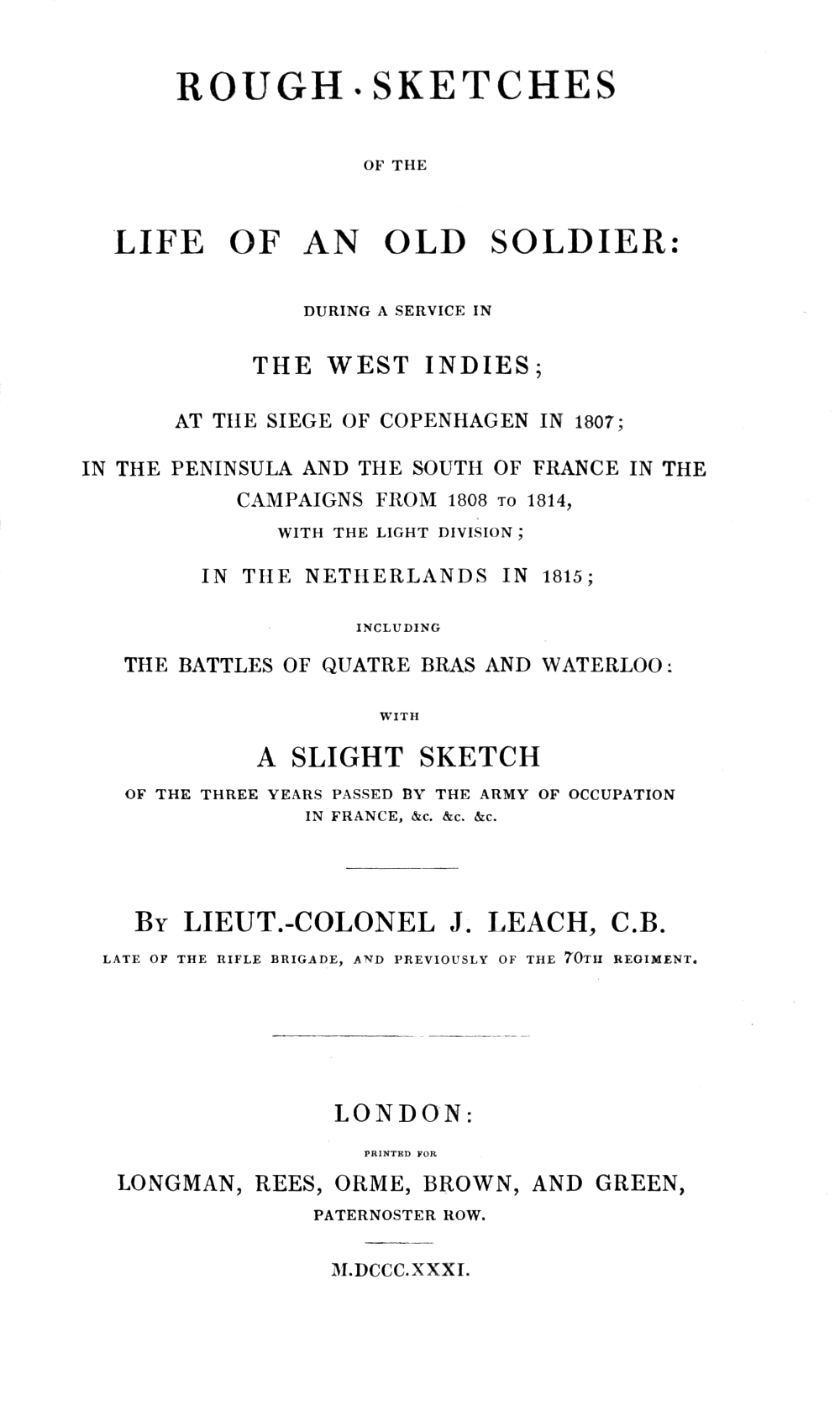
Footnotes have been collected at the end of each chapter, and are
linked for ease of reference.
Minor errors, attributable to the printer, have been corrected. Please
see the transcriber’s note at the end of this text
for details regarding the handling of any textual issues encountered
during its preparation.
The cover image was not available. The title page has been
used for that purpose.
Any corrections are indicated using an underline
highlight. Placing the cursor over the correction will produce the
original text in a small popup.
Any corrections are indicated as hyperlinks, which will navigate the
reader to the corresponding entry in the corrections table in the
note at the end of the text.
DURING A SERVICE IN
THE WEST INDIES;
AT THE SIEGE OF COPENHAGEN IN 1807;
IN THE PENINSULA AND THE SOUTH OF FRANCE IN THE
CAMPAIGNS FROM 1808 TO 1814,
WITH THE LIGHT DIVISION;
IN THE NETHERLANDS IN 1815;
INCLUDING
THE BATTLES OF QUATRE BRAS AND WATERLOO:
WITH
A SLIGHT SKETCH
OF THE THREE YEARS PASSED BY THE ARMY OF OCCUPATION
IN FRANCE, &c. &c. &c.
By LIEUT.-COLONEL J. LEACH, C.B.
LATE OF THE RIFLE BRIGADE, AND PREVIOUSLY OF THE 70TH REGIMENT.
LONDON:
PRINTED FOR
LONGMAN, REES, ORME, BROWN, AND GREEN,
PATERNOSTER ROW.
M.DCCC.XXXI.
TO
THE 70th REGIMENT,
AND
THE OLD 95th,
(NOW THE RIFLE BRIGADE),
IN WHICH TWO CORPS
I PASSED ONE AND TWENTY EVENTFUL YEARS,
THE FOLLOWING PAGES
Are Inscribed
BY THEIR OLD AND SINCERELY ATTACHED COMRADE,
J. LEACH.
PREFACE.
vii
As it is the fashion now-a-days for every one
to become an author, I see no reason why I
should not try my hand at it also, and let
my book run the same risk of being criticised,
lashed, and abused by the literati (if,
indeed, they deign to peruse it), as is every
day the case with some production or other,
and to which every one, who is bold enough
to make similar experiments, must make up
his mind.
Such as mine is, forth it goes to the
world; and it must be taken for better for
worse.
During many years of active service, I
kept a daily journal, in which I inserted
matters and things as they appeared to
me at the instant; and from which journals,
aided by a tolerably fair memory, and some old
notes and memoranda, the following pages
were put together in a rough state many
viiiyears ago, and may therefore, with great
propriety, be styled “Rough Sketches.”
I pretend not to any thing resembling
a history of the Peninsular War. A very
old Light Division comrade of mine, Colonel
Napier, has already done it in so masterly
a style, as to throw every other work on the
same subject comparatively into the shade.
The operations of the Light Division of
the Peninsular army I have detailed more
minutely than those of any other. That
division was, during a succession of campaigns,
much detached from the mass of
the army, having ample employment at the
outposts. But I have not omitted to mention,
also, the movements of other divisions,
whenever an opportunity offered for my becoming
acquainted with them.
It is unnecessary to remind my military
readers, that as I never, for one hour in my
whole life, held a staff appointment, but
always did duty with my regiment, it was
impossible that I could be acquainted, on
every occasion, with the general combined
movements of so large an army.
Those, however, who may have patience
ixto wade through my “Rough Sketches,” will
find in them a little about voyages, storms,
shipwrecks, yellow fevers, musquitos, sangaree
and sangarorum, sharks, dolphins, and
flying-fish; night marches and day marches,
camps and bivouacs, advances and retreats,
skirmishes, battles, and sieges; signoras,
waltzes, boleros, and fandangos; bull-fights,
wild boar shooting, wolves, and red deer;
British soldiers, and French, Spanish, and
Portuguese,—all of which I have endeavoured
to depict in their true colours.
If I have failed in my attempt, I am
sorry for it; but my regret will be infinitely
greater, if any of my brother-soldiers, whether
of the cavalry, infantry, artillery, or
engineers, either of the Peninsular army, or
of that which fought at Waterloo, should
accuse me of not having rendered due praise
to the conduct of their respective divisions,
brigades, or regiments, on particular occasions.
Let me again remind them, that I
was always regimentally employed; and
that if any such omissions exist in my book,
they are quite unintentional.
That they will be viewed in that light,
xby the liberal-minded, I entertain neither
fear nor doubt.
Forty-nine out of every fifty of the
scenes which I have here endeavoured to
describe, I was an eye-witness of; and, on
one or two occasions, when agues and fevers
placed me for a short period on the sick
list, the events which took place in the interim
I became acquainted with, by being
allowed to have access to the log-books of
some one or other of my brother-officers.
The thread of the narrative is therefore
unbroken.
Join my regiment in Jersey. Embark for England. Winter at Chatham. The 52d regiment made Light Infantry. New system of drill introduced. Encamp at Shorncliffe in Kent. French camp and flotilla at Boulogne. Invasion threatened, and precautions taken by Sir John Moore. The Duke of York reviews the troops at Shorncliffe. Sudden order for our regiment to embark for the West Indies. Unfortunate occurrence on the march from Shorncliffe to Portsmouth. Remarks thereon. Embark and sail for Barbadoes. Tremendous storm. Various occurrences on the voyage. Arrive at Barbadoes. First impressions as to climate, &c. Death of the Commander-in-Chief of the West Indies. We proceed to Antigua. The harbour and dock-yard. Disembark at midnight. Lose my baggage. Scarcity of fresh water in Antigua. The regiment suffers dreadfully from yellow fever. Its losses. Hurricane. Officers’ funerals. The military governor and his brigade-major die. A receipt for yellow fever. Dancing and other gaieties. Death of Sir William Myers, the new Commander-in-Chief in the West Indies. Terrible mortality in his family. Death of the new Governor of Antigua. Great mortality in the 96th regiment in Antigua. A French squadron. Dominica is attacked. The French are repulsed by the 46th regiment. We expect a xiivisit from the same squadron at Antigua. Preparations for its reception. We are reinforced. Long marches. Sudden death of several soldiers from excessive heat. The 68th regiment is sent to Antigua. Its immense losses by climate. Horse-races and balls at St. John’s. More funerals. Lord Nelson arrives in search of the French and Spanish squadrons. He returns to Europe. My health begins to suffer. A medical board orders me to Europe for its restoration. My own ideas as to slavery. Take my passage for Europe. Sail to Tortola. Large homeward-bound fleet. Dreadful gales and other mishaps on the voyage home. Anchor in Dublin Bay. Quarantine. Land at Dublin. Proceed to England.
Exchange into the 95th Rifle Corps. Expedition to Denmark. Sail to Elsineur. Imposing appearance of our numerous fleet. Scenery on the Danish and Swedish coasts. A party to Elsineur. Cronberg castle. Hamlet’s garden. Disorderly conduct of the Danes. Causes thereof. The army disembarks. The reserve commanded by Sir Arthur Wellesley. Advance towards Copenhagen. A sortie made by the garrison. Affairs between the Danish gun-boats and our advanced squadron. Ludicrous nocturnal affair at the outposts. The Danish pickets are driven in. The reserve is sent into the interior of the island of Zealand. Affair near Kioge with the Danish militia. A sortie from Copenhagen repulsed by Lieut. Light, of the 50th regiment. Bombardment of Copenhagen, and surrender of the Danish fleet and stores. Visit to the capital. Its deplorable appearance. The army re-embarks. List of Danish prizes. A large fleet of homeward-bound merchantmen joins us. We sail for England. A slight sketch of the xiiiDanes, and of the island of Zealand. Stormy passage to England.
Four companies of our 2d battalion embark. Sail to Cork, and join an expedition. Its destination. Boating excursions. The expedition sails. We anchor in Mondego Bay. Brigadier-General Fane’s brigade. The army disembarks in Portugal. Monks, friars, padres, and Portuguese females. March to Lavaos. Joined by troops under General Spencer. A present from the Portuguese junta. A Dutch concert. The army advances. Features of the country. Reach Lyria. Swiss deserters. Affair with the French near Obidos. Battle of Roleia. A close shave and a narrow escape. Lieutenant Cockrane. March to Lourinha. Reinforcements join the army from England. Battle of Vimiera. Sir H. Burrard arrives to take the command. A flag of truce. Convention of Cintra. Reflections thereon. Sir John Moore arrives. The British army encamps near Lisbon. Amity between the French and English soldiers in Lisbon. Lisbon. Its opera, &c. &c. An eccentric Highland chieftain. Fevers and agues; and by what means a person so afflicted may be rendered still more miserable.
The army under Sir John Moore leaves Lisbon. Marches to Salamanca. Sir John Hope joins Sir John Moore near Salamanca. Sir David Baird lands at Corunna. The whole army is concentrated. Affairs of cavalry. The army moves to attack Marshal Soult. Suddenly countermanded. Distribution of our first and second battalions. Gallant affair of cavalry near Mayorca. General Crawford’s light brigade destroys a bridge. The French endeavour to xivinterrupt them in their work. General Crawford marches to Benavente. Brilliant action of cavalry near Benavente. Two light brigades sent to Vigo. Their march thither, and embarkation. Cursory view of Sir John Moore’s retreat to Corunna, and his death. The army returns to England. Our third battalion is formed.
The Light Brigade composed of the 43d and 52d regiments of Light Infantry, and the 1st battalion 95th Rifle Corps. Embark for Lisbon under Brigadier-General Robert Crawford. Arrive at Lisbon. Proceed by water to Vallada. Santarem. Convents and nuns. March from Santarem to join Sir Arthur Wellesley. Sketch of the march. The Pass of Villa Velha, Castello Branco, Zarza Maior, Coria, Orapeza, &c. Extraordinary long march on 28th July, and want of water. We join the army at Talavera. Slight sketch of the field of action.
Scarcity of provisions. Horrid stench from the unburied bodies of men and horses. I lose my horse, and with him all my campaigning comforts. The British army marches on Orapeza to attack Soult. Conduct of General Cuesta at Talavera. The British army crosses the Tagus at Arzobispo. Desperate attack made by General Crawford’s troops on a herd of swine. How to dress pork in the most expeditious manner. The army retires towards Delatosa. General Crawford’s division proceeds to the bridge of Almaraz. Long and harassing marches thither. Parched peas and boiled wheat our food. A fortnight at Almaraz. Scanty diet of bran cakes and goat’s flesh, without salt. How to reduce a corpulent person. The army falls back to the southern frontier of Portugal, and is cantoned near the Guadiana. xvA short account of our retreat. Maravao. Castello de Vide. Jollification in the woods near it. Shooting party on the 1st of September. Portalegre. General Catline Crawford’s brigade. Aronches. General Crawford’s division reaches Campo Maior.
The country near Campo Maior, and the climate of Alemtejo. The army becomes very sickly. Fate of General Cuesta’sCuesta’s army after we parted company with it at Talavera. Various descriptions of field-sports near Campo Maior. How to keep off fevers, agues, &c. Shooting excursions in the forest of Albuquerque. Wild boars, wolves, and red deer. Bathing excursions of our battalion, and its march to and from the Caya. Destruction of hares, rabbits, and partridges. Riding down red-legged partridges. Lieut.-Colonel Sidney Beckwith’s system contrasted with that of many commanding officers of regiments. Rumours of the army being about to return to England. The army continues sickly. The army leaves its cantonments on the Guadiana, and proceeds to the northern frontier of Portugal. Our march to that point. Students and young padres at the University of Coimbra uselessly employed. Sketch of the country between Coimbra and Pinhel, and our march through it. The 95th Rifle Corps and 1st German Hussars cross the Coa, and take up the outposts. The manner in which we passed our time in the outlandish regions between the Coa and Agueda, until the campaign of 1810 opened. Various amusements for the soldiers encouraged by Lieut.-Colonel Beckwith.
A skirmish with the French near Barba del Puerco. The whole of our battalion moves up to the Agueda, and occupies an xviextended line of posts. Massacre of a French soldier by some Spanish shepherds, near Almofala. Night attack made on four companies of our battalion at the pass of Barba del Puerco. The enemy is repulsed with loss. Observations. Letter from Lord Wellington to Colonel Beckwith, expressing his approbation of the conduct of his corps on the occasion. General Crawford also thanks the regiment in orders. The French force at San Felices reinforced from Salamanca. Character of General Loison. General Crawford withdraws the troops from Barba del Puerco. We occupy Villa de Ciervo. Our ten companies reduced to eight, and some officers sent to England to recruit. Fine specimens of crystal found near Villa de Ciervo. My establishment is augmented by a young wolf. Two Portuguese light battalions join General Crawford. We are reinforced also by a troop of horse artillery, the 14th and 16th Light Dragoons. Extensive line of posts guarded by General Crawford’s corps. A large army under Marshal Massena assembles near Ciudad Rodrigo, intended to invade Portugal. The three different corps which composed it. By whom commanded. Massena’s proclamation to the Portuguese. He lays siege to Rodrigo. The Light Division watch him closely, and are constantly getting under arms from various causes. Invidious feeling of certain persons in the army towards the Light Division. The French batteries open on Rodrigo. Their cavalry drive our pickets over the Azarva. Prognostications of some wiseacres in the army that the siege of Rodrigo would be raised by Lord Wellington. General Junot crosses the Azarva to reconnoiter our force. Captain Krauchenberg, of the 1st German Hussars, distinguishes himself. General Crawford retires across the Duas Casas, and takes up a position behind the Touron. General Junot’s cautious manner of advancing. Query: Why did Massena never attempt to cut off the Light Division from xviithe Coa with his numerous cavalry? Rodrigo surrenders to the French. General Crawford surprises a French detachment. Colonel Talbot, of the 14th Light Dragoons, killed. Gallantry of his regiment. Exemplary conduct of the French infantry in square. Observations.
General Crawford falls back to Junsa, on the Coa. The French advance. Fort Conception is destroyed by mines. Action of the Coa, 24th July, 1810. Major M’Leod of the 43d regt. French grenadiers storm the bridge, and are destroyed. General Crawford retires at night to Valverde. Reflections on the events of the day. We march to Celerico, and make huts near the town. The Light Division is divided into two brigades. Massena besieges Almeida. The Light Division moves up to support the cavalry. The powder magazine in Almeida explodes and destroys the town. The garrison capitulates. Affair between our cavalry and the French near Freixadas. The army retires towards Coimbra. Excursion to the summit of a mountain to see a lake. Discussion with a padre as to the qualities attributed to its waters. We continue the retreat. The Light Division arrives at Mortagoa. Affair of cavalry. We fall back on Buzaco, engaged with the French advanced guard. Sketch of the position.
Battle of Buzaco. Flag of truce. General Simon’s baggage brought in. Wounded of the two armies removed from the field. Terrible carnage in and near Sula. The light troops constantly engaged. Deserters come over to us. Their reports of Massena’s intentions. The French army breaks up, and marches away to our left. Lord Wellington retires xviiifrom Buzaco to the lines of Torres Vedras. Occurrences on the march. Stores destroyed at Pombal. King John’s coffin in the cathedral at Battalha. Affair between our rear-guard and the French advanced guard. Our habitation takes fire, and we are nearly burnt out of it,—horses, mules, donkeys, and baggage. Affair of cavalry near Alcoentre. Speculations on Massena not having pursued us more vigorously in the retreat. The Light Division reaches Alemquer. The French turn us out of it without our dinners. We retire to Arruda in bad humour and in dreadful weather. An agreeable surprise. A word or two relative to the lines of Torres Vedras. Gun-boats on the Tagus. Jack Tar’s zeal. Great sufferings of the Portuguese from the French invasion. Reconnoissances made by Massena, and skirmishes brought on by it. Sharp affair between Sir Brent Spencer’s division and the enemy. Scarcity of provisions in the country in our front. Our employments whilst we remained in the lines. The French army falls back to a position behind the Rio Maior. Sentries of straw. We march in pursuit, and take some prisoners. Dead Frenchmen, horses, mules, and donkeys, on the road-side. The Light Division comes up with the enemy near Cartaxo. We are preparing to attack, when Lord Wellington arrives and countermands it. Causes thereof. The French retire across the Rio Maior. Rough sketch of their position. General Hill crosses the Tagus. The Light Division bivouac in a pine-wood. Washed out of a water-course by the rain. Lord Wellington makes demonstrations against the French position. The Light Division engaged with the enemy’s light troops on the left. The troops are withdrawn.
The Light Division holds the outposts at the bridge of Santarem. General Junot wounded near Rio Maior. The allied army xixis put into cantonments. How we passed the winter. Sufferings of the French army from want of provisions and forage. They are harassed by the armed peasantry and militia. Shooting and coursing parties close to the French videttes. Their courteous conduct on those occasions towards us. Anecdote of a dragoon and his cloak. Burlesque on horse-racing in the cantonments of the Light Division. Flags of truce. Conversation with French officers at the bridge of Santarem. Theatrical performances. The Marquis de la Romana dies. The Duke of Brunswick’s corps joins the Light Division. They desert by wholesale to the French. Several are shot by sentence of a court-martial. The corps is sent out of the Light Division. Lord Wellington contemplates relieving the Light Division for a time at the outposts, to give the men rest. This is not carried into effect. Some regiments join the army from England. The 7th division of infantry is formed. I go with a brother-officer on a frolic to Lisbon for five days. Return to our old post at the bridge. Lieutenant Strenowitz, of the 1st German Hussars, surprises a French cavalry post. Marshal Mortier defeats a Spanish army near Badajoz, and lays siege to the place. Massena commences his retreat out of Portugal. State of Santarem. The 1st battalion 95th Riflemen drives the French from a village. The Light Division and cavalry come up with the French near Pombal. The castle is attacked. Action near Redinha. Reach Condeixa. The Portuguese militia gain possession of Coimbra. Massena changes his line of retreat. Lord Wellington attacks Marshal Ney. He falls back to Miranda de Corvo. Conduct of the French army during the retreat. The French leave numbers of baggage-animals on the road much lacerated. The Light Division finds the enemy on the Ceira. Action near Foz d’Aroce. Remarks. The army out-marches the commissariat. Major Stewart of the 95th Rifle corps. His character. xxLord Wellington crosses the Alva. Massena retreats towards Celerico. Affair near Freixadas. The 95th loses its adjutant. His character. The army marches on Guarda. Massena falls back behind the Coa. Action near Sabugal. Colonel Beckwith.
The French army re-enters Spain. They leave a garrison in Almeida, which is blockaded. The Light Division and 1st German Hussars take up their original line of posts. Skirmishes at Marialva bridge. Some companies of our corps are sent to shoot the cattle at Almeida. Massena assembles his army to relieve Almeida. The Light Division and 1st German Hussars fall back and join the army in position, near Fuentes d’Onoro. Battle of Fuentes d’Onoro. Flag of truce in the evening. The wounded removed. Conversation with some French officers. A sprig of nobility in the French army at the head of one of their Hussar regiments. Colonel Beckwith’s brigade occupies Fuentes d’Onoro for the night. Precautions for its defence. The hostile armies remain close to each other for many days. Waggon-loads of wounded Frenchmen sent to Rodrigo. Marshal Marmont arrives from France. Assumes the command of the army in our front, and supersedes Massena. He inspects the infantry of the Imperial Guard within view of our position. The French army retires behind the Agueda. We resume our original line of outposts. Almeida is blown up, and the garrison escape. Marmont sends a cavalry force to reconnoiter Colonel Beckwith’s brigade. We send them back faster than they advanced. Intelligence reaches us of the battle of Albuera. We celebrate the king’s birth-day. Sudden order to march in the midst of our festivity. Affair between the 1st Royal Dragoons and the xxiFrench cavalry. We march into Alemtejo. A few lines relative to the march thither. Encamp on the Caya. Gallant but unsuccessful attempts against Fort San Christoval. The army offers battle to the united armies of Soult and Marmont. They decline the challenge, and fall back to Seville and Placentia. Terrible sickness in our army. Action of cavalry near Campo Maior. Fort La Lippe. I receive a present from a Portuguese don. Starved state of our horses. The army marches back to the northern frontier of Portugal. A bee-hive captured. Staff characters.
The Light Division crosses the Agueda. Lord Wellington reconnoiters Rodrigo. Don Julian Sanchez. The French governor taken prisoner by Guerillas. A picket of our light cavalry made prisoners in the Sierra de Gata. The Light Division reinforced by the third battalion of the 95th Rifle corps from Cadiz. Deaths by Alemtejo fever. I cross the mountains with my own company and one of Portuguese. Wild scenery. Goatherds. Their dress, language, and habitations. Rejoin the Light Division. Marmont advances to Rodrigo. The Light Division in position on the Vadillo. Gallant conduct of General Colville’s brigade. The Light Division joins the 3d and 4th near Guinaldo. The army falls back to Aldea de Ponte. The Light Division engaged with the French cavalry and dismounted chasseurs. Brilliant charge of the Fusileer brigade. General Picton’s light troops engaged. The army retires to Soita. Marmont follows the allied army no further, and falls back to Placentia. Our army goes into cantonments. Comparative merits of Spanish and English greyhounds. A new governor arrives at Rodrigo. Winter quarters in Spanish villages. Libraries not in vogue. An essay on cigars, and their utility xxiiin campaigning. A party made to shoot wild deer. General Hill surprises a French division. A shooting party in the mountains. Boleros, fandangos, and Irish jigs. Capital sport with the woodcocks. A good dancer and a particularly bad shot. Excursion to Robadillia. Just punishment inflicted on a demi-brigade of padres. The Light Division invests and lays siege to Ciudad Rodrigo. Redoubt of San Francisco stormed and taken. The siege and storming of Rodrigo. Death of Generals Crawford and M’Kinnon. Remarks on the defence made by the French governor. Contrast between the siege of 1810 and that of 1812. The army marches to the southward and besieges Badajoz. Difficulty of keeping our horses alive during the march. Siege of Badajoz. Storming of the place.
Marmont penetrates into Portugal during the siege. Lord Wellington marches back to the north. General Alten appointed to command the Light Division. The army advances to Salamanca. Takes up a position. Marmont’s army opposite. A fortified convent in Salamanca is besieged by the 6th Division. It is set fire to, and the garrison capitulates. Marmont retreats behind the Douro. We follow him. A dance at Navis del Rey. Arrive at Rueda. Wine vaults. French soldiers assassinated by the Spaniards. Marmont is reinforced. The Light Division falls back to Castrejon. The French cross the Douro. Attack the troops at Castrejon. We fall back behind the Guarena, closely followed by Marmont. Beautiful evolutions of the two armies. The 27th and 40th regiments repulse the French with loss. Deaths from want of water and excessive heat. British six-pounders and French nines, with their respective advanced guards. Observations on the fire-arms of French xxiiiand British dragoons. The two armies march within cannon-shot of each other for several days in succession. The Light Division crosses the Tormes, by a ford at night, in a tremendous thunder-storm. Battle of Salamanca. Marmont’s promises to the Spaniards of destroying Lord Wellington’s army not fulfilled. Opinions of certain British officers in the Portuguese army, as to the comparative merits of Portuguese, British, and French soldiers. Gallant attack of General Bock’s cavalry brigade on the French rear-guard. We pursue the French many days. Various reports of Marmont’s death. Corpse of the French General Ferez dug up and exposed to view by the Spaniards. We cross the Douro. Valladolid. Mode adopted of raising the wind to purchase bread, &c. The army marches on Madrid. Segovia. A beautiful Castilian. Palaces of El Rio Frio and San Ildefonso. Pass the Guadaramma mountains. Encamp in the park of the Escurial. The palace. Affair between some Portuguese and French cavalry. The army enters Madrid. Its reception. French garrison in the Retiro capitulates. A word or two about the capital. Its palace, streets, public walks, Castilian women, &c. Pheasant-shooting in Joseph Bonaparte’s park. A grand ball. A bull-fight. Extravagant fondness of the Spaniards of both sexes for this amusement. Four divisions march to Burgos, and lay siege to the castle. Soult raises the siege of Cadiz and marches on Madrid. General Hill and Colonel Skerrit join the troops at Madrid. Colonel Skerrit repulses Soult’s advanced guard at the bridge of Aranjuez. The Light Division marches to the front from Madrid. Soult passes the Tagus. We bid adieu, with great regret, to Madrid.
Commence the retreat to Salamanca. A wild boar killed. The armies from Burgos and Madrid unite near Salamanca. xxivThe army retreats to the Agueda. Sketch of the retreat. Rations of acorns and oak-leaves for man and horse. The Light Division engaged at San Munos. General Paget taken prisoner. We arrive at Rodrigo. The campaign of 1812 concludes. A few lines relative to it. We go into winter-quarters. Establish a regimental mess in an old barn. A supply of Douro wine. Vocal performers. Circular letter to officers commanding regiments, relative to the late retreat. The Light Division establish theatrical performances. Lydia Languish and Julia drink punch and smoke cigars behind the scenes. Coursing, woodcock-shooting, and Lord Wellington’s fox-hounds. Boleros, fandangos, waltzes, &c. &c. in our village. Hot punch by no means disapproved of by our fair partners. Lord Wellington proceeds to Cadiz for a short time. The French general Foy makes an attempt to surprise General Hill’s advanced post at Bejar, and is repulsed. General Kempt is appointed to command a brigade in the Light Division. Preparations for the campaign of 1813. Lord Wellington reviews the Light Division and 1st German Hussars. The Hussar Brigade, the Life Guards, and Blues, join the army, from England. The eight divisions of infantry, and by whom commanded.
The campaign of 1813 opens. The 2d and Light Divisions march on Salamanca. Sir Thomas Graham, with the six other divisions, crosses the Douro. He advances to the Esla and crosses it. The Light Division encamps at San Munos. Contrast between our situation then with that of the 17th of November, 1812, on the same spot. We reach the Tormes. The French retire from Salamanca, and are pursued towards the Douro. They suffer from our horse artillery and cavalry. The Light Division crosses the xxvDouro at Toro. Brilliant affair of cavalry, wherein the Hussar brigade distinguishes itself. We follow the French to Palencia, and from thence to Burgos. The French blow up the castle of Burgos, and retreat behind the Ebro. We pass the Ebro at Puente Arena. Magnificent scenery. Appearance of the troops descending the pass. Language, dress, and appearance of the people northward of the Ebro. Beautiful scenery at every step. The Light Division surprises a French division near St. Millan. The French army assembles near Vittoria. Sale by auction in the camp of the Light Division. Ladies’ dresses, &c. &c.
Battle of Vittoria. The Light Division and some cavalry pursue the French rear-guard on the road to Pampeluna. Engaged with them several days. Two French ladies restored to their husbands. Baron Alten directs the movements of the advanced guard with great judgment and effect. We take the last piece of artillery but one in possession of the French rear-guard. The country between Salvaterra and Pampeluna favourable for a retreating army. Reflections on approaching the Pyrenees. Lord Wellington marches with the 3d, 4th, and Light Divisions against General Clausel. A Spanish priest apprises that general of our movements, and mars our plans. Our benedictions on the said padre. We return to Pampeluna, and assist in the blockade. March into the Pyrenees. Splendid scenery. Sir Rowland Hill’s corps engaged in the passes. Vale of San Estevan. A week spent there. Dress, language, &c. of the Spanish Basques. Trout-fishing on the Bidassoa. The Light Division advances to Vera. Drives the French out of it into the pass. The first view of the ocean for four years. Cheers of the soldiers on seeing it. Rough sketch of the position of our army in xxvithe Pyrenees. Quadrilles danced by our French neighbours in their encampment opposite to us. Sir Thomas Graham besieges St. Sebastian. The French entrench themselves in our front. An attempt to storm St. Sebastian fails. Marshal Soult attacks our right wing. It falls back towards Pampeluna. Defeats the French, and drives them again into France, with great slaughter. The 7th and Light Divisions fall back from Vera and Echelar. Soult’s proclamation to his army before he attacked the allies in the Pyrenees. The Light Division makes forced marches to reach the bridge of Yanci. The Riflemen inflict a severe loss on the retreating columns of the French. General Kempt’s brigade drives the enemy from a high mountain into France. Gallant attack made by General Barnes’ brigade. The hostile armies occupy their former positions.
We celebrate the anniversary of the formation of our corps. St. Sebastian is stormed and taken. The French pass the Bidassoa near Vera. Part of the Light Division engaged in that town. The French attack the Spaniards, and are repulsed. They retreat to the Bidassoa, and force the bridge of Vera at night. Movements of the Light Division on this occasion. Lord Aylmer’s brigade joins the army from England. The left wing of the army passes the Bidassoa. The Light Division and Spaniards storm the entrenchments in the pass of Vera. Gallantry of Lieut.-Colonel Colbourne’s brigade. A French gun-brig destroyed by British cruisers, in sight of both armies. Horrible weather in our mountain encampment. Tents continually blown down. Violent snow-storm. Two Portuguese soldiers of the pickets die from cold. Pampeluna surrenders. The xxviiarmy invades France. Battle of the Nivelle. Approach Bayonne. French entrenched camp. Position of the allied army. Soult reconnoiters our line of pickets. Skirmishes. The Light Division drives back the French advanced posts in its front.
Sir Rowland Hill passes the Nive. Battles of the Nive. The French are beaten in every attempt against us. We dance-in the New-year of 1814 at Arcanguez. Reflections on the past and present situations of the two armies. Soult manœuvres near Dax. We take the field for a few days in very inclement weather. Return to cantonments. Heavy fall of snow in the Pyrenees. Capital woodcock shooting. The army moves to its right. Our battalion marches to St. Jean de Luz for its new clothing. Sir John Hope blockades Bayonne. He passes the Adour. The Guards repulse a sortie from the garrison. We march from St. Jean de Luz to rejoin the army. Orthes. Handsome peasantry. We rejoin the Light Division. Soult makes demonstrations against Sir Rowland Hill’s corps. The 15th Hussars attack a French cavalry post and take some prisoners. The 7th Division is detached to Bourdeaux. Lord Wellington marches on Tarbes. Affair near Vic Bigorre. Action near Tarbes. The French retreat towards Toulouse. We follow them. A pontoon-bridge is established below Toulouse. The army crosses.
Battle of Toulouse. The French retreat to Carcassone. The allied army enters Toulouse. Despatches reach Lord Wellington from Paris relative to Bonaparte’s abdication, and his xxviiideparture for Elba. He transmits this information to Soult, who declines a cessation of hostilities. We march from Toulouse towards Carcassone. Count Gazan meets us with a flag of truce. Soult acknowledges the new order of things. Hostilities cease. The dismay of fire-eaters at the termination of the war in the Peninsula and south of France. Sortie of the French garrison from Bayonne. Some regiments embark at Bourdeaux for America. Five weeks at Castel Sarrazin. Soult’s army reviewed at Montauban by the Duke d’Angoulême. We march to Bourdeaux. Take leave of our Portuguese allies. The parting. Arrive at Bourdeaux. Lord Wellington reviews the 43d, 52d, and 95th regiments. We embark for England.
Embark for Ostend. Proceed to Brussels. We are appointed to Sir Thomas Picton’s division. Battle of Quatre Bras. Ligny. Predictions and foretellings after things have occurred, no uncommon practice. Fire-side tacticians and critics. The army falls back from Quatre Bras to Waterloo. The cavalry are engaged.
Sketch of the battle of Waterloo, but more particularly of the operations of Sir Thomas Picton’s division. Death of Sir Thomas Picton. The 27th regiment. Advance of the Prussians. General attack on the French position, and their total defeat and route. The morning after the battle.
March to Paris. Cambray is taken by escalade. Letters from Highlanders to their friends in the North. Half a dozen xxixlines only relative to Paris. Another half dozen as to the three years spent by the army of occupation in the north of France. On the distribution of medals. The army evacuates France, and is dispersed all over the globe. Reflections on this breaking up of old friends and comrades. A campaign amongst the Glasgow radicals. Proceed to Ireland. Guarding jails, hunting stills and White Boys. A few words at parting with my military friends.
Join my regiment in Jersey. Embark for England. Winter
at Chatham. The 52d regiment made Light Infantry. New
system of drill introduced. Encamp at Shorncliffe in Kent.
French camp and flotilla at Boulogne. Invasion threatened
and precautions taken by Sir John Moore. The Duke of
York reviews the troops at Shorncliffe. Sudden order for
our regiment to embark for the West Indies. Unfortunate
occurrence on the march from Shorncliffe to Portsmouth.
Remarks thereon. Embark and sail for Barbadoes. Tremendous
storm. Various occurrences on the voyage. Arrive
at Barbadoes. First impressions as to climate, &c. Death
of the Commander-in-Chief of the West Indies. We proceed
to Antigua. The harbour and dock-yard. Disembark
at midnight. Lose my baggage. Scarcity of fresh water in
Antigua. The regiment suffers dreadfully from yellow fever.
Its losses. Hurricane. Officers’ funerals. The military
governor and his brigade-major die. A receipt for yellow
fever. Dancing and other gaieties. Death of Sir William
Myers, the new Commander-in-Chief in the West Indies.
Terrible mortality in his family. Death of the new Governor
2of Antigua. Great mortality in the 96th regiment in Antigua.
A French squadron. Dominica is attacked. The
French are repulsed by the 46th regiment. We expect a
visit from the same squadron at Antigua. Preparations for
its reception. We are reinforced. Long marches. Sudden
death of several soldiers from excessive heat. The 68th
regiment is sent to Antigua. Its immense losses by climate.
Horse-races and balls at St. John’s. More funerals. Lord
Nelson arrives in search of the French and Spanish squadrons.
He returns to Europe. My health begins to suffer.
A medical board orders me to Europe for its restoration.
My own ideas as to slavery. Take my passage for Europe.
Sail to Tortola. Large homeward-bound fleet. Dreadful
gales, and other mishaps on the voyage home. Anchor in
Dublin Bay. Quarantine. Land at Dublin. Proceed to
England.
The same year in which the British army gained
never-fading laurels in Egypt, I obtained a commission
in the 70th regiment, and shortly after
seeing my name in the Gazette, was ordered to
join in the island of Jersey. I felt that delight
which I fancy is experienced by most youngsters,
on making an escape from school, putting on a
scarlet coat, epaulet, cocked hat, and a tremendously
long feather, to say nothing of the false
queue affixed to a head of hair plastered with
pomatum and well powdered (the custom of those
days), together with sundry et ceteras too well
known to military men to need a further detail.
The regiment had recently returned from service
in the colonies; the officers in general were
3very young; and the soldiers, with the exception
of a small number of old hands, were recruits,
and on the whole a very fine body of men.
Jersey is rather better known than either the
interior of Africa, or New Holland. A description
of it would, therefore, be superfluous. During
the eleven months which I spent in it, I made a
tour round the island with some of my brother-officers,
and we had every reason to be satisfied
with our excursion. The roads, at the time I
mention, scarcely deserved that name; but I
understand that very excellent ones have been
since made, in various directions.
Towards the end of October, 1802, the 3d
regiment, or Buffs, arrived from England to relieve
us, and we sailed in ships of war to Deal, where
we disembarked, and marched to Dover Castle,
in which we remained three weeks, and from
thence proceeded to Chatham. The garrison consisted
of my own regiment, the Royal Staff corps,
and the first and second battalions of the 52d
regiment. Sir John Moore commanded here.
To the winter which we passed in Chatham,
with little to vary the scene except dock-yard
guards, main guards, and sundry other guards, on
which I constantly found myself posted, I do not
look back with any particularly pleasurable recollections.
In the early part of the spring of 1803, Sir
4John Moore picked and culled the finest and most
effective men of the two battalions of the 52d
regiment, the first of which Lieutenant-Colonel
Kenneth M’Kenzie was appointed to command,
and to organise as Light Infantry. The second
battalion was then gazetted as the 96th regiment,
and almost immediately afterwards sent to Ireland,
under the command of Lieutenant-Colonel
Conran.
The new system of drill which Lieutenant
Colonel M’Kenzie introduced at this period, and
which has been adopted by other light infantry
regiments, it will scarcely be denied by the most
prejudiced persons, has been attended with the
most complete success. I allude to the ease and
correctness with which the regiments drilled according
to that system marched and manœuvred
ever after.
In the month of June, 1803, we found ourselves
encamped on the heights of Shorncliffe, in Kent,
under Sir John Moore’s command, the following
regiments composing the brigade: the 4th or
King’s Own, the 52d Light Infantry, the 59th,
the 70th, and five companies of the 95th Rifle
Corps, with two pieces of light artillery. Every
one knows, or ought to know, that at this time
Bonaparte threatened our shores with a visit from
his numerous army and flotilla, which were in
and about Boulogne. We had no difficulty in
5seeing the immense mass of white tents on the
French coast, when the day happened to be clear.
Whether Sir John Moore entertained the same
apprehension of invasion which the majority of
the nation did, it is not for me to decide; but
certain it is that every precaution was taken at
night, by patrolling constantly along the beach
until morning,—and by having the quarter and
rear guards under arms one hour before day-break,
and remaining so until we could clearly ascertain
that our French neighbours had not ventured on
the high seas with their flotilla. We were constantly
practised to strike and pack our tents at
the shortest notice, and occasionally to load the
bât horses with them, and to make every preparation
for a march. Thus passed the summer
and autumn. The Duke of York reviewed the
brigade on the heights of Shorncliffe in the course
of the summer.
Towards the end of October, a sudden, and,
on our part, unexpected order arrived for our regiment
to march immediately to Portsmouth, to embark
for the West Indies. This intelligence caused
some long faces among a few of our old hands
who had previously served in that part of the
world; but the greater part of us being young and
thoughtless, the order for moving, being a novelty,
was received with pleasure rather than dislike.
We reached Portsmouth early in November,
6but not without an occurrence having taken
place on the march thither, which I have never
forgotten. We halted one night at Battle, in
Sussex. Some time after midnight, the officers
were called out of their beds in consequence of
an affray between some of our soldiers and a party
of artillerymen; but before we could reach the
small public-house in which the disturbance had
arisen, most unfortunately two artillerymen were
shot by our people, and another was bayoneted
in the body. A corporal and two soldiers,
who had committed this act, were left in the hands
of the civil power. They were subsequently tried
and acquitted; it having been proved that they
used their muskets and bayonets in defence of their
lives, which must have been sacrificed had they
not done so, as the artillerymen, in great numbers,
attacked them with bludgeons, and had already
broken open the door of the public-house in which
they were billeted. The three men in question
joined us in the West Indies twelve months after.
Some dispute as to the respective merits or demerits
of certain regiments, led to this unhappy
affair. A more dangerous subject cannot possibly
be agitated by any military men, from the drum-boy
to the commandant of a regiment. No man
is worthy to wear the uniform of his corps,
be that corps what it may, who is not as tenacious
of its good name as of his own individual
7character, and as ready to stand forward in its
defence.
Early in November we embarked at Portsmouth
in the Pandour (an old Dutch-built tub of
a 44, armed en flute, and fitted up as a troop ship)
and in the Comet transport. The Alexander
transport also sailed under our convoy, taking out
detachments for different regiments in the West
Indies. A few days after our departure from
Portsmouth, we encountered, in the skirts of the
Bay of Biscay, a most tremendous gale, which
lasted without intermission three days and nights,
during the greater part of which the helm was
lashed down; every stitch of canvass which we
attempted to carry was torn to atoms in an instant—the
pumps were choked—several feet of water
were in the hold—and we had an accumulation of
other nautical grievances and disasters, so numerous
as to baffle a landsman’s description of them.
On the morning of the fourth day the gale abated
considerably, and land was discovered; but, as
no observation had been taken for several days, it
seemed a matter of doubt what land it was. It
proved to be the Start, or the Bolt, or one of the
other iron-bound headlands eastward of Plymouth.
The wind having come fair, we stood on again for
the West Indies, although our commodore had it in
contemplation, at one time, to put into Plymouth,
and repair the damages sustained in the late gale.
8Who does not know, that on reaching certain
latitudes, one falls in with sharks, dolphins, flying
fish, and various other kinds both of fish and birds,
not found in the colder regions? I used to sit
hour after hour endeavouring to harpoon the dolphins
and other large fish, but generally with indifferent
success. Somewhere between Madeira
and Barbadoes we caught a large shark, to the
infinite delight of myself and the other youngsters
who had never previously navigated those seas.
The operation of ducking, shaving, &c. &c., so
scrupulously observed by the sailors in passing
the tropical line, we avoided, by a liberal donation
of rum to the sea-god.
In the course of the voyage, the old Pandour
chased, brought to, and examined several vessels,
all which proved to be Portuguese. One of them
was a large and beautiful ship, bound from Lisbon
to the Brazils, which, on first discovering her, was
pronounced by our naval men to be a frigate.
Our ship was cleared for action; the grenadier
company was posted on the forecastle, and the
light company on the poop; the remaining
companies were ordered below, until they should
be called up to board our supposed antagonist;
but, after a chase of many hours, she turned out
to be a neutral, and all our golden dreams of
prize-money vanished in an instant.
Once fairly in the trade winds, we glided
9smoothly along day after day, at six, seven, and
eight knots an hour; nor did any thing occur worthy
of notice until two or three days before arriving at
Barbadoes, when a suspicious-looking, schooner-rigged
vessel was discovered far to windward, on
which our little convoy closed, by signal, to the commodore.
The schooner followed many hours in the
wake of the Pandour, but with a certain degree
of caution. We had been running the whole day
directly before the wind, and our commodore,
getting tired, at last, of having this wasp of a
vessel hovering about him, without being able to
shake her off, or to put his paw on her, suddenly
hauled the Pandour to the wind, as near as she
could lay, which manœuvre the schooner performed
as rapidly as ourselves, flew away into
the wind’s eye, soon distanced us, and put all
chance of coming up with her out of the bounds of
possibility, unless we might, by some good chance,
injure her masts or rigging by our fire, which we
kept up as long as any chance remained of its
being effectual; but, as she outsailed us, we soon
gave up the chase, and stood on our original course.
All this was quite new, and very interesting to the
fresh-water sailors on board.
After a six weeks’ voyage from Portsmouth,
we anchored on Christmas-day in Carlisle Bay,
Barbadoes. The sky was cloudless, and the
heat sufficiently intense to satisfy a salamander.
10We could scarcely, at first, be reconciled to the
idea of its being Christmas, with such a blazing
sun over our heads; every tree and plant seen
on the island being as green as we have them
in England at Midsummer; and, above all, the
total absence of snow, frost, and the dark and
lowering clouds emblematic of that season in
Europe. The Commander-in-Chief of the Windward
and Leeward Islands, General Greenfield,
died whilst we were on our passage out.
During the few days which we passed at
anchor in Carlisle Bay, parties of our officers
went ashore at Bridgetown, where we were
hospitably entertained at the mess of the 64th
regiment. Between the noise of lizards, musquitoes,
and other tormenting devils, which sing
and bite throughout the night, and unite all their
efforts to destroy one’s slumbers, I got but a
small allowance of sleep, in spite of the liberal
potation of old Madeira imbibed at the 64th
mess. I may here remark, that during the whole
of my stay in the West Indies, I suffered less
than the generality of my brother-officers from
the bites of musquitoes, although their eternal
singing has tired my patience many a night.
Every thing which met the eye on our landing
was, of course, quite new, and, for a time, interesting
to the Johnny Newcombes of the regiment;
but the novelty soon wore off, and I
11cannot say that any thing I saw, with the exception
of the fine, bold, and striking scenery
which many of the West India Islands present
in passing them at sea, (or, in the nautical
phrase, running down the islands), excited much
interest in my mind. The 87th regiment, which
was stationed at St. Kitt’s, was ordered home on
our arrival.
We sailed from Barbadoes about the 28th
or 29th of December, and on the evening of the
31st anchored in English Harbour, in the island
of Antigua. Entering this harbour from the
ocean, by an extremely narrow and rocky passage,
the effect is quite magical, as you instantaneously
find your ship in a calm and well-sheltered
basin, surrounded by high, rocky hills,
studded in various parts with the houses and
wigwams of the blacks and coloured people.
The king’s dock-yard is at the inner extremity
of the basin. Soon after midnight we commenced
disembarking in the dock-yard, from
whence we marched to the Ridge and Shirly
Heights Barracks, which we reached soon after
day-break on the 1st of January, 1804. We
relieved a detachment of the 64th regiment,
which embarked a few days afterwards for Barbadoes.
By the negligence of the guard left in
charge of the baggage at the dock-yard, or by
some other mishap, I lost every article of my
12baggage except one portmanteau. Few subalterns
possessed a better kit than that which I
lost on this occasion; but I never could gain
any intelligence of it, nor was any remuneration
allowed me to replace it. This was an inauspicious
commencement in such a climate, where
an abundance of linen and wearing apparel is
so desirable.
It is singular that in the island of Antigua
there is not one spring of fresh water. Consequently
the inhabitants are dependent for their
supply of this necessary article on the rains,
which fall at certain periods in torrents, and are
caught in tanks, with which the barracks, as well
as the generality of the better class of houses,
are provided. From January until June 1804,
scarcely a drop of rain fell; so that for many
weeks we were on an extremely small allowance
of water. Even this would have been still more
limited, had not several sloops been constantly
employed, during this drought, in bringing barrels
of water from the neighbouring island of Montserrat,
and thereby replenishing the tanks. Although
the members of the corps to which I had
the honour to belong, were by no means addicted
to the use of water as a beverage, we nevertheless
suffered severely from its scarcity.
During the first five months after our arrival,
the regiment continued comparatively healthy;
13but in the month of June we were suddenly
visited with an attack of yellow fever, that eternal
curse and scourge of Europeans, which in a
few days filled the hospitals to such an excess
as has, perhaps, never been exceeded in any
regiment, and but rarely equalled. Between
the months of June and October we buried two-thirds
of the officers who came out with the
regiment from England, six of whom were captains.
The ravages occasioned by this infernal
pestilence amongst the soldiers, their wives, and
children, bore a full proportion to that of the
officers; nor did there appear any symptom of
the fever subsiding, until the islands were visited,
in the month of October, by one of the most
violent hurricanes which had been experienced
for many years. Intermitting fevers and agues
now took the place of the yellow fever, which
seemed to have nearly expended its fury. In
short, by the end of 1804, the regiment was a
perfect skeleton, and could with great difficulty
furnish men to perform the regimental duties.
We buried also, at this period, the military
governor, General Dunlop, and his brigade-major,
Captain Vans, both of whom came out with us
from England in the Pandour. The deaths were
so frequent, that General Dunlop directed the
procession and forms usually observed at military
funerals to be discontinued, and that the
14coffins of officers deceased should be carried to
the grave on the shoulders of the soldiers,
without band or drums, and without a party to
fire over them. This I have ever thought a most
prudent order; for what can so much tend to
depress the spirits as the constant recurrence of
that imposing ceremony. The general expressed
a wish that, in the event of his own death, he
should be buried precisely in a similar manner.
This order was obeyed to the letter; and both
he and his brigade-major, who died within a few
days of each other, were taken to their graves in
a light waggon, attended by the few of our officers
and soldiers who were able to do duty, and by
a small party of artillerymen.
As a proof that this dreadful fever visits
Europeans newly arrived with tenfold virulence,
the three companies of the 37th regiment, in
garrison with us at this time, had not more than
two or three men in hospital, whilst our men
were dying at the rate of eight and ten daily.
The 37th had been several years in Trinidad and
other islands, and were seasoned to the climate.
In 1805, the survivors amongst us were, in some
measure, seasoned, and the deaths consequently
were not so frequent.
For the benefit and edification of the faculty,
I must commit to paper the following fact, for
the accuracy of which I pledge myself, although
15I fear there are but few living witnesses to bear
me out in my assertion.
At the time when almost every officer was
on the sick-list, and the fever raged with the
utmost fury, I felt every symptom which I had
heard described by so many of my friends who
had been attacked, and had fallen victims to the
disorder. Violent pains, flushed face, my eyes
burning as if ready to start from their sockets,
excessive languor and thirst, made me think it
more than probable that my turn had at length
arrived to be carried to the little town of Falmouth,
and my bones to be deposited in the
churchyard. This attack, which took place in the
evening, was extremely sudden, for I was in rude
health two hours before. I instantly went to bed
without consulting any one, ordered my servant
to bring me a jug of boiling Madeira, which I
swallowed, and soon fell into a sound sleep; from
which I did not awake until six or seven hours
afterwards. The fever had entirely left me, but I
was so debilitated as not to recover from its short
attack in less than ten days or a fortnight. I
must endeavour to throw a light on this case of
mine, by explaining to my medical friends, that I
attribute the preservation of my life to the boiling
Madeira, inasmuch as it produced a most violent
perspiration, which, with my youth and a strong
constitution, proved an overmatch for the fever,
16and rescued me from its grasp. It was a kill
or cure business, and worthy only of a wild
youth, who, in after-years, has often looked back
with astonishment at his folly, and at the success
which attended his mad-brained remedy. If a
constant exposure to the sun in shooting, boating,
riding, &c. &c., contrary to the repeated advice of
old and experienced West Indians, were causes
likely to produce effects fatal to a newly-arrived
European, I most certainly did deserve
to suffer.
West Indians are proverbially fond of dancing,
and are not satisfied either with a moderate allowance
of it. Often have we retired at day-break
from private dances, bathed, and dressed for
parade, without attempting to procure a moment’s
sleep until the following night. Such frolics as
these, aided by liberal potations of sangaree, cold
punch, and other fluids, throughout the evening,
cannot long be played off with impunity, even
in climates less destructive than the one in
question.
Sir William Myers, the Commander-in-chief
of the Windward and Leeward Islands, came out
to take the command whilst I was in the country;
and out of fifteen or sixteen members of his
family, including servants, who accompanied him
from England, eleven, besides himself, died at
Barbadoes in an incredibly short space of time.
17Brigadier-general Vandeleur, who came out from
Ireland in 1804, and was appointed to command
the troops in the Island of Antigua after General
Dunlop’s death, survived but a few months. The
mortality in the 96th regiment, which arrived at
Antigua from Ireland in 1805, was quite dreadful;
and perhaps but little less so than that of
our own corps the preceding year. Antigua was
at this period, indeed, almost a certain grave
for newly arrived Europeans. Bad as it still is,
however, it cannot be doubted that the troops
stationed there of late years have suffered in a
comparatively trifling degree.
About this period a French squadron appeared
in those seas with some thousand troops
on board. They disembarked in considerable
force at Dominica; but the Governor, General
Prevost, repulsed them in various engagements,
and finally compelled them to re-embark with
loss, and to return to Guadaloupe or Martinique.
The conduct of the 46th regiment throughout the
whole business was particularly gallant.
At Antigua we were for some time afterwards
in expectation of a visit from the French
squadron, and every preparation was made for
its reception which our slender means afforded.
We were reinforced by the flank companies of
the 11th regiment, from some of the neighbouring
islands: we made several long marches
18and counter-marches, from one part of the
island to another, in consequence of various
false alarms; but the enemy never landed.
Five of our soldiers died on the road from coup
de soleil, during one very long march in the
heat of the day. Their deaths were almost
instantaneous. My servant, a young, active,
and healthy man, was one of those who died
in this manner.
The 68th regiment was sent to Antigua in
1805, with its ranks sadly reduced by the climate.
It had arrived in the West Indies about
five years before, with two battalions, each 1200
strong; and I have understood from their officers,
that they had buried in those five years 2400
men and sixty-eight officers. The regiment had,
of course, received repeated drafts of men from
England during that period.
Towards the end of October 1804, the air
being somewhat cooled by the rains which fell
during the hurricane, several days were devoted
to horse-racing, in the vicinity of St. John’s, the
principal town of Antigua. The course is circular,
and not bad. A little thorough-bred chestnut
English horse won every thing, and found no
difficulty in beating all the American and Creole
horses which started against him. The amusements
of the day were followed by balls at night,
which were kept up until day-break each morning.
19Two officers of our regiment died in consequence
of having partaken too freely of the gaieties of
the race week. They were remarkably fine-looking
men, and both grenadiers. One of them was
a most intimate friend of mine, and I have ever
regretted his loss.
In June or July 1805, Lord Nelson arrived
in the West Indies, in pursuit of the combined
French and Spanish squadrons, and remained
for some hours off the island of Antigua. That
he instantly returned to Europe, not having found
the object of his search in those seas, is well
known; as is also the terrible example which he
made of the combined fleets a few months afterwards
off Trafalgar.
The effects of constant exposure to the sun,
with other peccadilloes not warrantable in a
climate such as this, having begun to shew
themselves on me in the shape of a slow and
debilitating fever, a medical board, which assembled
to consider my case, decreed that an
immediate removal to Europe was the only chance
of my health being re-established.
Before I bid adieu to the spot where so
many of my earliest and much-valued military
friends and companions were taken prematurely
to their long homes, I must say a word or
two on the idea which I formed of the system
of slavery. I am well aware that different
20persons look at this question in different points
of view; but I am willing, nevertheless, to believe,
that the numbers in England who view
it with the same degree of indignation, horror,
and disgust, which I ever have done, preponderate
beyond all comparison; and that the time
is not far distant, when the voices of those will
be silenced who are not ashamed to declare,
that an unfortunate negro, writhing under the
lash of the merciless slave-driver, for laying aside
his spade for a few minutes in the heat of a
tropical sun, or for some offence equally trivial,
is infinitely better off, decidedly more happy,
and in a more enviable situation, than the labouring
peasant in the mother country. Facts are
stubborn things; and although many years have
rolled over my head since I left the West Indies,
I have not yet forgotten what the system of
slavery was in 1803, 1804, and 1805. The first
exhibition of the kind which met my eye a few
days after landing in Antigua, was a huge slave-driver
flogging most unmercifully an old decrepit
female negro, who appeared bowed down with
misery and hard labour. I know not what her
offence was, but she was one of a gang, as
they are termed, of negroes of different sexes
and ages, working with spades under a mid-day
tropical sun. A brother-officer, who was
with me on a shooting excursion, felt as astonished
21and indignant at this unnatural and
inhuman proceeding as myself; and our first
impulse was to threaten to shoot the driver if
he did not desist. I am not ashamed to say,
that, after drawing off to such a distance that
our small shot could not seriously injure the
vagabond, we peppered his legs pretty handsomely.
That we should have adopted so summary
a mode of punishment, had we lived twice
as long in the world, I will not say; but my
conscience has never reproached me for the steps
which we took to shew our disapprobation of
the diabolical act. I adduce this as only one of
the numerous instances of flogging which I had
ocular demonstration of. I have too often witnessed
the application of the lash to old and
young, male and female, and have too frequently
heard their cries and lamentations, ever to forget
it:—nor shall I ever cease to hold in utter detestation
and abhorrence this infernal system.
I have several times been on board vessels
laden with slaves from the coast of Guinea; and
I have no hesitation in saying, that the most
highly coloured description of this vile traffic ever
given, falls short of the reality of the sufferings
of those cargoes of ill-fated human beings.
Emancipation of the negroes must necessarily
be gradual; but I am one of those who hope
22most sincerely that it will in due time be effected.
Having taken my passage with two officers
of the 18th and 96th regiments, in a merchantman,
bound to Dublin, I bade adieu to Antigua,
and sailed under convoy of the Netley schooner
to Tortola, the grand rendezvous of the homeward-bound
fleet, which amounted to 260 sail.
Here we remained at anchor two or three days,
and then took our final departure for Europe,
under a strong convoy of ships of war. It was
a magnificent sight, when the whole of this immense
fleet weighed and stood out of the harbour.
In consequence of adverse winds, constant
gales, and so forth, our passage home occupied
thirteen weeks, which was more than double the
time we were in making the passage out from
Portsmouth to Barbadoes in 1803. This unusually
long and tedious voyage, in a dirty old
sugar-ship, during the last five weeks of which
we were on an extremely short allowance of
fresh water and provisions, was unmarked by
any occurrence worthy of notice, except that,
somewhere about the latitude of the Western
Islands, we encountered a terrible storm, which
lasted two days, during which seven vessels of
the fleet foundered, and three individuals only
of all their crews were saved, who were picked
23up by the Ramillies, 74, clinging to a piece
of a wreck. One note more on the disasters
of our tedious voyage, and I have done with
the subject.
In the month of September, about two hours
after midnight, it blowing very fresh, we were
almost thrown out of our berths by a sudden
shock, as if the ship had struck on a rock. In an
instant we bolted on deck, where all was dismay
and confusion. A vessel, considerably larger
than our own, had run aboard us, and the two
ships were hanging together by the yards and
rigging, as if they had been lashed for the purpose
of boarding; nor did any chance appear of
their being extricated. Every swell of the sea
caused the ships to thump against each other,
and to give such frightful shocks, as can only be
fully understood by those who have been in a
similar situation. I confess, that when I saw the
master of our ship, who was a Catholic, on his
knees crossing himself and giving up all for
lost, instead of stimulating his crew, as his mate
fortunately did, to make some efforts to cut away
parts of the yards and rigging, in order to disengage
us from our unwelcome neighbour, I
thought I might just as well have left my bones
in Antigua, as become a prey to sharks. Thanks
to our mate and the exertions of our little crew,
the vessels at length got clear of each other. We
24sustained serious injury in the rigging, yards,
&c., and had our jib-boom carried away. In
addition to these disasters, a leak was sprung,
which kept our pumps constantly going during
the remainder of the voyage; and every one on
board, passengers and all, was obliged to take
his turn. One of the frigates seeing our signal
of distress flying at day-break, sent an officer,
with a party of men and some carpenters, to
repair our damages, who remained with us two
days.
In the winter of 1805 we anchored in Dublin
Bay, the beauties of which are universally known
and acknowledged, and have been a thousand
times described by far abler pens than mine.
Had we not been doomed to perform quarantine
in this magnificent bay for many days, I believe
my retrospective view of it would have been infinitely
more pleasing. To us landsmen, after a
three months’ voyage, wishing the yellow flag
at the devil, and looking wistfully at the shore
without being permitted to land, it was no small
delight to be informed, after six or seven days’
penance thus performed, that we were at liberty
to go ashore.
I spent several days very pleasantly at Dublin,
with the two officers who came home with me
from Antigua. One of them returned to the West
Indies the following year, and fell a victim to the
25climate; the other was promoted into the 45th
regiment, and died in Portugal some years afterwards.
I embarked in the packet, and reached Holyhead
after a stormy passage of thirty-six hours,
and proceeded to my home, from which I had
been absent four years.
CHAPTER II.
26
Exchange into the 95th Rifle Corps. Expedition to Denmark.
Sail to Elsineur. Imposing appearance of our numerous
fleet. Scenery on the Danish and Swedish coasts. A
party to Elsineur. Cronberg castle. Hamlet’s garden.
Disorderly conduct of the Danes. Causes thereof. The
army disembarks. The reserve commanded by Sir Arthur
Wellesley. Advance towards Copenhagen. A sortie made
by the garrison. Affairs between the Danish gun-boats
and our advanced squadron. Ludicrous nocturnal affair
at the outposts. The Danish pickets are driven in. The
reserve is sent into the interior of the island of Zealand.
Affair near Kioge with the Danish militia. A sortie from
Copenhagen repulsed by Lieut. Light, of the 50th regiment.
Bombardment of Copenhagen, and surrender of the Danish
fleet and stores. Visit to the capital. Its deplorable
appearance. The army re-embarks. List of Danish
prizes. A large fleet of homeward-bound merchantmen
joins us. We sail for England. A slight sketch of the
Danes, and of the island of Zealand. Stormy passage to
England.
Three months out of the six which had been
granted me to return to Europe for the recovery
of my health, were already expended on the
voyage home, and it consequently became indispensably
necessary that one of two measures
should be decided on without loss of time. Either
27to rejoin my regiment, and spend some of the
best years of my life in a sugar island, where
cold punch, sangaree, cigar-smoking, musquito
bites, and every now and then a friend swept
off by yellow fever, were the only varieties I
had to calculate on; or to exchange into one of
the regiments in England or Ireland, whereby
I should stand a fair chance of participating in
any service going on in Europe or elsewhere, as
the fates might decree.
When encamped, in 1803, at Shorncliffe, with
the 95th Rifle Corps, I took a particular fancy to
it, and ever afterwards wished most ardently to
wear a green jacket. On my return from the
West Indies, this wish being by no means lessened,
I lost no time in feeling the pulse of the
captains of that corps; and, to my great joy,
found one of them disposed to exchange his
green jacket for a red coat, and to try his fortune
in Antigua. I was shortly afterwards gazetted,
and found myself fully accoutered as a
rifleman, and stationed with my regiment in
Kent, early in the spring of 1806.
Towards the end of that year, the battalion
to which I belonged received orders to be in
readiness for immediate embarkation. Report
said that the Marquess of Hastings was to command
the expedition; but we received counter-orders,
and no embarkation took place that year.
28In the summer of 1807, government having
decided on sending a powerful fleet and army to
the island of Zealand, in order to get possession of
the Danish fleet, the battalion to which I belonged
embarked in July at Deal—sailed the latter end of
that month—passed the Sound on the 8th of August—and
anchored between Elsineur and Copenhagen.
The strikingly bold and romantic scenery
which the coast of Sweden presents before reaching
the Sound, afforded us much pleasure. From
the fishing-boats which came off we were abundantly
supplied with excellent fish, and at an inconceivably
moderate rate.
Between Elsineur and Copenhagen our numerous
fleet of line-of-battle ships, frigates, sloops of
war, gun-brigs, bomb-vessels, and transports, containing
upwards of twenty thousand troops, lay at
anchor; and a more magnificent and imposing
sight cannot well be conceived.
The fine beech forests on the Danish coast,
growing in many places down to the water’s edge;
the bolder and more marked scenery on the Swedish
side; the distant view of Copenhagen, with
its formidable floating batteries; and, in an opposite
direction, the castle of Cronberg, with the
towns of Helsenburg on the Swedish shore, and
Elsineur on the Danish,—form a picture which I
can scarcely imagine to be exceeded in beauty
and interest.
29During the six or seven days after our arrival,
which were spent in negotiations, and before
it was finally resolved that our army should be
landed, to obtain by force that fleet which the
Danish authorities refused to place in our hands,
I went ashore with a party of our officers at
Elsineur. Of Cronberg castle, we were, of
course, not permitted to see more than the exterior,
which appeared extremely formidable. In
the town of Elsineur I can remember to have seen
but little either to amuse or interest. We lost no
time in procuring a person to conduct us to Hamlet’s
garden, which is in the vicinity of Elsineur;
and our guide, who was an antiquated female,
affected to point out with great precision and
exactness the identical spot where the old king
of Denmark slept at the time he met his death by
the hands of his brother. I recollect nothing
peculiar in the garden itself, it being like a hundred
other gardens which I have seen elsewhere.
On returning to the boat, about sunset, to
go on board our transport, a large concourse of
Danish sailors, and of the lower orders of inhabitants
of Elsineur, assembled in a tumultuous manner
on the pier, and were by no means nice or
scrupulous as to the manner in which they conducted
themselves towards any Englishman then
ashore. A captain of our navy and his boat’s
crew were maltreated, and some of them thrown
30into the water. Our party did not escape without
being hustled and jostled and pushed into our
boat. We effected our retreat, however, in good
order, and reached our ship without any serious
mishap.
That the Danes should have conducted themselves
so uncourteously on this occasion, is not to
be wondered at;—for it appeared that the final
answer from the Danish authorities in Copenhagen
had been received on that day by Lord
Cathcart and Admiral Gambier, the commanders
of our fleet and army, refusing to deliver the
Danish fleet into our hands. The alternative was
consequently soon known at Elsineur, that hostilities
would immediately commence. It may also
easily be imagined that the conflict which took
place a few years before, between the British fleet
under Lord Nelson, and the Danish fleet and floating
batteries at Copenhagen, was still fresh in the
recollection of thousands of the inhabitants, who
had witnessed it from the shore; nor is it probable
that they had yet forgiven us for the destruction
of their fleet, and the dreadful carnage occasioned
by their brave defence of it.
On the 15th of August the army received
orders to land on the following morning. The
reserve was under the command of Major-general
Sir Arthur Wellesley, and consisted of the 1st
battalion 43d Light Infantry, the 2d battalion 52d
31Light Infantry, the 92d Highlanders, with five
companies of the 1st and five of the 2d battalion
95th Rifle Corps. The remainder of the two
battalions of our regiment were, at this time, in
South America, under Generals Whitelock and
Sir Samuel Auchmuty.
Before day-break, on the 16th of August, we
were in the boats and launches, and rowed rapidly
towards the shore, over a sea as smooth as a
mirror. We landed, without opposition, on a
sandy beach; and some large woods being in the
vicinity, Sir Arthur Wellesley immediately directed
the companies of our corps to penetrate
them and reconnoitre the different roads and paths.
This having been done, the division advanced in
the direction of Copenhagen, and bivouacked at
night near a village, without having encountered
any thing more formidable than a few armed
peasants, who fled at our approach.
The next morning, at day-break, we again
moved forward, and, with other divisions of the
army, occupied the different roads leading to the
capital, and took possession of such houses as
were eligible, from their situation, for quartering
the troops. As the army closed on the city, the
fleet approached it also.
A day or two after we had taken post round the
city, a sortie was made from the garrison, its principal
force being directed towards the left of our
32position, near the sea, whilst some light troops kept
us in play by skirmishing with our centre. This
movement of the Danes was supported on the left
by their gun-boats, which cannonaded our posts
near the shore, and were also warmly engaged
with the vessels of our advanced squadron. They
were driven back, without much loss on our part.
There were several sharp affairs between the
Danish gun-boats and the brigs, bomb-vessels,
&c. &c. of our fleet, at various times, the whole
of which we could distinctly see from the shore.
The sea appeared quite alive with the incessant
plunging of shot and shells in various directions.
A ludicrous occurrence took place a few
days after we landed. Shortly after dark, the
reserve got under arms in great haste, in consequence
of some firing in our front from one of the
pickets of the division. Sir Arthur Wellesley
and his staff were soon on the spot; and the
alarm was found to have been occasioned by some
unfortunate Danish horses which had strayed
from their farm-yard. These animals came galloping
down the road which led to the picket,
with their collars, chains, and other apparatus,
with which they had been fastened all day to the
plough or harrow, and from which they had not
been disencumbered. The officer who commanded
the picket, hearing the galloping and
clanking of chains, hesitated not a moment to
33open a fire on the road where the ill-fated quadrupeds
were amusing themselves with kicking,
frisking, and various other gambols, after their
day’s labour. “Blaze away, my brave fellows!
we are attacked by cavalry!” was the order
promptly given, and instantly executed by the
picket; and blaze away they did, to the no small
annoyance of friend and foe: for we may conclude
that the Danish out-posts, as well as our
own, got under arms, and remained so until
matters were explained. The return of killed
and wounded of the Danish cavalry, in this nocturnal
affair, was never clearly ascertained.
On the 24th of August, at break of day, the
whole army drove in the Danish out-post, each
division clearing its own immediate front, and
causing the Danish pickets to take shelter under
the guns of the town. We had some skirmishing
with them amongst the gardens and suburbs, but
with a trifling loss on our side.
A day or two afterwards, the reserve was ordered
to march into the interior of the island, to
disperse a large body of militia and armed peasantry
which had assembled. Some troops, commanded
by General Linsingen, were also placed
under Sir A. Wellesley’s command, consisting of
hussars, light infantry, and light artillery, of the
German Legion. On the 29th of August, after
three or four days’ march, we found this body of
34Danish militia in a position near the village of
Kioge, with many pieces of artillery, indifferently
appointed. Sir A. Wellesley lost no time in attacking
them; nor did he experience much difficulty
in defeating and dispersing this ill-disciplined
force. We took from them their artillery,
fifteen hundred prisoners, and some ammunition,
stores, &c. &c. Our loss in this affair was very
trifling, as it was impossible that the Danes
could offer any effectual resistance to disciplined
troops. Their numbers have been rated as high
as fifteen thousand; but I believe it to have been
vastly exaggerated. In order to render the dispersion
of this body complete, and to prevent it
from reuniting, our division and General Linsingen’s
corps occupied different towns and villages
in the interior of the island; but the inhabitants
evinced no disposition to disturb us. Sir A. Wellesley
enforced the strictest discipline in his division,
which may, in a great measure, account for
the good understanding which existed between
the troops and the inhabitants. In October, the
reserve was still more scattered and detached in
towns and villages on the Belt.
Whilst Sir A. Wellesley was carrying on those
operations in the interior, the siege of Copenhagen
was prosecuted with vigour by the other divisions
of the army, aided by the fleet. A sortie was
made before daylight one morning, and was
35stopped by Lieut. Light, of the 50th regiment,
whose gallant conduct at the head of his picket
merited every encomium. On the 2d of September,
our mortar-batteries and the bomb-vessels of
the fleet opened a tremendous fire of shells and
rockets, with such effect, that the unfortunate
city was soon in flames in various places; and the
wooden steeple of a large church or cathedral fell
down, and spread the flames still farther around,
thereby increasing the danger.
To save the ill-fated capital from total destruction,
the Governor, General Peymaun, sent
out a flag of truce on the 5th of September, and
a capitulation was drawn up, by which the citadel
was to be placed in the hands of our troops, together
with the dock-yard, and the whole of their
fleet and stores. The news of the capitulation
reached us a few days after it was concluded, our
division being at this time several marches from
Copenhagen. I obtained leave of absence to
visit the capital, which the British officers were
allowed to enter with passports signed by a general
officer. Having procured one, signed by General
Ludlow, of the Guards, I spent five days with a
party of my brother-officers at a capital hotel.
Callous and insensible must he have been who
could have walked through the streets and witnessed
the horrors occasioned by the bombardment,
and the misery inflicted on thousands of the
36unoffending inhabitants, without bitterly regretting
that our government should have considered
it necessary to adopt such rigorous measures.
The museum and observatory escaped the conflagration.
From the ground to the summit of the
observatory, the passage is extremely broad, and
gradual in its ascent, and it commands a magnificent
view of the city, the sea, and the country
around to a considerable extent. One-third of the
city was destroyed by the bombardment; consequently
there was an appearance of confusion and
irregularity in the parts which had suffered most.
About the middle of October, the working
parties from the fleet and army having cleared
the dock-yard of all the stores and the whole of the
Danish fleet, preparations were made for the embarkation
of the army, and our return to England.
The reserve was withdrawn from the interior;
and before the end of October the whole army
was on board ship. The first and second battalions
of our regiment embarked in the Princess
Caroline, a Danish prize of 74 guns.
Eighteen Danish ships of the line, sixteen frigates,
nine gun-brigs, and twenty-five gun-boats,
being the whole of their naval force, were taken
possession of and carried to England, with the
exception of three or four, which were destroyed
as not sea-worthy, or in too unfinished a state for
the voyage.
37By the time the embarkation was completed,
a numerous fleet of homeward-bound merchantmen,
from different parts of the Baltic, joined us,
to take advantage of the convoy; and at length
we set sail for England, with a fleet which, including
ships of war, prizes, transports, and merchantmen,
amounted to nearly five hundred sail;
the largest, perhaps, ever assembled in the Baltic
or elsewhere.
The castle of Cronberg did not fire on the fleet
as we passed out of the Sound; and, indeed, had
the Danes been disposed to do so, we could, by
keeping near the Swedish shore, have avoided
any ill effects from their batteries. We had every
reason to be satisfied, during our stay in Denmark,
with the conduct of the inhabitants, who,
although they did not attempt to conceal their displeasure
at our having landed, burnt their capital,
and taken possession of their fleet, behaved uniformly
with civility towards us; and, with the exception
of the circumstance which took place at
Elsineur two days before we landed, to which I
have already alluded, I did not hear of an individual
having been abused or ill-treated, even in
the capital, notwithstanding that swarms of British
officers were there throughout the day and night,
and even before the flames which had consumed
their houses were thoroughly extinguished. There
are few capitals, similarly circumstanced, in which
38assassinations would not have taken place without
number, particularly in the southern parts of
Europe.
From our short sojourn in Denmark, I am
well inclined to respect the Danes as a brave,
honourable, and manly people. Their peasantry
are quiet, orderly, and industrious; and as totally
free from the preposterous pride of the Spanish
peasant, as of the cringing servility of the Portuguese.
The parts of the island of Zealand through
which Sir A. Wellesley’s division marched, in our
little expedition into the interior, is by no means
without interest. There appeared to be no lack of
cultivation, nor any symptom of want among the
peasantry. The features of the country are, in
general, not marked or bold; but the fine forests
of beech, with various lakes, form altogether a
pleasing picture.
After a passage of about four weeks from the
Sound, in which we experienced a succession of
heavy gales, and in which some vessels of the
fleet foundered, or were wrecked on the coast of
Holland, we anchored in the Downs; and our
regiment disembarked in large pilot-boats, in a
very heavy sea, which broke over us the moment
we touched the beach at Deal. We marched the
following day to Hythe barracks, in Kent, where
we were stationed during the winter: here we
were shortly afterwards joined by the companies
39of our two battalions which returned from South
America, after the storming of Monte Video,
under Sir Samuel Auchmuty, and the subsequently
disastrous and ill-fated expedition to
Buenos Ayres, under General Whitelocke. Their
loss in officers and men had been very severe.
CHAPTER III. — BATTLE OF ROLEIA — BATTLE OF VIMEIRA
40
Four companies of our 2d battalion embark. Sail to Cork, and
join an expedition. Its destination. Boating excursions.
The expedition sails. We anchor in Mondego Bay. Brigadier-general
Fane’s brigade. The army disembarks in
Portugal. Monks, friars, padres, and Portuguese females.
March to Lavaos. Joined by troops under General Spencer.
A present from the Portuguese junta. A Dutch concert.
The army advances. Features of the country. Reach
Lyria. Swiss deserters. Affair with the French near Obidos.
Battle of Roleia. A close shave and a narrow escape. Lieutenant
Cockrane. March to Lourinha. Reinforcements
join the army from England. Battle of Vimiera. Sir H.
Burrard arrives to take the command. A flag of truce.
Convention of Cintra. Reflections thereon. Sir John
Moore arrives. The British army encamps near Lisbon.
Amity between the French and English soldiers in Lisbon.
Lisbon. Its opera, &c. &c. An eccentric Highland chieftain.
Fevers and agues; and by what means a person so
afflicted may be rendered still more miserable.
In the spring following (1808), four companies of
our battalion, of which my own was one, embarked
at Dover and sailed to Cork, the grand
rendezvous appointed for an expedition, to be
commanded by Sir Arthur Wellesley; but of its
destination we knew nothing certain. The general
41opinion was, that South America was the
point against which the expedition was to be directed.
Indeed, we provided sea-stock for a long
voyage. During the four or five weeks which we
remained in the Cove of Cork, waiting the arrival
of Sir A. Wellesley from England, we amused
ourselves with boating parties to Glanmyre, and
other places of considerable beauty on the river,
and in frequent trips to the city.
About the second week in July the expedition
sailed, and at the expiration of a fortnight we
were off the coast of Portugal, near Oporto,
whence we steered to Mondego bay and anchored.
Although the weather was perfectly calm, I never
remember to have experienced more motion in a
gale of wind, than we felt during the six days
spent at this anchorage. The long and heavy
swell made the yards of the ship at times almost
touch the water, as she rolled from side to side,
which caused some awful breakages amongst our
wine-glasses and crockery-ware.
On the 1st of August, Brigadier-general Fane’s
brigade, consisting of the 45th regiment, the 5th
battalion of the 60th (German riflemen), and our
own four companies, disembarked at the mouth of
the Mondego river. The disembarkation of the
whole army followed as rapidly as the boats could
accomplish it; and the process of passing the bar
of sand, on which there is, even in the finest
42weather, a dangerous surf running, was effected, I
believe, without any thing more serious than some
wet jackets. Whilst we were drawing up our
men near the landing-place, and waiting for further
orders, we were beset with a host of padres,
friars, and monks, of all ages, each carrying a huge
umbrella of the most gaudy colour imaginable;
intended, no doubt, to protect their complexions,
which vied with those of chimney sweeps. These
gentry welcomed us with vivas, and protested
that, with our assistance, every Frenchman in
Portugal should speedily be annihilated. Our
visitors were not confined to the male sex; for
some olive beauties, with sparkling eyes and jet
black hair, were induced to take a peep at us;
and, before we parted, some of the more favoured
of us were presented with flowers and fruit from
the hands of these damsels.
Keeping our right towards the sea, we marched
several miles over an uninterrupted plain of white
sand, hot enough almost to have dressed a beef-steak,
into which we sunk ankle deep at every
step. The troops having been on board ship so
many weeks, were much fatigued with this their
first day’s march. We encamped near the village
of Lavaos, where the whole of the army assembled
as soon as the disembarkation was effected. Here
we remained upwards of a week, during which
several regiments, that had been some time before
43embarked, under General Spencer’s command,
landed and joined us.
The Portuguese Junta, at the head of which, I
believe, was the Bishop of Oporto, or of Coimbra,
sent a present to our army, consisting of pigs,
sheep, poultry, cart-loads of fruit, vegetables, and
wine, the arrival of which at camp was highly acceptable;
but the squeaking of pigs—the bleating
of sheep—the various and discordant notes of
geese, ducks, fowls, and turkeys—with the diabolical
groaning of the carts, the wheels of which are
never greased in Portugal, created such a concert
of vocal and instrumental music, as no description
could do justice to. The first week after our
disembarkation was employed in landing provisions,
ammunition, and stores, and in making the
necessary preparations for our advance on Lisbon,
which was occupied by General Junot, the
Duke of Abrantes, with the main body of the
French army.
About the 9th or 10th of August the army
moved forward, the advance guard being formed
by some squadrons of the 20th Light Dragoons
and General Fane’s brigade. Large pine woods,
growing on an arid, white, sandy soil, occasionally
varied by uncultivated heaths, with here and there
a vineyard, constituted the chief features of the
country through which we passed, in our march of
two or three days, from the camp of Lavaos to
44Lyria. We remained in bivouac a day near this
city, which had, a short time before, been visited
by a considerable French force, detached from
Lisbon to levy contributions on the different towns.
Here they were guilty of atrocities which exceeded
belief. The town bore every mark of recent depredation,
plunder, and excess of all kinds. The
walls of a convent, into which I went with some
other officers, were covered with blood and brains
in many places; damning proofs of the scenes
which had been recently acted there, in spite of
the attempts made by some persons to exculpate
the French, and to prove the assertions of the
Portuguese exaggerated. What unprejudiced person,
who has served in the Peninsular war, will
say, that an exaggeration of facts is necessary to
rouse feelings of indignation against the French
for their countless acts of merciless cruelty towards
the people of Spain and Portugal?
Leaving Lyria, we marched in the direction of
Lisbon, our advanced guard being in constant expectation
of coming up with detached parts of the
enemy, who were known to be falling back gradually
as we advanced. As yet, the only specimens
of the French army which we had seen, were five
Swiss deserters, from their infantry, clothed in
scarlet, and remarkably fine-looking men. The
time, however, was at hand, when we were to see
and to have a brush with them.
45On the 15th of August, after a long march,
a party of French cavalry and infantry were
found near the town of Obidos, where there
is a Moorish castle. Four companies of ours
and of the 60th regiment instantly attacked and
obliged them to retire. In the ardour of pursuit,
our people pushed on a considerable distance
from any support, and were met by a very
superior body of the enemy, sent forward to support
their advanced party. A sharp skirmish
ensued, in which we lost some few in killed,
wounded, and missing. The Honourable Captain
Pakenham, of our regiment, was wounded, and
Lieutenant Bunbury killed, the first British officer
who fell in the Peninsular wars. He was much
regretted by us all. Our companies, with some
of the 60th, occupied during the night, as an advanced
post, an extensive knoll near the road by
which the enemy had retired. We remained on
the qui vive until daybreak, when we prepared to
extract as much comfort, by way of toilet and
breakfast, from our havresacks, as their narrow
compass would admit. We carried every thing
on our own shoulders, so that we were by no
means superabundantly supplied with necessaries
or luxuries. Our baggage remained on board the
transports.
We halted on the 16th at Obidos, and on the
17th the army advanced to attack General Delaborde,
46who was in a position with six thousand
men, near the village of Roleia.
After a march of two or three hours, we found
the enemy occupying a formidable position, with
a plain in his front, where his cavalry, to the
amount of about five hundred, were drawn up;
and in his rear was Roleia, behind which village
were several passes through the mountains, by
which was his line of retreat, if defeated. The
British army was formed into several distinct columns
of attack, each brigade having a portion of
work cut out for itself. We were very soon
warmly engaged with the French light troops,
who contested the rough and mountainous ground
in which we attacked them, with great obstinacy;
and it was not without many severe struggles, and
a considerable loss, that we succeeded in dislodging
and driving them from mountain to mountain, and
in rooting them out from amongst the thick brushwood
and high heath, from which they kept up an
invisible and destructive fire as we advanced.
Whilst our brigade was thus engaged, the others
were not idle. The 9th and 29th regiments, in
attacking some passes in the mountains on our
right, encountered difficulties, from the nature of
the ground, and the gallant resistance made by the
47enemy, which the most determined resolution and
valour only could have surmounted. The Honourable
Colonel Lake of the 29th, and Colonel Stewart
of the 9th, fell at the head of their regiments.
As the captain of a company, with abundance
of work on my own hands at the time, I
pretend not to detail the particular feats of each
brigade and regiment. That six thousand veteran
French troops, commanded by a brave and experienced
general, were driven successively from one
formidable position to another by an inferior number
of British, the majority of whom had never
before seen gunpowder burnt in earnest, few will
deny to have been an exploit of which the army
had reason to be proud. True it is, that the
British far outnumbered the French; but the
numbers actually engaged fell short of those of our
opponents. Neither before nor since do I remember
to have felt more intense and suffocating heat
than we experienced in climbing the mountains
to the attack; every mouthful of air was such as
is inhaled when looking into an oven.
Having driven the enemy from one of the
highest mountains, and in the act of collecting our
men on its summit to renew the attack on a second
position, to which they had retired, one of my
brother-officers, whilst holding his canteen to my
mouth to give me some wine, well mulled by the
sun, received a musket shot through his hand, and
48through the canteen, which latter it split, splashed
my face thoroughly with wine, spoiled my draught,
gave me a sharp blow, which cut my mouth, and
spun me round like a top. For a few moments I
concluded that I was wounded; but the mystery
was soon explained by seeing my friend on the
ground, bleeding profusely, and the broken canteen
at his side. I sent a soldier with him to the
rear; and, notwithstanding that his wound was
for a length of time afterwards painful and troublesome,
we had the pleasure to see him rejoin us
in a few weeks. A more gallant soldier, sincere
friend, or a more independent, straight-forward,
manly fellow than Cockrane, never wore His
Majesty’s uniform. In proof of the high estimation
in which he was held by his corps, suffice it
to say, that his brother-officers erected a monument
to his memory in Ireland, where he died a
few years after the termination of the war in the
Peninsula and Waterloo, in both of which he was
actively engaged. An egotist being a character
for which I never had a predilection, this trifling
anecdote should not have found a place in my
memoranda of occurrences, if its narration tended
to place a feather in my cap; but as it was within
an ace of lowering me five feet seven inches, I
have ventured to note it in my log-book.
The French, being much superior to us in
cavalry, were enabled to effect their retreat in
49good order, as the plains beyond the mountains
were favourable for that arm. This success
was not gained without a heavy loss on our
side. The French left three pieces of artillery
in our possession, and a considerable number of
wounded, which, from the nature of the ground
and the rapidity of our advance, they could not
carry off. Their loss must have been severe.
We bivouacked this night on the plains beyond
the mountainous position from which the enemy
had been expelled.
On the 18th the army bivouacked near Lourinha.
About this time the 50th regiment was appointed
to our brigade, in place of the 45th, which
was moved to General Catline Crawford’s.
On the 20th, several regiments which had
arrived on the coast from England, under Brigadier-generals
Ackland and Anstruther, landed
at Maceira bay and joined the army, which was
in position near the village of Vimeira. Amongst
the newly arrived regiments were the 2d battalion
9th; 2d battalion 43d Light Infantry; 2d battalion
52d Light Infantry; the 97th, or Queen’s Germans;
and two companies of the 1st battalion
95th Riflemen.
Our brigade, under General Fane, composing
the advanced guard of the army, occupied a hill
50of no considerable height above the valley in
which Vimiera is situated. We had several pieces
of artillery at this point. On our right were the
97th in line. Some squadrons of the 20th Light
Dragoons, drawn up at the back of the hill, were
ready to support us, and to take advantage of any
favourable opportunity which might offer. The
2d battalions of the 9th and 43d were likewise
in reserve at or near this point, in column, if I
mistake not, fronting the village of Vimeira.
This, I believe, to have been nearly the disposition
of the troops on our part of the position on
the morning of the 21st of August, when the
cavalry of General Junot’s advanced guard appeared
in force, particularly towards the left of
our position, which the brigades of Generals Ferguson
and Nightingale were destined to defend.
The night before the battle I belonged to a
picket of about two hundred riflemen, of our own
regiment and the 60th, under the command of
Major Hill, of the 50th regiment. We were
posted in a large pine wood, to the right and
front of General Fane’s brigade. About eight
or nine o’clock in the morning of the 21st, a
cloud of light troops, supported by a heavy column
of infantry, entered the wood, and assailing
the pickets with great impetuosity, obliged us to
fall back for support on the 97th regiment. In
our retrograde movement, Major Hill, who commanded
51the pickets, was severely wounded. As
soon as we had got clear of the front of the
97th, and passed round its right flank, that regiment
poured in such a well-directed fire, that
it staggered the resolution of the hostile column,
which declined to close and measure its strength
with them. About the same time the 2d battalion
of the 52d, advancing through the wood,
took the French in flank, and drove them before
them in confusion. On the pickets being driven
in, I joined my own brigade, which was on the
left of the 97th. Here the business was beginning
to assume a serious aspect. Some heavy
masses of infantry, preceded by a swarm of light
troops, were advancing with great resolution, and
with loud cries of “Vive l’Empereur!” “En avant!”
&c. against the hill on which our brigade was
posted. In spite of the deadly fire which several
hundred riflemen kept up on them, they continued
to press forward with great determination,
until the old 50th regiment received them with
a destructive volley, following it instantly with a
most brilliant and decisive charge with the bayonet,
which broke and sent back, in utter dismay
and confusion, and with great loss, this column,
which a short time before was all confidence and
exultation.
In this charge the enemy lost seven pieces of
artillery and a number of prisoners. The road
52by which this column moved on to the attack
was choked with killed and wounded, the greater
part of whom lay in a small compass. I have
understood that the first trial of Shrapnell shells
in the fieldfield took place on that day, and that
they answered every expectation which had
been formed of their efficacy.
The French column, when broken and turned
back by the quick and accurate fire of our artillery,
which was never better or more gallantly
served, and by the fire and charge of General
Fane’s brigade, was assailed in its retreat by the
20th Light Dragoons, who dashed gallantly in
amongst the fugitives, and, in the ardour of the
moment, following them to a distance from any
support, encountered a very superior body of
French cavalry, which obliged the 20th to fall
back with some loss. Lieutenant-colonel Taylor
fell, whilst gallantly leading on his regiment in
this charge.
During the attack on our brigade, the French,
in some force, got round the left flank of the
50th regiment, and endeavoured to penetrate
into the village of Vimeira; but the 2d battalion
43d being let loose at them, a desperate conflict
ensued in and near the road which leads into the
village. The 43d highly distinguished itself, and
repulsed the enemy; but there were many broken
heads on each side. The particulars which I
53have endeavoured to detail, relate to what took
place on our part of the position.
On the left, the troops under Generals Ferguson
and Nightingale were assailed with similar
impetuosity; but the discipline and bravery of
the different regiments at that point baffled the
veterans of France, and took from them six pieces
of artillery, and a great number of prisoners,
leaving the ground covered with their killed and
wounded. The 36th, 40th, 71st, and 82d regiments
were principally engaged at this point.
It is but justice to our opponents to admit,
that no troops could have advanced with greater
determination and valour to the attack, or have
sustained with greater courage the deadly fire to
which they were exposed.
Our loss, although much inferior to that of
the French, was severe; but not more so, perhaps,
than might be expected, where so complete
a victory was gained. Thirteen pieces of artillery
were taken; six by the brigades of Generals
Ferguson and Nightingale, and seven by our
own, besides a number of ammunition-waggons,
powder, &c. &c. When it is remembered that
scarcely one-half of the British army drew their
triggers, and that every corps in the French army
had, in the course of the action, been engaged, it
will not be denied that this battle shed additional
lustre on the British arms.
54Lieut.-general Sir H. Burrard, who had been
sent from England to supersede Sir A. Wellesley
in command of the army, landed after the action
had commenced; and, with feelings highly honourable,
did not interfere in the command, but
allowed Sir Arthur to conduct matters, and to
bring the battle to a favourable termination. Sir
H. Burrard did not approve of our instantly following
up the discomfited troops of the French,
as was recommended by Sir A. Wellesley in the
strongest terms, it being the opinion of the former
that it would be more prudent to remain in our
position at Vimiera until some reinforcements,
which were hourly expected from England,
should arrive.
On the 22d, a flag of truce came in from the
French, which General Kellerman accompanied,
who was authorised to treat for the evacuation of
Portugal by the French. It is needless to add,
that this overture led to the convention of Cintra,
on which pages and volumes having been written,
little remains for me to say on the subject.
The wisdom and propriety of the government
in sending out Sir H. Burrard to supersede Sir
A. Wellesley, and immediately afterwards ordering
Sir Hew Dalrymple to supersede Sir H.
Burrard, is a question which I shall leave others
to decide. My own opinion on the business has
long since been formed. The old and homely
55adage, that “too many cooks spoil the broth,”
I conceive to have been verified on this occasion.
Much having been said as to the propriety and
consistency of Sir A. Wellesley having ever consented,
as far as he was concerned, to the convention
of Cintra, the simple question appears to
be this,—Had Sir A. Wellesley retained the command
of the army after the battle, and followed
up, as he unquestionably would, with a certain
number of his brigades, the French army, without
allowing it time to rally and re-form, whilst, with
the remainder of his force, he had pushed on
with all haste by another route, and thereby
gained possession of the passes leading to Lisbon
before Junot’s army could reach them, would the
convention of Cintra have taken place?
That Sir Arthur was sanguine in his expectation
of reaching the passes before the French, is, I
fancy, well known; and the nicety and exactness of
his calculations, in a variety of marches and military
movements, during a succession of brilliant
campaigns, can leave but little doubt on unbiassed
minds, that, in the present instance also,
he would not have miscalculated. It must be borne
in mind, that every minute, nay, every second,
was of the last importance to us, if the enemy was
to be followed up after his defeat, and the passes
gained before he could reach them. The aspect,
therefore, of affairs was totally changed on the
5622d, when the flag of truce came in. The enemy
then had possession of all the defensible positions
between us and Lisbon, independent of the citadel
and different forts near the capital. This
would have enabled General Junot to protract
the contest for a length of time; whilst the game
of the British clearly was to root out their opponents
with as little delay as possible, and to
gain possession of the capital; not only on account
of the lateness of the season, but because the presence
of our army would be desirable in Spain.
Soon after the cessation of hostilities between
Junot’s army and our own, Sir John Moore
arrived from Sweden with the troops which
composed the expedition to that country. The
British army closed towards Lisbon about the
end of September, and encamped near it before
the French army had embarked, which, agreeably
to the convention, was to be conveyed to
Bourdeaux in British ships. The best possible
understanding existed between the soldiers of the
two armies, who were to be seen drinking, carousing,
shaking hands, and walking arm in arm
about Lisbon.
The French infantry were encamped in the
squares of the city whilst the transports were
preparing for their reception. At length, when
the embarkation was completed, and the national
flag of Portugal once again waved on the citadel
57and forts in place of the tri-coloured, there was
such a combination of vivas, sky-rockets, ringing
of bells, singing, dancing, screeching, crying,
laughing, old and young embracing in the streets,
added to the curses and execrations uttered by
the populace against their late masters, as must
render every attempt at description hopeless.
Of Lisbon, suffice it to say that it is a city
which swarms with monks, friars, and ecclesiastics
of all ages, sorts, and kinds, and is filled
with every species of filth and dirt, in spite of the
measures taken by the French to prevent it.
The opera, which was thronged every night with
British officers, had lost the claim to which it at
one time pretended, of being the first in Europe.
Soon after our arrival at Lisbon, the four companies
of our regiment were moved to another
brigade, which was composed of a certain Highland
regiment and ourselves. The colonel of
the Highlanders commanded this brigade, having
been appointed a brigadier-general a few weeks
before.before. On hearing that our four companies
were to be under his command, this gallant
but eccentric old chieftain declared, “he did
not want a parcel of riflemen, as he already commanded
a thousand Highlanders, who would face
the devil.” Had our corps been raised northward
of the Tweed, it is more than probable that
our brigadier would have set a higher value
58on us; but we were removed to another brigade
before he had an opportunity of judging of the
merits or demerits of the Southerns in the field.
The army began to feel the effects to which
all troops are liable at the close of a burning
summer’s campaign, in a climate to which they
are not seasoned. Fevers and agues were extremely
prevalent, and I was one of the many
so attacked, which confined me to my bed many
weeks, and reduced me to a mere skeleton;
so that it was more than probable I should find
my grave in Lisbon. The intolerable stench of
the small fish called Sardinias, frying in villanously
bad oil under the windows of the hotel
where I lingered some weeks in a sad plight,
called forth maledictions on the miscreants so
employed which need not be committed to paper,
but which will be fully understood by those
whose olfactory nerves have been put to a similar
test, by inhaling that detestable odour whilst on
the bed of sickness.[A]
A. From the memoranda of my brother-officers, I give an
outline of what took place during my short absence from the
regiment, which the sickness alluded to rendered unavoidable.
CHAPTER IV.
59
The army under Sir John Moore leaves Lisbon. Marches to
Salamanca. Sir John Hope joins Sir John Moore near
Salamanca. Sir David Baird lands at Corunna. The
whole army is concentrated. Affairs of cavalry. The
army moves to attack Marshal Soult. Suddenly countermanded.
Distribution of our first and second battalions.
Gallant affair of cavalry near Mayorca. General Crawford’s
light brigade destroys a bridge. The French endeavour to
interrupt them in their work. General Crawford marches
to Benavente. Brilliant action of cavalry near Benavente.
Two light brigades under General Crawford sent to Vigo.
Their march thither, and embarkation. Cursory view of
Sir John Moore’s retreat to Corunna, and his death. The
army returns to England. Our third battalion is formed.
The British army under Sir John Moore marched
from Lisbon in the direction of Salamanca, towards
the end of October. The roads northward
of the Tagus having been reported impracticable
for artillery, Sir John Hope proceeded with the
cavalry, artillery, and several regiments of infantry,
through Alemtejo to Talavera de la Reina,
and from thence to the Escurial. The other
brigades of the army marched by Abrantes and
60Coimbra to Almeida, a fortress on the northern
frontier of Portugal, and from thence by Ciudad
Rodrigo to Salamanca, where they arrived about
the middle of November.
Sir John Hope having passed the Guadaramma
mountains, which divide New from Old
Castile, joined Sir John Moore early in December,
in the neighbourhood of Salamanca, and shortly
afterwards the army advanced towards the Douro.
The cavalry, under the command of Lord Paget,
occupied some towns and villages on that river.
Sir David Baird had arrived from England at
Corunna, and landed there with several thousand
troops; and having formed a junction with Sir
John Moore, the whole army was concentrated
near Mayorca about the third week in December.
The weather was exceedingly severe, and deep
snow was on the ground. The cavalry under
Lord Paget and Brigadier-general Stewart surprised
several of the enemy’s out-posts in the
open country, near Valladolid. Our hussars had
a brilliant affair near Sahagun, which ended in
the defeat and dispersion of a superior force of
the enemy’s cavalry, and in our taking a number
of prisoners.
Marshal Soult being in position behind the
river Carrion, Sir John Moore made every arrangement
to attack him. The army was put
in motion for that purpose on the night of the
6123d of December, which had a most exhilarating
effect on the spirits of the soldiers, who had
become impatient to meet their antagonists; but
Sir John Moore having received positive intelligence
that numerous French columns were in
full march against him, from various points, with
a view of cutting off his retreat from the coast,
the attack was immediately countermanded, and
not a moment was lost in withdrawing the army
across the Esla.
The four companies of our 2d battalion, which
sailed from Cork the preceding summer with Sir
Arthur Wellesley, and were with him at the
battles of Roleia and Vimeira, were joined by
the remainder of the battalion, which came out
with Sir D. Baird to Corunna; and the whole
were placed in Brigadier-general Robert Crawford’s
light brigade. Our first battalion was inin
the reserve, commanded by Sir E. Paget.
General Crawford’s light brigade was left in a
position on the left bank of the Esla, to protect
the passage of the bridge of Castro Gonzalo.
Some troops of our hussars, near Mayorca, attacked
a superior body of French cavalry, which
were advantageously posted, and beat them in
gallant style, taking many prisoners.
The light cavalry of the enemy hovered about
General Crawford’s brigade, and used every endeavour
to interrupt it whilst employed in the
62destruction of the bridge of Castro Gonzalo. It
was not an idle moment; for whilst a certain
portion of the brigade was busied in demolishing
the arches of the bridge, in a tempestuous
night of snow and rain, the remainder kept
watch, and covered the working parties, which,
as already stated, were close to the enemy’s
advanced pickets, who were in force, and by
whom repeated attempts were made to interrupt
them in a work so important to the whole
army. Planks having been laid across some
arches of the bridge which had been broken,
General Crawford’s brigade retired over them,
on the night of the 28th, to the opposite bank,
unperceived by the French; and then, springing
a mine, dismantled the bridge. The brigade then
marched to Benavente, a good town situated on
the Esla, where the cavalry and the reserve were
stationed.
On the following day, the reserve and General
Crawford’s brigade retired from Benavente, following
the march of the army, and leaving Lord
Paget with the cavalry to guard the passage of
the Esla, which was fordable at different points.
A most brilliant action took place in the plain
near Benavente, between our hussars and several
hundred cavalry of the Imperial Guard, under
the command of General Lefebre, and (it has
been asserted) within view of Napoleon himself,
63who, from the heights opposite, directed that
general “to cross the Esla, and to bring him
those English cavalry prisoners.” General Lefebre
passed the river at a ford, and obliged the
pickets of the British cavalry to fall back; but
being reinforced, they became the assailants in
turn, and in a short space of time sent back
the enemy across the Esla, at a much more rapid
pace than they had advanced.
General Lefebre was wounded and made prisoner,
with many other officers and soldiers; in
addition to which, the French suffered considerably
in killed and wounded. This gallant action
was not gained without the loss of about fifty of
our own cavalry. It was a salutary lesson to
the imperial gentry; and if their emperor witnessed
their defeat, so much the better. The
artillery, which was attached to the cavalry,
cannonaded the French as they re-formed on the
opposite bank of the Esla, and obliged them to
retire. General Crawford’s light brigade, and
that likewise which was composed of the light
battalions of the German Legion, under Brigadier-general
Alten (which was also placed under
Crawford’s command), were ordered to separate
from the main body of the army, and to proceed,
on the 31st of December, by cross roads
to Vigo; whilst the remainder continued their
retreat towards Corunna.
64The brigades under General Crawford were
not harassed by the enemy, after their separation
from the army, in their long and dreary retreat
to Vigo; but they suffered, nevertheless, severely
from constant marching, in snow and rain, through
the worst of roads, from want of rest, and other
privations and hardships inseparable from all retreats,
and particularly when made during such
an inclement season. Finally they reached Vigo,
the men and officers mostly without shoes to their
feet; and embarking on board transports, arrived
in England in the latter end of January, 1809.
Volumes have already been written on the
subject of the retreat to Corunna, which shew
that the sufferings experienced by the British
army were exceedingly great. Constant marching
through snow and over miserable roads, by
day and night; the uncertain and irregular supply
of provisions; the enemy’s advanced guard
constantly galling the rear guard of the British;
and the feelings of irritation naturally produced
in the soldier when retreating before an exulting
foe, were causes sure to bring with them irregularities
to a certain extent. That the retreat
from the Esla to Corunna was rendered indispensably
necessary for the preservation of the British
army, and that it was most ably conducted, the
prejudiced, and those ignorant of such matters,
only will deny. In the various actions in which
65our cavalry and infantry were engaged during
this long and arduous retreat, their superiority
over their opponents was incontestably proved.
I trust I shall be exculpated from the charge
of trumpeting the fame of my own corps, if I
observe that our first battalion, which was in
the reserve under Sir E. Paget, always forming
the rear guard of the infantry, and constantly
engaged with the French advanced guard, acquitted
itself much to the satisfaction of Sir John
Moore, who was an eye-witness of its conduct
in the various trying actions in which it was
engaged, and who repeatedly eulogised it.
In spite of the hardships and sufferings which
beset the British army in the retreat, its discipline,
which in many instances had become exceedingly
impaired, was in great measure suddenly
restored when drawn up to offer battle to
the enemy at Lugo, and subsequently at Corunna.
In the hardly contested battle of Corunna, although
fighting under manifold disadvantages, the
army gained a glorious victory; and proved to the
world that, in the day of trial, it was an overmatch
for the veteran troops which had overrun
and paralysed the whole continent of Europe.
On this occasion the army lost its brightest ornament,
by the fall of its gallant leader, Sir John
Moore, who died in the arms of victory. He was
buried on the ramparts of Corunna. Sir David
66Baird lost an arm in the battle; and the command
of the army devolved on Sir John Hope.
The night after the battle the army was embarked;
and towards the end of January 1809,
the whole of the troops from Vigo and Corunna
reached different ports in England. The two battalions
of our corps went into barracks in Kent.
I have attempted to give merely the outline of
the operations of our army, from the time of its
departure from Lisbon to its embarkation at Corunna
and Vigo.
Early in the spring of 1809, we received orders
to form a third battalion to our corps, by volunteers
from the militia. This was effected in a very
short space of time; and had not the order from
Sir David Dundas (at that time commander-in-chief)
arrived for us to discontinue receiving more
men from the militia, we could easily have raised
a fourth battalion.
The formation of a 3d battalion causing some
trifling promotion in the corps, I became effective
in the 1st battalion, and joined it from the 2d.
CHAPTER V.
67
The Light Brigade composed of the 43d and 52d regiments
of Light Infantry, and the 1st battalion 95th Rifle
Corps. Embark for Lisbon under Brigadier-General Robert
Crawford. Arrive at Lisbon. Proceed by water to Vallada.
Santarem. Convents and nuns. March from Santarem to
join Sir Arthur Wellesley. Sketch of the march. The Pass
of Villa Velha, Castello Branco, Zarzo Maior, Coria, Orapeza,
&c. Extraordinary long march on 28th July, and
want of water. We join the army at Talavera. Slight
sketch of the field of action.
A very short time had elapsed after the return
of the army from Corunna and Vigo, when orders
were transmitted to the three light regiments, the
43d, 52d, and the first battalion of our own corps,
to prepare for service again, with the least possible
delay, and to form a brigade under Brigadier-General
Robert Crawford. Our destination was
Portugal. The losses which we had sustained in
the late campaign were filled up from our 2d and
3d battalions; and I conclude that the 43d and
52d were completed in a similar manner. On
the 25th May, 1809, our battalion embarked at
Dover in the Malabar, Fortune, and Laurel transports,
68and sailed immediately to the Downs,
where we remained at anchor several days, in
very boisterous weather. On the 3d of June we
sailed under convoy of La Nymphe frigate and
the Kangaroo sloop of war, and anchored at St.
Helen’s.
In consequence of adverse winds, we were
detained between St. Helen’s, Spithead, Ryde,
Cowes, and Yarmouth in the Isle of Wight, until
the 18th of June, during which we contrived to
kill time by various excursions to Portsmouth,
Ryde, Newport, Carisbrook Castle, Yarmouth,
and Leamington. [N. B. We all agreed that the
women of the Isle of Wight were particularly
handsome.]
On the 18th of June we passed the Needles
with a fresh breeze; and the order of the day on
board our transport was, to bombard the sea-fowl
which swarm at this season on the rocks. Rifles
and fowling-pieces, with ball, slugs, and swan-shot,
were brought into full play on this occasion.
On the 19th, we were abundantly supplied
with fish by the Torbay fishermen; and, moreover,
opened another heavy and destructive fire
on such unfortunate gulls and other sea-birds as
ventured within reach. We pursued our course
with favourable winds and heavenly weather, and
entered the Tagus on the 28th of June, and the
same day anchored abreast of Lisbon. The pilot
69who conducted our vessel into the Tagus related
some marvellous stories of the Marquis of Romana
having recently played the devil with one
of the French armies. We placed, however, but
little reliance on his report.
As we entered Lisbon last year, after the convention
of Cintra, by the roads leading to it from
Vimeira, we had not until now so fair an opportunity
of judging of its magnificent appearance
from the Tagus. The country houses and convents
on the sides of most picturesque hills,
thickly planted with vines; the legion of windmills
near Belem; and, finally, the city itself,
form altogether so enchanting a picture, that
any attempt of mine to do it justice must inevitably
fail in toto. Besides, Lisbon and its river
have been often described by far more able pens.
How sadly is a stranger disappointed when he
lands and traverses the dirty, rascally streets of
this priest-ridden city, and wades, hour after hour,
through one uninterrupted accumulation of disgusting
filth, in which the inhabitants appear to
glory and rejoice! Instead of being the most
disreputable and dirty place in Europe (or perhaps
on the globe), it might most assuredly be the very
reverse. Above the city is one of the finest aqueducts
in the universe, from which almost every
street might, with good management, be constantly
washed, and every thing offensive carried down to
70the Tagus. But this, it appears, is quite foreign
to Portuguese taste. Let them therefore vegetate
in the old way, and luxuriate in the effluvia to
which they have ever been accustomed.
We were busily employed, from the moment
of our arrival on the 28th of June, to the 2d of
July, in purchasing horses, mules, donkeys, pack-saddles,
cigars, and various other odds and ends,
indispensable in campaigning. We were to proceed,
without delay, to join Sir Arthur Wellesley,
who was at this time in Spanish Estremadura. He
had arrived at Lisbon from England about a couple
or three months after Sir John Moore’s army returned
from Corunna to England, taking out with
him some troops, with which, in addition to the
regiments left by Sir John Moore in Portugal the
previous autumn, he immediately commenced
operations against Marshal Soult; and, by a series
of rapid and masterly movements, advanced to the
Douro—forced the passage of that river—completely
defeated the French army at Oporto, and
drove them out of Portugal, with the loss of their
artillery, baggage, ammunition, &c. &c.; and occasioned
them a heavy loss also in killed, wounded,
and prisoners.
The particulars of this brilliant exploit are too
well-known to render it necessary for me to enlarge
on it. Having cleared Portugal a second
time of its invaders, Sir Arthur turned his attention
71in a southerly direction, and was, at the
period of the arrival of our brigade at Lisbon,
co-operating with the Spanish General Cuesta in
Spanish Estremadura. Instead of landing the
light brigade at Lisbon, and marching it to Santarem,
it was determined that we should be conveyed
in boats to the village of Vallada, forty
miles above the capital, and that our baggage-animals
should be sent by land to Santarem.
About midnight on the 2d of July, the tide
serving to take us up the river, we were put into
flat-bottomed boats and launches, and the tedious
operation of towing us against the current commenced.
After twenty-four hours spent in this
bewitching manner, every man’s legs terribly
cramped by being crammed so tight into the boat,
we reached Vallada, near which place we bivouacked
on the bank of the river. I never entertained
the smallest doubt that all the frogs in the
Peninsula had assembled, by common consent on
this occasion, to welcome us to Portugal; for
such an eternal croaking I never heard before or
since. It failed, however, to spoil our night’s rest,
as sleep the previous night had been quite out of
the question, owing to our being constrained to
sit upright in the boats.
The three regiments composing the light brigade
having now landed, I may observe, that
unprejudiced persons, and those neither directly
72nor indirectly connected with it, have pronounced
it the finest and most splendid brigade that ever
took the field. I will venture to go so far as to
assert, that if it has been equalled, it has never
been surpassed, in any army, whether the materials
of which it was composed, its fine appointments
and arms, its esprit du corps, its style of
marching and manœuvring, and, in short, every
requisite for a light brigade, be considered. Each
regiment was nearly eleven hundred strong;
there were many hundreds in each battalion to
whom the smell of gunpowder in earnest was no
novelty; for they had served with Nelson at Copenhagen,
with Auchmuty at Monte Video, with
Whitelock in the ill-fated and bloody business at
Buenos Ayres, with Sir A. Wellesley at Roleia
and Vimeira, and with the ever-to-be-lamented
Sir John Moore at Corunna. If, therefore, they
were not veterans in age, they had at least some
claim to the appellation from their services.
4th.—After a few hours’ sleep near Vallada,
we bade adieu to our bivouac and the frogs, and
marched to Santarem, where we halted until the
7th, waiting for our baggage-animals, ammunition,
and commissariat arrangements. Santarem is aa
good town, beautifully situated on a high hill,
clothed with the finest olive groves, on the right
bank of the Tagus, overlooking its fertile banks to
a considerable distance, both above and below the
73town. Like all towns of any size in Portugal, it
is full of churches and convents. With the fair
inmates of the latter we had a deal of chit-chat,
although the close iron gratings which separated
us from our inamoratas obscured them in great
measure from view. That they all were blessed
with sparkling black eyes, I am ready to swear;
the rest was left to the imagination. By means
of the whirligig concern in which various matters
find their way out of and into the convent, these
fair ladies presented us with preserved fruits, nosegays,
and all sorts of fine things; in return for
which, certain little notes or love-letters, written
in villanously bad Portuguese, were transmitted
by the same mode of conveyance to them. They
appeared much interested as to the result of the
campaign in which we were about to take a part;
and two of them, who were heartily tired of
their unnatural prison, declared to myself and a
brother-officer, that they were ready and willing
to make their escape, with our assistance, and to
share our fortunes in the “tented field.” When
one considers that by so doing they would have
brought down on them the vengeance of monks,
friars, padres, and mother-abbesses, and that
these black-eyed damsels must have calculated on
being buried alive, or broiled on a gridiron, had
they been detected in such an adventure, we must
admit that they were heroines of the first class.
74General Crawford having decided that his brigade
should proceed independently by regiments,
our battalion moved on the 7th from Santarem;
and after a broiling march reached Golegao, a
small town prettily situated on the Tagus, but almost
entirely deserted by the inhabitants. Junot’s
army had plundered and ravaged it thoroughly
the preceding year.
We marched on the 8th to Punheite and Tanchos,
small towns on the right bank of the Tagus.
On a small island in the river near the latter place
stands a Moorish ruin, called Almeira, to which
we paid a visit.
9th.—Reached Abrantes, a dirty town, but
situated similarly to Santarem, and commanding
a most extensive and diversified prospect. We
did not halt in the town, but crossing to the left
bank of the Tagus by a pontoon bridge, bivouacked
in some large woods.
On the 10th we halted on the same ground.
General Crawford at this period issued a long
string of standing orders and regulations to his
brigade: many of them were undoubtedly excellent,
and well calculated to insure regularity,
on the march, in camp, and in quarters; but
they were so exceedingly numerous, and some so
very minute and tedious, that a man must have
been blessed with a better memory than falls
to the general lot of mortals to have recollected
75one half of them. I shall here remark that, in
consequence of the suffocating heat of the weather,
our march from Santarem into Spanish Estremadura
was chiefly performed in the night, or very
early in the morning. We usually started soon
after midnight, and were thereby able, in general,
to finish the day’s work by eight or nine in the
morning, and to rest during the heat of the day.
In some instances, when we did not commence
the march until dawn of day, we had, of course,
the full benefit of a southern sun the greater part
of the way.
I was, unfortunately, one of those restless
beings who, after a night spent in marching,
could not sleep in the bivouac during the day;
and many a time have I envied the happy fellows
who lay down like dogs, under a cork-tree,
and slept most soundly, until the rations of tough
beef (perhaps killed only a few hours before),
boiled into an omnium gatherum, with an onion or
two, some rice, and a mouldy ship biscuit, were
pronounced in a fit state for the table; the said
dinner-table being neither more nor less than the
turf at the foot of a tree, with a soldier’s knapsack
by way of camp-chair; a japanned half-pint tin
cup stood for wine glass, which, with a pocket-knife,
fork, and spoon, and a tin plate, constituted
the whole of our dinner service. It being utterly
impracticable to have a regimental mess whilst in
76the field, the officers of each company formed a
little mess of their own. Candlesticks not being
the fashion of the day, we substituted an empty
bottle in their place; and a most bandit-like appearance
the interior of our tents presented after
dark, filled generally with such clouds of smoke
from our cigars, that I have often since wondered
we were not smothered in our sleep from such
an atmosphere, in which we reposed rolled up in
our cloaks.
At midnight of the 10th we harnessed for the
night’s march, and poked our way in the dark towards
Gavion, a poor town. Near it are some
Moorish ruins, which I would willingly have visited,
had not my marching propensities been fully satisfied
for one day; having been thirteen hours under
arms, many of them under a scorching sun.
12th.—We reached, after a tedious march,
Neza, a dirty town, where there are some Moorish
walls and ruins, on which multitudes of storks
build their nests. Both old and young birds were
perched on the walls in great numbers, and were
fully as tame as pigeons. These birds are held
sacred in the Peninsula, and to shoot one of them
is considered nothing short of sacrilege.
13th.—Long before dawn of day we were
again on our legs, and in due time approached
the awfully grand and terrific pass of Villa Velha,
leading down to the Tagus by a zig-zag mountainous
77road, so well known to all old Peninsula
men.
It would be presumptuous beyond measure for
any one less gifted with descriptive powers than
Anne Radcliffe, to fancy he could do justice to
the wild beauties of this pass; suffice it, therefore,
to say, that its features are as bold and terrific
as are to be found any where short of the Alps or
Pyrenees. There is scarcely a vestige of cultivation
on either bank of the river, which rushes
with great rapidity through its rocky bed at the
foot of the pass. Eagles and vultures are abundant
in those regions; and their constantly soaring
above the summits of the mountains, which frown
over the river, gives an additional interest to the
picture.
On the summit of a mountain rising abruptly
from the Tagus on the opposite bank, and clothed
with gum cistus, stands a Moorish watch-tower,
an object which the admirers of fine scenery cannot
fail fully to appreciate. We bivouacked on the
right bank of the river, having passed it by a
curious flying bridge, large enough to carry only
a company or two at a time, which made it a long
and tedious process.
After two days’ march from Villa Velha over a
bad description of mountainous roads, and through
an uncultivated country, prolific only in stones,
gum cistus, and cork-trees, we reached Castello
78Branco, a place of considerable size, but, like the
generality of Portuguese towns, extremely dirty,
with narrow streets, where tens of millions of
flies were amusing themselves. We halted here
on the 16th and 17th, to allow the 43d and
52d regiments to join us. Three men of the
latter corps died between Santarem and this
place, from the excessive heat and fatigue. We
tried in vain, during our short sojourn there, to
get a peep at the nuns; but, as we afterwards
learnt that they were old and ugly, it ceased to
be a disappointment. Leaving Castello Branco
soon after midnight, the light brigade bivouacked
in some large woods of Spanish oak and cork near
Ladouira; and on the 19th, after toiling through
many leagues of a most barren, desolate, parched,
uninteresting country, we constructed huts for the
day near the wretched village of Zebreira, a few
miles distant from which stand the town and
Moorish castle of Monte Santo—fine, wild-looking
objects, perched on the summit of a mountain.
On the 20th we crossed the Elga, which river
is here the boundary between Portugal and Spain,
and encamped near Zarza Maior.
A stranger is forcibly struck, on entering Spain
from Portugal, by the superior neatness and cleanliness
which he finds, not only in the dress of the
Spanish peasantry, but moreover in their cottages;
to say nothing of the independent manly manner
79of the Spaniard, which, contrasted with that of his
Portuguese neighbour, throws the latter inevitably
into the shade. It was no trifling luxury to be
able to purchase to-day some of the excellent
white bread of Spain, after grinding, day after day,
a short allowance of ship biscuit, or the very inferior
bread of Portugal.
After two long and burning marches, through
a country not particularly attractive, we arrived at
Coria on the 22d. On the 21st I shot, in a large
wood where we encamped, a beautiful bird, the
name of which I am ignorant of, never having seen
one of the kind before or since. It was of the
crow genus, but much smaller, and the plumage
variegated. On the 23d we halted at Coria. We
made a fruitless effort to see and converse with the
nuns in one of the convents, who, we were assured,
were young and handsome. We undoubtedly had
to thank the lady-abbess for their non-appearance
at their prison gates. Coria is a city of great antiquity,
situated in a country affording a variety
of interesting scenery. From the summit of a
castle, now in a dilapidated state, but once perhaps
formidable, is an extensive and delightful
prospect, with mountains in the distance, forming
an amphitheatre round the plains watered by the
Allagon, and bearing abundance of corn, vines, and
olives. The cathedral is a fine building, having,
nevertheless, too much gingerbread work in the
80interior. The streets of this city are exceedingly
clean and regular when compared with those of
the towns which we had recently marched through
in Portugal.
During the 24th, 25th, 26th, and 27th, we continued
our march, under a burning sun. In those
four days we passed from Coria to Naval Moral,
many miles of the route being through extensive
and very thick forests of ilex and cork. Half a
pound of bread per man was served out on the
27th, which was instantly consumed, as, since our
departure from Coria, we knew of such a thing
only by name.
On the evening of the 27th, vague rumours
reached us at Naval Moral relative to the hostile
armies. We knew nothing certain further than
that Sir Arthur Wellesley and the Spanish General
Cuesta had united their forces in the plains
some leagues in our front; and as the French
under Marshal Victor, the Duke of Belluno, were
known to be not far distant from the allied army,
a general action might be expected daily.
28th.—Before day dawned we were off again,
and ere long, something like a distant cannonade
was heard. Our suspense and anxiety can easily
be imagined, aware as we were of the proximity
of the hostile armies to each other. We arrived
at Orapeza at mid-day, where General Crawford
considered a short halt indispensably necessary.
81He then directed the commanding officers of regiments
to select and leave at Orapeza such men
as were thought incapable of enduring the forced
march which he determined to make, and not to
halt until he reached the British army, which was
known to be engaged in our front, as the distant
but unceasing cannonade plainly announced.
Having rested his brigade in this burning plain,
where water was not to be procured, General
Crawford put it in motion towards Talavera de la
Reina. It may well be conceived it was a march
productive of the highest degree of feverish anxiety
and excitement. The one only feeling was
to push forward, to throw our mite into the
scale, and to lend a helping hand to our brothers
in arms.
We soon met wounded Spanish soldiers, and
Spanish soldiers not wounded, bending their course
in a direction from the field of battle. I wish I
could assert with equal truth that this retrogression
was confined to our Spanish allies; but the truth
must be told; and I regret to say, that stragglers
from the ranks of the British army, some without
a wound, were also taking a similar direction to
the rear. As they passed our column they circulated
all sorts and kinds of reports of a most disheartening
nature: “The British army was utterly
defeated, and in full retreat;” “Sir Arthur Wellesley
was wounded;” and, by others, “he was
82killed.” In short, all was suspense and uncertainty.
One thing was, nevertheless, certain—that
the cannonade continued without cessation.
We pressed forward until ten o’clock at night,
when, having reached a pool of stagnant water near
the road, in which cattle had been watered during
the summer, and where they had constantly wallowed,
a halt was ordered for an hour or two.
Those who have never been in similar situations
may be inclined to doubt my veracity when I state,
that the whole brigade, officers and soldiers,
rushed into this muddy water, and drank with an
eagerness and avidity impossible to describe. The
use of such an execrable beverage, except on extreme
occasions, like the one in question, where
we had been the whole day without water, under
a sun as oppressive as can be experienced in
Europe, might indeed be deemed extraordinary;
but excessive thirst knows no law.
After a short repose on the banks of this horse-pond,
we again got under weigh, and without
another halt joined the British army in its position
at Talavera. Here we learnt that a most sanguinary
contest had taken place the day before,
wherein the British army gained immortal glory,
the particulars of which are generally known;
and as the light brigade arrived too late to take a
share in the fight, I shall not be expected to describe
them. To shew that our brigade did all men
83could do to reach the field of action in time, suffice
it to say, that in twenty-four hours it passed over
upwards of fifty miles of country; as extraordinary
a march, perhaps, as is to be found on record;
particularly when it is remembered that each
soldier carried from sixty to eighty rounds of
ammunition, a musket or rifle, a great coat, and
(if I recollect rightly) a blanket, a knapsack complete,
with shoes, shirts, &c. &c.; a canteen and
haversack, bayonet, belts, &c. &c. Such a load,
carried so great a distance, would be considered a
hard day’s work for a horse. The heat was intense,
as every soldier who has served in the Peninsula
well knows is the case in the month of
July, in the heart of Spain, on its sun-burnt, arid
plains. Water was scarcely to be had, and of
such quality that the quadrupeds doomed to drink
it need not have been envied, much less the
bipeds. It must also be added, that for some days
before we had been very scantily supplied with
provisions. Very few men, comparatively speaking,
were left on the road. The constant cannonade
heard in front was a stimulus which had
a most beneficial effect, and made them forget,
for a time, their extraordinary fatigue.
It is not my intention to question the propriety
or necessity of the light brigade having been halted
two days at Santarem, one day at Abrantes, two
days at Castello Branco, and one day at Coria, on
84its march to Talavera; certain, however, it is,
that one day’s rest at Santarem instead of two,
and one day’s rest at Castello Branco instead of
two, would have brought a reinforcement of more
than three thousand light troops to Sir Arthur
Wellesley, before the bloody battle of the 28th;
and that such an addition to his force would have
been highly acceptable, particularly as he was deficient
in the number of his light troops. Could
General Crawford have foreseen that by those
halts his brigade would have arrived a few hours
too late at Talavera, I feel thoroughly convinced
that he would have pushed on, pêle-mêle, without
a single halt between Santarem and the field
of battle.
On our arrival at the position, we were immediately
sent to occupy some woods in front,
and to take charge of the outposts. Hundreds of
wounded were still on the field; but parties were
actively employed in taking them to the hospitals
in the town of Talavera. Very many of the
wounded of both armies who had been so injured
as not to be able to crawl back into their own lines
during the battle, were, most unfortunately, burnt
to death by the dry grass and brush-wood catching
fire from the explosion of the shells. A more
horrid death can scarcely be imagined. This occurred
on what might properly be termed the
neutral ground, in front of the two armies, where
85the light troops had been engaged, and when
knocked down, could not be carried from the field
so long as the contest continued.
The Spanish army commanded by General
Cuesta was strongly posted on the right of the
British, on intersected ground, and took but little
share in the battle; as the game of the French
commander evidently was, to crush and annihilate
Sir Arthur Wellesley’s troops with overwhelming
numbers, whilst he contented himself with keeping
the Spaniards in check with a very inferior
force. Although the loss of the British was extremely
severe, that of their opponents was infinitely
greater; nor were the sterling qualities of
our soldiers on any occasion put more severely to
the test, or the character of the British army more
nobly upheld, than on this bloody and memorable
day.
The allied army remained in the position on
which it had fought until the 3d of August,
during which time no movement of consequence
took place on its part. The enemy kept a strong
rear guard on the Alberchè (a river flowing
into the Tagus near the town of Talavera),
which the cavalry and the light brigade had an
eye to.
About the 1st of August Marshal Victor fell
back some leagues towards Toledo. The Spanish
cavalry pickets caused frequent false alarms in the
86camp, by blazing away in a most unmeaning and
useless manner at the French videttes.
I have but little to relate of occurrences from
the day our brigade joined the army, on the 29th
of July, to the 3d of August.
CHAPTER VI.
87
Scarcity of provisions. Horrid stench from the unburied bodies
of men and horses. I lose my horse, and with him all my
campaigning comforts. The British army marches on Orapeza
to attack Soult. Conduct of General Cuesta at Talavera.
The British army crosses the Tagus at Arzobispo.
Desperate attack made by General Crawford’s troops on a
herd of swine. How to dress pork in the most expeditious
manner. The army retires towards Delatosa. General
Crawford’s division proceeds to the bridge of Almaraz. Long
and harassing marches thither. Parched peas and boiled
wheat our food. A fortnight at Almaraz. Scanty diet of
bran cakes and goat’s flesh, without salt. How to reduce
a corpulent person. The army falls back to the southern
frontier of Portugal, and is cantoned near the Guadiana.
A short account of our retreat. Maravao. Castello de Vide.
Jollification in the woods near it. Shooting party on the 1st
of September. Portalegre. General Catline Crawford’s
brigade. Aronches. General Crawford’s division reaches
Campo Maior.
The Spanish authorities had failed most shamefully
in their promise of procuring supplies for the
British army; and I do not believe that more than
one day’s allowance of bread was issued from the
29th of July to the evening of the 2d of August,
nor were the rations of wine, spirits, and meat,
88forthcoming either. Dollars we had in our pockets,
it is true; but they soon became totally useless.
In Talavera every thing was soon bought up at
an enormous price, as may readily be imagined
when it is considered that 35,000 hungry Spanish
troops, and 20,000 British, were encamped near
the town, every one scrambling for bread, chocolate,
wine, and, in short, for whatever was
eatable or drinkable, at any price.
The feelings which constant hunger produces
were, however, in some degree counteracted two
days after the battle, by the insufferable stench
arising from the hundreds of dead bodies of men
and horses still unburied. The Spaniards at
length were ordered to collect the bodies in
heaps and to burn them; and even to the present
moment I am undecided whether the horrid
smell arising from those funeral piles was not
more trying than that which we had previously
experienced.
The 31st of July proved an ill-fated day to
me. I lent my saddle-horse to a brother-officer,
to ride from the camp into Talavera, to purchase
whatever he could lay his hands on; and, to my
utter horror and dismay, I saw my friend return
to the bivouac late in the afternoon, not on horseback,
but on foot, and with a face longer than
my arm. I was soon put out of suspense by
learning that a rascally Portuguese or Spanish
89boy, to whose care he had intrusted my charger
in the town whilst he went into a shop, had disappeared
with him. No Peninsula soldier need be
told that this was a serious mishap. The prad was
a capital one; and the saddle, bridle, the cloak
affixed to the saddle, the valise, containing all
the articles of the toilet, a blanket under the
saddle, and the various et ceteras, which in those
days constituted the sole comfort of campaigners,
were not to be replaced for love nor money on the
plains of Talavera. Instead, therefore, of having
a chestnut quadruped to carry me on the retreat
from Talavera to the frontiers of Portugal, and
having the benefit of a cloak and blanket at night
in the bivouac, (our tent was thrown away, by the
by, in consequence of death, by starvation and
fatigue, of my baggage mule) I had the felicity
to tramp it on foot from the Tagus to the Guadiana,
no trifling distance either, and to stretch
myself at the foot of a tree every night, with no
covering but the sky and a green jacket.
August 3d.—Before day-break this morning
the whole British army was put in motion towards
Orapeza. The occasion of our backs being thus
turned towards the army of Marshal Victor, which
had experienced so signal a defeat on the 28th
of July, was this: Sir Arthur Wellesley had received
information that Marshal Soult, with a
powerful army, had crossed the mountains which
90divide Leon from Estremadura, and was bearing
down, by forced marches, on the rear of the
British, with a view of cutting off their communication
with Portugal, by the bridges of
Almaraz and Arzobispo; thus hemming them up
in the narrow valley of the Tagus, and placing
them between two fires, viz. Victor in front and
himself in their rear. Not a moment was to be
lost; and Sir Arthur formed the daring resolution
of counter-marching the British army
and attacking Soult, in spite of his superior
force, whilst General Cuesta, with his thirty-five
thousand Spaniards, who had been almost
untouched in the battle of the 28th, should
remain at Talavera and keep Marshal Victor
in check.
In pursuance, therefore, of this plan, such of
our sick and wounded as could not be moved
were left in hospital at Talavera, the Spanish general
having faithfully promised to protect them.
A march of twelve hours brought the British
army to Orapeza; but, owing to the intense
heat of the weather, the want of water, and the
scarcity of provisions for many days before, the
road was covered with stragglers, who were quite
exhausted. Soon after our arrivalarrival at Orapeza,
the mortifying intelligence reached Sir Arthur,
that General Cuesta, instead of remaining at
Talavera to observe Victor, had abandoned that
91town and our hospitals, with the intention of
making the best of his way to the left bank of
the Tagus. No alternative now remained for the
British commander but to cross the Tagus at
Arzobispo, and to defend the line of that river,
or to fall back towards the southern frontier of
Portugal.
About this time Colonel Donkin’s brigade,
consisting of the 45th, 88th, and 5th battalion of
the 60th (Germans), was placed under General
Crawford’s orders, and, with the light brigade,
formed a division numbered the 3d. We halted
the remainder of the 3d of August at Orapeza,
and on the 4th the whole army crossed at the
bridge of Arzobispo. Our battalion was attached
to the cavalry, and formed the rear-guard.
As neither bread, meat, nor rations of any
kind, were to be had, General Crawford ordered
that any animals in the shape of cattle, sheep,
or pigs, which could be found in the extensive
woods in which we halted for the evening, should
forthwith be put in requisition for the troops;
and never do I remember having seen orders so
promptly obeyed. A most furious attack was
instantly made on a large herd of pigs, which,
most fortunately for us, little dreamt of the fate
that awaited them, or, I presume, they would
have absconded on our first appearance in the
forest. It would be useless to attempt a description
92of the scene of noise and confusion which
ensued. The screeches and cries of those ill-fated
swine, as they met their death at the point
of the bayonet, the sword, or sergeant’s pike,
and the rapidity with which they were cut up
into junks, with the hair on, and fried on the lids
of camp-kettles, or toasted at the fire on a pointed
stick, to allay the cravings of hunger of some
thousands of half-famished soldiers, was quite
incredible, and, I must add, truly ludicrous. As
neither bread, salt, nor vegetables were to be
procured, it must be confessed that the repast
was a singular one, although it was eaten with the
greatest goût, and was washed down with some
water from a rivulet hard by.
At midnight we resumed our march, the
main body of the army proceeding by the road
towards Truxillo, and our division taking its
route through a mountainous tract of country,
with orders to reach the bridge of Almaraz with
the least possible delay. After a thirteen hours’
march through a mountainous, barren, unproductive
country, affording no provisions of any
sort except now and then a large, coarse description
of pea, parched to a cinder by the sun, and
an occasional God-send of wheat, found in the
ungleaned fields near the line of march, we took
up our ground for the night in a wild, uncultivated
ravine, from which, I am inclined to think, the
93most enthusiastic admirer of romantic scenery
would have made his escape without delay, from
the fear of starvation. Our battalion was pushed
forward to some woods in the direction of Almaraz.
The heat was intense.
6th.—Day-break found us again in the act
of scrambling over the mountains, and with pretty
nearly the same sort of diet as on the preceding
day,—boiled wheat and dried peas, without salt,
bread, or meat. Spring water tolerably abundant,
as rivulets were found in the numerous
ravines. I cannot call to my recollection having
ever witnessed a day’s march where so many
men left the ranks from fatigue. Many hundreds
of the division were left in the mountains to find
their way to Almaraz at their leisure, or, rather,
as soon as exhausted nature had rallied. The
unavoidable scarcity of food will account for all
this, in addition to the length and severity of the
marches in the hottest part of Europe, and over
the most execrable roads.
To reach and to secure the bridge of Almaraz
was, however, of such vast importance, that if
only fifty men of the division had strength to
accomplish it, push on they must. In reality, we
were not certain whether on our arrival we
should not find Marshal Soult’s army in possession
of it; in which case, the situation, not only
of our own division but of the whole British
94army, would have been far from enviable. At the
end of fifteen hours’ march we had the satisfaction
to find two Spanish battalions encamped near
the bridge, one arch of which they had destroyed,
and thereby secured themselves and us from any
force passing from the opposite bank. Below
the bridge is a ford, but it cannot be deemed
exactly practicable for infantry, even at the
driest season of the year. Two companies of our
battalion were immediately sent on picket at the
ford, and the remainder bivouacked near at hand,
to support the pickets if attacked. Not a Frenchman
was at this time visible on the opposite bank.
It will not be denied that the British army
had been in a state of jeopardy for a considerable
time; nor was the danger entirely removed until
it had reached the left bank of the Tagus by the
bridge of Arzobispo, and until the passage of
Soult’s army, or any strong detachment of it, was
rendered impracticable, by the destruction of the
bridge of Almaraz, and by the arrival of our division
to guard the passage of the river at that
point. From the 6th of August to the 20th we
were stationed there for that purpose.
The main body of the division encamped near
the village of Las Casas del Puerto, in the formidable
pass through which runs the road from Badajoz
to Madrid, by the bridge of Almaraz. A
more extensive and magnificent prospect than that
95which one looks down on from this pass it is
difficult to imagine. Our battalion was kept in
advance during our stay in this position, and was
encamped in an olive-wood near the village of
Ramon Gordo, in readiness to support the two
companies which were always on picket near the
ford. Every evening at sunset we left the olive-grove,
and lay down by our arms on the bank of
the river near the pickets, returning to our campground
at sunrise.
The time which we passed at this spot, although
sufficiently monotonous, was such as one
is not likely to forget. To the best of my belief,
not one issue of bread was made to the troops
during the fortnight; but an exceedingly coarse
kind of flour, mixed with bran and chopped straw,
and in very small quantities, was distributed by
the commissariat. This, moistened with water,
and made into a sort of pan-cake, was baked on
a camp-kettle lid, and speedily devoured. The
only regret was that the quantity was so very
small. If any person who belonged to the troops
stationed at Almaraz at that period can say that
his appetite was satisfied on any one day of the
fourteen spent there, I can only remark, that he
was infinitely more fortunate than his neighbours.
Now and then half-a-dozen antiquated goats,
which the commissary contrived to take by surprise
in the mountains, found their way into the
96camp-kettles. A small slice of one of those
quadrupeds, without salt, a very limited allowance
of bran-cake, and an unlimited quantity of
spring-water, constituted our chief food. One day
we were so fortunate as to stumble on some bee-hives
in the gum cistus, with which the mountains
abound; and in a shorter time than I have
taken to relate the capture, the honey and the
comb were consumed. Wine or spirits money
could not procure. Perhaps the want of salt to
help us through with the goat’s flesh, was as much
felt as any thing. In short, if any corpulent
person despairs of reducing his weight by the
means usually adopted, I strongly recommend a
few weeks’ change of air and scene at Almaraz;
taking especial good care to observe the same
rules and regulations for diet; and to roast himself
throughout the day at the foot of a shadeless
olive-tree, in the dog days. If that fails to have
the desired effect, I give him up, and can prescribe
nothing further.
On the evening of the 12th, a picket of French
infantry first appeared on the heights opposite
the bridge and ford, between whom and the
Spaniards at the bridge some shots were exchanged.
The Spaniards, as usual, were the
aggressors in this unprofitable and ungentlemanly
warfare, of popping at sentries on the advanced
posts. During the eight following days after the
97arrival of the French opposite the ford, which
post two hundred of our battalion always held,
so far from a single shot being exchanged, our
men and the French had the best possible understanding;
and it frequently happened that the
officers of both parties took off their hats and
saluted each other across the river.
During the whole of the war in the Peninsula,
the Spaniards could never be made to comprehend
the meaning of this system; nor did they
ever let slip any opportunity of shooting an unfortunate
sentry on his post. Much as such a
practice is to be deprecated between the armies
of civilised nations, it cannot be denied that the
Spanish soldiers had a thousand causes of irritation
and of hatred toward their invaders which
the British soldier had not.
Before we left Almaraz, the effects of the late
harassing marches, bad provisions, the heat of the
climate, &c. &c. began to be severely felt, and to
shew themselves in fevers, agues, and dysenteries,
which placed numbers on the sick-list. Some
English newspapers were sent to us from head-quarters
of the army at Delatosa, in which were
accounts of active preparations going forward for
a secret expedition about to leave England. Its
probable destination served us to speculate on
in our mountain-camp; although not one of our
politicians dreamt at the time that so fine and
98numerous an army was doomed to waste its
strength in the pestilential marshes of Walcheren.
At midnight of the 20th, leaving two Spanish
battalions at the bridge and ford of Almaraz, our
division commenced its march towards the southern
frontier of Portugal; and rejoiced we were to
turn our backs on this land of starvation. We
reached the town of Delatosa the following day,
and found several brigades of our army encamped
there. We had not long taken up our ground
for the bivouac, when the thick brushwood by
which we were surrounded, being as dry as touch-paper,
was soon in one general blaze, occasioned
by the carelessness of the soldiers in kindling
fires in the midst of it. This was an occurrence
by no means unfrequent, and the baggage, horses,
mules, and asses, were often in imminent danger
of being roasted.
On the 21st, the whole army, except our division,
was in full march towards Truxillo, (the
birth-place of Pizarro,) from whence it was to
proceed by Merida to Badajoz. The same evening
we left Delatosa, and marched until midnight,
when we lay down by our arms on the
road-side four hours; and at day-break of the
22d, instead of following the track of the army,
our march was directed towards Carceres, where
we arrived on the 23d. Carceres is a town of
considerable size, standing in the midst of an
99extensive plain, with nothing remarkable either in
or about it, except a white monastery, perched on
the summit of a desolate-looking detached rock,
at no great distance from the town.
The 24th, 25th, and 26th, were spent in a
similar manner to the three preceding days, viz.
marching during half the night and several hours
of the day.
Those who have passed over the line of
country from Almaraz to Valencia d’Alcantara,
need not be told, that on its parched plains and
barren mountains any thing like herbage, in the
summer months, is rarely to be met with: it will
not, therefore, be wondered at that our baggage-animals
died daily by dozens. An issue of corn
for them from the commissariat was utterly hopeless.
I do not believe that I was more unfortunate
in this respect than my neighbours; but I do
know that I started from Lisbon with the light
brigade on the 3d of July, and by the 26th of
August I had only a donkey remaining out of my
original stud, which had consisted of two horses, a
mule, and the said donkey. Two died of starvation
and fatigue, and the other was lost at Talavera,
as before related.
If, during the retrograde movement towards
Portugal, our quadrupeds had a bad time of it,
the troops could boast but little better fare, as
any thing like a regular issue of provisions was
100unknown; nor, until we reached Valencia d’Alcantara,
on the 26th, was a loaf of bread to be procured,
and there only with much difficulty.
On the 27th and part of the 28th we halted
near Valencia d’Alcantara, an ancient walled
town; but I do not remember having seen any
cannon on the ramparts. From the gardens in
the neighbourhood we regaled ourselves with
vegetables and mulberries, the first luxury of the
kind we had tasted for some weeks.
On the 29th, having marched the greater part
of the preceding night, we entered Portugal once
more, which is here divided from Spain by a
rivulet. One of the most striking objects I ever
beheld is the small fortified town of Maravao, a
short distance within the Portuguese frontier,
perched on the summit of a dark isolated mountain,
which frowns over the road at its base. The
only approach to it is by an exceedingly narrow
zig-zag road, which a handful of men might defend
for ever; and, as there is no ground within
reach from whence it can be bombarded, I conceive
that its reduction would prove an arduous
undertaking, unless water and provisions failed
the garrison. A march of several miles through
a valley finely watered, and abounding with the
largest and most luxuriant chestnut-trees, brought
us to Castello de Vide, near which we encamped.
In this town, the first time for many weeks, we
101had an opportunity of purchasing bread, rice,
chocolate, and capital wine; and it is scarcely
necessary to add, that little else went on in camp
this day but eating and drinking the good things
from which we had so long been estranged. If
the whole truth must be told, such good use
was made of a certain fluid called “confession
wine,” with which the cellars in Castello de Vide
abounded, that not a thoroughly sober individual
could have been found in the whole division by
nine o’clock that night. Having nothing to apprehend
in the way of a surprise, not a Frenchman
being within several marches of us, the penance
which we had done for some weeks on spring
water, the most rigid stiff-laced person existing
will admit to have been a sufficient apology for
our jollification amongst the chestnut groves.
In its narrow and dirty streets, Castello de
Vide resembles nine-tenths of the towns of its
country. From the castle, or citadel, the eye
ranges over a vast tract of sun-burnt country,
mountain, and plain. Here we remained about
a week, without any occurrence taking place
worthy of a place in my journal.
On the 1st of September I considered it a
point of duty to keep up the good old custom of
waging war against the partridges, and started
for the purpose at day-break, with one lazy old
Spanish pointer, whose average pace was about
102three miles an hour. Between red-legged partridges,
hares, and quails, the day’s sport was
not despicable. On this occasion I was very
nearly minus a friend, and the king a good
officer; for I made a double shot, killing my
partridge, and throwing several grains of shot
into my friend’s regimental cap, which, for want
of a more sportsmanlike head-dress, he wore on
the occasion.
We moved from Castello de Vide on the 7th,
and reached Portalegre the same evening, where
we halted two days. It is amongst the best
towns in Portugal; and we saw some tolerably
fair specimens of Portuguese beauty in the convents.
There is a fine church or cathedral here
also.
General Catline Crawford’s brigade was in
Portalegre during our stay in it. These troops
had arrived at Lisbon from England or Ireland,
shortly after the light brigade, and were on their
march to join the army at Talavera, when Marshal
Soult crossing the mountains from Leon into Estremadura,
obliged them to re-enter Portugal.
The 10th brought us to Aronches, an old
walled town, but incapable of much defence.
Another blazing hot march on the following day
placed our division at its destination in Campo
Maior. The whole British army arrived about
this period near the Guadiana (which river divides
103the two countries), and was put into cantonments.
Head-quarters with one division of infantry
was at Badajoz; our own division at
Campo Maior; others at Villa Vicoza, Estremoz,
Albuquerque, and different towns and villages
near the Guadiana. In the open country in our
front, at or near Merida, were our advanced posts
of cavalry and horse artillery.
CHAPTER VII.
104
The country near Campo Maior, and the climate of Alemtejo.
The army becomes very sickly. Fate of General Cuesta’sCuesta’s
army after we parted company with it at Talavera. Various
descriptions of field-sports near Campo Maior. How to keep
off fevers, agues, &c. Shooting excursions in the forest of
Albuquerque. Wild boars, wolves, and red deer. Bathing
excursions of our battalion, and its march to and from the
Caya. Destruction of hares, rabbits, and partridges. Riding
down red-legged partridges. Lieut.-Colonel Sidney Beckwith’s
system contrasted with that of many commanding
officers of regiments. Rumours of the army being about to
return to England. The army continues sickly. The army
leaves its cantonments on the Guadiana, and proceeds to
the northern frontier of Portugal. Our march to that point.
Students and young padres at the University of Coimbra
uselessly employed. Sketch of the country between Coimbra
and Pinhel, and our march through it. The 95th Rifle Corps
and 1st German Hussars cross the Coa, and take up the outposts.
The manner in which we passed our time in the outlandish
regions between the Coa and Agueda, until the campaign
of 1810 opened. Various amusements for the soldiers
encouraged by Lieut.-Colonel Beckwith.
As the army remained stationary in this position
three months, I shall touch slightly on what
occurred under my own observation in General
Crawford’s division.
105Campo Maior is a walled town, commanded
by higher ground, and consequently incapable of
standing a siege of any length. It is three leagues
from Badajoz, and about the same distance from
Elvas. The country in its vicinity abounds with
olives, vines, corn, figs, pomegranates, and other
fruits; and there are many quintas, or country-houses,
near it, which have excellent gardens
well supplied with water. Indeed, the Portuguese
evince much industry and ingenuity in
conducting water to their gardens from a long
distance, and irrigating them. Without this precaution,
all vegetation must cease in the summer
months, the heat being so intense in this province
of Alemtejo as to burn every plant to a
cinder. The whole of Alemtejo, and more particularly
that part which approaches the sluggish
and muddy waters of the Guadiana, is proverbially
unhealthy, especially in summer and autumn.
The natives of the northern provinces
dread it as a West Indies or Sierra Leone; and
they have a proverb to this effect, “Once in
Alemtejo, never out of it again alive.” There
proved to be too much truth in the adage; for
during the three months our army was cantoned
there, the mortality was frightful; and I am confident
that I speak within bounds when I say,
that one-third of the army was in hospital, from
fevers, agues, and dysenteries.
106The natives of Alemtejo may be distinguished
at once from those of the north of Portugal, fever
and ague being legibly imprinted on their cadaverous
faces and emaciated figures. It is not,
then, a matter of surprise, that the British army,
which for months before its arrival on the Guadiana
had been unavoidably subjected to long
and harassing marches, constantly exposed to
the heavy dews at night without tents, and subsisting
on a very scanty allowance of food of the
worst kind, should feel severely the effects of this
unhealthy province.
A word or two now respecting the Spanish
army of General Cuesta since our parting company
with it at Talavera on the 3d of August. It
reached the left bank of the Tagus, I believe,
in safety; but was shortly afterwards attacked
by Marshal Victor or General Sebastiani, or by
both, and completely defeated and dispersed,
with the loss of a great part of its artillery, and
many men. Where and when this discomfited
army rallied, and what benefit Spain in after-days
reaped from its services, I leave to the historian
to relate. As a mere keeper of a daily
log-book, it is unnecessary that I should dive
into these matters.
Such amongst us as were addicted to field-sports,
had an excellent opportunity of gratifying
our propensities in that way during our sojourn
107at Campo Maior, although the heat was so great
until the end of October as to prove a damper
to those who were not keen sportsmen. Except
when a field-day occurred to prevent it, I was
amongst the number of those who lived in the
open air with gun or greyhound; and to the constant
exercise I attribute having enjoyed good
health, at a time when hundreds of our division
were suffering from agues and fevers, and very
many taken to their long homes. Doctors differed
as to the mode of living most likely to
retain health and to prevent sickness.
The water-beverage system found but very
few supporters in our corps; and, as far as my
own experience enables me to speak, I should
recommend, per diem, under similar circumstances,
and on the same spot, a fair allowance of generous
wine, several cigars (to prevent infectious
disease), the persecution of red-legged partridges,
quails, &c. &c., or a gallop with the wire-haired
greyhounds of the country across the plains after
the hares, which occasionally give rare sport. To
put in practice the latter part of the prescription
was found exceedingly difficult, in consequence
of the starved state of our Rosinantes rendering
even a canter next to impossible. With some
good English pointers and greyhounds, in few
countries could better sport be had than in
this neighbourhood. There are abundance of
108partridges, quails, hares, rabbits, (woodcocks
and snipes in winter,) bustards on the plains,
and florikins also in large flocks, plovers of
various sorts; also a bird of the grouse kind,
which the natives call tarambola; ducks, teal,
and other wild fowl in the Guadiana and the
Caya.
In the forest of Albuquerque, a few leagues
distant, are red deer, wild boars, wolves, and
foxes. To that forest we made several excursions,
taking with us some of our best marksmen,
and sleeping the night before in the small walled
town of Ouguila, which is on the borders of the
forest. Several fine red deer were killed, one of
which, a very large stag, I was so fortunate as to
bring down with a ball. Although neither wolves
nor wild boars were brought to bag, we nevertheless
had some shots at them. I look back on
those excursions as amongst the happiest days of
my life.
General Crawford directed that the regiments
of his division should frequently be marched to
the river Caya, about four miles distant, to bathe.
This was done independently by battalions.
Trifling occurrences sometimes make lasting impressions;
and the animated scene which our
visit to the river produced I have never forgotten.
Not only do I cherish the recollection of days
long gone by, which were full of excitement, but
109I derive indescribable pleasure from placing before
me, in battle array, some of those “trifles
light as air;” one of which, relative to our bathing
excursions in the Caya, shall be detailed in
as small a compass as possible.
Whether the intention of General Crawford
was, that the regiments should march to the
river to bathe as fully armed and accoutred as
if they were about to mount guard in some stiff-starched
garrison, I cannot say; but I know that
every corps did harness and march forth to the
river in that form, except our own. Colonel
Beckwith, on the contrary, always ordered our
men, on these occasions, to take with them neither
arms, accoutrements, knapsacks, nor any one
thing except their light fatigue dress, foraging-caps,
and a stick, for a purpose which shall immediately
be explained. The officers were desired
to take with them their fowling-pieces and
greyhounds; and, in this light, easy attire, we
marched to the river. As soon as we were clear
of the walls of Campo Maior, the whole battalion
was extended in one long line in skirmishing
order, bringing rather forward the wings, and
proceeding in this manner straight across the
great plain to the river. Hares, rabbits, and
partridges were soon started at all points; when
such shooting, coursing, and knocking down with
sticks and stones, and such mobbing of quadrupeds
110and birds commenced, that a game-preserving
John Bull would undoubtedly have stigmatised
us as a most nefarious corps of poachers. The
process of bathing having been duly performed,
the same scene took place on our return to the
town; and the spirit and glee with which all
hands entered into the sport may easily be
conceived.
Those who know nothing of the habits of the
red-legged partridge, would be surprised to be
told that we frequently made parties to ride
them down. I can fancy the incredulous stare
of some of my countrymen, if they heard any
person bold enough to make such an assertion.
But that it is not more strange than true,
there are many living witnesses to prove. If a
red-legged partridge be pursued by a person on
horseback whilst on the wing, and a great noise
and shouting is made, he will not rise a second
time, but will continue running, and at last
crouch, and allow himself to be taken up. I
have but rarely known them to rise and take
a second flight.
As I am inclined to believe my most bitter
enemies will acknowledge that adulation and
flattery are not amongst my besetting sins, I may
declare, without any apprehension of being taxed
with the appellation of toad-eater, that I have ever
considered Lieutenant-Colonel Sidney Beckwith
111to have been better calculated for the command
of a regiment of light troops than most men who
are to be found. In the common acceptation of
the word, “a capital commanding officer of a regiment,”
too often implies a good barrack-square
drill—a man whose military ideas soar but little
beyond the orderly room, the exact fit of the
soldier’s coat, and the proper allowance of pipe-clay
wherewith to plaster his belts twice every
twenty-four hours. Such a man does not discover,
until the moment he actually finds himself
in the field in good earnest, with his regiment
placed in the teeth of an enterprising and experienced
enemy at the out-posts, and constantly
liable to be attacked, that he is little better than
a novice in his profession (the practical part of
it at least), and that commanding a battalion at
Dublin or Portsmouth is one thing, and in the
field another. It is also no less true, that the
sentiments which I have ventured to express on
this subject, many men of a certain school would
be perfectly horror-struck at, as sapping the
foundation of what they deem the essentials of
the service. Be it so: Doctors differ. I speak
not at hap-hazard, but from some little experience
in those matters; and I must confess that
the marching and counter-marching in a barrack-yard
have but few charms for me.
Colonel Beckwith was, indeed, the very reverse
112of such commanding-officers as I have just
described; and I may safely say, that he held
those matters very cheap when compared with
other things of so much greater importance, which
daily presented themselves. Far be it from me
to insinuate that Colonel Beckwith did not feel
the vast and imperious necessity of discipline, or
that any one iota of regimental detail was not
performed to the letter; but he was always
averse to tease and torment the old soldier with
more than a certain quantum of drill, particularly
at a time like that in question, when the army
was reposing from its late fatigues and starvation.
Whether the general system adopted by him
rendered his battalion efficient in the field, and
able to perform its duties at the out-posts of
the army, to the satisfaction of the different
general officers under whom it served many
years in succession, I leave impartial judges to
determine.
Rumours and reports of all kinds were circulated
during our stay at Campo Maior. Amongst
others, it was declared that transports had arrived
at Lisbon to take the army to England, the cause
of the Peninsula being considered hopeless. The
sickness continued even after the cool weather
in November appeared; and our loss of men
was very severe. Many of our officers went to
England for the recovery of their health, which
113some of them never succeeded in thoroughly
regaining.
A strong corps of the French army having
concentrated at or near Salamanca in the end
of the autumn, by which the fortress of Ciudad
Rodrigo and the north of Portugal were menaced,
the British army broke up from the Guadiana
early in December, on the 12th of which month
the head of General Crawford’s division, consisting
of our own regiment, marched to Aronches,
on its route to the north of Portugal. General
Hill was left with his division and some cavalry
in Alemtejo.
At this time, Marshal Beresford, ably seconded
by other British officers attached to the Portuguese
service, was actively employed in organising
the new Portuguese levies; and in some few
months after this date, enabled them to contend
successfully with the veterans of France, as will
be seen by and by.
Passing through Portalegre, Crato, Ponte de
Sor, and Abrantes, without meeting any adventure
worth relating, we reached Punheite on the
22d; which town I mentioned in our march from
Lisbon to Talavera in July. We patronised in
the evening what was dignified with the name of
an opera; a very indifferent exhibition of bolero
and fandango dancing.
Thomar, a good town, in which we found
114Marshal Beresford’s head-quarters, and many of
the new levies, brought us up for the night on
the 23d. The light brigade was put into a
large, cold, cheerless convent; and as the weather
was frosty, we had some trouble to counteract
the effects of the easterly wind rushing through
the long galleries, by a liberal allowance of mulled
wine, brought up in camp-kettles, and drank
out of half-pint tin cups, vulgarly denominated
black jacks.
Two days’ march more through a country
not particularly enchanting, brought us to Lyria,
a large town situated in a fertile valley. On a
hill above it is an old castle, in all probability
Moorish. I slightly mentioned Lyria last year,
on the march of the army towards Roleia and
Vimeira.
On the 27th we reached Pombal, by an excellent
road. It is a town of no great size, with
the usual accompaniment of a Moorish castle
overlooking it. The one in question is a fine
bold object, and imparts an air of some consequence
to Pombal.
We arrived on the day following at Condeixa,
one of the cleanest and neatest towns in
Portugal. Our battalion was packed up for the
night in one large house, the property of a man
who had taken flight with his family to the
Brazils, in the fear of a third invasion from the
115French. It is probable that this mansion never
contained so much company before, nor of so
noisy a kind.
The road from Condeixa to Coimbra is capital;
which latter place we entered on the 29th, and
halted in on the 30th. Coimbra is considered
the third city in Portugal, Lisbon and Oporto
ranking before it. Possibly no city in Europe
is more beautifully situated. It stands on high
ground overlooking the Mondego, as it winds its
course through a beautiful valley, cultivated with
Indian corn, vines, &c. &c., and whose banks
are not deficient in boldness. Across the river
is a handsome bridge leading to the city, in which
are many churches, convents, good shops, and
the largest university (I believe) in the kingdom.
We could not but observe, that the crowds of
students with which the streets swarmed, and the
legions of idle young vagabonds coming under
the head of clericos, with the crowns of their
heads shaved, running all over the city after the
host, might have been better employed at that
moment in training themselves to the use of arms,
to resist the numerous legions of France, which
threatened for the third time to invade their
country. Leaving our benedictions with these
worthies, we prosecuted our march on the 31st
over a mountainous tract of country, and by
infamously bad roads, to Ponte de Marcella,
116a miserable village on the river Alva. I was one
of eight officers for whose particular accommodation
on that night was appropriated a little, dirty,
dark den of a room, with an earthen floor. Having
masticated some lean, tough, ration beef, and
swallowed some sour wine, we contrived to whiff
away care and sorrow with our cigars, and reposed
in our cloaks on some Indian corn straw.
1st January, 1810.—Crawling out of our hovel
as soon as daylight appeared, and having wished
each other “a happy new year,” our best legs
were put foremost, and we quartered for the
night at Venda and Gallices, two villages on
the road leading towards Celerico, at the foot of
the Sierra d’Estrella, a lofty and extensive chain
of mountains, the tops of which were covered
with snow.
Every yard of this road must afford pleasure
to those who take the slightest interest in fine
scenery; for here you have the boldest mountains
on the right, from the sides of which may be seen
villages and convents jutting out amongst the
woods of pine in the most picturesque manner
imaginable; whilst on the left of the road the
country assumes a softer aspect, being diversified
with valleys cultivated with the vine and
Indian corn, and not wanting in villages, although
of a poor description.
This sketch of the country which we marched
117through on new year’s day, 1810, must suffice
for the general features of the line of march to
Celerico, where we arrived on the evening of the
3d of January. It is an ancient town, with the
old story of the Moorish castle, by way of citadel,
overhanging it, and is perched in some rough
rocky ground not far from the Mondego.
In passing through a village on the 3d, where
there was a convent, we were welcomed by the
nuns with reiterated vivas, and wavings of white
handkerchiefs from the windows, coupled with
curses and execrations on the French, who were
hovering on the frontiers of their country, and
would soon probably oblige them to decamp from
their prison. I have already alluded to the pallid
sickly appearance of the natives of Alemtejo,
when contrasted with those of the north. The
Portuguese are an ugly race at best; but those
of the northern provinces are perfect angels of
light compared with the southern.
Colonel Donkins’ brigade, consisting of the
45th, fifth battalion of the 60th, and the 88th,
which had been placed under General Crawford’s
orders, on the retreat from Talavera last summer,
was now removed from his command, and he retained
only his original light brigade, viz. the 43d,
52d, and our own 1st battalion. In the course of
a few months from this period, two Portuguese
Cacadore regiments (light infantry), Nos. 1 and 3,
118were sent to General Crawford, which, together
with the three British corps just mentioned, formed
the light division, by which name it was known
during the remainder of the Peninsular campaigns.
The 45th, 88th, and part of the 60th, were subsequently
in the division commanded by Major-general
Picton, who first arrived from England
to join this army in the spring of 1810.
The 4th of January brought us to Pinhel, an
old Moorish town, similar to Celerico, standing
amongst rugged rocks, and having in it a palace
belonging to the Bishop of Pinhel. In the castle
are some curious and very ancient pieces of artillery,
composed of a number of broad iron hoops
bound together, thus forming a tube. The whole
British army, except General Hill’s division, which
remained in Alemtejo, reached the north of Portugal
about this period. Head-quarters with the
Guards were at Vizeu; other brigades and divisions
at Pinhel, Tranquosa, Celerico, and various
towns on the left bank of the river Coa; General
Crawford, with the 43d and 52d regiments, remained
at Pinhel; and our battalion, with some
of the 1st German Hussars, were the only troops
pushed across the Coa to observe the enemy’s
outposts on the Agueda, the most advanced of
which were at St. Felices, a Spanish town opposite
the formidable pass of Barba del Puerco.
Crossing the Coa on the 6th of January,
1191810, our regiment marched to Villar Torpim,
Regada, and Cinco Villas, three poor villages;
and we were frequently moved during the months
of January, February, and March, (in consequence
of various rumours and reports of intended attempts
on the part of the French to surprise the
outposts,) to other villages lying between the two
rivers, well known to old light division men of
that day, viz. Figuera, Mata de Lobos, Escallion,
Escarigo, &c. &c. Deep snow fell soon after we
had taken up our new quarters, which rendered
the otherwise miserable desolate villages still
more forlorn. Coursing and shooting were our
chief employments by day, and at night we
either whiffed away cigars over some Douro wine,
and speculated on the campaign which was soon
expected to commence, or danced boleros, fandangos,
and waltzes, with the good-looking daughters
of an Israelite, in whose house I was billeted,
in Villar Torpim.
To detail the manner in which we killed time
every day during the dreary winter months, some
weeks of which we were nearly snowed up in our
hovels, and in the poorest villages in the Peninsula,
would be nearly a repetition of what I have
just stated. Until, therefore, we began to feel for
the enemy in the month of March, towards Barba
del Puerco, my tale is quickly told.
It is not my intention to enter minutely into
120the history of Padre Joan’s pigeon-house near
Mata de Lobos! There are but few, very few, of
the good fellows now living who understand this
innuendoinnuendo. Stewed pigeons and pigeon-pies were
esteemed great delicacies, and a most useful accompaniment
to tough, lean, ration beef, at the
outposts; but the less said the better as to the
mode by which we procured them.
In the said village of Mata de Lobos I passed
many happy but bandit-like days in February,
sitting at night over a brass pan of charcoal, and,
with my three jolly subalterns, reposing in the
same diminutive den, rolled up in our cloaks, on
some straw. Amongst our other amusements,
whilst thus detached far in front of the army,
we frequently got up foot-races (our horses being
in but poor trim for such feats), played matches
at foot-ball, and rackets against the tower of the
church, had duck-hunting with dogs in a piece
of water, and sometimes turned a pig loose, with
his tail greased, when he was pursued by the
soldiers, and became the lawful prize of the man
who could catch and hold him, which was no
easy matter. Our gallant commander, Colonel
Beckwith, was ever amongst the first to encourage
those meetings, considering, no doubt, and
very justly, that to divert and to amuse his men,
and to allow them every possible indulgence compatible
with the discipline of the battalion, whilst
121an interval of quiet permitted it, was the surest
way to make the soldiers follow him cheerfully
through fire and water, when the day of trial
came; for they well knew that he was the last
man on earth who would give them unnecessary
trouble, or, on the other hand, would spare either
man or officer, when the good of the service demanded
their utmost exertions. I venture further
to assert, without fear of contradiction, that he
was never deceived or disappointed in the liberal
view which he took of those matters.
If any are inclined to accuse us, whilst thus
isolated in those wild regions, in the depth of a
dreary winter, of having passed our time in irrational
and fruitless pursuits, let me remind them
at once, and without beating about the bush, that
although Malta, Gibraltar, Halifax, Quebec, Portsmouth,
Plymouth, and various other garrisons, at
home and abroad, can boast of excellent libraries,
billiard-tables, whist clubs, and dinner clubs, independent
of garrison balls and garrison concerts,
&c. &c., the rascally villages between the Coa and
Agueda, growing out, as it were, from amongst the
huge blocks of granite, and peopled by the most
wretched, dirty, idle, ignorant, priest-ridden peasantry
any where to be found, afforded none of
these resources.
Such brigades of the army as were in Alemtejo
with General Hill, or behind the Coa, in Vizeu,
122Tranquosa, and other towns, where one, two,
or more regiments were quartered together, had
resources by no possibility attainable by his
Majesty’s first battalion 95th Rifle Corps at that
moment. In spite of which, however, I believe
that few, if any members of the battalion, would
have exchanged, on any terms, their situation
with those rearward.
In the first place, we were neither pestered nor
tormented with the formal process of mounting
guard every morning, with band, bugles, drums, or
trumpets; but in each village of our cantonments
a small guard of a corporal and three or four men
was mounted quietly, to ensure regularity. In
the next place, we ranged free and unrestrained,
with horse, gun, or greyhound, when and where
we thought proper.
When the month of March arrived, matters of
far greater moment claimed our attention than
such pastimes as I have recently described. The
sooner, therefore, I jump to the period when, for
the first time during the campaign of 1810, we
came in contact with the French, the better.
CHAPTER VIII. — NIGHT ATTACK ON OUR POST AT BARBA DEL PUERCO.
123
A skirmish with the French near Barba del Puerco. The whole
of our battalion moves up to the Agueda, and occupies an
extended line of posts. Massacre of a French soldier by
some Spanish shepherds, near Almofala. Night attack
made on four companies of our battalion at the pass of
Barba del Puerco. The enemy is repulsed with loss. Observations.
Letter from Lord Wellington to Colonel Beckwith,
expressing his approbation of the conduct of his corps
on the occasion. General Crawford also thanks the regiment
in orders. The French force at San Felices reinforced
from Salamanca. Character of General Loison. General
Crawford withdraws the troops from Barba del Puerco. We
occupy Villa de Ciervo. Our ten companies reduced to
eight, and some officers sent to England to recruit. Fine
specimens of crystal found near Villa de Ciervo. My establishment
is augmented by a young wolf. Two Portuguese
light battalions join General Crawford. We are reinforced
also by a troop of horse artillery, the 14th and 16th Light
Dragoons. Extensive line of posts guarded by General Crawford’s
corps. A large army under Marshal Massena assembles
near Ciudad Rodrigo, intended to invade Portugal.
The three different corps which composed it. By whom
commanded. Massena’s proclamation to the Portuguese.
He lays siege to Rodrigo. The light division watch him
closely, and are constantly getting under arms from various
causes. Invidious feeling of certain persons in the army
towards the light division. The French batteries open on
Rodrigo. Their cavalry drive our pickets over the Azarva.
124Prognostications of some wiseacres in the army that the
siege of Rodrigo would be raised by Lord Wellington.
General Junot crosses the Azarva to reconnoitre our force.
Captain Krauchenberg, of the 1st German Hussars, distinguishes
himself. General Crawford retires across the
Duas Casas, and takes up a position behind the Touron.
General Junot’s cautious manner of advancing. Query: Why
did Massena never attempt to cut off the light division from
the Coa with his numerous cavalry? Rodrigo surrenders to
the French. General Crawford surprises a French detachment.
Colonel Talbot, of the 14th Light Dragoons, killed.
Gallantry of his regiment. Exemplary conduct of the French
infantry in square. Observations.
On the 27th of February the first company of the
battalion for detachment (Captain Creagh’s) was
ordered to march from Escarigo, to reconnoitre
the village of Barba del Puerco, in which he found
a strong detachment of French cavalry and infantry,
with whom he had a skirmish, and fell
back, agreeable to his orders, to Escarigo, where
I joined him with my company; and a third company
was pushed forward from Villar Torpim to
Vermiosa, to support us.
The following day I was ordered to reconnoitre
Barba del Puerco again, which, finding
that the French had vacated, I occupied as a
picket-post, sending a small party to the bridge
at the foot of the pass; opposite to which was
a picket of infantry and cavalry, detached from
the French force at St. Felices.
125By information collected at Barba del Puerco,
from the padre of the village (who afterwards
proved himself a vile traitor to his country),
the French force at St. Felices consisted of
3000 men, infantry, cavalry, and artillery, under
the command of Baron Ferez, a German in the
French service, and a general of brigade belonging
to General Loison’s division. Our whole
battalion was about this time ordered to close
up to the Agueda, and, in conjunction with the
1st German Hussars, we held Villa de Ciervo,
with four companies; Barba del Puerco, with
four companies; Almofala and Escalhao, each
with one;—thus watching all the fords on the
river, from Villa de Ciervo on the right, to beyond
Escalhao on the left, at the junction of the
Agueda and Douro;—a long line of country for
so small a force, and at such a distance from
support.
With a view of keeping us on the qui vive,
and of enabling every officer in the battalion to
make himself acquainted, in the event of being
driven back, with the line of the river, the roads
leading from it towards the Coa, and the general
features of the district entrusted to our charge,
our companies frequently exchanged posts.
Being stationed at Almofala early in March,
I witnessed a disgusting and cruel sight. Having
gone with another officer to the mountainous bank
126which overhangs the river not far from the village,
to visit the picket, we perceived a French soldier,
unarmed, running down the mountain on the opposite
side of the river, no doubt with the intention
of trying to cross over and desert to us. Three
Spanish shepherds who were tending their sheep
on the same side of the river, intercepted him, and
beat him to death with their clubs in less time
than it has taken me to write an account of the
sickening sight. We called out, and made signals
to them to desist, and to spare him, but in vain.
We fired several shots over their heads to intimidate
them, but it had no effect, and the butchery
went on without our being able to interfere, or to
interrupt those savages in what they considered,
no doubt, a most patriotic and meritorious exploit.
A deluge of rain had so swollen the river, which
roared at the foot of the mountain, that to pass
it was impossible; and, indeed, could we have
effected it, the blood-thirsty shepherds would have
escaped, before we could by possibility have
reached them. To have inflicted the summary
punishment on them with a rifle ball, which we
all felt well inclined to do, would have been only
an act of justice; but it was a step, nevertheless,
which the higher authorities would have visited
with a heavy punishment.
If the number of men which the French army
lost by assassinations of a similar kind, during the
127whole of the war in the Peninsula, could be ascertained,
it would be an interesting and extraordinary
document. Much as every man possessing
the slightest degree of humanity must abhor the
inhuman system of killing stragglers, adopted by
the Spaniards, great allowance must, nevertheless,
be made for them, who thus retaliated for the
countless acts of cruelty committed by their
invaders.
The French general, Ferrez, who commanded
at St. Felices, made a strenuous effort at midnight
of the 19th of March to surprise the post at Barba
del Puerco, which four companies of our battalion
under Colonel Beckwith occupied. At the head
of six hundred chosen men, grenadiers and light
infantry, this general placed himself; and having
concealed his force as near the bridge as possible,
unheard by our double sentry on the other side
of it, (for the roaring of this mountain-river,
swollen by the late rains, was such, that no other
sound but the rushing of its waters amongst the
rocks could be heard,) dashed across, and driving
before him a sergeant’s piquet posted near the
bridge, up the face of the pass, pressed on rapidly
until met by our companies; when a conflict took
128place of the most extraordinary kind, both from
the nature of the terrific mountain-pass in which
the combatants met, and the unusual hour which
the French general had selected for the attack.
One blaze of fire on the head of their column,
as soon as it could be distinguished, followed instantly
by a cheer and a charge, sent the enemy
headlong down the side of the mountain in the
utmost confusion, and across the bridge, to which
they were pursued by our men, pouring in a constant
fire, and with good effect.
On the opposite bank, lining the broken ground
near the bridge, General Ferrez had placed the
reserve of his infantry, stated to have been fifteen
hundred men, to cover the retreat of the attacking
party. Those men kept up a random fire across
the river as soon as their routed countrymen had
rejoined them, which did but little execution.
It soon ceased; and thus terminated this nocturnal
affray.
If a man be permitted to speak of his own
corps in terms of approbation, I most assuredly
feel myself entitled to do so on this occasion. Of
the four companies stationed at Barba del Puerco
for the defence of the pass, one was detached to
a path far to the right of the village, to check
any body of the enemy which might advance in
that direction; and meeting no enemy there, of
course it was not engaged; consequently, three129companies, suddenly roused out of their sleep at
midnight, beat back, in a short space of time, six
hundred chosen veterans on their reserve of
fifteen hundred men, and inflicted on them no
trifling loss. Two French officers were found
dead in the pass, with many of their soldiers
killed and wounded; some prisoners were also
taken. We lost one officer killed (Mr. Mercer),
and from fifteen to twenty sergeants and privates
killed and wounded. Colonel Beckwith received
a shot through his cap, whilst in the act of rolling
a huge piece of rock down on the fugitives,
by way of accelerating their retreat. Lord Wellington
sent a handsome letter of thanks to
Colonel Beckwith, expressive of his approbation
of the conduct of the regiment; and General
Crawford, never lavish of praise, issued an order
complimentary to the corps.
A few days after this affair, the post at Barba
del Puerco was reinforced by one company of the
43d and two of the 52d, which regiments had
recently been sent across the Coa from Pinhel;
but the day after their arrival, the whole of the
troops were withdrawn from the pass to Villa de
Ciervo, and a small party of the German Hussars
left as a picket.
Intelligence reached us on the 25th of March,
that the French force at San Felices had been
augmented by the arrival of the remainder of
130General Loison’s division from Salamanca. The
name of Loison will not be forgotten by the
Portuguese of the present generation; for he was
one of the most cruel of their invaders, and at
the time he commanded a division in Junot’s
army, in 1808, previous to the convention of
Cintra, permitted such atrocities to be perpetrated
by the troops under his command, as would have
disgraced a band of untutored savages.
Early in April, orders reached us from England
that the ten companies of which our battalion was
composed should be formed into eight, and that
two captains and a proportion of subalterns, with
a few sergeants and privates, should proceed
home to recruit. This arrangement was carried
into effect soon afterwards, and the eight companies
numbered about one hundred men each.
It will, therefore, be perceived, that in less than
nine months after our arrival from England with
nearly eleven hundred men, we were melted down
to about eight hundred; and for this we were
principally indebted to the Alemtejo fever during
the previous autumn, having as yet sustained but
a trifling loss from the enemy.
Near Villa de Ciervo our officers discovered
some good specimens of crystal, which, when
afterwards sent to England, polished, and set,
made seals much resembling white cornelian.
Soon after this discovery, another of the natural
131productions of the country came into my hands,
in the shape of a young wolf, which I purchased
from a peasant, but which could never, whilst he
remained in my possession, be made to receive
the same fine polish of which the crystals were
susceptible; for he was such a savage and untameable
brute at six months old, and, moreover,
so ravenous, that I found it no easy matter to
satisfy his appetite, and that of my greyhound
puppy likewise, which was his foster-brother. I
made a present of him, after being tormented five
months with his society in camp, bivouac, or
quarters; and he found his way to England, in the
autumn of the year of which I am now treating,
under the especial protection of a noble lord, at
that time one of Lord Wellington’s aides-du-camp.
Towards the end of April, the 1st and 3d regiments
of Portuguese caçadores were added to
General Crawford’s command, and, with the three
British light regiments, formed what was from
that period ever afterwards termed the Light
Division.
In addition to the 1st German Hussars and
his division of infantry, the following troops were
sent across the Coa during the spring, to reinforce
Brigadier-General Crawford: a troop of horse
artillery, commanded by Captain Ross; the 14th
and the 16th Light Dragoons; the whole forming
a command of which a lieutenant-general might
132have been ambitious. With this force, General
Crawford observed a long line of country through
which the Agueda flows; patroling with his cavalry
as far to the right as the fords in the
neighbourhood of Fuente Guinaldo, and even yet
higher up the river; and to the left as far as the
junction of the Agueda and Douro, near Escalhao.
His artillery, infantry, and the greater part of his
cavalry, were stationed behind the Azarva (a small
river running into the Agueda) in Gallegos and
Espeja. He had cavalry pickets at Carpio, Marialva,
Moulina dos Flores, at the ford of Val
d’Espina, in front of Villa de Ciervo, and at
Barba del Puerco, which, as a glance at the map
will shew, was an extensive line to guard. He
supported the cavalry posts on the Azarva by
pickets of infantry.
A powerful French army, destined to invade
Portugal, began to assemble in the beginning of
May, on the right bank of the Agueda, preparatory
to its laying siege to the Spanish fortress
of Ciudad Rodrigo, which is distant three or four
leagues from Gallegos, the head-quarter village
of General Crawford’s corps. That active guerilla
chief, Don Julian Sanchez, hovered about the
French army, and lost no opportunity of annoying
and incommoding it.
This army, styled by the French “the Army of
Portugal,” was commanded by Marshal Massena,
133the Prince of Esling, and was to be composed of
three distinct corps: the 2d corps, commanded
by General Regnier; the 6th corps, by Marshal
Ney, Duke of Elchingen; and the 8th corps, by
General Junot, Duke of Abrantes. The cavalry
had for its chief General Montbrun.
Massena, in his proclamation to the Portuguese
nation, previous to his entering their country,
declared, that he came not to invade Portugal,
but to rescue it from the English, whom he intended
forthwith to “drive into the sea, and to
plant the imperial eagles on the citadel of Lisbon,”
and some more trash of the same nature. He
added, that he was at the head of one hundred
and ten thousand Frenchmen for the express purpose,
and that resistance to the imperial decree
was useless. The 6th and 8th corps only had
been collected on the Agueda at the period
now alluded to, the 2d corps being employed
elsewhere.
A minute and detailed account of every different
movement made by the enemy, for the purpose
either of covering their large foraging parties,
of reconnoitering our line of posts, or of trying the
various fords, &c. &c. from the time of the affair
at Barba del Puerco, on the 19th March, up to
the period of General Crawford’s corps recrossing
the Coa, on the 24th of July, would fill a volume,
and, moreover, afford but little interest to any one
134now living, except an odd one or two remaining
on this side the river Styx, who were actors in
the scenes to which I allude. It is sufficient to
observe, that from the beginning of March until
the 24th of July, we were stationed so close to
the outposts of the French, as to render it necessary
for the soldiers to sleep fully accoutred, and
the officers, consequently, with their clothes on,
ready to get under arms in an instant; and we
were, as a matter of course, always under arms
one hour before break of day. In short, the
French cavalry were eternally in motion, in large
bodies, towards our chain of posts, and we as often
under arms waiting for them.
Jealousy is a demon which rears its head in
all communities and societies, and, I fear, is to be
found in military as well as in civil life. Amongst
a certain number (I hope a few only) of malecontents
in the army, the very name of the “Light
Division,” or the “outposts,” was sufficient to turn
their ration wine into vinegar, and to spoil their
appetite for that day’s allowance of ration beef
also. In good truth, general officers were to be
found, whom I could name, that bore towards us
no very good will; perhaps because it was not
their lot to hold so prominent a command as that
of our more fortunate and favoured brigadier.
But, be that as it may, those invidious barkers and
growlers, whether in the subaltern or in the higher
135ranks, in whose mouths was ever uppermost,—“Ah!
the Light Division! what is the Light Division
more than any other?”—should have been briefly
answered thus—The Light Division never did
affect to place itself on a pedestal, as being superior
to its comrades in arms; nor, on the other
hand, when the most honourable, dangerous,
harassing, and responsible post was allotted to
it, and it was pushed across the Coa in the very
teeth of Massena’s numerous legions, which it
watched night and day, month after month, along
a difficult and extensive line of country, whilst the
other divisions of the army were in cantonments
behind the Coa, as perfectly at their ease, and as
safe from surprise, as if they had been in a garrison
in England,—could it have calculated on
having its prominent services called in question
by men, many of whom scarcely ever saw the
Light Division in their lives, and were ignorant of
the manner in which it was constantly employed
in every successive campaign. I feel that I am
justified in touching on this subject, (insignificant
as it may appear,) inasmuch as it concerns every
Light Division-man of that day.
On the 24th of May, the French threw a pontoon
bridge over the Agueda, not far from Ciudad
Rodrigo; and in the latter end of the month
commenced operations against that fortress. Their
136working parties were constantly cannonaded, by
day and night; and at times very heavily.
The French batteries, being at length completed,
opened, at daybreak of the 25th of June,
a most tremendous fire on the town, which was
returned with equal spirit. At the same moment
a large body of their cavalry advanced, and drove
back our hussar pickets across the Azarva, on
those of the infantry. Along the right bank of
that river the enemy established a strong chain of
cavalry posts, which they held during the remainder
of the siege. This movement brought
the pickets of the opponents extremely close to
each other at the bridge of Marialva.
Soon after the French batteries opened on the
25th, a tremendous explosion was heard, which,
we soon learnt, was occasioned by a shell from
the town having fallen into one of the enemy’s
magazines. To detail the daily progress of the
siege is not in my power: all we knew was, that
the fire from the besiegers and the besieged was
tremendous, and was kept up night and day with
unremitting fury. Some wiseacres asserted roundly
that Lord Wellington would cross the Coa, and
advance with his army to the relief of Ciudad
Rodrigo. It required, however, but a small allowance
of consideration and common sense to be
convinced, that to have marched against an army
137so numerous and experienced as that of Massena,
with a force far inferior in numbers, and half that
force made up of raw Portuguese levies who had
never smelt powder, was not a measure likely to
be adopted by so able and talented a commander
as ours. But in all regiments, brigades, and divisions
of every army, there are some few tacticians
to be found of the same calibre, who fancy that
the commander-in-chief is a perfect ignoramus in
such matters, when compared with themselves.
Lord Wellington and General Spencer visited
the outposts the day after the French batteries
opened on the town. We still occupied Gallegos
by day; but every evening General Crawford
marched his infantry to a wood on some heights
behind the village, towards the river Duas Casas,
where we bivouacked, and returned soon after
daybreak to the village. This, I presume, was a
precautionary measure, fearing the enemy might
attempt a night attack on the village, which their
extreme proximity rendered probable.
From some commanding ground in the French
lines, the return of our division from the heights
to the village could plainly be perceived; and
possibly being deceived on that point, mistaking
us for reinforcements sent across the Coa to join
General Crawford, Massena ordered General
Junot to cross the Azarva at Marialva Bridge on
the 4th July, with, it was supposed, about fifteen
138thousand men; and, by a close reconnoissance, to
ascertain how matters really stood.
4th July.—Being under arms, as usual, an
hour before day-break, on the heights, some shots
were heard from our cavalry pickets at Marialva,
who shortly afterwards retired slowly and in excellent
order, keeping up a continued skirmish.
Captain Kraukenberg, of the 1st German Hussars,
an officer of the highest merit, distinguished
himself on this occasion. Forming his squadron
on some eligible ground near a small narrow
bridge over a rivulet which runs through Gallegos,
he waited until as many of the French dragoons
had crossed as he thought proper to permit, when
he instantly charged and put them into confusion,
killing and wounding many of them, and bringing
some prisoners with him to the heights, where
General Crawford had drawn out the Light Division
in line. The horse artillery opened with
effect on the head of Junot’s troops, who advanced
with caution; but General Crawford having ascertained
their great superiority of numbers, decided
on retiring across the Duas Casas. This
movement was covered by some cavalry and our
battalion, who skirmished with the advance of the
French until we had passed the river, which was
effected with a very trifling loss on our part. Two
hundred riflemen and some cavalry were left on
the heights of Fort Conception as a picket, the
139remainder being placed in a position near the
Portuguese village of Val de la Mula, behind the
rivulet called the Turon, which is here the boundary
of the two countries.
It has ever been a matter of surprise to those
amongst us who have given it a thought, that a
general of so rash and ardent a temper as Junot
has been represented, should have displayed so
much caution on this occasion. Had he been
aware that the only force in his front was about
four thousand infantry, a troop of light artillery,
and some squadrons of cavalry, and that it had no
support within many leagues, it is to be presumed
he would have pushed us with much more vigour
in our retrograde movement to the heights of Fort
Conception; and had he done so, he might have
made General Crawford fully sensible that he had
delayed his retreat across the Duas Casas too
long, whereby the safety of his division was in
some measure endangered, and for no possible
purpose.
Why Massena permitted the Light Division to
remain so long between the Azarva and the Duas
Casas, it is not for me to question, as the Prince
of Esling was most indisputably a man of first-rate
military ability. With greater reason may
we wonder that, near as we were to so large an
army for some months, with extensive plains between
us and the Coa, no attempt was made by
140the numerous French cavalry to surprise and cut
us off from that river.
We remained for some days in the position
near Val de la Mula, having cavalry pickets on
the Duas Casas. Ciudad Rodrigo surrendered on
the 10th of July, after having sustained a furious
bombardment of sixteen days, during the greater
part of which the cannonade on both sides was
tremendous. There was a large and practicable
breach in the walls, and a numerous French army,
highly exasperated at the obstinate defence of the
garrison, ready to storm and take it, cost what it
might. Perfectly aware that he had no chance
of being relieved by the army of Lord Wellington,
or by any of the Spanish forces, the governor
capitulated, and the garrison became prisoners
of war.
On the night of the 10th of July, General
Crawford marched from Val de la Mula with seven
companies of our battalion, two of the 52d, two
pieces of artillery, the 14th Light Dragoons, and
a part or the whole of the 1st German Hussars,
to surprise a post consisting of about two hundred
French infantry and a troop of cavalry, at the
Spanish village of Barkela. Before daybreak we
reached our ground unperceived by the French.
The two field-pieces and the nine companies of
infantry were drawn up on some rising ground
about half a mile, or thereabout, from the village.
141As soon as day broke and shewed us the enemy,
in search of whom we had been marching the
whole night, General Crawford ordered a charge
to be made on them, as they were seen moving
out of Barkela towards the French camp, on the
other side of the Agueda. Their troop of cavalry
was soon sabred or made prisoners; but with
their infantry it was otherwise. Instantly forming
a small square, they retired, rapidly and in good
order, in the direction of the ford. Colonel Talbot,
at the head of the 14th Light Dragoons, rode gallantly
at and charged the little phalanx with great
impetuosity, but without being able to break it.
No troops on earth could have conducted
themselves with greater gallantry than the old
and often-tried 14th Light Dragoons; and in
so determined a manner did this distinguished
corps make their charge, that Colonel Talbot,
whose body I saw a few minutes after he was
killed, bore the marks not only of bullets but
of bayonets: and it is equally true, that he and
many of his brave followers who actually reached
the square, met their death by the bayonets of
this invincible little body of Frenchmen, who
steadily resisted their charges, and, without leaving
in our hands one of their brave band, succeeded
in making good their retreat over the plain.
Some hundreds of the finest cavalry of which the
British army could boast continued hovering
142about, ready to pounce on and to break them, if
the least disorder should be detected.
It was impossible not to respect and admire
the exemplary conduct of the French infantry;
and this affair may probably tend to open the
eyes of many men who talk with great composure
of riding down and sabring infantry on a plain
with cavalry, as if it was the most simple and
feasible operation imaginable. But it must be confessed
that such opinions are generally advanced
by theoretical, not practical, soldiers. If the
simple little fact in question be not considered conclusive,
I must refer all sceptics on the subject to
encounters of a more recent date; and they will
find that at Waterloo not one British square was
broken by cavalry on that bloody day.
It will be naturally asked, where were General
Crawford’s nine companies of infantry and his
two pieces of artillery all this time? It may be
answered, that they were standing without orders
on a hill about half a mile distant; but why they
were not ordered to advance, is more than I can
explain. It is to be presumed that, had the field-pieces
been ordered to advance at a brisk pace,
with the cavalry, a few discharges of grape-shot
would either have annihilated the square in ten
minutes, or caused it to surrender; and it is no
great presumption on the part of any individual
belonging to the nine companies of British infantry
143present to pronounce, that they would
have proved rather an overmatch for two companies
of Frenchmen. Our loss on this occasion
was, Lieut.-Colonel Talbot and a quarter-master
of the 14th Dragoons killed, and about twenty-five
men and horses killed and wounded.
CHAPTER IX. — ACTION AT THE COA
144
General Crawford falls back to Junsa, on the Coa. The French
advance. Fort Conception is destroyed by mines. Action of
the Coa, 24th July, 1810. Major M’Leod of the 43d regt.
French grenadiers storm the bridge, and are destroyed.
General Crawford retires at night to Valverde. Reflections
on the events of the day. We march to Celerico, and make
huts near the town. The Light Division is divided into two
brigades. Massena besieges Almeida. The Light Division
moves up to support the cavalry. The powder magazine in
Almeida explodes and destroys the town. The garrison capitulates.
Affair between our cavalry and the French near
Freixadas. The army retires towards Coimbra. Excursion
to the summit of a mountain to see a lake. Discussion
with a padre as to the qualities attributed to its waters.
We continue the retreat. The Light Division arrives at
Mortagoa. Affair of cavalry. We fall back on Buzaco,
engaged with the French advanced guard. Sketch of the
position.
Leaving his cavalry at Val de la Mula, General
Crawford withdrew the Light Division, on the 16th
of July, to Junsa, a poor village about half a
league distant from the Portuguese fortress of
Almeida, and on the same side of the Coa, situated
amongst some rocks overlooking the river.
On the 19th, a trifling affair took place between
145the cavalry in front of Val de la Mula, in
which we made a few prisoners.
At break of day on the 21st, the Light Division
and the artillery were ordered out of their
bivouac near Junsa. Our battalion, with the
horse artillery, advanced on the road towards
the Turon, to support the cavalry, who were falling
back from Val de la Mula, before a superior
force of infantry, cavalry, and artillery. The remainder
of the division was placed amongst some
rocks and walls near Almeida.
On the advance of the French towards Fort
Conception, on the 21st, the mines which our
engineers had formed there were fired, and the
whole exploded with a tremendous noise, and
rendered the works useless to the invading army.
On the 22d, General Crawford drew his whole
force back near Almeida, observing with pickets
of cavalry the different roads on the great plain
in front.
On the 23d, I happened to be on picket with
my company in front of Junsa, amongst some
granite rocks, as a support to the hussars on the
plain. A more tremendous night of thunder,
lightning, and rain, I never remember before or
since, from which our only shelter was the lee
side of the rocks. This was merely a prelude to
what occurred on the following day.
146
24th July.—Soon after daybreak, the whole
of Marshal Ney’s corps, consisting of troops of
all arms, to the amount of about twenty-five
thousand men, advanced for the purpose of investing
and laying siege to Almeida, and of
driving General Crawford’s corps of observation
over the Coa, should it be found on the same side
of the river.
General Crawford placed his infantry in line
amongst some rocky ground and stone walls, his
left being within seven or eight hundred yards
of the walls of Almeida, and his right thrown
back in a convex form towards the Coa. Our
cavalry posts in the plain were soon forced back
on the infantry, and a brisk cannonade commenced.
The advance of the French cavalry
were brought to bay by our infantry in the intersected
ground; but Marshal Ney having more
than twenty thousand infantry at his back, was
not long to be delayed in this manner. Although
the left of our line was under the protection of
the guns of the fortress, the French assailed it with
great impetuosity; and the right and centre also
soon found itself beset with a swarm of light
troops, supported by heavy columns constantly
advancing, and aided by their artillery, which
cannonaded us warmly.
147It is not improbable that at this moment our
brigadier began to think it would have been more
prudent, and equally beneficial to the cause for
which the British army was contending in the
Peninsula, had he implicitly obeyed the positive
orders of the Commander-in-Chief, to withdraw
his corps of observation behind the Coa, on the
fall of Ciudad Rodrigo, or on the first symptom
of Massena’s advance on Almeida, and by no
means to risk an action against the superior numbers
with which the French would undoubtedly
advance towards that fortress. I never heard it
yet doubted or denied that such were the orders
transmitted to General Crawford from head-quarters,
long before the 24th of July.
The baggage, artillery, cavalry, and the two
Portuguese light battalions, were directed to retire
instantly to the bridge over the Coa, and to gain
the opposite bank without delay. Those who
have seen and know this narrow and difficult
defile, need not be informed, that to keep at
bay as many thousand infantry as Marshal Ney
might think proper to send forward, whilst the
road was choked with troops, baggage, and artillery,
which it was absolutely necessary should
be covered and protected, during a retreat of a
mile or more, and until they had crossed the
bridge in safety, was no easy matter.
The troops destined to cover the retreat consisted
148of our own battalion, and a considerable
part, or the whole, of the 43d and 52d regiments.
No further description of this rocky defile is necessary,
than that the road is very narrow, and as
bad as the generality of mountain-roads in the
Peninsula are; and moreover, that it is overhung
by huge rocks in many places, from which, had
our pursuers been permitted to possess themselves
of them, they might have annihilated the troops
underneath, without their being able to retaliate;
and thus, the only option left them would have
been a walk to Verdun as prisoners of war, or an
instantaneous passage across the Styx instead
of the Coa.
By this time the fight had begun in good earnest;
and, in order that my story may not be too
long, it will be sufficient to say, that from the
commencement of the action at the edge of the
plain until we reached the river, every inch of
ground admitting of defence was obstinately
contested by the rear-guard, which was followed
by fresh troops every instant arriving to support
their comrades. The French artillery failed not
to help us along, whenever they had an opportunity,
with a nine-pound shot.
As the rear-guard approached the Coa, we
perceived that a part only of our cavalry, infantry,
and artillery, had yet crossed the bridge; it became,
therefore, indispensably requisite for us to
149keep possession of a small hill looking down on,
and perfectly commanding the bridge, until every
thing had passed over, cost what it might.
I trust I shall be pardoned for saying that the
soldiers of the old and gallant 43d, and that part
also of our own battalion whose lot it was to
defend this important hill, against a vast superiority
of numbers, proved themselves worthy of
the trust.
In ascending the hill, a musket-shot grazed
the left side of my head, and buried itself in the
earth close by. Both my subalterns, who were
brothers, were severely wounded in the defence
of this hill; and we had but barely time to send
them, with other wounded officers and men, across
the river, ere we were obliged to retire, and to
make a push in double-quick time to reach the
bridge; the whole time exposed to such a fire
from the hill which we had just abandoned, as
might have satisfied the most determined fire-eater
in existence.
If any are now living of those who defended
the little hill above the bridge, they cannot fail
to remember the gallantry displayed by Major
M’Leod, of the 43d, who was the senior officer on
the spot. How either he or his horse escaped
being blown to atoms, when, in the most daring
manner, he charged on horseback, at the head of
a hundred or two skirmishers of the 43d and of
150our regiment mixed together, and headed them
in making a dash at a wall lined with French
infantry, which we soon dislodged, I am at a loss
to imagine. It was one of those extraordinary
escapes tending strongly to implant in the mind
some faith in the doctrine of fatality. This gallant
officer was killed afterwards whilst heading his
regiment at the storming of Badajoz, and was
sincerely regretted by all who knew him.
The whole of General Crawford’s corps at
length gained the opposite bank of the Coa, and
was strongly posted near the bridge, behind walls,
rocks, and broken ground. The torrents of rain
which fell the night before had so swollen the
river, that all the fords were at that moment impassable;
a fortunate circumstance, as the only
way by which we could now be attacked was over
the narrow bridge, on which we could bring a
destructive fire; and we likewise commanded the
approach to it from the opposite side with musketry.
An incessant fire was kept up across
the river by both parties, and after it had continued
some time, the French sent a party of
grenadiers to storm the bridge, with the vain hope
of driving us from our new position. They advanced
most resolutely in double-quick time, and
charged along the bridge; but few, if any, went
back alive, and most of those who reached our side
of it unhurt were killed afterwards. This experiment
151was repeated, and it is almost needless to
add, that it met the same fate each time.
The French officer who directed those attacks
on the bridge, might have known, before he caused
the experiment to be made, that a few hundred
French grenadiers, advancing to the tune of “Vive
l’Empereur!” “En avant, mes enfans!” and so
forth, were not likely to succeed in scaring away
three British and two Portuguese regiments, supported
by artillery. It was a piece of unpardonable
and unjustifiable butchery on the part of the
man who ordered those brave grenadiers to be
thus wantonly sacrificed, without the most remote
prospect of success. They deserved a better
fate, for no men could have behaved with more
intrepidity.
About five o’clock in the evening the firing
ceased on each side, as if by mutual consent;
partly because, having been engaged since six
o’clock in the morning, both parties found themselves
pretty much exhausted, to say nothing,
perhaps, of the hopeless case which our antagonists
found it to drive us from our tenable position.
Floods of rain fell after mid-day, which continued
for some hours.
We permitted a party of the enemy, unarmed,
to come on the bridge, and on our side of it, to
bring away their wounded. Two officers of grenadiers
of their 66th regiment lay dead at the head
152of the bridge, which, as well as the ground on
each side of it, was covered with killed and
wounded. The loss of our regiment in this action
was two officers killed and eight wounded, three
of whom died a few days afterwards. We lost
several sergeants, bugle-boys, and about one hundred
and twenty rank and file. The total loss of
the Light Division was from three to four hundred
men. Thus ended the affair of the Coa; a day
which will not easily be forgotten by those who
were present; and I may also add, that although
an overwhelming French force obliged the Light
Division to retreat, and to contend with it under
every possible disadvantage, until it had gained
the opposite bank of the river, the retreat was so
well covered and protected by the excellent disposition
of the troops forming the rear-guard, that
we may, without being accused either of vanity
or bravado, look back on it as a day of glory, not
of defeat.
Soon after dark, General Crawford retired with
his whole force from the Coa to a wild rocky
country, near the village of Valverde, where we
bivouacked late that night amongst some granite
rocks, drenched to the skin with the rains of the
preceding day and night. We had here time to
reflect on the events which the last twenty-four
hours had produced, and were extremely puzzled
to conjecture why General Crawford, if he was
153determined to give battle with the Light Division,
consisting of four thousand men, to Marshal Ney’s
whole corps of twenty-five thousand, did not cross
the Coa, without waiting to be forcibly driven
over, and having taken up a position on the left
bank, then and there challenge his opponent.
The investment of Almeida was not retarded five
minutes by our waiting under its walls for the
approach of the besieging army.
At midnight of the 25th we fell back from
Valverde in a deluge of rain, and bivouacked near
Freixadas, into which village we were sent on the
26th, by Lord Wellington’s orders, who left his
head-quarters at Celerico, on hearing of the action
on the Coa, and came to meet us. Here we had the
luxury of a roof over our heads,—quite a novelty
in those times; and we lost no time in making
ourselves as comfortable as circumstances would
admit. One night of sound sleep in an old uninhabited
house, and dry clothes, put us in condition
again for whatever might be forthcoming.
On the 28th, passing through several villages
from which the inhabitants had all fled, in fear of
the approach of the French, we arrived at Celerico,
and made huts of the branches of trees, in some
woods near the town, in which were Lord Wellington’s
head-quarters. Here the Commander-in-Chief
directed that our division should be divided
into two brigades, and be commanded as
154follows: the first brigade by Lieutenant-Colonel
Beckwith, consisting of one half of his own battalion,
the 43d regiment, and the 3d Portuguese
Caçadores; the second brigade by Lieutenant-Colonel
Barclay, of the 52d, consisting of his own
regiment, the other wing of the 95th Rifle Corps,
and the 1st Portuguese Caçadores.
Immediately after our retreat across the Coa,
on the 24th of July, Massena commenced the
siege of Almeida, the governor of which, Colonel
Cox, was an English officer in the Portuguese
service.
On the 5th of August we were again ordered
to the front to support the cavalry; and during
the ensuing fortnight were constantly on the move
from bivouac to bivouac, according to the reports
received of the enemy.
Although the villages in this part of Portugal
are, in general, extremely poor and wretched,
the valleys in which some are situated, with the
Estrella mountains frowning over them, are equally
beautiful with most that are to be found in the
Peninsula; and, from the secluded situation of
some, one would have thought that an invading
army, in its march from the frontier to the capital,
might have passed near them without discovering
that they existed.
Notwithstanding that we were night and day
on the qui vive, sleeping in our clothes, and liable
155to be under arms at the shortest notice, some
sportsmen amongst us contrived to slay many
hares, partridges, quails, and rabbits, which proved
a happy addition to the lean ration beef.
On the 26th, 27th, and 28th of August, the
rains fell almost without intermission, accompanied
by lightning and thunder. As we were
at this time vegetating under some huts made of
the branches of trees, which kept out about as
much rain as a large sieve would have done, we
had the full benefit of this shower-bath.
The French batteries opened on Almeida about
this period; and a few hours after the bombardment
commenced, most unfortunately a shell exploded
in the great magazine, blew half the town
about the ears of the garrison, and so injured the
works, that the governor was under the necessity
of capitulating. This was a most unexpected
misfortune, as Massena was now able to prosecute
his march on Lisbon some weeks earlier
than Lord Wellington had calculated on.
On the 28th, the French drove back our cavalry
from Freixadas, after a skirmish in which
we lost a few men and horses, and the enemy
some prisoners, belonging to their far-famed 32d
regiment of light infantry, said to have been
the corps which in Egypt was styled “Invincible.”
The same night we made a long
march in dreadful rain towards Celerico.
156Early in September the army began to retrograde
slowly towards Coimbra, which many people
affirmed was a prelude to its embarkation at
Lisbon for England. The Light Division and the
cavalry followed the main body a few marches
in the rear; and we were not molested by the
enemy’s advanced guard, until a few days before
we approached the position at Buzaco, on which
Lord Wellington had determined to measure his
strength with Massena.
Being halted one day in a village at the foot
of the Sierra d’Estrella, I started on an expedition
with a brother-officer, to see a lake on the
summit of a mountain, having read the following
account of it in an old Portuguese book belonging
to the padre of the village: “This lake is bottomless;
the properties of its waters are to turn wine
into vinegar in a short space of time. It communicates
with the sea, notwithstanding its vast distance
from the ocean; for when the sea is rough,
the waters of the lake are troubled also.”
As we did not for a moment doubt that,
from the padre’s direction, we should easily find
the object of our search without a guide, we
were rightly served, after a tedious ascent on
foot, which occupied three hours and a quarter,
up the face of a mountain covered with rocks,
and with heath of an incredible height and
thickness, to learn, from a shepherd on its summit,
157that we were still some leagues from the
lake.
The day was far advanced, and we were too
much fatigued to prosecute the search; so we
descended, and arrived late in the evening at
the village, drenched with rain, and in no great
good humour with the padre, on whom we threw
the whole blame of the failure. Discussing some
wine the same night with our clerical friend,
we endeavoured to enlighten him as to the wonderful
history of the lake, and the properties
ascribed to it. It might or might not be bottomless,
for any thing we knew to the contrary;
but, as for its turning wine into vinegar, we assured
him, that had we been wise enough to have transported
to its banks a bottle of his good wine, we
should have taken for granted one part of its wonderful
properties, and, instead of committing the
bottle to the deep, to be converted into vinegar,
the contents should have been put to a far better
use. As for the latter part of the story, we accounted
for it by concluding that the self-same
gale of wind which agitates the sea, will have a
similar effect on a body of fresh water, if exposed
to its fury on the very summit of one of the highest
mountains to be found in the Peninsula. The
padre shook his head at our logic, and, I have
no doubt, concluded that we were a couple of
sceptical and heretical rascals.
158On the 20th September we commenced our
daily labours before daybreak, and, by a movement
to the right, we left the road leading from
Celerico to Coimbra, crossed the Mondego by a
ford, after having marched along its beautiful
serpentine banks several miles, and found ourselves
on the main road leading from Vizeu to
Coimbra. General Pack’s Portuguese brigade,
and some cavalry, were likewise on this road, by
which the mass of the French army was moving
down on Coimbra. The four following days we
were constantly getting under arms, owing to
the incessant arrival of reports from our cavalry
pickets in front. In short, we slept with one
eye open the whole time, and the men were
always accoutred.
Lord Wellington arrived at the outposts on the
23d, just as our cavalry were skirmishing with
and retiring before the French advanced guard
near Mortagoa; and he immediately ordered Generals
Crawford and Pack, and the whole of the
cavalry, except a few squadrons, to retire by the
road leading towards the Sierra de Buzaco. We
bivouacked that night on a bleak cold hill, covered
with heath; and having no provisions, nor
any fluid stronger than water to counteract the
effect of the dews and piercing wind, we were
not sorry when ordered to stand to arms as usual,
an hour before daybreak on the 24th. We then
159moved a short distance to the rear, and took up
our ground in some pine-woods; several of our
companies being posted as pickets to support those
of the cavalry in their front.
Soon after mid-day the French came on with
a body of cavalry, on whom our dragoons made a
spirited charge, and drove them back with some
loss. The remainder of the day we were tolerably
quiet.
On the 25th, the French again came on with
such a numerous and combined force of cavalry,
infantry, and artillery, that the Light Division,
General Pack’s brigade of Portuguese, and the
small cavalry force with us, immediately commenced
their retreat towards the Sierra de Buzaco,
on which the whole of the allied army,
including General Hill’s division from Alemtejo,
was now assembling in a position covering
Coimbra.
The French adopted a very efficacious plan in
their pursuit of our rear-guard, by sending forward
light infantry and light cavalry to skirmish,
intermixed, side by side; thus affording mutual
support to each other, as the ground became
either open or intersected. By those means, and
aided by their flying artillery, the French pressed
our rear-guard closely, which was formed by a
squadron or two of the cavalry, and some companies
of our battalion and of the 52d regiment.
160We continued to be engaged until we reached
the position at Buzaco. Nothing could exceed
the regularity with which this retreat was conducted;
and it was effected without much loss.
The French cannonaded Colonel Beckwith’s
brigade heavily in the village of Sula, which
stands on the side of the Sierra de Buzaco; and
they attacked at the same moment with infantry
a village farther to the right, which our other
brigade, under Colonel Barclay, defended. The
French, after a sharp fire on both sides, were
driven back, and sustained some loss. The light
troops of General Picton’s division were, about
the same time, engaged with the advance of General
Regnier’s corps far to our right. The two
armies remained pretty quiet the rest of the day,
except an occasional shot from the pickets.
Long before day dawned on the 26th, the loud
brass drums of the French roused both armies
from their slumbers, and we stood to our arms
as usual. The night had been as cold as nights
usually are in the end of September on the tops
of high mountains. The appearance of the numberless
fires which both armies had kept up
throughout the night, and which were still burning
when we stood to our arms in the dark, was
a sight indescribably grand, and far exceeding
all the illuminations that were ever got up at
Vauxhall, the Tivoli gardens, or elsewhere.
161When day broke, the hostile armies, divided
only by a wide valley, were drawn out, waiting
for the orders which should bring them in contact.
Massena’s army was concentrated in one
immense dark mass on the brow of the opposite
mountain, and the allied army was formed in lines
ready for its reception. The precise disposition
of our army I cannot pretend accurately to
describe; but I know that General Hill was on
the extreme right; on his left, Generals Picton,
Leith, and Pack; on the left of the latter some
Portuguese; and still further to the left, was the
Light Division, with another division of British
and Portuguese infantry in continuation to the
left. I believe the reserves were in column near
the convent, which stands on the highest part of
the Sierra de Buzaco. As the mountainous regions,
in which the two armies had posted themselves,
did not admit of the use of their cavalry,
I cannot take upon myself to say how ours was
disposed of; but I believe a brigade under General
Fane observed the enemy’s movements far
to General Hill’s right; and the remainder were
either in reserve behind the centre, or detached
at a distance to the left.
Along the base of the Sierra ran an extended
chain of our infantry pickets; and in like
manner at the foot of the French ridge of mountains
their pickets were thrown out. The valley,
162therefore, which divided us, was considered neutral
ground.
Early in the morning the French cannonaded
our four companies again, which were
advanced into the village of Sula, but could not
dislodge us. Massena then sent out a cloud of
light infantry, who engaged our pickets all along
the line; and under cover of this fire he reconnoitered
our position. This fire of the light troops
lasted without intermission until night.
Massena, during the morning, closed up from
his rear all his troops, cavalry, infantry, and artillery,
and placed them in one vast solid mass
opposite to us; no doubt with the hope of intimidating
the allies at the mere sight of such
legions. Their numbers I do not pretend to determine;
but his whole army was now in view,
except the garrisons left in Ciudad Rodrigo and
Almeida, and perhaps some posts of communication
with the frontier. He must have sustained
no trifling loss in the sieges of the two fortresses,
added to which, many hundreds were killed and
wounded at the Coa on the 24th July; but nevertheless,
out of the 110,000 men, which he boasted
being at the head of a short time before, in his
proclamation to the Portuguese nation, something
considerable must have yet remained to him.
The fire of the light troops throughout the
26th having been kept up without intermission,
163we relieved our companies at this duty every hour
or two. The situation of a light bob, or a rifleman,
was found to be no sinecure. The blaze
of musketry with which the mountains and
valleys had rung for twelve hours, ceased with
night; and every thing was as quiet as if the
two armies had been in their own countries in
profound peace.
CHAPTER X. — BATTLE OF BUZACO.
164
Battle of Buzaco. Flag of truce. General Simon’s baggage
brought in. Wounded of the two armies removed from the
field. Terrible carnage in and near Sula. The light troops
constantly engaged. Deserters come over to us. Their
reports of Massena’s intentions. The French army breaks
up, and marches away to our left. Lord Wellington retires
from Buzaco to the lines of Torres Vedras. Occurrences
on the march. Stores destroyed at Pombal. King John’s
coffin in the cathedral at Battalha. Affair between our rear-guard
and the French advanced guard. Our habitation
takes fire, and we are nearly burnt out of it,—horses, mules,
donkeys, and baggage. Affair of cavalry near Alcoentre.
Speculations on Massena not having pursued us more vigorously
in the retreat. The Light Division reaches Alemquer.
The French turn us out of it without our dinners. We
retire to Arruda in bad humour and in dreadful weather.
An agreeable surprise. A word or two relative to the lines
of Torres Vedras. Gun-boats on the Tagus. Jack Tar’s
zeal. Great sufferings of the Portuguese from the French
invasion. Reconnoissances made by Massena, and skirmishes
brought on by it. Sharp affair between Sir Brent
Spencer’s division and the enemy. Scarcity of provisions
in the country in our front. Our employments whilst we
remained in the lines. The French army falls back to a
position behind the Rio Maior. Sentries of straw. We
march in pursuit and take some prisoners. Dead Frenchmen,
horses, mules, and donkeys, on the road-side. The
Light Division comes up with the enemy near Cartaxo. We
165are preparing to attack, when Lord Wellington arrives and
countermands it. Causes thereof. The French retire across
the Rio Maior. Rough sketch of their position. General
Hill crosses the Tagus. The Light Division bivouac in a pine-wood.
Washed out of a water-course by the rain. Lord
Wellington makes demonstrations against the French position.
The Light Division engaged with the enemy’s light
troops on the left. The troops are withdrawn.
27th.—Day had scarcely made its appearance
when Massena inundated the valley with light
troops, with whom we were soon warmly engaged;
and, as their columns of attack moved forward
to their support, we were driven gradually up the
face of the mountain on our reserves. A considerable
portion of the infantry of Marshal Ney’s
corps advanced steadily and in excellent order by
the road leading to the crest of that part of the
position where the Light Division was drawn out
in line. General Loison’s division, which led the
attack, was allowed by General Crawford to reach
nearly the summit of the ridge, when he ordered
a volley from his division, and a charge with the
bayonet. The effect was instantaneous and most
decisive; and it is impossible to describe the confusion
and carnage which instantly ensued in the
enemy’s ranks.
It can be readily conceived, that so large a
166column, wedged close in a road of no great width,
being once broken and forced back, those pressing
on from the rear to support it were literally borne
back down the mountain by the tide of fugitives,
in spite of any exertions of theirs to retrieve
matters.
The instant the attacking columns were turned
back, they were exposed to the fire of our whole
division; whilst our battalion and some caçadores
were ordered to pursue, and to give them a flanking
fire, and the horse artillery continued to pour
on them a murderous fire of grape, as they were
struggling through the narrow streets of Sula,
and trampling each other to death in their great
haste to escape. Men, muskets, knapsacks, and
bayonets, rolled down the side of the mountain
in such a confused mass, as it is impossible to
convey a just idea of.
The village of Sula, and the ground on each
side of it, as also the road by which the columns
of attack advanced, were heaped with killed and
wounded, all lying within a small space of ground.
Whilst we were thus employed, General Regnier
made an attack equally desperate on Generals
Picton, Leith, and Pack, far to our right. Those
troops served Regnier’s corps with much the same
description of sauce which the Light Division had
administered to Marshal Ney’s. We were at too
great a distance to distinguish what passed between
167the troops of Picton, Leith, and Regnier; but we
were near enough to witness the gallant manner
in which General Pack’s Portuguese brigade
charged and drove back with the bayonet a formidable
attack made on it by the enemy, covering
the ground with their dead. This was the
first trial made of the new Portuguese levies,
organised by British officers, and it proved most
satisfactory.
The 32d and 70th French regiments, both of
high renown, were stated to have been nearly
destroyed by Picton’s division. The French general,
Simon, whose brigade was at the head of
the column which attacked the Light Division, was
wounded and made prisoner, with three hundred
of his men, near the summit of the Sierra. No
further attack was made by Massena after these
failures, except by his light troops, who, like
swarms of bees, filled the valley, and kept us
constantly employed until towards evening, when
the firing ceased on both sides, and a flag of truce
came in, bringing General Simon’s baggage, and
with it a pretty little Spanish woman, part of his
establishment. The fair one was in tears, and
appeared much agitated. During this cessation of
hostilities, unarmed parties of both armies were
employed in bringing away their wounded.
I went down into the village of Sula, and had
some conversation with several French officers
168and soldiers. They acknowledged their loss to
have been very severe; and one man assured me,
that his company, which numbered one hundred
men in the morning, could only muster twenty-two
effective men after their repulse. Amongst
the dead in the immediate front of the Light
Division, I found men belonging to the following
French regiments, and I cut some buttons off
their coats:—the 6th, 26th, 66th, and 82d, the
Legion du Midi, and a regiment of Germans.
The time agreed on for the cessation of hostilities
having expired, and the French evincing
a disposition to hold the village of Sula with a
few men, Lord Wellington, who was with our
division at the moment, ordered a company of the
95th to drive them from it, which was speedily
accomplished, and we established strong pickets
in it for the night.
Thus ended the battle of Buzaco, a day in
which the Marshal Prince of Esling was completely
foiled in all his attempts, and was defeated
with severe loss.
28th.—The next morning we were in expectation
of another attack, as several deserters, who
had come over to us in the night, agreed in the
report that General Junot, whose corps had not
been engaged the day before, had volunteered to
storm, with fifteen thousand grenadiers, that point
of the position where the Light Division stood.
169No general attack, however, was made on the
28th; but Massena let slip swarms of light troops,
as heretofore, and kept us eternally at work with
them, until night put an end to the contest. The
French erected a half-moon battery on a hill immediately
fronting us, and our artillery endeavoured
to throw shells on their working parties, but the
distance was rather too long. Being on picket
with my company in Sula, seven deserters came in
during different periods of the night, all agreeing
in the same story, that the French army had broken
up, and was marching away to turn our left.
When day dawned on the 29th, we found that
the reports of the deserters were correct, and that
the whole allied army, except the Light Division
and a small force of light cavalry, which were
left on the position as a rear-guard, was already
retiring on Coimbra. About nine o’clock in
the morning we followed the main body, and
bivouacked at night in a wood some miles from
Buzaco.
Despairing of forcing the allied army from its
formidable position, Massena had recourse to a
wide movement, by which he was enabled to
outflank us, and to advance on Coimbra by a
road far to our left. It was now pretty evident
that, having given up the position at Buzaco,
the next spot on which Lord Wellington would
challenge his opponent would be in the lines of
170Torres Vedras; nor were we deceived. At Pombal,
near which we bivouacked on the night of
the 3d of October, some provisions and stores
which the commissariat could not remove in time,
were ordered to be destroyed. The streets flowed
with rum, many casks of which had been staved,
and the contents spilt, that the French might not
benefit by them. So inveterate is the propensity
of drink in the soldier, that, in spite of every precaution,
many of them contrived to get drunk by
dipping the rum out of the streets, on our march
through the town, in tin cups, or in any vessel
nearest at hand.
The 5th brought us to Battalha, where there
was a magnificent cathedral, which was in some
measure destroyed the following year in Massena’s
retreat out of Portugal. In the cathedral were
buried many of the royal family of Braganza,
and amongst the number a King John, in whose
reign, I think, the cathedral was built. I know
not who the culprits were, nor to what division of
the army they belonged; but in going into the cathedral,
I saw the coffin of the said King John open,
and the body, which was of course embalmed,
exposed to view, wrapped in rich robes of crimson
velvet and gold. By way of a relic, I cut off
a button and some gold fringe from his majesty’s
robes; whilst others, more ambitious, could be
satisfied with nothing less than a royal finger.
171On the same day, our cavalry of the rear-guard
had an affair with the enemy’s advanced
guard, which it drove back in a spirited manner,
and took some prisoners.
On the 6th, 7th, and 8th, we continued the
retreat in unceasing rains, and halted one night
in an uninhabited cottage with only half a roof on
it, in which four of us, besides our servants, horses,
mules, and donkeys, were huddled together. In
endeavouring, by dint of a fire, to dry our clothes,
which were fairly rusted on us by constant exposure
to the weather by day and night, the
remnant of the cottage, as the devil would have
it, caught fire; and with great difficulty we succeeded
in dragging forth from the flames and
smoke our miserable quadrupeds and the baggage,
and depositing them in the street, under as tremendous
a torrent of rain as would have satisfied
old Noah himself. With the assistance of the
soldiers, aided also by the continued rain, the
flames were got under, and we re-entered our
hut, where we passed the night, and started the
following morning, in another delicious day of
rain, to Alemquer.
Near Alcoentre our rear-guard was again attacked
on the 8th, and beat back the French with
loss. It has ever been a matter of surprise, that
Massena did not press more closely on the rear-guard
from Coimbra to the lines of Torres Vedras.
172No doubt that able chief had sufficient reasons for
not doing so; but that he might sometimes have
come up with us, had he been determined to do
so, there can be no doubt, as the allied army did
not make any forced marches in its retreat.
Our division entered Alemquer on the 9th,
a good town, commanding a pretty view of the
Tagus. Here we enjoyed the supreme luxury of
a roof over our heads, and made up for lost time
by a good night’s sleep. The town was deserted
by the inhabitants, through fear of the invading
army.
On the 10th, as we were anticipating with
great glee an attack on a turkey, that by some
extraordinary piece of good fortune had found its
way into the camp-kettle of our company’s mess,
we were suddenly called to arms by sound of
bugle; for, in spite of the rain, those miscreants
of the French advanced guard would not remain
quiet;—I suppose because they envied us the
glorious feast which was nearly ready for use.
A few shots from the pickets soon explained how
matters stood; and in less than ten minutes the
whole division was under arms, and some companies
engaged with the French advanced guard
at the outside of the town. We were forthwith
put in march towards Arruda, where, after wading
through oceans of mud and water, and with an
incessant shower-bath from above, we arrived
173after nightfall. The raging of the elements
rendered our retreat comparatively quiet and
comfortable; as the French were glad enough,
no doubt, to shelter themselves from the storm
in our late quarters at Alemquer, and to allow us
to proceed unmolested. We were, nevertheless,
in an exceedingly bad humour at being obliged
to vacate in their favour, and to lose our dinners
into the bargain. I think there is an old
saying about “might giving right;” and as the
French were by far the stronger party, I do not
blame them for turning us adrift in the manner
they did.
It sometimes happens, when we are anticipating
every sort of evil and mishap, that a bright
gleam of sunshine appears when least expected.
This was just the case when we reached Arruda,
in a dark tempestuous night, soaked with rain,
half-famished with hunger, bitterly cursing the
fellows who had, a few hours before, turned us
out of our comfortable quarters, and expecting
neither more nor less than to bivouac in some
snipe-marsh. Our joy may be conceived, at finding,
not only a roof over our heads in Arruda,
but a prospect of not going to bed supperless.
We consoled ourselves for the loss of the turkey
at Alemquer with some fowls, and a good
allowance of capital wine, which we found in
the house allotted to myself and my subalterns.
174Never was a town more completely deserted
than Arruda. The inhabitants, dreading the approach
of the French, had taken flight to Lisbon,
leaving their houses, many of which were magnificently
furnished, without a human being in them.
The chairs and tables were subsequently carried
up to the camp, which was formed on the fortified
ridge of hills running from the Tagus to the sea,
so well known by the name of the lines of Torres
Vedras, and they proved highly useful to us in
our canvass habitations.
The army had now reached those far-famed
lines, which have been already so often described.
The right rested on the Tagus, at or near the village
of Alhandra, and the left somewhere near
Torres Vedras on the sea. Gun-boats, manned
from our fleet at Lisbon, gave additional strength
to the right; and Jack Tar never lost an opportunity
of bombarding with great zeal any party
of the French which happened to heave in sight.
On one occasion, a French general officer, whose
name I have forgotten, was killed by a round
shot from the gun-boats.
At certain parts of the chain of hills which
were not scarped by nature, and therefore accessible,
works of different kinds had been constructed,
to impede the enemy in his attack.
Numerous redoubts and field-works, mounting
heavy ship-guns, had also been formed along
175the summit of the position. In addition to these
defences, immediately on the arrival of the army
each division had some hundreds of men constantly
employed throughout the day, fair or
foul, to give additional strength to that part of
the position allotted it to defend. It was therefore
evident that every day Massena delayed the
attack was much in our favour, as our position
was increasing in strength hourly.
Thousands of the unfortunate inhabitants of
the provinces through which our army had recently
retreated, had abandoned their homes, and
were endeavouring to exist between Lisbon and
the lines. There was, therefore, an immense
population hemmed up in a small space of country,
hundreds of them without a house to cover
them, or food to eat, except what was afforded
by the bounty of the rich at Lisbon, and by the
liberal subscriptions raised for them in England.
In the course of the winter, the number of
Portuguese who actually died of want was quite
dreadful. It was not unusual to see hordes of
those poor wretches, old and young, male and
female, in rags, the very pictures of death, seated
in despair on the wet ground, round a miserable
fire, on which was placed an earthen vessel, full
of such herbs as could be gathered in the fields
and hedges. Thousands contrived to drag on a
miserable existence on this vile sustenance. Their
176death-like, emaciated faces were sufficient to have
touched the heart of the most callous and unfeeling.
The British soldiers assisted them by every
means in their power; and in the Light Division
(as well as, I conclude, in every other) soup was
made from the heads and offal of the cattle killed
for the troops, and distributed amongst the starving
inhabitants.
I have a thousand times wished it were possible
that every man, woman, and child, of all
ranks, in England, could have been transported
to this heart-rending scene only for five minutes;
that by having had an insight into the various
miseries to which the ill-fated inhabitants of the
theatre of war are inevitably subjected, they
might return satisfied, and bless their stars that
an army of Frenchmen were not riding rough-shod
over old England, and inflicting on its people
similar miseries to those which I have attempted
to describe.
As soon as tents were sent up from Lisbon,
we encamped in due form near the summit of
the lines, daily expecting a general attack, and
wondering why it was so long delayed.
From the period of our arrival in the lines, on
the 10th of October, to the 15th of November,
when Massena fell back behind the Rio Maior,
the rains, which never ceased falling, soon found
their way through the tents, so that we were
177seldom dry. Massena frequently made reconnoissances
on the position, which brought on various
affairs with the pickets; and, on the 13th of October,
a sharp affair took place between the light
troops of Sir Brent Spencer’s division and those of
the enemy, who were repulsed with loss. On
this occasion a company of our 3d battalion, which
had recently arrived from England, and was attached
to Sir Brent Spencer’s division, had its
captain and a lieutenant severely wounded, and
lost many men.
A wide open valley, which divided the pickets
of the two armies, in the immediate front of the
Light Division, the French frequently made foraging
parties into; but after the first week, I
do not believe as much provision could have been
found for man or horse, in the whole valley, as
would have rationed half a squadron of Lilliputian
cuirassiers for twenty-four hours.
Deserters were constantly coming over to us
from the French lines, bringing all sorts of reports,
vague and contradictory, but which, nevertheless,
served us to speculate on. Thus, between constantly
strengthening our position; endeavouring
to keep off agues by dint of cigars, and of such
fluids as were sometimes attainable from the
sutlers who paid us a visit from Lisbon; reconnoitering
our French neighbours with telescopes;
trying to keep our horses, mules, and donkeys
178alive during the inclement weather, with chopped
straw, or what little herbage the hills afforded,
with, now and then, a very diminutive allowance
of barley or Indian corn; and the occasional
arrival of letters and newspapers from England,—we
passed some five or six weeks, wondering
whether Massena would attack us, or walk away
from our front.
The 15th of November put to rest all surmises
on this point. I happened to be on picket in front
of Arruda on the night of the 14th; and looking,
as usual, with all our eyes, in the twilight of the
following morning, towards our opponents, the
French sentries, we thought, could be discovered
as heretofore: but when day broke thoroughly,
we found that the cunning rogues had played us
an old trick of theirs, by placing figures of straw
upright, with a soldier’s cap on each, and a pole
by their side to represent a musket. Their whole
army had retired, during the night, in the direction
of Santarem; and we were sent in pursuit
some hours afterwards.
We now began to think that the “frightened
leopard” would have a respite; and that the operation
of “driving him into the sea,” as Massena
had promised the Portuguese a few months before,
was likely to be postponed for a time. Our division
did not come up with the French rear-guard
this day, and at night we bivouacked on a heath
179near Alemquer. Sir Brent Spencer’s column took
seventy prisoners near Sobral.
On the 16th, the Light Division made a movement
to the right, which brought it close to the
Tagus. We pushed on through Villa Nova and
Azimbuja; and although we could not reach their
rear-guard, we took many prisoners, who, from
sickness, fatigue, or in search of plunder, had
straggled from their ranks. The road from Alemquer
to Azimbuja was covered with horses, mules,
and asses, belonging to the French, which had
died from want of forage. We passed many
French soldiers lying dead by the road-side,
whose appearance indicated that disease and want
of food had carried them off. Every house in
every town or village which lay in their line of
retreat was thoroughly ransacked. Desolation
and devastation marked their track.
On the 17th, long before day dawned, we were
on the move, and about mid-day came up with
the enemy, posted on some rising ground near
Cartaxo, having a large plain, covered with short
heath, in their front. They shewed only a few
squadrons of cavalry and about three battalions
of infantry; concealing their main force, as it was
afterwards ascertained, behind the brow of the
hill. General Crawford, conceiving it to be only
a small rear-guard, the whole of which was exposed
to view, instantly made dispositions for the
180attack, by forming the Light Division into a single
line, which, with the troop of Horse Artillery and
one squadron of the 14th Light Dragoons, constituted
his whole force.
We were just about to advance across the plain
when Lord Wellington arrived on the ground, and
instantly put a stop to our proceedings; as the
force in our front consisted of one whole French
corps, numbering, it was believed, eighteen thousand
infantry, and from two to three thousand
cavalry, with a due proportion of artillery. We
could, undoubtedly, have given a good account of
the troops which the French general thought
proper to expose to our view; but that we could
have also mastered the remainder which were in
reserve behind the brow, I will not undertake
to say. Had other divisions of our army been
sufficiently advanced to have aided in the attack,
it is more than probable that Lord Wellington
would have tried his hand at them. We were
stationed for the night with the 4th and 14th Dragoons,
in Cartaxo, where General Cotton and the
cavalry head-quarters were also. This town had
shared the same fate as every other through which
we marched.
Before daylight on the 18th, we groped our
way forward, and shortly after came up with the
French rear-guard near the Rio Maior, which it
was about to cross by a bridge and causeway.
181After some skirmishing, they passed the river, and
we had then an opportunity of examining the
formidable position on which Massena had fallen
back, whereby he was brought nearer his communication
with the frontier and his resources, and,
moreover, was enabled to canton his army in
an infinitely more secure position than that which
he occupied whilst fronting us in the lines of
Torres Vedras.
The outline of this new position, which he
held nearly four months, may be given in a few
words. The front was covered by the river Maior,
which, during the winter months, is not fordable.
The bridge and causeway, leading across
it to the foot of the heights of Santarem, are exceedingly
long and narrow; and a smaller hill,
detached as if it had been placed there for the
express purpose, looks down on the causeway,
which the French artillery and musketry stationed
there completely enfiladed. The French formed
breast-works for their infantry in various places
near the head of the causeway, and abattis on it.
Rising boldly, and somewhat abruptly, from
their end of the causeway, is a high hill, on the
top of which stands Santarem, already mentioned
in my journal of 1809. In that town were Massena’s
head-quarters during the whole winter.
The extensive woods of olive which clothed
the sides and summit of the hill the year before,
182when we passed through on our route to Talavera,
were cut down in less than forty-eight hours by
the French, who constructed with them a double
row of most formidable abattis across the whole
of the ridge.
The right extended towards a country difficult
of approach in the winter months, from the
wretched state of the roads in the neighbourhood.
General Hill’s division crossed the Tagus in boats
at or near Azimbuja, and occupied Chamusca and
other villages on the left bank of the river. The
Light Division, on the night of the 18th, was pushed
close to the bridge, at which we had strong
pickets; and those who were not on that duty
turned into some roofless hovels near at hand,
drenched with the never-ceasing rain.
Lord Wellington was employed on the 19th
in reconnoitering the French position. The same
day the First Division closed up from the rear, and
joined us at Vallé, a straggling sort of village near
the causeway. At night our division was ordered
into a large pine-wood, to make ourselves as comfortable
as we could; but in which we passed as
cheerless a night as one uninterrupted deluge of
rain might be supposed to produce. Hoping to
escape in some measure from the fury of the
storm, many of us crept into an old water-course
in the wood, in which, rolled up in our cloaks,
and doubled up with wet and cold, we did contrive,
183nevertheless, to fall asleep. But it is impossible
to forget being suddenly awoke, a short
time afterwards, and feeling myself all at once
buoyed up and floating down the little ravine, in
the same plight as if I had been dragged under
a ship from stem to stern. There was a general
outcry from all the party who had sought refuge
in this water-course, and a scramble to get on
terra firma took place. Taking a few mouthsful
of rum and a cigar, the remainder of the
night was spent at the foot of a fir-tree, smoking,
shivering, and cursing our stupidity for having
taken up so injudicious a position.
Daylight was never more welcome than when
it broke next morning, although the rain rather
increased. We had, however, something in perspective,
which was likely to call into exertion
both body and mind, and that pretty quickly.
A general attack, as we then understood, was
forthwith to be made on the French position.
The First Division made demonstrations near the
causeway, as in like manner did other troops further
to their left. The Light Division and some
cavalry at the same moment crossed the Rio Maior,
by a narrow bridge behind Vallé, and advanced
along the marshy plain towards the extreme left of
the enemy’s position, which rested on the Tagus.
We were soon engaged with their pickets, with
whom we kept up a skirmish for some hours, and
184in such rain as might be supposed to have rendered
fire-arms useless. Numbers of their light troops
were scattered along the base of the position,
ready for our reception, if we should advance to
the attack; but Massena concealed his masses
behind the brow.
Towards evening we were ordered to fall back
again towards Vallé; and it was generally understood,
that the object of the demonstrations which
Lord Wellington had made, was to ascertain
whether the whole French army was really there,
or only a rear-guard. Finding a strong force
concentrated, and posted in a most formidable
position, no attack was made.
CHAPTER XI. — 1811. MASSENA’S RETREAT OUT OF PORTUGAL. — ACTION NEAR SABUGAL
185
The Light Division holds the outposts at the bridge of Santarem.
General Junot wounded near Rio Maior. The allied army
is put into cantonments. How we passed the winter.
Sufferings of the French army from want of provisions and
forage. They are harassed by the armed peasantry and
militia. Shooting and coursing parties close to the French
videttes. Their courteous conduct on those occasions towards
us. Anecdote of a dragoon and his cloak. Burlesque
on horse-racing in the cantonments of the Light Division.
Flags of truce. Conversation with French officers at the
bridge of Santarem. Theatrical performances. The Marquis
de la Romana dies. The Duke of Brunswick’s corps
joins the Light Division. They desert by wholesale to the
French. Several are shot by sentence of a court-martial.
The corps is sent out of the Light Division. Lord Wellington
contemplates relieving the Light Division for a time at the
outposts, to give the men rest. This is not carried into
effect. Some regiments join the army from England. The
7th division of infantry is formed. I go with a brother-officer
on a frolic to Lisbon for five days. Return to our
old post at the bridge. Lieutenant Strenowitz, of the 1st
German Hussars, surprises a French cavalry post. Marshal
Mortier defeats a Spanish army near Badajoz, and lays
siege to the place. Massena commences his retreat out of
Portugal. State of Santarem. The 1st battalion 95th
Riflemen drives the French from a village. The Light Division
and cavalry come up with the French near Pombal. The
186castle is attacked. Action near Redinha. Reach Condeixa.
The Portuguese militia gain possession of Coimbra. Massena
changes his line of retreat. Lord Wellington attacks Marshal
Ney. He falls back to Miranda de Corvo. Conduct of the
French army during the retreat. The French leave numbers
of baggage-animals on the road much lacerated. The Light
Division finds the enemy on the Ceira. Action near Foz
d’Aroce. Remarks. The army out-marches the commissariat.
Major Stewart of the 95th Rifle corps. His character.
Lord Wellington crosses the Alva. Massena retreats
towards Celerico. Affair near Freixadas. The 95th loses
its adjutant. His character. The army marches on Guarda.
Massena falls back behind the Coa. Action near Sabugal.
Colonel Beckwith.
As the two armies remained here in a state of
comparative inactivity more than three months, I
propose giving a short sketch of what occurred
during that period, and the manner we generally
passed our time.
The Light Division had charge of the outposts
at the causeway, three hundred men being always
on picket at the head of the bridge, and several
more on inlying picket near at hand. On the
bridge (which was mined and charged) we constructed
an abattis; and to render our post at the
causeway more secure, we made covert ways
and traverses.
The French were employed in the same manner
on the opposite side, and in a few weeks they
completed a very neat battery on the little hill,
187so as to enfilade the bridge. Here they kept
about a brigade of infantry.
In various half-ruined hovels and stables near
the bridge, our division was stowed away pretty
close, sleeping fully accoutred throughout the
winter; being so near the enemy, that a few
minutes would have sufficed to bring us in contact.
The sentries of the two armies were so near each
other on the bridge, and the videttes of the cavalry
so closely advanced on the marsh on the right,
that they might have conversed without exalting
their voices much.
Sir William Erskine and General Pack held
the posts some distance to the left of the Light
Division, near the town of Rio Maior; and in the
course of the winter they had some sharp skirmishing
with the French, who made forward
movements, with the hope of obtaining provisions
and forage, but were always disappointed and
driven back. In an affray of this kind, which
General Junot headed, with a view of procuring salt
for his troops in Rio Maior, he was wounded in the
face by Sir William Erskine’s light troops.
Lord Wellington’s head-quarters were at Cartaxo,
where the Guards and the other troops composing
the First Division were stationed. Other
divisions were cantoned still further to the rear.
Every day brought some rumour as to the intended
movements of our adversaries, not one in fifty
188of which proved correct; for instance, “Massena
would be reinforced immediately with thirty or
forty thousand men from a distant part of Spain,
and would instantly make a grand attack on our
lines.” Two days afterwards, “Massena and his
legions were off in a canter out of Portugal.”
But I believe that the real state of suffering
which the French army experienced during the
winter was not exaggerated; nor, perhaps, until
it retreated out of Portugal, was the full extent of
the privations and hardships to which it had been
subjected for some months, known to any one,
except the Commander-in-Chief and a few officers
of his personal staff. The horses in Massena’s
army were kept alive latterly on the stalks of the
vine, bruised and mixed with corn, when they
were so fortunate as to procure any of the latter
article. Many of the Portuguese peasantry, armed
with fowling-pieces, pikes, &c. &c., aided by the
militia and the ordonenza, continually harassed
the French, cut off their supplies, killed stragglers
without mercy, and in various other ways placed
Massena’s army in any thing but an enviable
situation.
The sportsmen in our division constantly had
recourse to gun, pointer, and greyhound; and in
the marshy plain between the Rio Maior and the
Tagus we contrived to amuse ourselves very
well, and often with success; hares, quails, snipes,
189and golden plovers, being abundant. In these
pastimes the French cavalry pickets, posted on
the marsh, never interfered with us, nor interrupted
our sport, although we frequently coursed
hares, and shot quails, within half range of their
carbines. On the contrary, their conduct was
courteous, and, if I may use the expression, gentlemanly
to a degree. One anecdote in particular
deserves being mentioned. It was customary for
our cavalry pickets to patrole every morning before
daybreak, to ascertain if any change or movement
had taken place in the French chain of
cavalry posts. One morning, in a thick fog, a
small patrole of ours suddenly found themselves
close to a superior force of French cavalry, and
instantly retired; but, in the hurry, one of our
dragoons dropped his cloak. Our patrole had
ridden but a short distance to the rear, when it
was called to by the French, one of whom riding
up to within a short distance, dropped the captured
cloak on the ground and rode away, making
signals to the English dragoon who had lost it, to
pick it up. This was carrying on the war as it
should be; and it is but justice to add, that we
rarely found them deficient on this point.
In addition to shooting and coursing, the sporting
characters at the outposts went through the
formal process of racing, near Vallé; and I can
never forget the first essay of the kind, where six
190or eight half-starved devils, whose diet had for
some months consisted principally of chopped
straw and winter-grass, started, with gentlemen
riders, for a sweepstakes. Before they had gone
one hundred yards, the horse which was ridden
by my friend T. of the 43d regiment, came down
heels over head, from sheer debility; and those in
his wake, according to the nautical phrase, ran
foul of him and his racer, who lay floundering on
the earth. A greater burlesque on horse-racing
never was witnessed: were I certain of seeing so
amusing an exhibition at Newmarket, Epsom, or
Doncaster, I verily believe I should seldom fail
to attend their meetings.
Flags of truce frequently passed between the
two armies, which afforded us many opportunities
of conversing with the French officers who came
with them to the bridge. One of Massena’s aides-du-camp
talked very big of the gaieties which
were going on at Santarem, and of the theatre
which the French officers had established there.
It was intimated to this loquacious gentleman by
the field-officer of our pickets, that the arrival at
the French head-quarters of a large drove of cattle,
some waggon-loads of flour or bread, and a few
other necessaries of the sort, might, by possibility,
be as acceptable, and rather more useful to them
than all their dramatic works.
If, however, the French could get up theatrical
191performances, we, on the other side of the causeway,
were determined not to be outdone in that
respect. Accordingly, the soldiers of a certain
company in our battalion did make the attempt,
having converted an old house, in which olive oil
had formerly been made, into a theatre: the
blankets and great-coats of the soldiers made
capital side-scenes; and had not too much wine
and grog found their way behind them, no doubt
the piece would have gone off with great éclat.
But, as the truth must be told, they all forgot
their parts; and it was a toss-up whether our
attempt at horse-racing or play-acting was the
most perfectly ludicrous.
Whilst we remained here, the Marquis de la
Romana, who resided at Lord Wellington’s head-quarters,
died; and, as a patriotic, zealous, and
upright man, was a great loss to the Spanish
nation. General Crawford went on leave of
absence to England during the winter. When
we arrived here from the lines of Torres Vedras,
the Duke of Brunswick Oels’ corps of infantry,
which had recently reached Portugal, was sent to
join the Light Division. They deserted to the
French in such numbers, that we had a lease
of them but for a few weeks. Lord Wellington
caused several of them who had been taken
in the attempt to desert to the enemy, to be
tried and shot; and, immediately afterwards, he
192directed that the corps should be sent away from
the Light Division.
After the Light Division had been about three
months at the bridge of Santarem, Lord Wellington
ordered over to his head-quarters the commanding-officers
of regiments of that division, to
confer about giving the men some rest, and relieving
them for a time at the advanced posts.
The unanimous wish of the officers commanding
regiments coincided with that of his lordship, that
the Light Division, which was only in its proper
place, should remain where it was, and so it did.
It was whispered that the Fusileer Brigade, and
the remainder of General Cole’s division, would
relieve us at the outposts; but this, like a thousand
other on dits, proved without foundation.
Several regiments arrived at Lisbon from
England or Ireland about this time; amongst
others, the 51st and 68th Light Infantry; and the
7th division of infantry was now formed, or, more
properly speaking, the 8th, there being previously
six numbered divisions, independent of the Light.
During our stay at Vallé I obtained leave of
absence for five days, to go to Lisbon with a
brother-officer, merely for the sake of a frolic.
We lost no time on the road, and found ourselves
at Latour’s hotel in as short a time as our horses
could conveniently carry us thither. It is not less
strange than true, that on our return from the
193opera, when I got into a regular-built bed, I
could no more sleep than I could have taken
wing and flown across the Tagus. Ever since
the month of February 1810 (exactly one year),
we had been constantly so near the enemy at
the advanced posts, sleeping in our clothes, in
bivouac, or in some hovel of a picket-house,
rolled up in our cloaks on the ground, that
I felt quite like a fish out of water, and was
not reconciled to a bed. We spent our five
days’ leave of absence in Lisbon in the manner
which may be supposed, after having been so
long estranged from civilised life. In truth we
made the most of our time, and lost no opportunity
of amusing ourselves in the ways best
suited to our taste. When we returned to our
old post at the causeway, we found every thing
in statu quo.
During this temporary inactivity of the hostile
armies, ours remained generally healthy. Many,
however, were afflicted with fevers, agues, and
dysenteries; but when the nature and description
of our winter-quarters are considered (of the
troops at the outposts at least), and the number
of men always on duty, and exposed to the weather
during several winter months, it appears
extraordinary that so little sickness existed.
A sharp attack of fever and ague, which I experienced
early in February, placed me for a little
194time hors de combat, and reduced me to a skeleton.
To the log-books of my comrades, therefore,
I am indebted for items of what occurred
during my short illness.
Lieutenant Strenowitz, of the German Hussars,
at the head of his picket of twenty men, surprised
and made prisoners one of the French cavalry
pickets near the town of Rio Maior. This took
place in February. During that month, the
French, under Soult or Mortier, attacked one of
the Spanish armies in the vicinity of Badajoz.
The Spaniards were completely defeated; and
the French forthwith commenced the siege of
that fortress.
The remainder of the winter passed away
at the outposts, much in the same manner as
I have already described. A thousand reports,
vague and contradictory, were ever afloat as to
Massena’s intentions. The 5th of March put an
end to all surmises.
It had been rumoured for some time, that
Massena was removing his sick, heavy artillery,
baggage, and other encumbrances, to the rear,
and as his army was known to be rapidly decreasing,
from sickness, want of provisions, medicine,
195&c. &c. we daily expected that they would
decamp and retreat into Spain. Lord Wellington
sent orders to our division at the outposts to
keep a sharp look-out, and to report the instant
they disappeared from our front.
On the night of the 5th of March they retreated,
and had recourse to an old trick of theirs,
already alluded to in this journal; that of manufacturing
sentries of straw, and placing caps on
them. When day-light thoroughly broke, on the
6th, the deception was explained, which during
the twilight had created something like a doubt.
The Light Division was immediately ordered in
pursuit; and on entering Santarem, where Massena’s
head-quarters had been the whole winter,
that ill-fated town presented such a picture of
misery, filth, devastation, and dilapidation, as no
pen can describe.
In the march of the Light Brigade from Lisbon
to Talavera in 1809, we halted two days at Santarem,
at which time its appearance was altogether
extremely prepossessing. How utterly
changed was it now! The extensive and valuable
olive-groves which clothed the sides of the hill
on which the town stands, had long since been
cut down by the French to construct abattis, and
for firewood. For this act no blame can be attached
to them, as no one will deny their right
to strengthen their position by whatever means
196were nearest at hand, nor to their making as
good fires as they were able, to keep out cold
and the devil from their winter-quarters. But
what defence can possibly be set up for the
wanton destruction of houses, furniture, churches,
convents, and, in short, of every place and every
thing in and about this unfortunate town, and
that, also, under the immediate eye of Massena
and his numerous staff? Here and there a
wretched, half-starved, cadaverous Portuguese,
with an appearance scarcely human, who had contrived
to drag on a miserable existence during the
winter, might be seen amongst the ruined habitations,
thereby completing the sickening picture.
Of our fair friends the nuns, it was difficult
to say what had been the fate; but it is to be
presumed that they left Santarem before the
French occupied it. The convents, of which
they had been inmates in 1809, exhibited now
nothing but piles of filth, disgusting beyond description.
The French rear-guard had left Santarem
before the arrival of the Light Division, which
pushed on after them on the road to Pernes,
where it passed the night. The sketch given of
Santarem will suffice for Pernes, which had
fared equally bad, and presented objects of
misery and disgust at every step, sufficient to
raise feelings of the highest indignation against
197Massena and his followers, to whose name indelible
disgrace will be attached for their atrocious
and wanton cruelties.
The Light Division and some cavalry, which
formed the advanced guard, were followed and
supported by other divisions brought up from the
rear, as soon as it was known that the French
were retreating.
On the 8th of March, the Light Division first
came in contact with the enemy’s rear-guard, at
a small village, which our battalion was instantly
ordered to attack, and from whence it soon dislodged
them. On the 9th the advanced guard
came up with the enemy, who, in considerable
force, was drawn out on a plain in front of Pombal,
and some skirmishing took place towards evening.
The castle, as also the walls near it, and the
town itself, all of which were very defensible, the
French held with a strong force of infantry, the
main body of their army having fallen back, on
the 10th, to a formidable position behind the
town. On the 11th our battalion and the 3d
Portuguese Caçadores attacked the castle, and,
after a sharp conflict, drove the enemy from it
with considerable loss. Had the other divisions
of the army been at hand, there is but little doubt
that Lord Wellington would have made a general
attack on their position behind the town. A
deluge of rain descended at night, which, with
198the extreme proximity to the French advanced
posts, was well calculated to keep people on the
qui vive.
During the night of the 11th, Massena withdrew
his army from Pombal; and on the following
day, the Light Division and cavalry came up
with them near Redinha. The French set fire
to Pombal, in the most wanton and barbarous
manner, before they retreated from it. Lord
Wellington made dispositions for attacking them
immediately. The Light Division was soon warmly
engaged, and, after a fierce struggle, forced the
French through some thick and extensive woods.
The rear-guard made a gallant attempt to check
their pursuers near the town of Redinha, the
bridge leading across the river being choked at
the moment with disheartened fugitives, for whose
safety the rear-guard appeared inclined to make
great sacrifices; but their flanks being assailed
simultaneously, whilst they were pressed warmly
in front, they were obliged to give way, and were
chased through the town, suffering severely in
killed, wounded, and prisoners, in their attempt
to cross the bridge, to which they were crowding
in great confusion and dismay. No respite was
allowed them; and the Light Division, with some
cavalry, stuck close to their heels until night.
On reaching Condeixa the next day, it was
found to have shared the same fate as Pombal
199and other towns which lay in Massena’s line of
retreat. It had been plundered and set on fire,
and such enormities committed, as would have
disgraced a band of Hottentots or North American
Indians. During this day, although no serious
engagement took place, there was some skirmishing,
which terminated only by the approach of
night. The French withdrew from Condeixa to
a position further in their rear, in consequence
of a movement made on their flank by General
Picton’s division.
On the 14th, Marshal Ney, who commanded
the French rear-guard, halted in a position presenting
many obstacles. Colonel Trant, with a
body of Portuguese militia and irregular troops,
had got possession of Coimbra, which frustrated
Massena’s plans, and prevented his retreating by
that city to Vizeu. He therefore bent his steps
towards the river Alva, so as to reach the road
from Ponte de Marcella to Celerico. Lord Wellington
attacked Marshal Ney in front with the
Light Division, whilst with other divisions he
turned his flanks; and, after a long and extremely
hard day’s work, throughout the whole of which
the Light Division was sharply engaged in driving
the enemy from one stronghold to another, Marshal
Ney fell back to Miranda de Corvo, which
town, like Pombal, Condeixa, and others, was
in flames.
200It would be a useless repetition to detail the
pitiable state of every town and village which
lay in Massena’s line of retreat. Flames, ruin,
murder, and devastation, marked their track. If
any man is to be found bold enough to defend
their conduct in this retreat, he is a fit subject
to have been incorporated with that army, which
disgraced the name of Europeans.
Being closely pursued, the French destroyed
at and near Miranda de Corvo a quantity of
baggage, ammunition, &c.; and that their baggage-animals
might not prove useful to their pursuers,
they cut the back-sinews of their legs, and
left great numbers of them in this state of suffering
on the road. It would have been more
humane, would have answered the same purpose,
and have occasioned less delay to the French on
their retreat, if a musket-ball had been sent through
the head of each unfortunate animal, instead of
their being left to linger in such a lacerated
state.
During the early part of the 15th, a thick mist
from the mountains favoured the retreat of the
enemy, and for some time prevented pursuit.
When it cleared away, the advanced guard followed
through Miranda de Corvo, which was
still burning, and towards evening came up with
the French in position behind the Ceira, a mountain
river; but Marshal Ney’s corps, which formed
201the rear-guard, had not crossed, and was near
Foz d’Aroce, having at its back the rocky bed of
the Ceira, which was passable only by a bridge;
heavy rains having rendered the fords impracticable.
Of this perilous situation of Marshal Ney’s
corps, Lord Wellington, ever alert, took immediate
advantage.
The day was drawing to a close, and the troops
were cooking their suppers, when a sudden order
reached the bivouac for them to fall in, and to
attack the French rear-guard. The enemy were
not driven from their ground without a stout resistance
and many broken heads on both sides.
At length they were forced back, in utter confusion,
on the narrow bridge, which their comrades
on the opposite side blew up; thus leaving
on the same side the river with the British,
many of their countrymen, who were drowned
in the Ceira, by attempting to flounder through
its rapid stream. Some hundreds perished in
this manner; and they threw two of their eagles
into the river, to prevent their becoming trophies
of the victors.
Between the killed, wounded, drowned, and
prisoners, the loss of the French must necessarily
have been severe in this action, which, like many
other engagements before and since, between advanced
and rear-guards, where the Light Division
happened to be principally engaged, has been
202dignified with the appellation of an affair. An
unfortunate and disastrous affair it proved for the
French; and it may here be observed, that the
numerous engagements of this description, which
rarely find their way into the Gazette, except
under the head of affairs of posts, are not so very
trifling in their nature as some persons may be
inclined to fancy, who have merely hearsay evidence
of such matters. In this action the 3d
Division and other troops also took an active
part.
It is difficult to conjecture why Marshal Ney’s
corps was placed in a position so opposite to all
rule, and so replete with peril. If Massena directed
him to occupy for the night the ground on
which Lord Wellington attacked him, he was the
person to whom culpability must be attached. If
Marshal Ney took up that position without orders,
he clearly committed an error. Massena, however,
who (it is to be presumed) was at hand, and
fully aware of Ney’s situation, might have withdrawn
his rear-guard across the Ceira before it
was attacked. In either case, then, Massena appears
to have been the person responsible for that
grand error. These ideas naturally suggest themselves
to persons not in the grand secret; but
it is possible that Marshal Massena had some
cogent reason for thus exposing his rear-guard.
The contest did not terminate until after dark;
203and during the night, he retired from his position
on the Ceira.
Having out-marched the commissariat, and
the country being so thoroughly ransacked and
plundered as to afford provisions of no kind,
Lord Wellington was unable to proceed far in
pursuit of the French on the 16th.
During the operations of the last few days,
our corps had to regret the loss of many of its
members. Amongst the number must not be
omitted the name of Major Stewart, who commanded
one wing of our 1st battalion, at the head
of which he fell, whilst gallantly leading it to the
attack. By his death the regiment was deprived
of an officer who thoroughly understood the command
of light troops, and was quite at home at
outpost duty. He had a quick and accurate eye
in taking advantage of ground, was devoted to
the particular nature of our service, and his mind
soared far above the uninteresting minutiæ of barrack-yard
drill—the exact distance from button to
button on the soldier’s jacket, the width of his
leather stock, and other matters of the kind,
which in too many regiments are considered of
vital importance.
On the 17th the French army took up a position
behind the Alva, the banks of which are
rugged and difficult of access in many places.
By means of fords, and a temporary bridge, Lord
204Wellington contrived to effect the passage of the
river at different points, turned their flanks, and
obliged them to give up that line of defence.
Some prisoners were made by the advanced
guard, which pursued the harassed enemy until
night. Massena continued his retreat by the
road at the foot of Sierra d’Estrella towards
Celerico, and was followed by the British with
as much haste as the want of provisions would
permit, their rapid advance having left the commissariat
far behind, and the country affording
not a morsel of any thing for man or horse. From
these unavoidable causes, more respite was granted
to the retreating army than would otherwise have
been their lot.
From Celerico, Massena bent his steps towards
Guarda; and in following him, the advanced guard
came up with, in the end of March, part of the
French rear-guard near Freixadas. Colonel Beckwith
directed an attack on them by a party of
the 95th Riflemen, who soon drove them from a
windmill where they were at work, and through
the village. On this occasion our battalion sustained
a loss by the death of its adjutant, Mr.
Stewart. It is perhaps not too much to say, that
no man in any corps ever filled the situation of
adjutant better than he did, and very few half so
well. He was open-hearted, manly, friendly, and
independent, a most gallant and zealous officer,
205and much devoted to his own corps. He neither
cringed to, nor worshipped any man, but did his
duty manfully, and with impartiality,—two qualities
inestimable in adjutants. By the soldiers
he was idolised, and very justly. When his duties
as adjutant did not interfere, he was amongst the
first to enter into any frolic and fun; and a more
jovial soul never existed.
The army was directed to march on Guarda,
where Massena had concentrated his force, and
appeared confident, in the apparently impregnable
position which he had taken up. The unexpected
advance, however, of the allied army on different
points simultaneously, had the immediate effect
of hurrying him from the mountainous region on
which he was perched, and obliged him to seek
safety behind the Coa, where the advanced guard
found him on the 1st of April.
The rocky banks of the Coa the Light Division
had reason to remember, as eight months had
scarcely elapsed since its collision with Marshal
Ney’s corps near Almeida. The French marshal
failed not to make the most of the position which
the rugged, and in some places inaccessible, banks
of the Coa afforded. His left, under General Regnier,
extended considerably above Sabugal, and
occupied the formidable heights which overlook
the river, and are in some places studded with
chestnut-trees of large size.
206Towards the left of the French position, Lord
Wellington turned his particular attention; and
on the 2d of April made arrangements for attacking
it the following day.
The outline of the plan was, that the Light
Division and some cavalry should pass the river
by a ford at some distance above Sabugal, whilst
other divisions assailed the position by fords and
the bridge near the town. The operations of the
day commenced by the Light Division passing
the Coa at a ford of considerable depth, under
fire of Regnier’s advanced posts, who were driven
back on their supports by Colonel Beckwith’s
brigade, which first crossed the river.
In this, as in all other mountainous regions,
thick fogs appear and disappear very suddenly;
and such was the case on the present occasion.
Its temporary dispersion discovered Colonel Beckwith’s
little brigade almost in contact with the
whole of Regnier’s corps, which, after a sharp
fire, forced back, with overwhelming numbers, the
four companies of the 95th (that composed Colonel
Beckwith’s advance) on the 43d regiment; and,
aware that the number of his opponents was trifling,
the French general made an impetuous
attack with infantry, cavalry, and artillery, to
207crush and annihilate them before support should
arrive. But the 43d, on which the Riflemen were
driven back for support, was a corps not to be
meddled with free of expense, as they very soon
proved to their antagonists, by driving them back
in most gallant style with the bayonet. Fearful
as were the odds, Colonel Beckwith’s brigade
pursued the French into their own position, and
inflicted on them a severe loss; but being reinforced,
they again drove back this handful of
men. They, however, possessed themselves of
some stone walls and broken ground, by which
they contrived to hold on until they once more
obliged their enemy to retreat; and entering their
position with them, charged and captured a
howitzer. For the recapture of this, the French
were making another grand effort, when the second
brigade of the Light Division, with troops also of
the 3d and other divisions, arrived near the scene
of action, which obliged Regnier to make a rapid
retreat. In less than forty-eight hours afterwards,
the whole French army was over the Portuguese
frontier, and sought shelter under the guns of
Ciudad Rodrigo. A French garrison was left in
Almeida.
Thus did Massena’s invasion of Portugal terminate;
and in this manner was his threat fulfilled
of “driving the English into the sea.”
In consequence of the hazy weather, the
208movements of the different divisions did not take
place precisely as Lord Wellington intended; for
some of them lost their way in the fog, and, not
reaching the point of attack chalked out for them
at the exact moment, the Light Division was thus
unavoidably left for a length of time engaged in
a most unequal contest. That it held its ground
stoutly, and made a gallant and successful struggle
for victory, will scarcely be denied by those to
whom the very name of “Light Division” has ever
been like wormwood. In his public despatches
Lord Wellington eulogised the conduct of the
Light Division in the highest terms. Colonel Beckwith’s
forehead was grazed by a bullet, and his
horse was shot under him. That cool courage
which can look calmly at danger, and adopt measures
to meet it at the instant, under the most
critical and appalling circumstances, Colonel
Beckwith possessed in an eminent degree. The
number of dead bodies left on the field by the
French, attested the nature of the conflict. The
loss of Colonel Beckwith’s brigade was also
severe.
CHAPTER XII. — BATTLE OF FUENTES D’ONORO.
209
The French army re-enters Spain. They leave a garrison in
Almeida, which is blockaded. The Light Division and
1st German Hussars take up their original line of posts.
Skirmishes at Marialva bridge. Some companies of our
corps are sent to shoot the cattle at Almeida. Massena
assembles his army to relieve Almeida. The Light Division
and 1st German Hussars fall back and join the army in
position, near Fuentes d’Onoro. Battle of Fuentes d’Onoro.
Flag of truce in the evening. The wounded removed.
Conversation with some French officers. A sprig of nobility
in the French army at the head of one of their Hussar
regiments. Colonel Beckwith’s brigade occupies Fuentes
d’Onoro for the night. Precautions for its defence. The
hostile armies remain close to each other for many days.
Waggon-loads of wounded Frenchmen sent to Rodrigo.
Marshal Marmont arrives from France. Assumes the command
of the army in our front, and supersedes Massena.
He inspects the infantry of the Imperial Guard within view
of our position. The French army retires behind the
Agueda. We resume our original line of outposts. Almeida
is blown up, and the garrison escape. Marmont sends a
cavalry force to reconnoiter Colonel Beckwith’s brigade.
We send them back faster than they advanced. Intelligence
reaches us of the battle of Albuera. We celebrate the king’s
birth-day. Sudden order to march in the midst of our
festivity. Affair between the 1st Royal Dragoons and the
French cavalry. We march into Alemtejo. A few lines
relative to the march thither. Encamp on the Caya. Gallant
210but unsuccessful attempts against Fort San Christoval.
The army offers battle to the united armies of Soult and
Marmont. They decline the challenge, and fall back to
Seville and Placentia. Terrible sickness in our army. Action
of cavalry near Campo Maior. Fort La Lippe. I receive
a present from a Portuguese don. Starved state of our
horses. The army marches back to the northern frontier
of Portugal. A bee-hive captured. Staff characters.
The Light Division, with its old friends the First
German Hussars, soon took up the same line of
outposts on the Azarva which they held last
summer, during the period that Massena was
laying siege to Ciudad Rodrigo. One brigade
was at Gallegos, the other at Espeja, having
Hussar pickets across the Azarva at Carpio and
Marialva, and on the Agueda, at Moulina dos
Flores.
Several sharp skirmishes between the infantry
pickets took place at Marialva bridge, in the
month of April. The French were invariably the
aggressors; but what good result they expected
from it, was known only to themselves.
The French garrison in Almeida was blockaded
by General Pack’s Portuguese brigade,
and some British battalions. Several companies
of our regiment were also sent to shoot the cattle
that were turned out to graze under cover of the
guns of the fortress. This frequently brought a
cannonade on our men. Towards the end of
211April Massena concentrated his army near Ciudad
Rodrigo, for the purpose of attacking the allies,
and of raising the blockade of Almeida.
On the 2d of May he crossed the Azarva in
great force, obliging the Light Division and the
German Hussars to fall gradually back; and we
bivouacked between Espeja and the Duas Casas,
close to the enemy’s advanced guard.
On the 3d, before daybreak, we were again
in motion; and having crossed the Duas Casas at
Fuentes d’Onoro, without molestation from the
French, took up the ground allotted for us on the
heights above that village. Here we found the
1st, 3d, 5th, 6th, and 7th Divisions in position;
the 2d and 4th being employed before Badajoz,
under Marshal Beresford. The 7th Division, under
General Houston, was on the extreme right, near
Navis d’Avair, the 1st and 3d to the right and
rear of the village of Fuentes d’Onoro, the 5th
and 6th on the left towards Fort Conception, and
the Light Division near the centre, as a flying
corps, ready to be despatched to any point of
this extended position most menaced.
The village of Fuentes d’Onoro was occupied
by troops detached from the 1st and 3d Divisions;
the greater part of the cavalry were towards the
right, where the ground was favourable for their
operations. This was nearly the disposition of
our army, although I cannot answer for trifling
212inaccuracies. If the general outline be correct,
it is enough for my purpose.
On the evening of the 3d the French made a
brisk attack on the village, but were beaten back
in handsome style, and with considerable loss, by
the light troops of General Picton’s division, commanded
by Colonel Williams, of the 60th regiment,
and, I believe, by some light infantry of
the 1st Division also. In the midst of this
attack the Light Division was marched off in
great haste to support General Erskine’s division
on the left, which was menaced by General Regnier’s
corps; but nothing further than an affair of
light troops took place at that point. The whole
of the following day, which Massena employed in
reconnoitering, passed as quietly as possible, although
the sentries of the two armies were within
pistol-shot of each other in some parts of the line.
About sunset the Light Division was ordered to
move from the left to the centre of the position.
May 5th.—The moment daylight appeared
Massena sent a powerful body of cavalry, supported
by heavy masses of infantry, with artillery,
under the command of General Junot, to attack
our extreme right. The Light Division was instantly
ordered to occupy a wood in front of and
213to the right of the 1st Division. The vast superiority
in numbers of the French cavalry obliged
the 7th Division to fall back from near Navis
d’Avair; and in performing this movement, some
of General Houston’s regiments checked the
enemy’s dragoons by their steadiness, and by well-directed
vollies, whilst the British cavalry, under
the Hon. General Stewart, made a brilliant charge
on that of the enemy, who were endeavouring
to interrupt General Houston’s movement.
The 7th Division was now taking up a new
alignement, with its right thrown back towards the
heights near Villa Formosa, and communicating
by its left with the 1st Division. Whilst this was
in progress, the French attacked, with many battalions
of infantry, the wood into which the Light
Division had been ordered, and a sharp fire was
kept up for some time on both sides. The British
right being turned at Navis d’Avair, the mass
of French cavalry, with artillery, continued to advance
along the plain, threatening to cut off the
Light Division from the position on the heights.
We were, therefore, directed to retire from the
wood, to form squares of battalions, and to fall
back over the plain on the 1st Division. The
steadiness and regularity with which the troops
performed this movement, the whole time exposed
to a cannonade, and followed across a plain by a
numerous cavalry, ready to pounce on the squares
214if the least disorder should be detected, has been
acknowledged by hundreds of unprejudiced persons
(unconnected with the Light Division), who witnessed
it from the heights, to have been a masterpiece
of military evolutions. We sustained a very
trifling loss from the cannonade, and reached our
station in the position near the 1st Division.
Massena now halted Junot’s corps pretty well
out of range of our artillery; and contented himself
by keeping up a heavy cannonade, and sending
out swarms of light troops to amuse us, as the
term is. Four companies of our corps, under
Major O’Hare, being sent into the rocky valley of
the Turon, to check some of these gentry who
were endeavouring to penetrate between the 1st
and 7th Divisions, drove them out from amongst
the rocks and stone walls which they endeavoured
to occupy. Our old comrades, the 1st Germans,
and 14th and 16th Light Dragoons, headed by
General Stewart, supported the high character of
their respective corps; and, although very inferior
in numbers to the French cavalry, taught them a
useful lesson on that day.
About this period several desperate attacks
were made on the village of Fuentes d’Onoro, in
each of which the brave troops stationed there for
its defence drove back their antagonists with
great slaughter. The village was defended by
troops from the 1st and 3d Divisions. The
215French were charged with the bayonet through
the village again and again, in spite of all their
strenuous and energetic attempts to carry it.
Lord Wellington sent down regiment after regiment,
in detail, for its defence, according to the
numbers detached against it by the enemy; and
towards evening, the 88th regiment, on arriving
at the head of the village from the heights above,
met a French column pressing boldly on, and in
great force, which this distinguished Irish corps
instantly charged with the bayonet, and drove
through the village with great slaughter. Judging
by the number of killed and wounded lying near
the spot where they came in contact with their
enemy, Pat made excellent use of powder, ball,
and bayonet. The 71st, 79th, the 2d battalion
of the 24th, and all the regiments employed in
the defence of the village, rivalled each other in
gallantry and good conduct. On the left no
serious attack was made; but the light troops of
the 5th Division were sharply engaged with those
of General Regnier, near Fort Conception.
Thus did Massena utterly fail in every attempt,
and left the village and the ground near it covered
with killed and wounded. Shortly before dark,
Colonel Beckwith’s brigade of the Light Division
was ordered into the village, to relieve the troops
of the 1st and 3d, who rejoined their respective
divisions on the heights.
216We had been but a short time at Fuentes
d’Onoro, when a flag of truce came in, requesting
permission to send into the village unarmed
parties to bring away their wounded, who filled
the streets and houses. During this truce, several
French officers came down to the little bridge
over the Duas Casas, at the foot of the village, on
which happened to be posted a file of men of my
own company, whilst two French grenadiers were
on sentry at the other end of it. On the centre
of the bridge three French officers met and conversed
a considerable time with the officers of my
company, and were politeness itself. After offering
us a pinch of snuff, by way of prelude, the
events which had taken place during the day
were discussed. They paid many compliments
to the gallant conduct of our army, and declared
that to-morrow would be a great and decisive
day, and full of glory for one of the two armies.
The captain of the 9th Light Infantry was a
remarkably smart, talkative, Frenchman-like, little
fellow. He had two musket-shots through his
cap, one of which had grazed his head, and the
blood was trickling down his face at the moment.
He treated it very lightly, saying it was a mere
nothing—the fortune of war!
Our attention was just then called, by our
little friend of the 9th Light Infantry, to a flashy
young man, dressed in a gay hussar uniform, who
217came galloping along near the bridge: “Do you
see that boy?” said he: “he is about twenty
years of age only; has just arrived from France to
commence his career in Spain, and commands one
of our hussar regiments. But,” added our friend
(with a shrug of his shoulders), “he is the nephew
of the war minister, which accounts for it.”
It was now nearly dark, and the greater part
of their wounded were carried into their own
lines; so, having made profound bows to our new
acquaintance on the bridge, we commenced preparations
for the defence of the village from a
night attack. One part of it was still in possession
of the French; and I may therefore safely
assert, that on no occasion during the war was
extreme vigilance more necessary than at this
moment. The sentries of the two armies were so
near each other that they might easily have conversed.
We blocked up with large stones the
narrow streets and paths leading to our part of
the village; and Lord Wellington caused trenches
and field-works to be made during the night, on
the open ground in front of his right, where it
was favourable for the operations of the numerous
cavalry of his adversary.
The morning of the 6th found the two armies
precisely in the same positions as on the preceding
day. There was a dead calm and perfect
silence: not a shot was exchanged throughout
218the day. From the highest point of our position
could be seen carts-load of wounded French
moving in the direction of Rodrigo.
The 7th, 8th, and 9th, passed just in the same
manner as the 6th: not a shot was fired by either
party. The French still continued to remove
their wounded towards Rodrigo.
At break of day on the 10th, the Light Division
and cavalry followed the enemy, who retreated
during the night of the 9th behind the Agueda,
and we soon found ourselves once more in our old
quarters at Gallegos and Espeja.
Marshal Marmont (the Duke of Ragusa) arrived
from France, in the midst of these operations,
to take command of the “army of Portugal,”
and to supersede Massena. Marmont drew
out the Imperial Guards, in review order, one day
between the 5th and 10th, whilst the two armies
remained inactive near Fuentes d’Onoro; and we
were able clearly to distinguish this fine body of
infantry without the assistance of our telescopes.
On the night of the 10th May, the French
garrison in Almeida contrived to effect its escape
through the force employed to blockade it, and
to reach San Felicis by the pass of Barba del
Puerco. In this bold and well-conducted movement
the French lost some hundred men. General
Brenier, the French governor, spiked and
destroyed all the cannon on the works; and having
219placed mines in various places, and left slow
matches in them, a terrible explosion took place
some time after the garrison had left it, which
blew the town and ramparts to atoms.
On the 12th, Marshal Marmont sent from
Ciudad Rodrigo three regiments of cavalry to reconnoiter
our post at Espeja. Colonel Beckwith
formed his three battalions into squares, near the
village, and opened a fire on the French dragoons
as soon as they came within reach, which instantly
sent them back over the Azarva, with the loss of
a few horses.
On the 22d of May, intelligence reached us of
the sanguinary battle fought at Albuera, between
the French, under Marshal Soult, and the little
army under Marshal Beresford, consisting of the
2d and 4th British Divisions, Colonel Alten’s
German Light Brigade, and a corps of Spaniards.
The particulars of this hardly contested day are
well known; and as the Light Division, with the
other five of Lord Wellington’s army, were at
that time employed in the neighbourhood of
Fuentes d’Onoro, many marches from Albuera,
I am unable to give any account of it. We know,
however, that British valour never shone more
conspicuously, nor has the steady and unflinching
bravery displayed by the regiments on that
bloody day ever been surpassed. To their invincible
courage was the victory due.
220In the middle of May, the 3d and 7th Divisions
of infantry marched from the north to join Marshal
Beresford on the Guadiana; and towards
the end of the month, the Light Division received
orders to move in the same direction. Marmont
was, about this time, detaching troops into Spanish
Estremadura, through the passes of the Sierra de
Gata, to form a junction with Soult, and to raise
the siege of Badajoz, which Marshal Beresford
had now a second time commenced, after having
defeated Soult at Albuera. In proportion, therefore,
as Marmont detached to the southward,
were the British divisions directed to move in
a parallel direction, by way of Castello Branco
and Villa Velha.
It was not until early in June that the Light
Division marched towards that point; and on the
4th, whilst we were celebrating the birth-day of
George the Third, in the village of Espeja, with
wine, cigars, and a dance with the Spanish fair
ones, an order reached us to march before break of
day. I will be sworn that our fair partners would
have been fully as well pleased, as we should
also, if the order had arrived some twelve hours
later, for it broke up a merry party, and obliged
us to retire to our hovels, to order our baggage-mules
to be saddled, and to march without a wink
of sleep; no, not even enough to give us a chance
of dreaming of our black-eyed signoras.
221On the 6th June, the 1st Royal Dragoons had
an affair in the open country near Espeja, in
which that distinguished old corps repeatedly repulsed
the French cavalry, and made some prisoners.
On the 7th, the Light Division bivouacked
near Sabugal; and as the day was favourable for
fishing, I ardently longed for the necessary apparatus
to wage war on the trout, which are remarkably
fine in this part of the Coa; but I had
neither rod, lines, nor flies. We were now on
our route into Alemtejo, and prosecuted our march
there, day after day, under a scorching sun, without
meeting with any adventure on the road
worthy of being noticed. We took the route by
Memoa, Penamacor, San Miguel, Castello Branco,
Villa Velha, Neza, &c.
On the 11th of June, many hundreds of men
were left by the road-side, quite exhausted by the
intense heat. This obliged us to make frequent
halts in the day, and to proceed at night; and by
some mishap we were without our baggage, and
consequently without provisions for forty hours.
Passing from Neza through Alpalhao, Portalegre,
and Aronches, halting a day or two here and there,
we bivouacked, on the 23d of June, in the hottest
and most parched piece of ground in the Peninsula,
lying between Aronches and Campo Maior,
and on the left bank of the Caya. In this neighbourhood
Lord Wellington had concentrated his
whole army.
222Marshals Soult and Marmont, one from the
north and the other from the south, had united
their forces, amounting, it was calculated, to
eighty thousand men. This obliged Lord Wellington
to raise the siege of Badajoz. Several
gallant attempts had been made to storm Fort San
Christoval, a strong place on the right bank of the
Guadiana, connected with Badajoz; but all unfortunately
failed, owing, I believe, to the impracticability
of the breaches.
I ought to have observed, that during Massena’s
retreat out of Portugal, in the month of March,
this fortress fell before Marshal Soult’s army,
after a trifling siege, and the very shadow of a
defence, at a time when the Spanish governor was
aware that Marshal Beresford was marching to
his relief.
What a favourable opportunity now offered to
the Spanish armies (if they had any bodies deserving
that name) to make play in the different
districts, drained of French troops by the junction
of Soult and Marmont on the Guadiana! I never
heard that they profited much by it.
Our army remained in position on the Caya
about one month; when the two French marshals,
not liking to attack us, broke up from the Guadiana,
after having completely garrisoned and
provisioned Badajoz, without accepting the challenge
given by our chief. If our ranks were not
thinned by the sword at this moment, they were
223most terribly so by fevers, agues, and dysenteries,
so prevalent and destructive in Alemtejo, particularly
in the hot months. In no part of the world
have I experienced a more constant, sickening,
deadly heat, than in the encampment on the Caya.
I never enjoyed better health, nor ever exposed
myself more to the sun, with gun and greyhound;
and I bathed twice a day in the stagnant waters
of the Caya, which abounded with water-snakes,
leeches, and all manner of devils.
On the 22d of June there was a sharp affair
between some of our cavalry (I think the 13th
Light Dragoons and 2d German Hussars,) and a
body of French dragoons, supported by infantry,
near Campo Maior. We made many prisoners,
and sustained a loss of about forty men. This
was the report which reached us in camp. We
frequently rode over to Elvas, the fort La Lippe,
which commands the town, being well worth a
morning’s ride to see.
Whilst we remained in this furnace of a camp,
I received a present from a Portuguese don, or
some big-wig, who had a country house near us,
of an exceedingly fine puppy of the breed of
Spanish bull, or wild-boar dogs, of a blue slate
colour, and as big, when full grown, as the largest
and most powerful mastiff. I lost him about a
year afterwards, which in reality I was not
sorry for, his temper being much on a par with
224that of my young wolf, already mentioned in
these pages.
Had Don Quixote lived at this time, he might
have gone blindfold through our camp, quite
certain to have found a Rosinante in any horse on
which he first laid his hands. Chopped straw and
stagnant water, with constant exposure to a
broiling sun, and being picketed under a shadeless
tree, reduced them to a pitiable state, and
established the well-known furrows down the
hind quarters, so strongly indicating poverty and
starvation.
On the 20th of July the army marched in a
northerly direction, retracing its steps by Portalegre,
Neza, Villa Velha, &c., and in a few
weeks General Hill’s Division alone remained in
Alemtejo, with a few regiments of cavalry. On
our march back to the north, being encamped one
day at Villa Velha, I made an excursion with a
brother-officer to the summit of the mountain on
the north bank of the Tagus, where a Moorish
watch-tower stands: there, amongst the gum
cistus, as good fortune would have it, we stumbled
on some bee-hives, which the Spaniards and
Portuguese make of the outer bark of the cork-tree.
We laid an embargo on one of them, and
marched triumphantly into camp, smothered the
bees with gunpowder, and voted the honey a
capital substitute for sugar, of which we had none
225in our canteens, nor money to purchase any.
Is there an old Peninsula man who has not long
since ascertained that tea with honey is more
palatable than tea without sugar?
I cannot help here observing, (on this as well
as on many other long marches, where, from
scarcity of forage and hard work, the horses of
infantry officers resembled scare-crows, and were
fit subjects only for the fox-hound kennel,) the
infinite amusement we often derived from witnessing
the glance of sovereign contempt which
some of the young aides-du-camp deigned to
throw on us and on our Rosinantes, as they rode
along the flanks of the columns on well fed, pampered
chargers, following in the train of their
generals. No one will suppose that I am so illiberal
as to make this a sweeping clause. Far,
very far from it. I have known, and still do know,
many excellent fellows who were not spoiled by
having held staff appointments; nor did they
think themselves degraded at the termination of
the war by returning to their regimental duty.
If there is one school worse than another for a
youngster, on his first obtaining a commission, it
is that of being placed, instanter, on the staff as an
aide-du-camp, before he has done duty with his
regiment for a year or two. If a sprig of aristocracy
assumes any airs with his regimental companions,
he pretty quickly learns a useful lesson,
226and finds that system will not do. But once
placed on the staff, such foibles are not so likely
to be there corrected as at a company’s mess in
a bivouac, with a set of merry, hungry, cigar-smoking
subs, and a rough and ready captain at
their head.
CHAPTER XIII. — STORMING OF CIUDAD RODRIGO — STORMING OF BADAJOZ
227
The Light Division crosses the Agueda. Lord Wellington
reconnoiters Rodrigo. Don Julian Sanchez. The French
governor taken prisoner by Guerillas. A picket of our light
cavalry made prisoners in the Sierra de Gata. The Light
Division reinforced by the third battalion of the 95th Rifle
Corps from Cadiz. Deaths by Alemtejo fever. I cross the
mountains with my own company and one of Portuguese.
Wild scenery. Goatherds. Their dress, language, and
habitations. Rejoin the Light Division. Marmont advances
to Rodrigo. The Light Division in position on the Vadillo.
Gallant conduct of General Colville’s brigade. The Light
Division joins the 3d and 4th near Guinaldo. The army
falls back to Aldea de Ponte. The Light Division engaged
with the French cavalry and dismounted chasseurs. Brilliant
charge of the Fusileer brigade. General Picton’s light
troops engaged. The army retires to Soita. Marmont
follows the allied army no further, and falls back to Placentia.
Our army goes into cantonments. Comparative
merits of Spanish and English greyhounds. A new governor
arrives at Rodrigo. Winter quarters in Spanish villages.
Libraries not in vogue. An essay on cigars, and their utility
in campaigning. A party made to shoot wild deer. General
Hill surprises a French division. A shooting party in the
mountains. Boleros, fandangos, and Irish jigs. Capital
sport with the woodcocks. A good dancer and a particularly
bad shot. Excursion to Robadillia. Just punishment
inflicted on a demi-brigade of padres. The Light Division
228invests and lays siege to Ciudad Rodrigo. Redoubt of San
Francisco stormed and taken. The siege and storming of
Rodrigo. Death of Generals Crawford and M’Kinnon.
Remarks on the defence made by the French governor.
Contrast between the siege of 1810 and that of 1812. The
army marches to the southward and besieges Badajoz. Difficulty
of keeping our horses alive during the march. Siege
of Badajoz. Storming of the place.
But I must take leave of staff men, and proceed
across the Agueda once more. This was effected
by the Light Division and some cavalry
on the 10th of August, at a ford called Vado de
Carros. We occupied Martiago and other villages
near it. On the following day Lord Wellington
ordered us to accompany him in a reconnoissance
on Ciudad Rodrigo. On our approaching the
town, the governor sent out a few hundred infantry
and some field-pieces, which did not advance
from under the protection of the heavy guns
of the works. We returned to our villages late
that night.
The whole army, except General Hill’s corps
in Alemtejo, was now cantoned on the northern
frontier of Portugal; our division and the German
Hussars being advanced across the Agueda. Marmont’s
head-quarters were at Placentia, and the
French also occupied Salamanca with some thousand
troops. Although Ciudad Rodrigo was not
strictly blockaded, it could not be said to have been
229much otherwise, for the Light Division and some
cavalry occupied villages near it, on the right bank
of the Agueda. Cavalry also watched it in the
direction of El Bodon, on the opposite bank; and
the active Guerilla chief, Don Julian Sanchez,
eternally hung about the walls, ready to pounce
on any small party which might leave the town.
One day a party of those Guerillas made the
governor and his escort prisoners, almost under
cover of the guns of Rodrigo. About this period
an officer of one of our light dragoon regiments,
who was on picket in one of the passes of the
Sierra de Gata, was surprised and made prisoner,
with all his party, by a strong patrole of French
cavalry.
On the 21st the Light Division was reinforced
by five companies of our third battalion, under the
command of Lieutenant-Colonel Barnard. They
arrived at Lisbon from Cadiz, and had been
present at the memorable battle of Barossa, fought
on the 5th of March. Two companies also of our
second battalion had been sent from England to
join the Light Division within the last six or eight
months; those being the most effective men that
could be collected from a battalion which went to
Walcheren in 1809, upwards of a thousand strong.
Many officers and soldiers died whilst we were
in this neighbourhood, having undoubtedly brought
the malignant fever with them from that unhealthy
230camp on the Caya, in Alemtejo. Amongst the
number were Colonel Drummond of the 24th
regiment, (who commanded a brigade in the Light
Division during Colonel Beckwith’s absence in
England, from ill health,) Major Elers of the 43d,
three officers of our own regiment, and a great
number of soldiers.
On the 9th September I was detached with
my own company, and one of Portuguese Caçadores,
across the Sierra de Gata to Las Herrias
and Aldea Juella, two villages of the worst possible
description, buried in the heart of mountains,
as awfully grand and terrific as I ever
beheld in Spain, Switzerland, or elsewhere.
The inhabitants of those wretched hovels, which
I have dignified with the name of villages, were
all dressed in the skins of goats, sheep, and
wolves, looking more like demons than any thing
human. Although no Patagonian in height, I
was obliged to stoop double, in order to go in
and out of the shed, which, as commandant, I
took care should not be the worst in the colony.
Some dried fern in a dark corner, which looked
as if the devil should have been its inmate, where
myriads of fleas had established themselves as
“lords and masters,” was my bed, and my pillow
a knapsack.
Although only a few leagues distant from the
villages of Martiago, &c. &c. on the north side
231of the mountains, from which we came, where
the Spanish language is spoken with tolerable
purity, it was quite a hopeless case to endeavour
to understand those goatherds, or to make them
comprehend us. Their lingo resembled Hebrew
or Arabic quite as much as Castilian. I often
wished that some one highly gifted with descriptive
powers could have taken a peep at the magnificent
scenery which surrounded us on all sides,
and have done something like justice to it.
We were detached to those villages to observe
some narrow roads, by which infantry or light
cavalry might have approached from Marmont’s
outposts, between us and Placentia, and to collect
such information as we were able relative
to the movements of the enemy.
During the fortnight which was spent amongst
those uncouth goatherds, we were constantly
accoutred night and day, and ready to stand to
our arms at a moment’s notice. The days were
passed in patrolling, reconnoitering, and endeavouring
to collect information from the mountaineers,
who either could not or would not enlighten
us as to Marmont’s movements. I believe
our colonists were not a little nettled
because we took possession, by General Crawford’s
orders, of such goats and sheep as were
requisite to ration the troops. Bread and wine
were sent to us from the head-quarters of the
232division every fourth day, across the mountains
on mules.
Two deserters came over to us on the 11th,
who reported that Marmont was detaching troops
from Placentia to Salamanca. We were heartily
rejoiced, at the expiration of a fortnight, to be
recalled, and to join the Light Division in more
Christian-like quarters at Martiago. On our
march across the mountains we saw a large
wolf, which had been rambling about near a village,
and at which one of our men sent a rifle-ball,
but it had merely the effect of quickening
his pace, the distance being too great to give us
a chance of killing him.
Marmont had assembled his whole army, and
having crossed the mountains from Placentia, was
advancing to raise the blockade of Rodrigo, and
to throw into it a large convoy of provisions.
His advanced guard was on the Agueda, and
some of his cavalry watched the Light Division,
which occupied a very extended line of country
behind the Vadillo, a mountain-river flowing into
the Agueda; which latter stream separated us
from the remainder of the army, and rendered
our position an extremely ticklish one. Here
we remained three days, on the last of which
(25th September) Marmont sent forward from
Rodrigo a strong force of cavalry with artillery
towards El Bodon, in which village a brigade
233belonging to the 3d Division was stationed, commanded
by the Hon. General Colville. On the
heights near it, this brigade, with a few troops
of (I believe) the 11th and 12th Light Dragoons,
and some Portuguese artillery, was attacked most
furiously, and they held their ground with a
steadiness and bravery which should immortalise
them.
The Light Division being at the time on the
Vadillo, some leagues off, we could only hear
the distant cannonade, and were kept many hours
in a state of uncertainty and anxiety, knowing,
that unless the troops on the left bank of the
Agueda were able to keep the French in check,
we must necessarily be cut off from the main
body of our army, and scramble into the mountains,
at whose base we were in position.
Three British battalions, weak in numbers, the
2d battalion of the 5th, the 77th, and the
2d battalion 83d, composed General Colville’s
brigade; and having formed a square, they resisted
repeated charges of a numerous cavalry,
and were for a length of time exposed to a destructive
cannonade. The conduct of the squadrons
of our cavalry was equally gallant, who
charged and drove back, again and again, very
superior numbers of French dragoons. Some
Portuguese guns, of which the French cavalry
had gained temporary possession, were retaken
234by the 5th regiment, which charged and fairly
beat them away.
This is almost the first instance on record of
a battalion of infantry in line, and on a plain,
attacking a body of cavalry; yet that such was
the case on this occasion, I believe is beyond all
doubt. This gallant little brigade fell back in
the course of the day towards Fuente Guinaldo,
near which the remainder of the 3d and 4th Divisions
were in position, and had hastily thrown
up some field-works.
The same night the Light Division marched
from the Vadillo, and on the 26th, crossing the
Agueda by a ford near the mountains, joined the
3d and 4th Divisions in the position at Guinaldo.
Sir Thomas Graham was on the Azarva, with
some troops of cavalry and infantry.
The French employed the 26th in bringing
forward heavy columns of infantry and cavalry
from Ciudad Rodrigo towards our position. As
soon as it was dark, all the troops at Guinaldo
retired in the direction of Aldea de Ponte, except
the Light Division and some of the 1st German
Hussars, which were left as a rear-guard.
About midnight we followed the main body, and,
with the exception of a short halt, were marching
until the evening of the 27th, when we joined
some other divisions near Aldea de Ponte. So
much time would not have been requisite to go
235that distance, had we not been interrupted in our
retreat by the French cavalry, who came up
about mid-day, charging and driving in on us
our small body of German Hussars. On each
side of the road the ground was rough and rocky,
which enabled us to bring their cavalry to a standstill;
but some of them dismounting, attacked us
as light infantry, which brought on a sharp skirmish
between some companies of our regiment
and their dismounted chasseurs. After getting
some broken heads, and possibly not liking to
carry on a light infantry warfare, they thought
fit to return to their horses, and to resume the
shape of cavalry. The remainder of the day they
were more cautious in approaching us.
Late in the evening the Fusileer brigade,
composed of the 7th and 23d regiments, under
the command of the Hon. General Pakenham,
made a brilliant charge, and drove back, in gallant
style, a superior body of French infantry
near Aldea de Ponte, which Marmont had sent
to take possession of a hill, from which Lord
Wellington was reconnoitering. The light troops
of General Picton’s division were briskly engaged
also. Until night put a stop to it, there
was an animated cannonade; when Lord Wellington,
leaving the Light Division and some
cavalry as a rear-guard, withdrew his army towards
Soita.
236Our division followed at midnight, and about
eight o’clock the next morning reached a position
near Soita, on which the whole allied army,
except General Hill’s corps, was drawn out
to give battle to the Duke of Ragusa, should he
think proper to accept the challenge. But Marmont
followed us no further than Aldea de Ponte,
except with some cavalry; and in a few days he
withdrew his whole army across the Agueda, and
from thence to Salamanca and Placentia. He had
been obliged to collect, at great inconvenience,
a force vastly superior to that of the allies,
particularly in cavalry, and to march a long
distance, for the purpose of introducing a convoy
of provisions into Ciudad Rodrigo; and by draining
Placentia, Salamanca, and other districts, of
French troops, he afforded an opportunity to the
Spaniards of operating on his flanks and rear.
In declining to give Marmont battle between
the Agueda and Aldea de Ponte, it is probable
that Lord Wellington was influenced by two
most potent reasons: 1st, Because the French
infinitely outnumbered the British, particularly
in cavalry, for the operation of which arm the
country was favourable; and 2dly, Because the
further he drew Marmont away after him from
the Agueda, and from his resources, the fairer was
the opportunity offered to the Spaniards of stirring
themselves in the part of the country recently
237vacated by their invaders. These are my
own ideas on the subject, which may, however,
be erroneous.
The Light Division was once more in villages
on the Agueda, and the remainder of the army
were stationed nearly as before Marmont’s advance.
On the 10th of October a large coursing
party went out on the plains near Guinaldo, to
set at rest a point long at issue amongst our
sporting characters, as to the comparative merits
of English and Spanish greyhounds. A capital
hare was found, and she went away for a mile
or two over as fine a country for coursing as is
any where to be found, before two English greyhounds,
which had lately been sent out to the
43d regiment, and a Spanish greyhound, considered
excellent. The hare was killed by the
English dogs, which were so exhausted by the
heat of the day and the severity of the course,
that one of them died immediately, and the other
was saved with great difficulty by bleeding. The
Spanish dog came up very contentedly a long
while after the hare and greyhound were dead.
The heat had not affected him, because he was
accustomed to the climate; and, moreover, he
took particular care not to distress himself by
an over-display of zeal.
However well the cross between the English
238and Spanish greyhound may answer, I would
advise no sportsman, who does not wish to expose
his own judgment and his dog’s prowess,
ever to think of running a greyhound of the pure
Spanish breed, even if he be the best that Spain
ever produced, against a moderately good English
dog, at Newmarket or elsewhere.
Marmont sent, in the latter end of October,
to Rodrigo, a new governor from Salamanca, to
replace the one who had been surprised some
time before, and made prisoner by the Guerillas,
almost under the walls of the town. This new
governor was escorted by a body of cavalry and
infantry, to relieve the troops in the place, who
returned, immediately on the arrival of the new
garrison, to Salamanca. When the weather permitted,
we amused ourselves as usual with coursing
and shooting, and at night either collected
the village fair ones, and, aided by some musicians
of the band, danced the night half through,
or sat round a brass pan of charcoal, whiffing
away care with our cigars, and speculating on
what the next campaign might produce. When
the winter rains confined us to our wretched
hovels, and prevented us from following our usual
avocations in the field, it must be allowed that
we were sometimes brought to a nonplus, and
sadly troubled to kill time during the day.
It should be remembered that Spanish villages
239do not afford the same resources as are to
be found in every insignificant place in England.
Books were quite out of the question. Some few
individuals of a corps might possibly possess a
small pocket volume or two; but when it is considered
that the first and most necessary point,
and that which occupied our chief attention, was
to procure, by some means or other, forage for
our horses and mules, that the baggage which
contained our few comforts and necessaries might
be carried with us from place to place, it will
readily be comprehended that a portable library
was deemed less essential for our existence than
a portmanteau containing a few changes of linen,
boots, &c. &c., to say nothing of tea, sugar, chocolate,
rice, bread, meat, a pig’s-skin of wine, a
keg of spirits, cigars, spare horse-shoes and nails,
&c. &c.,—that is to say, when any of these good
things could be procured for love or money, which
very frequently was not the case.
Our half-starved animals had more than enough
to do in scrambling along with such matters on
their backs, without the additional weight of libraries,
even had it been possible to have procured
books. A good telescope and correct maps of the
country were indispensable; next to which may
be mentioned cigars, without which there was no
getting on.
To be able fully to appreciate their utility and
240comfort, it is necessary that a man should sleep
in a camp or bivouac in a dreary night of rain or
snow,—that he should know what a night march
is, and be initiated into every sort and kind of
vicissitude which campaigning brings in its train.
If a man in England, after having eaten an alderman’s
dinner, and lounged on a sofa, with a Turkey
carpet under his feet, a blazing fire before him, and
a cigar in his mouth, fancies that he really knows
the comfort of tobacco in that shape, he is very
much mistaken; as is in like manner the equestrian
or pedestrian dandy, with unshorn lip, who
whiffs his cigar all over London, and through
the Park, on a fine, bright, butterfly morning.
He must rise, wet to the skin and numbed
with cold, from the lee side of a tree or hedge,
where he has been shivering all night under a
flood of rain,—then let him light his cigar, and
the warmth and comfort which it imparts is incredible.
Or, let him march, night after night,
until he is so overpowered with sleepiness as to
tumble off his horse during his momentary doze,
(sleeping as he rides along, and falling in
amongst the column of soldiers, who are in a
similar plight); or if he is marching on foot, rolling
about in the ranks in a state between sleeping
and waking,—let him then apply his cigar, and
he is awake again.
Although I do not calculate on any of my
241friends in England trying such experiments, in
order to satisfy their curiosity, or to prove the
correctness of my statement, there are still living
witnesses enough to prove that the picture is not
overdrawn.
On the 8th of November a large party of us
set out to shoot wild deer in the mountains near
Serradilia. We soon roused three fine ones; but
our party were very noisy, and, as is invariably
the case where all are talkers and no hearers,
a regular plan was not adopted, as should have
been the case, to out-manœuvre the game, by
which means they were shot at too soon, and in
too great a hurry; and one of the marksmen was
much nearer killing a brother-officer than either
of the deer.
About the middle of November we heard of
General Hill’s corps having surprised the French
General Gerard’s division near Carceres; taking
their baggage, with some prisoners, and dispersing
the remainder. The French had many killed
and wounded in this brilliant affair, which was
planned with secrecy and skill, and carried into
effect with infinite spirit and gallantry. It was
with the greatest difficulty that the commissariat
could provide bread for the troops at the outposts
at this period; and we were sometimes
without any for days together.
On the 11th of December, having heard of
242a flight of woodcocks, I went, with two of my
brother-officers, to a solitary farm-house in the
mountains beyond the Vadillo, where we slept.
We took with us our servants, a mule laden with
provisions, portmanteaus, &c. &c., and the Irish
piper belonging to the band. In the evening we
danced boleros, fandangos, and Irish jigs, with
the farmers’ daughters, and early the next morning
attacked the woodcocks, which I never
remember to have seen more numerous. We
had capital sport, and returned late at night to
our quarters at Atalaia. One of our party, who
was a better performer at the dance than with
a gun, fired thirty shots, at least, without killing
a single bird; and towards evening, by way of
putting a finishing stroke to the day’s work, he
let fly at an enormous wild cat, which was perched
on a tree above his head, not twenty yards distant,
and the animal escaped unhurt. This was
a standing joke against him ever after.
New-year’s day of 1812 brought with it snow
and frost in abundance, which induced a party of
us to obtain a few days’ leave of absence, and,
with gun in hand, to make an excursion, on the
3d of January, to Robadillia, a large village in one
of the deepest and most secluded valleys of the
Sierra de Gata, where a Spanish family resided
with whom we had become acquainted on the
other side of the mountains in the previous
243autumn. We sent on two servants with mules, on
which we carried a change of clothes, tea, sugar,
cigars, meat, &c. &c.; for, be it known, that in
Spain, if you wish to fare moderately well whilst
travelling, nothing of this kind should be left to
chance.
The snow was so deep on the mountains, that
we passed them with infinite difficulty; and, but
for the honour of the thing, might as well have
left our guns behind us, as the only living animal
we saw was a wild boar, going at the rate of
thirty miles an hour, many gun-shots distant.
The old don, his wife and daughters, received
us kindly, and procured billets for us in the village.
They beat up for volunteers, and having
collected the village belles, and a fiddler or two,
we danced with great glee; after which, we gave
the fair ones a supper at our billets. This was
followed by duets, trios, catches, and glees, and
melodies of all sorts and kinds, both Spanish,
Irish, Scotch, and English. Some young padres,
with the crowns of their heads shaved, were
amongst the party invited to accompany the
ladies to our fête; and these lads were evidently
much annoyed at the preference which the signoras
evinced towards the heretical Englishmen;
nor did they attempt to disguise their feelings.
I am free to confess that I never had a great
predilection for any of that idle, vagabond class;
244and in this I was by no means singular, for I
found my comrades quite ready to join in any
frolic or fun which might be proposed as a just
punishment for their uncourteous conduct.
When the amusements of the evening were
over, and we had escorted our partners to their
homes, we still found some of those clericos hanging
about the street with lanterns in their hands.
We suddenly opened a heavy fire of snow-balls
on them, of the hardest and most terrific kind,
which smashed their lanterns to atoms, and battered
them from head to foot, to a degree beyond
a joke. We heard their curses and execrations
on Englishmen and heretics gradually die away
as they ran from us and hid themselves in their
respective habitations.
Thus ended our frolic in Robadillia, which
was soon followed by matters of a far different
nature. Intelligence reached us that the Light
Division was instantly to invest and lay siege to
Ciudad Rodrigo, and that it was moving to El
Bodon, Pastores, and other villages nearer that
fortress. Having said farewell to our friends in
Robadillia (not including the padres), we passed
the whole day in floundering across the snowy
mountains, and joined our battalion late at night
at El Bodon.
We found that the 1st, 3d, and 4th Divisions,
which had been moved up to villages nearer the
245Agueda, were, in conjunction with the Light
Division, to carry on the siege of Rodrigo, and
that a pontoon bridge had been thrown across the
river some distance below the town. The divisions
were to relieve each other every twenty-four
hours in the trenches, as the frost was very severe.
On the 8th of January, the Light Division
marched before break of day, and forded the
Agueda above the knees, near the convent of Carredad.
The weather being very sharp, the process
was not a pleasant one. The necessary
dispositions for the investment of the place were
soon completed, under the immediate directions of
Lord Wellington. There was some cannonading
from the town as the regiments advanced to take
up the different posts allotted to them. General
Pack’s Portuguese brigade invested the town on
the left bank of the river, and was in a position on
the heights above the bridge which leads into it.
On some rising ground stood the redoubt of
San Francisco, which it was necessary to take
before operations could be commenced against
the town. At nine o’clock at night, three hundred
men, belonging to the 43d, 52d, 95th, and
the 3d Portuguese Caçadores, under the command
of Lieutenant-Colonel Colbourne, of the 52d,
stormed and carried it. Our loss was three officers
and about twenty men. We lost a lieutenant
of the Rifle corps, a most promising young
246man. All the French troops in the fort, amounting
to about seventy men and three officers, were
either made prisoners or bayoneted in the assault.
Strong working parties immediately commenced
the first parallel on the heights where the redoubt
stood; and, as the garrison kept up an extremely
heavy fire, both of shot and shells, without intermission,
throughout the night, we worked like
rabbits, and before daybreak were tolerably well
covered in the trenches. Daylight enabled the
French to direct their fire with greater accuracy,
which was tremendous.
The 1st Division relieved ours on the 9th; and
the French being enabled to overlook us from the
top of the cathedral tower, and to see the troops
as they arrived to relieve each other, always
took that opportunity, when the trenches were
crowded with double numbers, to open every gun
and mortar which could possibly be brought to
bear, and kept up as dreadful a fire of shot and
shells as men were ever exposed to. General
Crawford’s horse was killed under him by a round
shot. Having been relieved by the 1st Division,
we went through the freezing operation of fording
the Agueda, and returned to our villages late at
night, they being some leagues distant from the
fortress. No rocking was necessary to send us
to sleep, after thirty-six hours spent in the manner
I have related.
247The siege was prosecuted the two following
days by the 3d and 4th Divisions; and on the 12th
the Light Division was again in the trenches.
We were employed all day in completing some
batteries, and at night in laying the platforms for
the battering artillery. The garrison kept up, as
usual, an eternal fire of shot, shells, and grape,
by which we lost many men. Some companies
of our regiment were sent out of the trenches,
after it was dark, to get as near the town as possible,
and to fire at the artillery-men through the
embrasures. If this operation was a disagreeable
one to the enemy, it was far from a delectable one
for us: they threw fire-balls among us, which
were composed of such combustible matter, that
they could not easily be extinguished, and made
every thing near them as visible as at broad day.
The moment we were perceived, musketry and
grape were served out with no sparing hand.
When relieved by the 1st Division on the 13th,
we went through the same fiery ordeal again, from
every piece of ordnance which the garrison could
make use of.
On the night of the 13th, a convent in the
suburbs, in which the French had three pieces
of artillery, which enfiladed the trenches, was
stormed and carried with great intrepidity, by
some troops of the German Legion, belonging to
the 1st Division. On the following day, the 40th
248regiment assaulted most gallantly another convent
in the suburbs; and at four o’clock the same
afternoon our batteries opened on the town for
the first time. The 3d Division was in the
trenches on the 15th, and the firing from both
parties was kept up with great fury. It was the
turn of the Light Division in the trenches on the
16th, and we commenced at night a battery for
seven guns very near the town. Every person
who shewed his nose above the trench next morning
was instantly saluted with grape and musketry,
whilst shells were constantly dropping into
the battery. A sortie was made one morning
under cover of a thick fog, favoured by which the
French approached unperceived near the trenches;
but some men of the 2d battalions of the 24th
and 42d regiments on duty there, immediately
charged with the bayonet, and drove them back
into the town. Two breaches in the walls having
been reported practicable on the 18th, the 3d
and Light Divisions were ordered to arrive on the
ground on the 19th, and to storm the town that
night.
The outline of the attack was as follows:—The
3d Division was to storm the large breach, and
the Light Division the lesser one, whilst General
249Pack’s Portuguese brigade should make a false
attack at a different point. At eight o’clock at
night the assault was given, and in less than half
an hour both the breaches were carried, after a
severe struggle, during which the assailants were
exposed to a most destructive fire of musketry
and grape, hand-grenades, &c. &c.
Whilst the 3d Division was engaged at the
large breach, one of the enemy’s expense magazines
exploded with a terrible crash, which blew
up a great number of both parties, amongst
whom was Major-General M’Kinnon, who commanded
a brigade in the 3d Division. Captain
Uniacke, of our battalion, who had been sent,
before the storm commenced, to keep up the communication
between the two divisions along the
glacis, and to endeavour to keep down the fire of
the French infantry from behind the ramparts,
was blown up, with many men of his company.
He was a remarkably fine young man, and greatly
regretted. General Crawford received a mortal
wound whilst bravely leading his division to the
assault, and was buried near the spot where he
fell. General Vandeleur, who commanded a brigade
of the Light Division, was also severely
wounded; as were also Lieut.-Colonel Colbourne,
and Major George Napier of the 52d regiment:
the latter lost an arm in command of the storming
party of the Light Division, consisting of three
250hundred men of the 43d, 52d, and 95th regiments.
The loss of the 3d and Light Divisions was very
severe, although not more so than might have
been expected.
When a town is stormed, it is inevitable that
excesses will be, as they ever have been, committed
by the assailants, more particularly if it
takes place at night. It affords a favourable
opportunity for the loose and dissolute characters,
which are to be found in all armies, to indulge in
every diabolical propensity. That this was the
case to a certain extent, on the night in question,
no one will deny; but, at the same time, I feel
convinced that no town taken by assault ever
did or ever will suffer less than Rodrigo. It is
true that soldiers of all regiments got drunk, plundered,
and made great noise and confusion in the
streets and houses, in spite of every exertion on
the part of the officers to prevent it; but bad and
revolting as such scenes are, I never heard that
either the French garrison, when it had once surrendered,
nor any of the inhabitants, suffered
personal indignities or cruelty from the troops.
About midnight some houses in the main street
caught fire, and the flames spread rapidly, the
engines being out of repair and almost useless.
By dint of great exertions, the fire was in some
measure got under.
Daylight of the 20th presented a horrid sight,
251and unfit to be contemplated in cold blood.
Many objects, of both parties, lying near the spot
where the magazine had exploded, were frightful
to a degree. Bodies without limbs, and limbs
without bodies, were scorched and scattered about
in different directions; and the houses near the
breaches were filled with such of the wounded as
were able to crawl away from the ramparts, with
a view to find shelter from the severe frost, which
numbed their wounds. The French garrison
were marched off as prisoners of war, either to
Oporto or Lisbon, on the 20th.
I think it will have forcibly struck every man
who was present at the siege and storm, that the
governor directed much more of his attention to
keeping up an unremitting fire of shot and shells
at the working parties in the trenches, during the
whole of the siege, than to a judicious defence of
the breaches.
The 5th Division was ordered into Rodrigo to
assist in the repair of the works and to garrison
the place, and the 3d and Light Divisions, and
General Pack’s brigade, marched back to their
respective villages. Twelve days only after the
town was first invested, it was stormed and taken;
and the operations against it were carried on in
the dead of winter, during very severe frost. It
is fair, therefore, to remark, that Massena, in
1810, besieged it with a numerous army, when it
252was defended only by Spaniards, whom he affected
to despise; yet it occupied him three times
as long to reduce the place as it did Lord Wellington,
although it was defended against the
British and Portuguese by imperial legions. If
it is urged that the Spanish garrison in 1810
was very superior in numbers to the French garrison
in 1812, let it not be forgotten that the
besieging army and battering train brought against
it in 1810 were proportionably numerous. Marshal
Marmont was so completely taken by surprise,
that the town had fallen almost as soon as
intelligence reached him of the allies having laid
siege to it. Any attempt, therefore, on his part,
to relieve the garrison would have been hopeless.
We remained in cantonments, within a short
distance of Rodrigo, about one month after the
siege, and were then ordered to march to the
southward, and to besiege Badajoz. The 3d, 4th,
and Light Divisions, were selected for this duty,
as it was considered they had learned something
of their business in that way at the siege of
Rodrigo; the breaches in which place were now
in a tolerable state of repair, and a Spanish garrison
ready to march in.
A few days before we moved towards the south,
several deserters, who were taken in Rodrigo, were
tried by a general court-martial, of which Major-General
Kempt, who had just joined the army in
253the Peninsula, was the president. Some were shot
and the remainder pardoned. The reason they
alleged for deserting to the enemy was, that they
had several months’ pay due, which they saw no
prospect of ever receiving. The excuse was a lame
one, and the remedy which they adopted, in the
hopes of bettering themselves, most unjustifiable.
On the 25th of February we were to commence
the march towards the Guadiana; but
the great consideration was, how we were to
persuade our scarecrows of baggage-horses and
mules to perform the journey in winter, when
there was no green forage on the ground, nor any
hay, straw, or corn to be procured in the line of
country through which our route lay. I well
remember purchasing, before we set out, a fanega
of wheat (weighing about seventy pounds) for
eleven Spanish dollars, and thought myself fortunate
in being able to procure it at that price; so
completely had every thing of the kind been consumed,
or bought up by the commissariat for the
staff, cavalry, and artillery. In addition to the
wheat, we purchased for our quadrupeds, at an
enormous price, small cakes of Indian corn-flour,
which the Portuguese peasantry eat. With those,
the wheat, and the straw, or rotten winter grass,
which we were sometimes able to glean after our
day’s march, we contrived to reach Elvas on the
16th of March, our division having halted at
254Castello de Vide from the 7th to the 13th of the
month.
On the 17th of March, at break of day, the
Light Division marched out of Elvas to the tune
of St. Patrick’s Day, in commemoration of that
saint; and we joined the 3d and 4th Divisions
before Badajoz, on the left bank of the Guadiana,
which divisions had arrived there the day before.
Some Portuguese troops invested the town on
the opposite bank.
Detachments of the 3d, 4th, and Light DivisionsDivisions
commenced operations, as soon as it was
dark, against a strong redoubt called Fort Piccurina,
from which vollies of musketry and shells
were fired on the covering and working parties
during the night. The rain descended in torrents,
and the cold was extremely severe. No sooner had
day broke, than a heavy fire from the town and
the redoubt opened on us. At the expiration
of fourteen hours, we were relieved by detachments
of the three divisions, and returned to our
camp, which was a short distance out of range
of the guns of Badajoz, situated in a muddy
marsh full of water. The other divisions of our
army, not employed in the siege, were in a position
in the neighbourhood of Albuera, to protect
the besieging army from any attempt which Marshal
Soult might make from the south to relieve
the garrison.
255A sortie was made on the 19th, with about
1500 infantry and some cavalry, who were driven
back with considerable loss. Just before the
sortie was made, and for some time after it was
repulsed, every gun on the works was kept in
play on the troops in the trenches, in the most
furious manner; and it occasioned us a heavy
loss. The siege was prosecuted with the utmost
vigour, in spite of the rains, which descended
almost without intermission during the first ten
days, and filled the trenches with water. So
many men were required to carry on the operations,
that nearly one half of our time was spent
in the trenches.
On the 22d, some riflemen were ordered to
approach as near as possible to the Guadiana,
and to endeavour, by shooting the artillerymen
across the river, to silence some field-pieces
brought out by the French from Fort San Christoval,
which enfiladed the trenches. This had
the desired effect; and the field-pieces were
withdrawn into the fort, after some of the gunners
had bitten the dust.
On the 25th, our batteries opened their fire
on the town, which was returned with equal
spirit. The same night Fort Piccurina was
stormed and carried by detachments from the
3d and Light Divisions, after considerable resistance,
and with the loss of many men. Immediately
256on its fall, another parallel was commenced.
From the ravelin of San Roque, and
from the walls of the town, the covering parties
were exceedingly galled by a constant fire of
musketry.
In the end of March and the beginning of
April our batteries were in full play on the town,
which being breached in several places, orders
were given that it should be stormed on the night
of the 6th of April.
Two breaches were to be stormed by the 4th
and Light Divisions, the former assaulting that on
the right, and the latter that on the left. The 3d
Division was to escalade the castle, whilst the
5th Division, which had not taken a part in the
siege, and had recently arrived in the neighbourhood,
was directed to attack the town and the
fort of Pardaleras to the left of the Light Division.
Some Portuguese troops threatened Fort
San Christoval and the works on the right of
the Guadiana.
Soon after dark, the columns moved out of
the trenches to the different points allotted them
to attack. Major O’Hare, of the 1st battalion
95th, commanded the storming party which
headed the Light Division; and some companies
257of our corps lined the glacis, to keep down
the fire of the enemy from the ramparts. The
discharge of grape-shot and musketry, with buck
shot in addition to bullets, the hand-grenades,
rafters of wood, and various weapons of destruction
hurled from the ramparts on the heads of the
assailants in the ditch, in their desperate and
reiterated attempts to force their way through
the breaches, and to mount the ladders for the
escalade of the castle and town, was of so dreadful
and destructive a nature, as to beggar all
description, and to render it a hopeless undertaking
for the most gifted person to depict in true
colours.
The enemy had dug deep trenches between
the top of the breaches and the town, and had
fixed sword-blades and pikes in the trench.
From some houses near the top of the breach
a terrible fire of musketry was poured on such
as contrived to reach its summit. Those obstacles
alone were insurmountable, without the
addition of a continued and most deadly fire of
grape and musketry from the ramparts, and from
the summits of the breaches; in the repeated
and fruitless attempts to carry which, the assailants
were falling in vast numbers every moment.
The 3d Division having at length, after
sustaining a dreadful loss, gained possession of
the castle by escalade, and the 5th Division
258having penetrated into the town by the same
means, and also possessed themselves of Fort
Pardalleras, the French were forced to retire
from the breaches, by which the 4th and Light
Divisions, with difficulty, entered the town. The
French governor retired to Fort San Christoval,
with some hundreds of his men; but finding that
the town and castle were in possession of the
allies, he surrendered.
In this manner fell Badajoz, after perhaps
as desperate and destructive a struggle as the
annals of history afford, considering the numbers
employed in the attack and defence. Never
were troops exposed to a more terrible fire, or
placed in a situation where their sterling qualities
were put more to the test. Every regiment
employed suffered exceedingly, both in the
storm and in the arduous duties of the siege.
Amongst the many whom our regiment had to
lament, was Major O’Hare, who fell in the
breach. The service boasted not a more truly
gallant soldier.
Marshal Soult was marching from the south
to the relief of Badajoz, but his movements were
too slow; and he retired towards Seville, on
receiving intelligence of its fall.
The Dukes of Dalmatia and Ragusa were
most completely outwitted, deceived, and disappointed,—one
by losing Ciudad Rodrigo, and
259the other Badajoz. Two frontier fortresses of
vast importance were laid siege to in winter, in
the teeth of the French armies, and wrested
from them in a most skilful manner.
CHAPTER XIV. — BATTLE OF SALAMANCA
260
Marmont penetrates into Portugal during the siege. Lord
Wellington marches back to the north. General Alten
appointed to command the Light Division. The army
advances to Salamanca. Takes up a position. Marmont’s
army opposite. A fortified convent in Salamanca is besieged
by the 6th Division. It is set fire to, and the garrison
capitulates. Marmont retreats behind the Douro. We follow
him. A dance at Navis del Rey. Arrive at Rueda.
Wine vaults. French soldiers assassinated by the Spaniards.
Marmont is reinforced. The Light Division falls back to
Castrejon. The French cross the Douro. Attack the troops
at Castrejon. We fall back behind the Guarena, closely
followed by Marmont. Beautiful evolutions of the two
armies. The 27th and 40th regiments repulse the French
with loss. Deaths from want of water and excessive heat.
British six-pounders and French nines, with their respective
advanced guards. Observations on the fire-arms of French
and British dragoons. The two armies march within cannon-shot
of each other for several days in succession. The
Light Division crosses the Tormes, by a ford at night, in a
tremendous thunder-storm. Battle of Salamanca. Marmont’s
promises to the Spaniards of destroying Lord Wellington’s
army not fulfilled. Opinions of certain British
officers in the Portuguese army, as to the comparative merits
of Portuguese, British, and French soldiers. Gallant attack
of General Bock’s cavalry brigade on the French rear-guard.
We pursue the French many days. Various reports of
261Marmont’s death. Corpse of the French General Ferez dug
up and exposed to view by the Spaniards. We cross the
Douro. Valladolid. Mode adopted of raising the wind to
purchase bread, &c. The army marches on Madrid. Segovia.
A beautiful Castilian. Palaces of El Rio Frio and
San Ildefonso. Pass the Guadaramma mountains. Encamp
in the park of the Escurial. The palace. Affair between
some Portuguese and French cavalry. The army enters
Madrid. Its reception. French garrison in the Retiro
capitulates. A word or two about the capital. Its palace,
streets, public walks, Castilian women, &c. Pheasant-shooting
in Joseph Bonaparte’s park. A grand ball. A
bull-fight. Extravagant fondness of the Spaniards of both
sexes for this amusement. Four divisions march to Burgos,
and lay siege to the castle. Soult raises the siege of Cadiz
and marches on Madrid. General Hill and Colonel Skerrit
join the troops at Madrid. Colonel Skerrit repulses Soult’s
advanced guard at the bridge of Aranjuez. The Light
Division marches to the front from Madrid. Soult passes
the Tagus. We bid adieu, with great regret, to Madrid.
Marshal Marmont had entered Portugal during
the latter end of the siege, and penetrated towards
Castello Branco, dispersing the Portuguese militia
and irregulars. This movement caused Lord
Wellington to march from Badajoz a few days
after its fall, towards the north. Marmont fell
back behind the Agueda on his approach, and
subsequently to Salamanca. With the exception
of a corps under General Hill, which was left in
Alemtejo, the whole army was cantoned on the
northern frontier of Portugal, with the Light
262Division and some cavalry on the Agueda; and
in the month of June it advanced towards Salamanca.
About this time, Major-General Baron Charles
Alten, of the German Legion, was appointed to
command the Light Division, vacant by the death
of General Crawford. During the siege and
storming of Badajoz, the command of it had
devolved on Lieutenant-Colonel Barnard, of the
95th Rifle corps, who conducted it most ably
and gallantly through all its arduous duties. If
a thorough knowledge of their profession, calm,
cool courage, great presence of mind in action,
frank and gentlemanly manners, and the total
absence of what may be termed teazing those
under their command, are qualities to be appreciated,
I do say (and in so saying utterly disclaim
all adulation or flattery) that both Baron
Alten and Colonel Barnard merited the high
estimation in which they were held.
On arriving at Salamanca, the army was
obliged to cross the Tormes by fords, as the bridge
was commanded by a convent, which the French
had long since converted into a fort, mounted
with heavy guns, and having a garrison within its
walls of many hundred men. The 6th Division
was left to besiege the fort, and the other divisions
took up a position on some heights, about
a league in front of Salamanca, with the right
263resting on the Tormes. Marmont was in position
on a line of hills opposite, about two miles distant;
a wide, open valley dividing the two armies.
On the night of the 24th of June, a party of
the 6th Division assaulted the fortified convent,
but unfortunately did not succeed, and sustained
some loss in the attempt. On the 27th they
stormed an outwork near the convent, and carried
it in fine style. Our batteries having plied the
fort with shells and red-hot shot, and set it on
fire, the garrison, consisting of eight hundred men,
capitulated, and were made prisoners of war.
The same night Marmont, having learned the
fate of the garrison, withdrew his army from our
front, and in a few days crossed the Douro, at
Tordesillas, taking up a position behind that river,
and occupying Zamora and Toro. There were
several sharp skirmishes, and much manœuvering
on the part of Marmont, whilst the two armies
were in front of Salamanca, but it led to no
serious result.
We followed the French rear-guard on the
28th, 29th, and 30th of June, without coming up
with it; and on the 1st of July the Light Division
and some cavalry entered Navis del Rey, where
we made a few prisoners. In spite of fatigue,
we contrived to get up a dance at night, which
many of the signoras honoured with their presence.
Having snatched a couple of hours’ sleep,
264we were again on the road before day dawned;
and, after a burning march, reached Rueda, a
decent kind of town, a few miles distant from the
Douro. Our cavalry made some prisoners from
the French rear-guard.
The whole country from Salamanca to Rueda
is one vast sun-burnt plain, with scarcely a tree,
but abounding with corn, and, near the Douro,
with vines. All the towns and villages in this
part of the country may literally be called so
many wine vaults. Every house and street is
excavated, and filled with white wine of tolerably
good quality.
Descending, after a long day’s march under a
roasting sun, into those deep cellars, where the
air and wine were both like ice, was no trifling
luxury; the transition being nearly as great as
from the equator to the pole. This, however
pleasant, might be supposed to have been an unsafe
experiment. The only inconvenience, however,
complained of was, that the wine was so
cool and delicious, as to render it no easy matter
to ascend the long flight of steps, and to regain our
billets above ground. Several stragglers who
were found in the wine-cellars by the Spaniards,
after the French rear-guard had left Rueda, and
before we arrived, were put to death; and we
saw several others in the churchyard, cut and
lacerated in a shocking manner. The system of
265warfare carried on between the Spaniards and
French was revolting to the greatest possible
degree.
We remained at Rueda with the head-quarters
of the army some days, watching Marmont,
who remained tolerably quiet in his position
behind the Douro, until reinforced by General
Bonnet with troops from some of the northern
provinces.
About the 15th he began manœuvering, and
made many feints to cross at various points, which
caused corresponding movements on our part.
On the night of the 16th, the Light Division
marched from Rueda, and the next day we took
up our ground near the village of Castrejon, with
the 4th Division, General Pack’s brigade, and
some cavalry. After marching and counter-marching
his army for a day or two, with a view of
deceiving Lord Wellington, Marmont passed the
Douro at Tordesillas, on the night of the 17th, with
the whole or greater part of his army, and on the
morning of the 18th bore straight down on the
troops at Castrejon. A furious cannonade soon
commenced; and as the country was quite open,
and every way favourable for cavalry, the infantry
were ordered to form close columns or squares
of battalions: in this manner we remained stationary
for a length of time, under a heavy fire of
artillery, whilst the cavalry, and some companies
266which had been thrown out in front, were engaged
in a sharp skirmish.
Lord Wellington now ordered the infantry to
retire in columns, covered by the cavalry and
horse artillery. No man who was present can
possibly have forgotten that magnificent sight,
nor the steadiness and extreme regularity with
which the columns fell back over this extensive
plain, followed and assailed in flanks and rear by
overwhelming numbers of cavalry and artillery.
During this retreat we were exposed to a constant
cannonade, and threatened by heavy masses
of infantry, ready to close with us if our pace was
relaxed for a minute. Nor was the steadiness
and gallantry displayed by the cavalry and horse-artillery
less worthy of admiration. A halt of
two or three minutes would have enabled the
French infantry to reach us. Thus we marched
some miles over a country as level as a chessboard,
in columns of battalions, ready to engage
the French infantry if they should overtake us,
and equally so to receive their cavalry, in square
or close column, if they attempted to charge.
The beautiful series of evolutions of the two
armies on this day, and on the three following,
were such as a man may never witness again if
he lives for ages.
The heat was suffocating, and there being no
water on this sun-burnt plain, numbers of men
267dropped on the road, and, of course, fell into the
hands of the enemy, as we could not stop to bring
them along. Many soldiers, particularly of the
Portuguese, died on the road, from the heat and
want of water. At length we arrived at the edge
of this elevated plain, which looks down on the
Guarena, a small river in the hot months; and
when we reached it, man and horse made a rush
to quench their thirst. I have never quite forgiven
our pursuers for pounding us with round
shot from the heights above, and not allowing us
time to swallow a mouthful of the lukewarm,
muddy beverage, without the accompaniment of
a nine-pound shot.
Soon after we had got into a position, on some
high ground not far from the river, a column of
infantry endeavoured to turn our left. The 27th
and 40th regiments were posted there, and, by a
volley, a cheer, and a resistless charge with the
bayonet, instantly drove back the French, taking
a general officer and upwards of two hundred
men prisoners, killing and wounding many more.
During the remainder of the day we were tolerably
quiet. A hot wind with a thick suffocating
atmosphere set in and lasted a day or two.
It is worthy of remark, that the horse artillery
which accompanied our advanced and rear-guards,
consisted of light six-pounders only, whereas the
artillery attached to the French advanced and
268rear-guards were usually eight-pounders, equal to
British nines. It is obvious, therefore, that our
people always laboured under a great disadvantage
in this respect, as the French could batter and
pound us at such a distance as it was not in the
power of our light six-pounders to return with
effect. I have heard officers of our artillery complain
of this, and have frequently witnessed the
fact myself. Surely, if the cats of horses in the
French army could drag along, at a pace sufficient
to keep up with their cavalry, nine-pounders, the
beautiful and powerful English horses belonging
to our horse artillery were equally capable of
drawing guns of the same weight of metal, and
at a much more rapid rate, if required.
It is to be hoped that those who have the direction
of affairs at Woolwich, have already considered
those matters, and that they will adopt
measures accordingly. It is equally desirable
that those at the head of the British cavalry
should bear in mind, that the French dragoons
and chasseurs à cheval were armed during the
Peninsular war with a long fusée, which could
throw a ball as far as the musket of an infantry
soldier, and that our dragoons, on the contrary,
both light and heavy, were armed with a little
pop-gun of a carbine. The consequence of this
was, that when bodies of cavalry met at a distance
from their infantry, the French dragoons often dismounted
269where the country was intersected and
woody, and shot at our dragoons at a distance
which rendered our short carbines almost useless.
I appeal to old Peninsula cavalry men and officers
for the accuracy of my statement.
As we should never be too proud to fight our
enemy with his own weapons, nor to take a leaf
out of his book, I think it would be advisable
that our cavalry, both light and heavy, should
not only be furnished with longer fire-arms, but be
perfectly instructed also how to dismount and to
skirmish as light infantry. That they will be
required sometimes to oppose their enemy in that
manner, if a continental war ever again takes place,
they will most assuredly find. In the French
army, one man was left in charge of three or four
horses, out of reach of fire, whilst the dismounted
dragoons or chasseurs became efficient light infantry,
and acted as such if their own infantry
were not up.[B]
B. Since writing the above, a better carbine has been given
to our light dragoons, and the men are instructed to dismount,
and to act as light infantry.
On the 19th of July the two armies remained
in a state of perfect tranquillity until the cool of
the evening, when Marmont, instead of attacking
the position in which we had offered him battle
on the 18th and 19th, put his whole army in
motion along the Guarena, threatening our communications
270with Salamanca. Lord Wellington
instantly made corresponding movements, by
marching the 1st and Light Divisions and cavalry
to the right, followed by the remainder of his
army, in a direction parallel with that of the
French. We advanced in columns with the same
exactness and regularity as at a field-day in
England, ready at a moment to halt, and to form
either lines or squares, as might be necessary.
The French marched within cannon-shot of us,
with apparently the same exactness, each army
eyeing the other as two game-cocks do before
coming to close combat. Round shot and shells
were sent every minute across the valley which
divided us; and the cavalry skirmishers, who
covered the flanks of their respective armies, were
frequently engaged. Night put a stop to the
marching and firing, and we laid down by our
arms as near to our enemy as it was possible to
do, without treading on the toes of each other.
The manœuvering of hostile armies in presence
of each other has often been compared to a game
of chess; and if ever that simile held good, most
assuredly it did on the 20th of July, as well as on
the preceding days. Daylight put the two armies
again in motion, each marching towards the same
point, with precisely the same regularity as on
the 18th and 19th. The country being open, the
cavalry on both sides covered the march, aided
271by light artillery, which frequently opened where
a bend in the roads happened to bring the hostile
columns a trifle nearer to each other. The infantry
preserved the same order of march as on the preceding
days, and were often so near that a few
minutes would have been sufficient to bring on
a general engagement.
Many hours were passed in this manner, when
a sudden turn of the road by which the French
columns were marching, drew them away from us
for a time. We made a short halt in the afternoon,
the troops being much exhausted with the heat,
want of water, and continual marching in such
exact order. We soon resumed our march, which
was prosecuted during the greater part of the
night of the 20th, and on the morning of the 21st
we halted on the right bank of the Tormes. The
same evening we passed the river by a ford, in
one of the most violent storms of rain, thunder,
and lightning, I ever remember, and bivouacked
on its left bank. The thunder and lightning so
terrified the cavalry horses, that many of them
broke away from their picketings and galloped
into the French camp.
22d July.—An hour before daybreak we, as
usual, were under arms; shortly after which Lord
272Wellington dislodged, with the 7th Division, some
French infantry from a hill, and reconnoitered his
antagonist from that point.
The hostile armies were now once more opposite
each other, that of Marmont occupying some
heights called the Arapiles, threatening with his
left to outflank the British right. Many hours
were spent by him in various evolutions, and by
a continued fire of light troops.
I presume not to detail minutely the disposition
of our army; but I know that the 3d Division,
commanded by General Pakenham, in the absence
of General Picton, who was sick, was withdrawn
from the heights on the right bank of the Tormes,
and suddenly directed to march to the extreme
right of our line. On the left was the Light
Division, with the 1st near it, and in the centre
were the 4th, 5th, 6th, and 7th, General Pack’s
Portuguese Brigade, the reserve artillery, cavalry,
&c. &c. General Hill’s division was in Alemtejo.
In the afternoon, Marmont recommenced the
system which he had adopted ever since he crossed
the Douro, of endeavouring to turn our right flank,
and to cut off our communications with Ciudad
Rodrigo, instead of making a general attack on
the position. Whilst he was in the act of so doing,
the 3d Division, supported by some cavalry, was
directed to attack the French left. This distinguished
division, led by the brave General
273Pakenham, bore down all opposition, and upset with
the bayonet every thing which crossed its path, in
spite of the destructive fire of artillery and musketry
to which it was exposed. It was bravely
seconded and supported by several regiments of
cavalry, who sabred and made prisoners a great
number of the enemy. This was followed by
various desperate and successful attacks, made by
the 4th, 5th, and 6th Divisions, and General Pack’s
brigade, with some cavalry; all of which conducted
themselves with an intrepidity and resolution
which nothing could withstand; and that
army which had for many days before followed
the British from the Douro to the Tormes, confident
of victory, found itself, on the night of the
22d of July, most completely defeated, with the
loss of many thousands killed, wounded, and prisoners.
They lost a considerable portion of their
artillery also.
The 1st and Light Divisions took but little
share in this glorious battle; nor am I aware that
the 7th Division was seriously engaged. Half of
our army, therefore, inflicted so severe a loss on
the French, that they would have been destroyed
or taken, if we had been favoured with two hours
more of daylight. Under cover of the night, the
enemy retreated rapidly, and recrossed the Tormes,
which they might have found no easy matter,
if a corps of Spaniards had defended some of the
274passages across the river, as desired by Lord
Wellington. Just before dark the Light Division
was ordered to advance, and attack the 1st
French Division, commanded by General Foy,
which had been in our front the whole day; but
as they offered no serious resistance, and were
already in the act of retrograding, nothing more
than a sharp fire of light troops took place, in
which our general, Baron Alten, was wounded,
with some other officers and men.
Marshal Marmont was severely wounded by
the bursting of a shell in the middle of the action,
and the command of his army devolved on General
Clausel. The French lost several general officers
killed and wounded; amongst the latter were
Generals Ferez, Bonnet, and others.
On our part, General Le Marchant was killed,
whilst gallantly leading a brilliant charge of cavalry.
Generals Beresford, Cotton, Alten, Cole,
and Leith, were wounded. The army bivouacked
near the ground from which the enemy had been
driven; and thus terminated the glorious 22d of
July.
Marshal Marmont had often assured the Spaniards,
that although Lord Wellington knew how
to defend himself in the mountain fastnesses of
Portugal, he would make a severe example of
him and of his army if ever they ventured into
the plains of Leon. It requires but little logic to
275prove that our chief did venture into the plains of
Leon, far away from his mountain fastnesses, and
that for many days he manœuvred within cannon-shot
of the Duke of Ragusa’s army, and offered
him battle more than once on those plains, and
that he finally gained a glorious and decisive victory
over an army of veterans, led by experienced
generals. Nor should it be forgotten, that the
French army was numerically stronger than the
allies, many thousands of whom were Portuguese,
who, although they had been embodied upwards
of two years, and had conducted themselves remarkably
well, could not be considered equal to
the veterans of France.
Some few British officers in the Portuguese
service have been bold enough to declare, that
they would rather command a Portuguese regiment
than a British, and that they were in every
respect equal, and in some respects superior, to
the British, and decidedly so to the French troops.
Those, however, who advanced such doctrines,
must have been well aware of their absurdity.
The moment daylight appeared on the 23d,
the cavalry, with the 1st and Light Divisions,
were sent in pursuit of the retreating army. General
Bock’s brigade of heavy dragoons of the
German Legion, supported by a regiment or two
of light cavalry, found the French rear-guard of
infantry and cavalry on a height, near the road
276leading to Peneranda. The infantry formed a
square, which their cavalry shamefully abandoned
to its fate.
General Bock forthwith attacked their square
with his heavy dragoons, and succeeded, after
losing many men and horses, in breaking it.
Nothing could be more daring than this charge,
or more worthy of admiration and imitation.
About 1700 prisoners were taken, consisting of
two or three battalions of the French 69th regiment.
Some horse grenadiers were also taken
about half an hour before.
My faith in the capability of a well-formed
square of infantry to resist cavalry, will not be
shaken by this single instance to the contrary;
for it is the only one that has ever come within
my knowledge in the Peninsular war; and I am
confident that forty-nine times out of fifty, if the
square is well formed, and artillery out of the
question, the infantry will have the best of the
fight. This was also the first instance that came
under our eye of the French cavalry having shewn
a want of spirit. Their general conduct was such
as to draw forth the admiration of their enemies.
This square being disposed of, we followed in
pursuit, and soon afterwards found a strong rear-guard
of cavalry, infantry, and artillery, formed
on an eminence near a village; and Lord Wellington,
who was with us, made dispositions as
277quick as lightning to attack them. The first
and Light Divisions, with the cavalry and horse
artillery, advanced across the plain in beautiful
order; but the French melted away and disappeared
before we could reach them. Our cavalry
took some prisoners in the course of the day.
General Clausel conducted the retreat of the
French army with considerable ability and rapidity;
and although his rear-guard was seen at a
distance moving over those extensive plains, day
after day, we could not overtake it. We followed
him by Peneranda, Flores d’Avila, Aldea Secca,
Arevalo, Olmedo, &c. &c.; and after many long
and tiresome marches over those parched plains,
in weather intensely hot, the first and Light Divisions,
and some cavalry, crossed the Douro on the
30th of July, and bivouacked on its right bank, a
few miles distant from Valladolid. In every town
and village through which we marched, from the
Tormes to the Douro, Marmont’s death was reported
as certain. He positively died at Peneranda,
so he did also at Arevalo; and he was
buried in half a dozen different towns.
The French General Ferez, who died of
wounds received at Salamanca, was buried outside
the town of Olmedo; and the Spaniards,
in a most savage and brutal manner, had dug
up the body, and exposed it to view by the
road-side. I went, with some others, to see
278the corpse, which was that of an amazingly
athletic man, apparently of the middle age. We
caused the body to be re-interred, but I have
no doubt that the Spaniards dug it up a second
time. This was the same general who commanded
the night attack on four companies of
our battalion, in the pass of Barba del Puerco,
in the month of March 1810.
We halted on the Douro about twenty-four
hours, which was a great god-send, as, from the
16th of July to the evening of the 30th, the army
had been constantly marching or fighting. A
day’s rest on the bank of a large river, where
we could bathe and get our linen washed, was a
luxury which we well knew how to appreciate
and to make the most of.
Valladolid was soon filled with officers and
soldiers, endeavouring to purchase bread, wine,
and other things—those at least in the army
who could muster a few dollars, which were
rare articles, there being seven months’ pay now
due to us. For my own part, I sold some silver
spoons and a watch to raise the wind, considering
a loaf of bread, some chocolate, and a few other
things of the kind, far more necessary than plate,
after the scanty allowance of provisions which
we had been on for some weeks. We found in
Valladolid about a thousand sick and wounded
French, which they had not time to remove. It
279is a city of great antiquity, full of churches and
convents, has a large plaza or square, a Scotch
college, and some good shops.
The French army continuing its retreat on
Burgos, Lord Wellington left the 6th Division of
infantry as a corps of observation near the Douro,
and with the remainder of his force marched
towards the capital, which we were all on the
tiptoe of impatience to behold.
On the 8th of August we halted, after a
long march, on the banks of the Eresma; and
being only twelve miles from Segovia, which
we thought could not be seen too soon, a small
party of us stole away from camp on horseback,
and did not relax our pace until we had reached
that far-famed city. We met, on the promenade
near the town, one of the most lovely women
I ever beheld in any part of the world, attired
in the most bewitching manner. Years have not
erased from my memory her countless charms,
which assertion may appear ridiculous and incredible,
as we had not the felicity even of
exchanging words with her. Her elegant but
simple costume of black silk with slashed sleeves,
and the numerous et cetera of the Castilian female
dress, which are perfection itself, her beautiful
figure, sparkling intelligent eyes, her small feet
and ancles, her easy and graceful walk, and an
infinity of female graces happily blended, formed
280a whole which I have never seen surpassed. If
the fatigue occasioned by continual marching
was likely to send us into the arms of Morpheus,
the image of this enchantress had a contrary
effect, for that night at least. But, alas! we
never saw her after, although we patrolled the
next day all over Segovia, the public walks,
squares, convents, &c. &c.
The cathedral, the aqueduct, and the castle of
Segovia, are all objects of interest, particularly the
latter, which at once reminds one of Gil Blas.
The French had fortified the castle, and converted
it into a citadel to overawe the town. The square
is large and handsome, and a good market was
held in it. The promenades under avenues of
trees, on the banks of the Eresma, are exceedingly
pretty. This place is famed for leather
and leather-curriers, one whole street being inhabited
solely by them, and by some legions of
cobblers.
On the 9th we were obliged to take our
departure, and to join our division, which we
found encamped near an ancient palace of the
kings of Spain, called El Palazio del Rio Frio.
The French had stripped it of every kind of
furniture and ornament. About two leagues distant
from it is the palace of San Ildefonso, which
I regretted not being able to see. Lord Wellington’s
head-quarters were there on the 9th. Both
281those palaces are situated on the north side of
the Guadarrama mountains, which divide Old
from New Castile, and are cool retreats in summer
from the intolerable heat, which roasts every
thing to a cinder in the plains below.
We crossed the Sierra de Guadarrama on the
11th, by an excellent winding road, and encamped
on the southern side, in the park of the Escurial.
We soon mounted our horses, and went off, pell-mell,
to the palace of the Escurial, which was a
few miles from the camp, counting the moments
until we reached it. This, like the Palazio del
Rio Frio, had nothing left but the bare walls;
the French having carried away all the paintings
and valuables. The building is very extensive,
but I was altogether much disappointed. Some
paintings on the walls, intended to represent
battles between the Moors and Spaniards, were
much defaced. The only thing which I remember
worth seeing, was the sepulchre in
which the royal family of Spain are interred.
The whole of the dome, as well as the entrance
to it, is composed of the finest marble, highly
ornamented with gold. The gardens, which are
extensive and full of fountains, were entirely
neglected, and overgrown with weeds.
It was now ascertained that Joseph Bonaparte
had left Madrid with the whole of the garrison,
and taken a southerly direction.
282On the 10th or 11th there was an affair, on
the road from the Guadarrama mountains to
Madrid, between General d’Urban’s Portuguese
cavalry brigade and some French dragoons, in
which the Portuguese were driven back, and
abandoned two or three field-pieces that were
attached to them. The arrival of a regiment or
two of British cavalry set all right again, by
their driving back the enemy and retaking the
artillery.
On the 12th the army entered Madrid. It
would be labour in vain to attempt to describe
the enthusiasm and delight evinced by all classes
of the inhabitants on our arrival. Old and young,
men, women, and children, in tens of thousands,
filled the streets, embracing the officers and soldiers,
kissing the colours of the regiments, and
the happy ensigns who carried them. They cried,
laughed, sung, and danced with joy, so that it
was impossible to doubt their sincerity. Few of
us were ever so caressed before, and most undoubtedly
never will be again. The windows and
balconies were crowded with elegantly dressed
females, all joining in the enthusiasm of the moment.
The French had been four years in possession
of Madrid, and at length they witnessed
their departure.
In the Retiro, a royal edifice, which is situated
on commanding ground near the city, the
283French had left a garrison of two thousand men.
This Lord Wellington instantly invested. On
the 14th the governor capitulated, and the garrison
became prisoners of war. Many thousand
stand of arms, a great number of cannon, stores,
ammunition, provisions, &c. &c. were also taken
in the Retiro.
Madrid has been described a thousand times
by a thousand different people, which renders it
unnecessary for me to attempt it. The regularity
of the buildings, and the general cleanliness
of the streets, were so unlike what we had
been accustomed to for some years, that we were
quite enchanted. The street of Alcala would be
admired in any capital in Europe, as would also
the far-famed promenade at its foot, which has
ever been remarkable for its beauty and regularity,
and ought to be still more prized on
account of the crowds of lovely women who are
to be seen there in the cool of the evenings,
dressed inimitably well, in their elegant and
most becoming national attire. Many of my
countrymen were most desperately smitten during
our stay in this delightful quarter, or thought
they were so. The palace contained, in addition
to its own finery, every thing that was worth
transporting from the Escurial and other palaces.
The walls were consequently studded with paintings
and ornaments of all kinds.
284Near the walls of the city is a royal cottage,
called the Casa del Campo, the favourite retreat of
Joseph Bonaparte, with his court. In an extensive
enclosure or park he had established a good
sprinkling of pheasants, which were brought from
France; and thinking them fair game, we employed
many of our leisure hours in the grounds
very successfully with our guns.
On the 15th a grand and crowded ball was
given to Lord Wellington and the army by the
inhabitants, and we here had a glorious opportunity
of feasting our eyes on Castilian beauty,
which shone most resplendently.
On the 31st of August a grand bull-fight was
given, in a large amphitheatre called the Plaza
de Toro, which is capable of containing many
thousand spectators. Tickets of admission were
sent to all the regiments, and in we went, all
curiosity, to witness this barbarous and ancient
national amusement. The countless numbers of
Spanish females, of all ages, belonging to the
higher class of society, dressed as if for a grand
ball, and taking intense interest in this cruel
amusement, did certainly puzzle us Englishmen
not a little, and was a convincing proof of what
early habit will effect. If an opinion of the
general character of Spanish females is to be
formed from seeing them once only, and that
at a bull-fight, one would naturally conclude
285them to be utterly devoid of feeling, and a most
inhuman set of devils in the garb of angels. But
when it is remembered, that from their earliest
infancy they are taught to look forward to a
bull-fight as the first, the greatest, and most delightful
of all amusements, in the same manner as
our young misses in England contemplate going
to a masked ball or an opera, our wonder will
cease in a great measure. I should, nevertheless,
be much better satisfied, on account of the
admiration which I feel for the fascinating Castilians,
if they abhorred the diabolical process of
torturing the noble animal to death, and turned
from it with the same disgust as the females of
other parts of Europe naturally would do.
Eight extraordinary fine bulls, in the highest
possible condition, with coats like silk, were killed
on this occasion; and the instant each unfortunate
animal was slain, several mules, of immense size,
ornamented with ribands and flowers on their
trappings, were brought into the amphitheatre;
and the dead bull being made fast to the traces,
he was drawn round the scene of action in triumph;
whilst the flourish of trumpets, bands of
martial music, and the deafening exclamations
of “bravo!” from thousands of all ages and of
both sexes, concluded this affair of blood. Lord
Wellington gave a grand ball the same evening.
The 1st, 5th, 6th, and 7th Divisions, with all
286the cavalry, except the 1st German Hussars and
14th Light Dragoons, marched from Madrid on
their route to Burgos, which was forthwith to be
laid siege to. Lord Wellington soon afterwards
left Madrid, and followed this part of his army.
The 4th Division remained at the Escurial, and
the 3d and Light, with the German Hussars and
14th Dragoons, in and near Madrid.
The months of September and October passed
much to our satisfaction in this delightful quarter;
during which we had frequent accounts of the
operations before Burgos. Marshal Soult, on
hearing of Marmont’s defeat at Salamanca, and
the occupation of the capital by the allies, raised
the siege of Cadiz, which had employed his army
nearly three years; and evacuating Andalusia and
the southern provinces, marched on Madrid in
October, with every man he could muster.
On the siege of Cadiz being raised, the British
garrison in that place, as well as General Hill’s
corps from Alemtejo, marched on the capital, and
reached Aranjuez, on the Tagus, during the month
of October. General Hill now assumed the command
of all the troops in and near Madrid; and
in the latter end of October, Marshal Soult having
arrived opposite Aranjuez, and threatened to
cross the Tagus, the 3d and Light Divisions were
marched out of the city, and made a forward
movement towards that river.
287Our division marched to Alcala on the 25th,
a good town, five leagues from the capital; and
on the following day to Arganda: but, in consequence
of some movement of the enemy, we had
no sooner settled in our quarters for the night,
after a long march, than we were ordered to retrace
our steps to Alcala; thus marching and counter-marching
the whole twenty-four hours. On the
30th we returned to Madrid, and all the troops
encamped on the heights near it.
Soult had effected the passage of the Tagus
with a force so numerous, that it was certain we
must abandon Madrid, and form a junction with
the other wing of our army, which was about this
time retreating from before Burgos; having unfortunately
failed, in spite of many desperate
efforts, and after having lost a number of brave
men, in attempting to reduce the castle. General
Skerret’s division had a sharp affair, at the bridge
of Aranjuez, with Soult’s advanced guard, in the
end of October, and repulsed it with great spirit.
I went into the capital to take a last farewell
of it, and of my Spanish friends. There was a
gloom and sadness depicted on the countenances
of all the inhabitants, and a death-like silence in
the streets, which, when contrasted with the unfeigned
joy evinced on our entry three months
before, was very disheartening. Their new friends
were about to leave them, and their old oppressors
288advancing, with rapid strides, to re-occupy their
city, and perhaps to wreak vengeance on them for
the kind reception which they had given to the
British. Many a curse did we bestow on the
Spanish general, Ballasteros, for not having
thrown every impediment in the way of Marshal
Soult’s army, during its advance from before
Cadiz to Madrid. Envy and jealousy of our great
chief actuated him, without doubt.
The moment of our departure had now arrived:
the rear-guard of cavalry was gradually
falling back towards the heights; and, in a dark,
gloomy afternoon, on the 31st of October, we
bade farewell to that city, in which I passed some
of the happiest days of my life, and shall ever
look back on with mixed sensations of pleasure
and regret. The rains of winter had already
commenced; the prospect of a long and dreary
retreat, of wet camps and bivouacs, and the long
train of privations and vicissitudes which winter
campaigning more especially brings with it,
stared us in the face. Ample employment for
mind and body was in perspective, which left us
but little time to muse on our friends in Madrid,
or to think of any thing but the active business in
which we were forthwith to be employed.
CHAPTER XV. — DIVISION OF THE INFANTRY IN THE CAMPAIGN OF 1813.
289
Commence the retreat to Salamanca. A wild boar killed.
The armies from Burgos and Madrid unite near Salamanca.
The army retreats to the Agueda. Sketch of the retreat.
Rations of acorns and oak-leaves for man and horse. The
Light Division engaged at San Munos. General Paget
taken prisoner. We arrive at Rodrigo. The campaign of
1812 concludes. A few lines relative to it. We go into
winter-quarters. Establish a regimental mess in an old barn.
A supply of Douro wine. Vocal performers. Circular letter
to officers commanding regiments, relative to the late
retreat. The Light Division establish theatrical performances.
Lydia Languish and Julia drink punch and smoke cigars
behind the scenes. Coursing, woodcock-shooting, and
Lord Wellington’s fox-hounds. Boleros, fandangos, waltzes,
&c. &c. in our village. Hot punch by no means disapproved
of by our fair partners. Lord Wellington proceeds to Cadiz
for a short time. The French general Foy makes an
attempt to surprise General Hill’s advanced post at Bejar,
and is repulsed. General Kempt is appointed to command a
brigade in the Light Division. Preparations for the campaign
of 1813. Lord Wellington reviews the Light Division and
1st German Hussars. The Hussar Brigade, the Life Guards,
and Blues, join the army, from England. The eight divisions
of infantry, and by whom commanded.
We encamped on the 2d of November at
the foot of the Guadarrama mountains, and had
scarcely taken up our ground for the evening,
290when two wild boars were roused out of the
brushwood. An instantaneous attack was made
on them with swords and bayonets: one of them
was killed and the other escaped, fortunately for
him, or he would have shared the fate of his associate,
who was cut up into fifty pieces in a few
minutes, and grilled on camp-kettle lids, with the
hair on.
We crossed the Sierra de Guadarrama on the
3d, and on the 7th reached Alba de Tormes, having
met with no particular adventures during those
five days’ march; nor did the French advanced
guard overtake us. The rains had set in with
great violence. We were here joined by the four
divisions which had fallen back from Burgos.
They had been much harassed in their retreat,
and were now in a position on the heights of San
Christoval, in front of Salamanca. The 2d, 3d,
4th, and Light Divisions, crossed the river at Alba
de Tormes, and bivouacked, in tremendous rains,
for a few days, in some woods near it.
On the 11th, the enemy made an attempt
to drive General Hill’s division out of Alba de
Tormes, but were repulsed with some loss. The
armies of Marshal Soult and General Clausel, the
former from the south and the latter from the
north, had now formed a junction in our front,
their united forces being reckoned at eighty thousand
men.
291On the 14th, the whole allied army was on
the left of the Tormes, and took up a position
nearly on the same ground where it had gained
so signal a victory on the 22d of July. Soult
crossed the river also above Alba de Tormes, and
General Hill’s corps drove back his advanced
guard towards evening.
On the 15th, Soult had recourse to a wide flank
movement, threatening our communications with
Rodrigo. Finding himself vastly outnumbered,
Lord Wellington commenced his retreat, by two
or more roads, towards the Agueda. The Light
Division formed the rear-guard to that column
commanded by the Hon. General Edward Paget,
consisting of several divisions. The rains descended
in floods, and our division did not arrive
on the ground allotted for it until long after the
other troops had bivouacked for the night. We
had no provisions; and had we been so fortunate
as to possess some, the weather was so inclement
as to prevent the possibility of kindling fires with
the green wood of the swampy forest in which we
passed the night, under the lee of the largest trees
we could find.
The 16th was a repetition of the 15th: we
were ploughing through mud and water to the
knees, from before break of day until long after
dark, and over as bad roads as are to be found in
Christendom. No provisions were forthcoming
292for man or horse, except the acorns of the Spanish
oak, that abounded in the gloomy forests through
which our route lay. The rains never intermitted,
and lighting fires was consequently an undertaking
of great difficulty.
On the 17th, we were again on our legs long
before daybreak, and ready for another start.
What I have related as to roads, weather, fatigue,
and want of food, on the 15th and 16th, applied in
every respect to the 17th. But we had this day,
in addition to other troubles, the cavalry of the
French advanced guard to deal with, which,
coming up with the Light Division early in the
day, employed us to keep them at bay from our
flanks and rear, in their frequent attempts to
molest us from the more open parts of the forest.
Nothing of consequence, however, took place
until afternoon. The enemy had by this time
brought forward a large force of infantry and
artillery so close to the heels of the Light Division,
as enabled them to attack us at the moment we
were passing the Huebra, by a deep ford near San
Munos. They cannonaded us heavily at this unfavourable
moment, and at the same instant assailed
us with a swarm of light troops, which some
companies of ours and of the 52d were thrown
out to oppose. No troops at a field-day in England
ever manœuvered, or marched with greater
steadiness and regularity, than did the Light
293Division in its retreat from the heights to the
river and across it, although exposed to a heavy
fire of round shot, which constantly plunged into
the columns, and was kept up long after we had
reached the opposite bank. Here we formed
lines ready for the reception of the French infantry,
if they thought fit to follow us. Their
light troops, who galled our rear and flanks, received,
nevertheless, a useful lesson from those by
whom they were opposed; and the difficult and
perilous operation of retiring in columns over a
river by a deep ford, in close contact with a superior
force, and under manifold disadvantages, was
accomplished without serious loss. It was believed
that Marshal Soult in person directed the
operations of his advanced guard.
Whilst we were passing the river, he sent a
number of light troops to endeavour to ford it at
another point, and to attack our left flank. In
this attempt he was foiled by some companies of
the 52d and 95th regiments. Not a Frenchman
passed the Huebra that night, and the pickets
of the two armies were divided only by this narrow
stream.
After dark, the commissaries brought some
bullocks for the troops, which were instantly
knocked on the head; but it was next to impossible
to cook the meat, in consequence of the continued
rains and sleet, and the green wood not
294igniting. By dint of perseverance, we at last did
kindle a spark of fire, and were busily engaged in
toasting, on the points of our swords, our scanty
rations, which had been alive and walking about
the forest half an hour before. I never shall
forget the dismay and disappointment of some
half dozen of us, when, crowded round an apology
for a fire, in a state of starvation, and ready to
bolt the beef before it was half toasted, down
came the drops of rain from the trees above,
shaken violently by the storm, and in an instant
extinguished the fire, and with it our hopes of a
supper. In a fit of despair, we commenced groping
about under the trees for acorns, of which consisted
our repast; whilst our unfortunate horses
plucked away at the leaves, which, in reality,
was the only food they had for four days.
The numerous carcasses of animals belonging
to the army which covered the road from Salamanca
to Ciudad Rodrigo, were the strongest
proofs I can adduce of having neither caricatured
nor exaggerated. It is equally true that acorns
were the food of nine-tenths of us for several days.
Our division sustained considerable loss on the
17th, chiefly from the French artillery; but when
it is considered that we were obliged to engage
them under such extremely unfavourable circumstances,
the only wonder is that our loss was not
more severe.
295A few minutes before we commenced our retreat
across the Huebra, Sir Edward Paget was
taken prisoner by a party of French cavalry,
which stole in from the forest between the interval
of the 7th and some other division, and carried
him off with his orderly dragoon.
When day broke on the 18th, and allowed us
to look about and see what part of the play was
next to be performed, we found ourselves (I mean
the Light Division) all alone on the heights above
the Huebra, and made up our minds to a serious
attack from Soult’s advanced guard, which was
separated from us only by the river. Most fortunately
for us the French felt themselves so weary
of the pursuit, and, probably, (like ourselves) so
nearly famished with hunger and cold, without the
power of bettering themselves, unless by turning
their backs on those inhospitable forests, and retracing
their steps to Salamanca, that they did not
attempt to cross the river, or to molest us during
the remainder of the retreat. Had Soult known
what we knew, most assuredly it would have been
otherwise; for the 7th and some other divisions
were floundering through a muddy defile not a
mile from us. This would have necessarily
obliged our division to wait on the heights above
the Huebra, and to protect the retreat of the
other divisions, cost what it might. Fate ordered
it otherwise, and after another day of swimming,
296rather than marching, through this endless,
swampy forest, in sleet, snow, and rain, we
bivouacked near Santa Espirita, cold, wet, and
supperless, as on the three preceding nights. The
quartermaster of the 52d regiment administered
a mouthful or two of rum to me on the 18th,
which I firmly believe was the most beneficial
cordial ever imbibed by man.
The 19th brought us under the walls of Rodrigo,
from whence bags of biscuit were instantly
sent out to meet us, around which it was found
necessary to post sentries with bayonets fixed,
to prevent the soldiers from rushing in and helping
themselves before a regular distribution could be
made. We encamped on the banks of the Agueda
some days, whilst arrangements were making for
quartering the troops during the winter. Thus
ended the retreat of the army from Burgos and
Madrid, and with it the campaign of 1812.
If Lord Wellington failed in his attempt against
Burgos, he took during that campaign, by storm, the
fortresses of Rodrigo and Badajoz; and he gained
the glorious battle of Salamanca, which obliged
Marshal Soult to raise the siege of Cadiz, and to
evacuate the southern provinces of Spain, which
were thereby free; and thus gave an opportunity
to the Spaniards of exerting themselves in the
cause of their country, by the formation of armies
for the ensuing campaign. By the end of November,
297the army was settled in winter quarters.
General Hill’s division was stationed at Coria,
the Light Division and the 1st German Hussars
in villages near the Agueda, and the remainder
of the cavalry, infantry, and artillery, within the
Portuguese frontier.
A few days after we got into houses, and indulged
in sitting over charcoal fires, there was
a pretty general complaint amongst men and
officers of a sensation in the limbs not unlike
being frost-bitten. Our medicos pronounced it
to be the effect of a transition from cold and wet
bivouacs to more comfortable accommodations,
rest, quiet, and something better by way of food
than acorns.
This winter it was the good fortune of our
battalion to be quartered together, for the first
time during several campaigns, in the Spanish
village of Alameda. We instantly, therefore,
set to work to establish a regimental mess; and
having ransacked the canteens of each company
for knives, forks, spoons, &c., and purchased wine-glasses
and tumblers at Almeida, nothing was
now wanting but a mess-room and some good
Douro wine. The first difficulty was soon obviated,
by our taking possession of a barn, through
the roof of which we built two large chimneys,
rather uncouth as to size and shape; and making
a long table with benches, equally rough, around
298it. A great quantity of excellent wine reached us
from the Douro, far preferable, in my opinion, to
the best bottled Port wine to be found in England;
and it would be folly to deny, that we made excellent
use of it during our temporary repose in
winter quarters, or that its exhilarating qualities
brought to light many vocal performers, of whose
musical talents we had not until then been aware.
Soon after the army was put into winter
quarters, the Commander-in-Chief sent a circular
letter to the officers commanding regiments, expressing
his highest disapprobation of the conduct
of the army at large during the late retreat, which
we found as difficult to digest as the acorns in
the woods of San Munos. That many regiments
were guilty of great irregularities, and did fall to
pieces and lose their discipline during this disastrous
retreat, was too true; but it was no less
so, that many others, which I could name, maintained
their order, good spirit, and discipline,
throughout the retreat, and left no men behind
who were not either too badly wounded on the
17th of November, at San Munos, to be brought
on, or were actually expiring from sickness, excessive
fatigue, cold, wet, and want of food. The
charge was, therefore, thought by many people
too sweeping.
The Light Division established a theatre during
the winter at Gallegos, which might have vied
299with half the provincial ones in England, if we
could but have procured female performers. Lord
Wellington and his staff rode over from head-quarters
one dark night, (twelve miles through
execrable roads,) to witness our performance. It
is impossible to imagine any thing more truly
ludicrous than to see Lydia Languish and Julia
(which characters were performed by two young
and good-looking men, dressed uncommonly well,
and looking somewhat feminine on the stage,)
drinking punch and smoking cigars behind the
scenes, at a furious rate, between the acts.
There was good coursing and woodcock-shooting
in the neighbourhood, which occupied much
of our time and attention. Lord Wellington’s
fox-hounds often met within reach of our cantonments,
but such was the miserable state of our
horses, that the staff-men only could avail themselves
of it. We now, as on former occasions,
assembled the village fair ones, and frequently
danced half through the long winter nights; nor
were our fair partners at all averse to hot punch
between the boleros and fandangos. Our nights
were spent in the utmost conviviality and harmony,
in the old barn where we messed. Here we also
perused the English newspapers, which sometimes
reached us.
Lord Wellington left the army for a short
time, and proceeded to Cadiz, to consult with the
300Spanish Cortes about the co-operation of their
armies in the ensuing campaign.
In the month of March 1813, the French General
Foy made an attempt at night to surprise
General Hill’s advanced post at Bejar, occupied
by the 50th regiment and a regiment of Portuguese
Caçadores. The French were repulsed
with loss, and obliged to make a hasty retreat.
In April, Major-General Kempt was appointed
to command a brigade in the Light Division. We
were now beginning to arrange pack-saddles for
our baggage animals, and various other matters
indispensable for opening the campaign.
Early in May, Lord Wellington reviewed the
1st German Hussars and the Light Division on
the plains of Espeja. Many spectators, who
neither belonged to the troops assembled, nor
could have been particularly interested about the
Light more than any other Division, pronounced
their whole appearance, and the style in which
they moved, to be as near perfection as possible.
About this period, the Life Guards and Horse
Guards Blue, and the Hussar Brigade, joined the
army from England, and looked as fair and
beautiful as lilies, when contrasted with the sun-burnt
visages and battered appointments of the
cavalry regiments which had been many years in
the country.
The campaign of 1813 was about to open:
301the army was in the highest health and condition,
the losses sustained in the late campaign had been
filled up by reinforcements from home, and every
one anticipated a march to the Ebro, if not to
the Pyrenees. The disastrous retreat of Bonaparte
from Moscow had obliged him to recall
from the Peninsula many thousands of his veteran
troops, and with them Marshal Soult, to join him
in the north of Europe.
The eight divisions of our infantry were thus
composed and commanded. I cannot take on
myself to state the names or stations of all the
commandants of brigades. Each division had several
Portuguese battalions attached to it, besides
which there were some independent Portuguese
brigades, not belonging to any division. Every
division had a troop or brigade of artillery. How
the cavalry were brigaded I know not, except that
the newly arrived Hussars were together, and the
Life Guards and Horse Guards Blue formed the
household brigade. I may possibly err in the posting
of one or two regiments of infantry, but I am
certain that the following is tolerably correct.
The 1st Division was commanded by Lieutenant-General
Sir Thomas Graham, and consisted
of the Guards and troops of the German Legion.
302The 2d Division was commanded by the
Honourable Lieutenant-General Stewart, and consisted
of the 3d regiment or Buffs, 28th, second
battalion 31st, second battalion 34th, 39th, 50th,
57th, second battalion 66th, 71st Light Infantry,
and the 92d Highlanders.
The 3d Division, commanded by Sir Thomas
Picton, consisted of the 5th, second battalion 24th,
45th, 74th, second battalion 83d, second battalion
87th, 88th, and 94th regiments.
The 4th Division, commanded by Sir Lowry
Cole, consisted of the second or Queen’s, 7th
Fusileers, 20th, 23d Welsh Fusileers, the third
battalion 27th, 48th, and second battalion 53d
regiments.
The 5th Division, commanded by Sir J. Leith,
was composed of the third battalion of the Royals,
4th or King’s own, 9th, second battalion 30th,
38th, second battalion 44th, second battalion
47th, and second battalion 59th regiments.
The 6th Division, commanded by the Honourable
Major-General Sir E. Pakenham, in the
absence of Sir Henry Clinton, consisted of the
11th, 32d, 42d, 61st, 79th, and 91st regiments.
The 7th Division, commanded by the Earl of
Dalhousie, was composed of the 6th, 51st, second
battalion 58th, 68th, 82d, and a part of the Duke
of Brunswick Oels’ Light Infantry.
The Light Division, commanded by Major
303General Baron Charles Alten, consisted of the 43d
and 52d Light Infantry, the 1st, 2d, and 3d battalions
of the 95th Rifle Corps, (in all eighteen
rifle companies), the 1st and 3d Portuguese
Caçadores, and the 17th Portuguese regiment
of the line; which latter corps was appointed to
the Light Division after the retreat from Burgos
and Madrid.
Part of the 5th battalion of the 60th (German
Riflemen) was distributed amongst the different
divisions of the army, the head-quarters of the
regiment being in the 3d Division. In speaking
of Sir Rowland Hill’s corps, the second division,
with some regiments of cavalry and Portuguese
brigades, are included. Sir Thomas Graham,
properly speaking, commanded a corps consisting
of the 1st and 5th Divisions; and subsequently
other troops were added to his command.
Having attempted a description of our winter
quarters, and the manner in which we passed
our time; and, moreover, having drawn out on
paper the eight divisions of infantry, the sooner
I put them in motion the better.
CHAPTER XVI. — AFFAIR NEAR ST. MILLAN.
304
The campaign of 1813 opens. The 2d and Light Divisions
march on Salamanca. Sir Thomas Graham, with the six
other divisions, crosses the Douro. He advances to the
Esla and crosses it. The Light Division encamps at San
Munos. Contrast between our situation then with that of
the 17th of November, 1812, on the same spot. We reach
the Tormes. The French retire from Salamanca, and are
pursued towards the Douro. They suffer from our horse
artillery and cavalry. The Light Division crosses the
Douro at Toro. Brilliant affair of cavalry, wherein the
Hussar brigade distinguishes itself. We follow the French
to Palencia, and from thence to Burgos. The French blow
up the castle of Burgos, and retreat behind the Ebro. We
pass the Ebro at Puente Arena. Magnificent scenery.
Appearance of the troops descending the pass. Language,
dress, and appearance of the people northward of the Ebro.
Beautiful scenery at every step. The Light Division surprises
a French division near St. Millan. The French army
assembles near Vittoria. Sale by auction in the camp of
the Light Division. Ladies’ dresses, &c. &c.
On the 21st of May the Light Division broke
up from its winter quarters, crossed the Agueda
by the ford of Moulina dos Flores, and encamped
near San Felices Chico. Salamanca was the
point on which our march was to be directed.
305Our old friends, the 1st German Hussars, and
the 14th Light Dragoons, accompanied us, as did
also the brigade consisting of the Life Guards
and Blues. Lord Wellington and head-quarters
moved with us. Sir Rowland Hill’s corps advanced
on Salamanca, by a road parallel on our
right. The 1st, 3d, 4th, 5th, 6th, and 7th Divisions
of infantry, with the remainder of the cavalry,
under the command of Sir Thomas Graham,
crossed the Douro somewhere near (I think) Torre
de Moncorvo, a day or two before the 2d and
Light Divisions moved towards Salamanca. The
passage of the Lower Douro was thus effected
without difficulty or opposition; and whilst Sir
Thomas Graham was advancing towards the Esla,
the 2d and Light Divisions, with the cavalry
regiments already mentioned, marched on Salamanca.
On the 23d our column encamped, after a
tolerably long march, on the left bank of the
Huebra, near San Munos; and we found ourselves
on the identical spot where we had passed
so dreary and miserable a night on the previous
17th of November. What a contrast did our
situation now offer! When last there, we had
bivouacked without fires, in a deluge of rain and
sleet, without provisions for man or horse—cold,
wet, half-famished, and nearly in rags. Now, on
the contrary, the weather, the country, and every
306face, looked smiling and gay. A beautiful May
morning, the valley abounding with grass for our
animals, plenty of provisions in our canteens, the
horses and mules quite renovated by rest, men
and officers refitted in all the requisites for this
their sixth campaign, and having the cheering
prospect before them of driving the imperial legions
nearer to their own country. We halted
on the 24th on the same ground; and having
nothing better to do, I went with my subalterns
to the Huebra, in which we caught a number
of dace, which soon found their way into the
frying-pan.
On the 26th we reached the Tormes; and the
advanced party of the French cavalry retired to
Salamanca on our approach. The French garrison
in Salamanca fell back towards Toro, and
were followed some miles by the 1st German
Hussars and the 14th Light Dragoons, with a
troop of horse artillery, which cannonaded their
squares and caused them some loss. We crossed
the Tormes on the 28th, and encamped near
Aldea Nueva de Figuiron, where Lord Wellington
left us, under Sir Rowland Hill’s command, and
set off to join Sir Thomas Graham on the right
bank of the Douro. Here we remained encamped
until the 2d of June, when we advanced on Toro,
where the enemy had destroyed some arches of
the bridge over the Douro.
307On the following day the Light Division
crossed, after a tedious process, on planks, and
by a small flying-bridge hastily constructed.
Sir Thomas Graham had passed the Esla without
any serious loss or opposition, and advanced on
Toro, whilst the 2d and Light Divisions menaced
it from the opposite bank. Those combined operations
obliged Marshal Jourdan to abandon the
line of the Douro almost without a shot, although
it had been fortified with great labour. The French
army retired in the direction of Palencia, leaving
near Toro a strong rear-guard of cavalry, which
was attacked with great spirit and gallantry by
the newly arrived Hussar brigade, and defeated,
with the loss of 200 prisoners, and many killed
and wounded. This brilliant affair reflected the
highest credit on the Hussar brigade.
Joseph Bonaparte had evacuated Madrid, and
having formed a junction with Jourdan, their
united forces were marching on Palencia, with
the allies in their track. Various were the speculations
and calculations as to the time and place
where Joseph Bonaparte would offer us battle.
Passing over a sun-burnt, parched, brown, uninteresting
country, affording scarcely any wood or
water, and still less provisions, with a terrific sun
over our heads, we reached, in four days from
Toro, Palencia, where the greater part of the
army assembled.
308Near a small town called Ampudia, we saw
immense heaps of a kind of crystal from which
the Spaniards make lime. In England it is called
talc. Its appearance is very beautiful, much resembling
thin, yellow glass.
Joseph Bonaparte had reviewed a part of the
French army near Palencia the day before we
arrived, and then directed it to march on Burgos.
Palencia is an ancient city, standing on the left
bank of the Carrion, in a well-cultivated valley;
and it has a canal which communicates, I fancy,
with the Ebro. So many thousand troops were
encamped near the city, that a great scramble
was made to purchase provisions at any price.
On the 8th, 9th, 10th, and 11th, we continued
marching over an open, uninteresting country,
totally destitute of wood. The water which it
afforded was often brackish. Heavy rains fell
during the greater part of the time.
On the 12th, the Hussar brigade, General
Ponsonby’s Heavy Dragoon brigade, and the
Light Division, having found the French in force
near the villages of Isar and Ornelio, were directed
to halt on the heights above, until a
movement, made by General Victor Alten’s light
cavalry and Sir Rowland Hill’s corps, obliged
the enemy to abandon their position, and to retire
towards Burgos. In this movement their
squares of infantry received some damage from
309the fire of our horse artillery. Sir Rowland Hill’s
corps and the Light Division had prepared matters
to attack the French infantry, but having
the start of us by a mile or more, it was impossible
to overtake them in their retreat to the
river Urbel.
Soon after daybreak on the 13th, a heavy
explosion was heard in our front, which was
occasioned by the castle of Burgos being destroyed
by mines. Marshal Jourdan was now
in full retreat towards the Ebro, taking the great
road by Miranda. The Light Division and some
cavalry immediately marched towards the Ebro,
by the road to Puente Arena, encamping that
night near Tovar, and on the 14th near Quintana
Juan; the country over which we passed affording
but little to cheer the heart of man or
beast. Sir Thomas Graham, with the 1st and
5th Divisions, and a corps of Spaniards, had
been detached to the left, with directions to cross
the Ebro near its source at Reynosa. Thus that
line of defence, if Marshal Jourdan ever projected
it, was, by a series of rapid and masterly movements,
turned and rendered untenable; and the
left wing of our army was actually across it as
soon as, if not before, the French.
The 4th and Light Divisions, with the Hussar
brigade and General Ponsonby’s dragoons,
marched on the 15th; and after traversing some
310leagues of the same uninteresting kind of country
over which we had been moving for the last
fortnight, a scene suddenly burst on our view,
when we reached the head of a pass leading
down to the Ebro, which it is impossible to forget
as long as the powers of recollection remain.
I have since passed the Alps and Appennines, and
travelled over many parts of Switzerland; but
nothing have I seen comparable to this magical
and lovely spot, according to my own ideas of
beauty.
From the Tormes to the Ebro our route had
lain over one of the most monotonous and uninteresting
countries I ever beheld,—without wood,
feature, verdure, streams of water, picturesque
villages, or any one recommendation whatever to
the admirer of fine scenery. Scarcely any thing
could be purchased, as we drew near the Ebro,
to help out the homely fare of ship-biscuit, rum,
and lean ration beef, which was alive and merry
in the morning, and consumed before night.
What, then, was our excessive delight on suddenly
and unexpectedly beholding an extensive valley
at our feet, through which flowed the rapid Ebro;
and that valley, as well as the country for miles
beyond, teeming with fresh woods, fruit-trees,
beautiful villages, gardens, and every thing which
could delight the sight! For hundreds of miles
before, the eyes had dwelt constantly on rocks,
311brown stubble, and more frequently on uncultivated
wilds, where a hare would have been put
to its shifts to find sustenance, or a jack-snipe to
procure one day’s rations. The lofty mountains
which overhang the Ebro near the Puente Arena
are clothed to the summit with the most luxuriant
woods of oak, beech, and birch. Here,
also, the box-tree grows to an incredible size.
Great numbers of young eagles and vultures
were sitting on the ledges of the precipices,
whilst the old birds soared far above them.
In this valley we encamped on the night of
the 15th, and procured fresh bread, fruit, and
vegetables,—luxuries of which we had known
but little for many weeks. Our horses were,
no doubt, equally rejoiced at the change of diet,
from thistles and stubble, to fine fresh grass.
The appearance of the allied army descending
this pass—cavalry, infantry, and artillery, British,
Hanoverians, and Portuguese, in red, blue, green,
and brown—requires a pen much more able than
my humble one to describe.
Proceeding on the 16th, by a mountainous
road, along the right bank of the Ebro, for about
a league, we suddenly turned our backs on the
river, and saw its waters no more. We encamped
in a beautiful valley near Medino del Pomo,
where there was a large convent, but whose inmates
we had not a sight of.
312Why Marshal Jourdan did not attempt to
stop us in the passage of the Ebro, at Puente
Arena, it is not my business to inquire; nor
why he did not leave a small party of cavalry
to observe us at that point. The language,
dress, and appearance of the inhabitants on the
north of the Ebro are very dissimilar to those of
Castile and Leon.
On the 17th, the Light Division was sent, by
a difficult mountainous route, impracticable for
artillery, through a continuation of the most bewitching
scenery in the universe,—the valleys
watered by the clearest streams, and producing
abundance of wheat and Indian corn, and the
mountains covered with the finest timber. We
encamped near Rio de Loza.
The next morning, our battalion and a squadron
of the 1st German Hussars were ordered to
form the advanced guard of the Light Division;
and as we were feeling our way through an intricate,
thickly wooded country, we stumbled on
a party of French Hussars, in front of the village
of San Millan, with whom our German friends
instantly had a brush, and took some prisoners.
I know not where Lord Wellington’s head-quarters
had been the night before, nor from whence he
313came; but in an instant he appeared on the spot,
and directed the 1st and 3d battalions of our corps,
supported by the remainder of General Kempt’s
brigade, to attack a brigade of French infantry,
which we had pretty nearly caught napping in
San Millan. We engaged them briskly in front,
whilst some of our companies assailed both their
flanks simultaneously. This drove them in confusion
from the village, with the loss of some
baggage. On a rising ground behind it they
formed a battalion in line, to cover the retreat
of the remainder. A few minutes, however, sufficed
to disperse it, and we pursued them closely
for some miles, killing and wounding many, and
making some prisoners. We lost many men in
this affair, but fewer than the French.
Whilst General Kempt’s brigade was thus
employed, the second brigade of the Light Division,
commanded by General Vandeleur, to our
great surprise was heard engaged in our rear
with another French brigade. General Vandeleur
took all their baggage and some hundred prisoners,
dispersing the remainder, and driving
them into the mountains, whither a corps of Spaniards,
who well knew the intricate country, were
sent in pursuit, and, without doubt, shewed most
tender mercy to such of the unfortunate fugitives
as fell into their hands. The rapidity of Lord
Wellington’s movements had been such, that this
314French division, which we surprised at mid-day,
were not even aware of the allied army having
crossed the Ebro; so at least many of the prisoners
declared.
The 4th Division, which marched by a road
parallel on our left, had a brush with the French
light troops, who were retiring towards a position
near Vittoria.
We halted on the 20th to allow other divisions
to close up from the rear. From the
summit of a mountain near our camp we had
a splendid view of the country about Vittoria,
where Joseph Bonaparte and Marshal Jourdan
were assembling their forces. The horses, mules,
and baggage, which had been captured from the
enemy by the Light Division on the 18th, General
Alten directed to be sold by auction in the
camp this day, and the money produced by the
sale to be divided amongst the troops, before any
more heads were broken by a collision with our
French neighbours. Portmanteaus and trunks
were consequently forced open, and various
articles exposed for sale; amongst others, a
large assortment of female dresses. Silks, satins,
muslins, cambrics, gauzes, lace, flounces, bobbinets,
tabbinets, poplins, and all sorts of finery,
were put up to the hammer, and sold, without
reserve, to the highest bidder. That a universal
feeling of regret for the fair females who had
315thus lost their wardrobes pervaded all minds,
I am ready to declare; but as there was no
remedy for their misfortunes, abundance of purchasers
were found.
CHAPTER XVII. — BATTLE OF VITTORIA.
316
Battle of Vittoria. The Light Division and some cavalry pursue
the French rear-guard on the road to Pampeluna. Engaged
with them several days. Two French ladies restored to their
husbands. Baron Alten directs the movements of the advanced
guard with great judgment and effect. We take
the last piece of artillery but one in possession of the French
rear-guard. The country between Salvaterra and Pampeluna
favourable for a retreating army. Reflections on approaching
the Pyrenees. Lord Wellington marches with the 3d, 4th,
and Light Divisions against General Clausel. A Spanish
priest apprises that general of our movements, and mars our
plans. Our benedictions on the said padre. We return to
Pampeluna, and assist in the blockade. March into the
Pyrenees. Splendid scenery. Sir Rowland Hill’s corps
engaged in the passes. Vale of San Estevan. A week
spent there. Dress, language, &c. of the Spanish Basques.
Trout-fishing on the Bidassoa. The Light Division advances
to Vera. Drives the French out of it into the pass. The
first view of the ocean for four years. Cheers of the soldiers
on seeing it. Rough sketch of the position of our army in
the Pyrenees. Quadrilles danced by our French neighbours
in their encampment opposite to us. Sir Thomas
Graham besieges St. Sebastian. The French entrench
themselves in our front. An attempt to storm St. Sebastian
fails. Marshal Soult attacks our right wing. It falls
back towards Pampeluna. Defeats the French, and drives
them again into France, with great slaughter. The 7th
317and Light Divisions fall back from Vera and Echelar.
Soult’s proclamation to his army before he attacked the
allies in the Pyrenees. The Light Division makes forced
marches to reach the bridge of Yanci. The Riflemen inflict
a severe loss on the retreating columns of the French.
General Kempt’s brigade drives the enemy from a high
mountain into France. Gallant attack made by General
Barnes’ brigade. The hostile armies occupy their former
positions.
On the 21st Lord Wellington made a grand attack
on the French position near Vittoria, and gained a
splendid victory, which those who took a part in
are vain enough to suppose will be remembered
long after old Charon has crossed the Styx with
them, unassisted by a pontoon bridge. A minute
detail of the great struggle between two such
large armies, on which the fate of Spain depended,
I do not presume to give; but a rough
sketch I shall attempt. The French right and
centre were covered by the Zadora, and their left
extended towards, and rested on, a mountainous
ridge overlooking the less rugged ground on
which the centre was posted.
The scene of action has been termed “the
plains of Vittoria;” but although compared with
the left of their position it was level, there was
no lack of hill and dale, and, in some parts, of enclosures.
Sir Rowland Hill’s corps commenced
318the action by attacking the left of the French
position, on which a perceptible impression was
soon made, notwithstanding that the enemy
offered a stout resistance, and occasioned our
troops a heavy loss.
This success of the right wing was soon followed
by a general attack with the 3d, 4th, 7th,
and Light Divisions, directed by Lord Wellington
in person. Those troops crossed the Zadora by
different bridges opposite the French centre,
against which they immediately advanced, under
a tremendous cannonade, and in such beautiful
and imposing style, as no one who was an eye-witness
is likely to forget. Long before the
centre of our army passed the Zadora, the 1st
and 3d battalions of our corps were pushed forward
to its banks, and warmly engaged with the
French light troops posted on the opposite side
amongst the rocks. The passage of the Zadora
was effected, and some companies of our battalion
had crowned the heights not many hundred
yards from it, when a murderous fire of musketry
was opened on us, from several battalions of infantry
at its foot placed behind stone walls. This
sudden blaze of fire checked the skirmishers, and
prevented our descending the hill until the supporting
columns arrived; which, with a part of
the 3d Division, who opened a flanking fire, dislodged
the French from the walls. We then
319followed them through a village near at hand,
where our battalion took three pieces of artillery
and some prisoners.
The French now opened a terrible fire of artillery
on the village and the troops about it, under
cover of which they re-entered it, and endeavoured
to retake the guns. But our men had
cut the traces; and as many of the gunners and
artillery-drivers, with their horses, had been shot,
the guns remained in our possession. Except in
after-days, at Waterloo, I do not remember to
have experienced a more furious cannonade than
at this point. Whilst this was going forward,
Sir Rowland Hill was driving the French left
before him, and the British centre was fast closing
with theirs. They soon, therefore, commenced
a general retreat towards Vittoria, taking advantage
of every favourable piece of ground to check
us with their numerous artillery, and covered also
by a swarm of light troops.
About this period of the day,—(as a regimentalist,
and tied to my battalion, I do not pretend
to accuracy as to moments or minutes,)—the troops
under Sir Thomas Graham, consisting of the 1st
and 5th Divisions, with some cavalry and Spaniards,
attacked, in the most resolute and spirited
style, the French right, and, after a succession of
sanguinary contests, drove the enemy from their
ground on the higher part of the Zadora; and
320thus completed one of the most brilliant victories
ever gained. That the French lost all
their artillery, baggage, stores, military chest,
and the whole material of their army, is universally
known. The greater part of the French
army was obliged to retreat, without delay, by
the Pampeluna road, into the “sacred territory
of France.”
It was a fine sight, shortly before dark, to
behold the French cavalry formed in one dense
mass, to cover the retreat of their discomfited
army. I conclude, that if daylight had lasted
a short time longer, we should have seen the
cavalry of the two armies measure their strength.
Such, however, was not the case. From the
moment of crossing the Zadora, early in the day,
until night put an end to the contest and pursuit,
we had been constantly engaged.
We bivouacked about a league from the city
of Vittoria, amidst waggon-loads of captured baggage
of all kinds, consisting of boxes of gold and
silver belonging to the military chest, clothes, trinkets,
horses, mules, ammunition-waggons, guns,
commissariat stores, and waggons belonging to
French general officers, where we found fresh
bread, Swiss cheese, wine, brandy, &c. &c., of
which we made good use, having tasted nothing
since daybreak. Two officers of my company were
severely wounded in this battle, and were a great
321loss to our little mess in the bell tent. This
signal victory was gained by seven divisions;
one (the 6th) having been left near the Ebro,
and consequently taking no share in the battle.
Joseph Bonaparte narrowly escaped being made
prisoner; and many fair ones, both French and
Spanish, who could not contrive to escape with
their husbands or lovers, were left in Vittoria,
or amongst the baggage on the field. Men and
officers were so occupied with discussing the
events of the day over the camp fires, smoking
cigars, and making free with the wines and other
good things found amongst the spoils, that daylight
arrived, and summoned us again to move,
almost before we could take any repose.
On the 22d, the Light Division and the 4th,
with some cavalry, followed by the remainder
of the army, marched in pursuit of the enemy
by the road to Pampeluna; and Sir James Graham’s
corps advanced in the direction of Tolosa.
We did not reach the French rear-guard; and
encamped at night near Salvaterra, a town with
a wall round it.
Next morning, at daybreak, the Light Division,
with the 1st German Hussars and 14th Light
Dragoons, went in pursuit, and came up with their
rear-guard early in the day, just after they had
set fire to a wooden bridge over a small river.
We found a ford, by which our battalion, forming
322the advance of the Light Division, passed, and
immediately commenced an attack, supported by
the cavalry and horse artillery. We continued
a running fight until the afternoon, driving them
through Lacanza, and taking many prisoners. It
rained tremendously the whole day.
The French set fire to several villages in a
wanton and cruel manner; and when we reached
them, they were half consumed. With great difficulty
we were able to get through the streets,
as the burning rafters were falling into them every
instant. For a moment it was a matter of doubt
whether the horse artillery, with their ammunition,
should venture to pass; but the ardour of
pursuit overcame all other feelings, and they rattled
through at a brisk pace, fortunately without
any mischief occurring.
Late in the afternoon a carriage was seen
coming up from the rear with two ladies. These
proved to be the Countess Gazan, wife of the
chief of the French staff, and the wife of some
other French officer, who had fallen into our
hands in the late battle. Lord Wellington lost
no time in restoring them to their husbands, and
they were handed over to their countrymen at
the advanced posts.
On the 24th, the Light Division, with the
German Hussars and the 14th Light Dragoons,
started again at daybreak, and came up with a
323rear-guard of several thousand infantry, occupying
a formidable position behind a mountain river
called the Araquil. The banks being extremely
rocky and difficult of approach, and the fords impracticable
from the heavy rains, which still descended,
they could not be attacked but by a
narrow bridge. The only infantry advanced thus
far were the 1st and 3d battalions of the 95th
Riflemen, with which, however, General Alten
immediately set to work, before the remainder
of the division arrived. Our 3d battalion climbed
a mountain on the left, which enabled them to
throw a fire on the enemy’s right, whilst the
1st battalion blazed at them in front across the
river. This, with the appearance of the remainder
of the Light Division approaching, caused the
French gradually to melt away and to continue
their retreat.
We lost many men in this desultory fight.
Coming up with them again soon afterwards, in
a more open country, the horse artillery cannonaded
them with considerable effect, and the
cavalry charged and sabred many men. At this
moment there was a strange mixed fight of the
three arms, cavalry, infantry, and artillery, all
scuffling and pounding their adversaries simultaneously.
Never did the commandant of an
advanced guard bring into play more quickly,
and with better judgment and effect, the different
324description of troops under his command
than Baron Alten, and, moreover, without the
least confusion or delay. He was always with
the most advanced party, whether it happened
to be cavalry or infantry; and in his quiet, cool
manner, did the business to admiration. We
stuck close to the heels of the enemy, and captured
from them the last piece of artillery but
one which remained out of the whole of their
immense train before the battle of Vittoria. They
took refuge under the guns of Pampeluna; and our
advanced guard occupied for the night some farm-houses
and villages within a few miles of it. The
country from Salvaterra to Pampeluna is highly
favourable for a retreating army, as it affords
various positions amongst the defiles and woods,
and behind the rivulets, to stop its pursuers,
without the aid of artillery.
At an early hour on the 25th we advanced
towards Pampeluna, and began to think it possible,
nay, probable, that ere long we should
not only behold from the Pyrenees “the great,
the grand, the beautiful France,” but tread its
soil. Contrasting the present situation and position
of our army with what it had been three
years before, when shut up in the lines of Torres
Vedras, it appeared like a dream. Then Marshal
Massena threatened to kick us into our ships;
whereas now, the “Leopard,” having cleared
325the Peninsula of its invaders, was advancing
with rapid strides to threaten in his turn. We
threw out strong pickets towards the fortress,
and occupied Villa Alba, and other small villages
near it.
The appearance of Pampeluna, standing in a
large plain not far from the base of the Pyrenees,
and watered by the Arga, is very imposing.
It is a place of considerable strength; but
to the engineer department, or those better versed
in fortification than myself, I leave the task of
describing its weakest and strongest points.
Lord Wellington, taking with him, on the 26th
June, the 3d, 4th, and Light Divisions, and some
cavalry, marched in pursuit of General Clausel,
who, with three French divisions, was endeavouring
to reach France by some of the Pyrenean
passes, in a more easterly direction. The
brave, patriotic, and indefatigable Spanish General,
Mina, had, by destroying bridges, breaking
up roads, and in various other manners, obstructed
General Clausel’s movements, and obliged
him to make considerable détours to reach different
points.
We encamped near Muro on the 26th, and on
the 27th marched through a good town called
Tafala, where the people greeted us with joy and
enthusiasm. After a long march through a fertile
and beautiful country, we encamped near Olite,
326an old town with a wall round it. The whole of
the 28th was spent in following the route by
which it was expected we should come up with
General Clausel; and worse or more rugged roads
no one need wish to travel over. At midnight we
bivouacked in some ploughed land on the banks
of the Arragon, without baggage or provisions,
and in tremendous rain.
We were ordered to halt on the 29th in our
bivouac, it having been ascertained that a Spanish
priest had given General Clausel information of
the march of the three British divisions. This,
by causing him to change his direction, prevented
our taking him by surprise, and, in all probability,
giving a good account of him. Clausel
effected his retreat into France; and we returned
on the 30th towards Pampeluna, bestowing sundry
benedictions on the padre for having marred our
plans, and given us three long marches to no
purpose.
On the 3d of July we found ourselves within
a few miles of Pampeluna again, where we remained
until the 5th, assisting in the blockade.
We then commenced penetrating into the Pyrenees,
and on the 6th reached Lanz, amidst the
most lovely scenery imaginable. The valleys,
watered by the clearest streams, are well cultivated
with Indian corn, and the mountains clothed to
their summits with the most luxuriant woods.
327A sharply contested affair between the advance
of Sir Rowland Hill’s corps and the enemy
took place this day at or near the pass of Maya,
in which the French were driven from the mountains
into their own country. At daybreak, on the
7th, we quitted our beautiful encampment; but it
was only to exchange it for one equally so. No
country in the known world can afford scenery
more interesting or more truly splendid. Here is
all the wild magnificence of the Alps, without the
eternal monotonous fir and larch. Oak, beech,
birch, box, and various trees, flourish on the sides
and summits of the mountains, in a manner which
I have never seen in other regions of the kind,
except on the Ebro.
We had scarcely taken up our ground for the
night, near Gostello, when an order was sent for
our battalion to move to San Estevan, a town
about one league in front of the bivouac of the
division, whence we were to push pickets on the
roads leading to Vera and Echelar. If we were
struck with astonishment and delight at suddenly
looking down on the Ebro on the 15th of June, we
were equally so, when, on crowning a mountain,
we all at once beheld the vale of San Estevan
beneath, with the Bidassoa flowing through it.
But a truce with descriptions of scenery. Simply
let me observe, that I consider this valley unequalled
in romantic and picturesque beauty.
328Our arrival excited great curiosity, as we were
the first British troops that had ever visited this
secluded spot. The inhabitants received us hospitably
and kindly, although they at first doubted
our being English, as we were not clothed in
scarlet. The French had fortified San Estevan
against any sudden attempt from the guerillas of
Mina and Longa, who eternally hovered about
the mountains, and threatened the garrison. The
complexions of the women in this part of Spain
are very unlike those of the southern provinces,
where the heat is so much more intense. Here
you see the bloom of the northern Europeans; and
their features also are dissimilar to those of the
south. The women wear their fine long hair
plaited, which hangs down the back to a great
length, and is tied at the bottom with ribands of
the most gaudy colours. The peasantry are a remarkably
handsome race. Of the Basque language
I know nothing, further than that it is, in print,
unlike any other I have seen. Half a dozen consonants
without a vowel, is nothing uncommon; but
it does not strike one as being inharmonious or
harsh. The Spanish is as little understood by
the peasantry as German or English; and even
the better classes do murder the Castilian most
cruelly.
We remained a week in San Estevan; and as
it was the first halt of any consequence which we
329had made since the 21st of May, we enjoyed
beyond measure our short sojourn there. We
had dances every night, and received the greatest
attention from the people of all classes. The
tune of one of their provincial dances we converted
into a quick march for the band; and I
have never since heard it, without being instantly
reminded of the few happy days which I passed
in that delightful spot. Whilst there, I caught
some uncommonly fine trout in the Bidassoa,
which abounds with them.
On the 14th July, the Light Division marched
towards Vera; and on the 15th approached that
town, which the French occupied, as well as some
walls and enclosures in its front. A part of the
43d regiment attacked the village, whilst our battalion
was ordered to ascend the heights of Santa
Barbara, and to drive off their pickets. From its
summit we had a distant view of the ocean, which
for several years we had not seen. A spontaneous
and universal shout was raised by the soldiers,
which must have astonished our French
neighbours, who were separated from us only by
a valley.
The French held the pass of Vera with a
strong force, and had thrown up field-works of
different kinds for its defence. The 1st and 5th
Divisions were near St. Sebastian; on the left bank
of the Bidassoa was the Light Division, fronting
330the pass of Vera, the 7th Division at the pass of
Echelar, and the other four divisions further to the
right, occupying Maya, Roncesvalles, and other
passes. The greater part of the cavalry were
cantoned towards Vittoria and the Ebro, it being
impossible either to feed or to employ them in the
mountains where the army was now posted, and
whence we looked down on, and cast a longing
eye at, France.
A few days after we had encamped near Vera,
we saw a gay assemblage of French officers and
well-dressed females dancing to the music of a
band in front of their tents, on the other side of the
valley. The distance across was so trifling, that
we distinctly made out the tunes to which they
capered away, and, with our telescopes, could see
their faces. Here were two large armies so near to
each other, that an order for either party to advance
would have brought on an engagement in a few
minutes. Still, so much were they at their ease, that
one party looked on at the other quadrilling!
Sir Thomas Graham had commenced the siege
of St. Sebastian with the 5th Division. The
French army was entrenching itself in an extended
position, with its right on the sea near the
mouth of the Bidassoa, and the left stretching
along the lower Pyrenees in front of the western
passes. On the 25th, a breach in the walls
of St. Sebastian was stormed by a party of the
3315th Division, but unfortunately the attack did not
succeed, and the assailants lost many men in
their gallant attempt. On the same day, Marshal
Soult, who had recently joined the French
army from the north of Europe, and superseded
Marshal Jourdan, attacked, with a heavy force,
Sir Rowland Hill’s corps at the pass of Maya;
which, after a desperate resistance, and having
suffered severely from numbers very superior, was
obliged to fall back in the direction of Pampeluna.
The other divisions also, which formed the right
of the army, retired through the mountains, from
position to position, after a variety of skirmishes,
during several days in succession, and ultimately
defeated Marshal Soult with great loss, in a desperate
conflict in front of Pampeluna.
The 1st and 5th Divisions, during those operations
remained near St. Sebastian, and the
7th and Light were ordered, on the 26th of
July, to fall back from the passes of Echelar
and Vera. But as, in the various intricate mazes
and sheep-paths of the Pyrenees, through which
we marched day and night, and floundered in
the dark amongst precipices, from the 26th to
the afternoon of the 30th, a man had quite enough
to do to be able to ascertain the route taken by
his own division, I shall not venture, to detail the
movements of the 7th Division.
Soon after we had arrived at Lecumbra, on
332the 30th, we received the glorious intelligence of
Marshal Soult’s army having sustained a signal
defeat in its repeated attacks on the right wing
near Pampeluna, consisting of the 2d, 3d, 4th, and
6th Divisions, which four alone, and at a great
distance from the others, had beaten Marshal
Soult to his heart’s content, and driven the remnant
of his army back into France. The brunt
of the battle was understood to have fallen on
the 4th Division, which supported the high
character it had acquired on various former
occasions.
Marshal Soult, who had in his proclamation
to the French army, a few days before, promised
them that the English should be driven back over
the Ebro, and the birth-day of the Emperor celebrated
in the city of Vittoria, was obliged, for the
present, to renounce his intentions, and to beat
a rapid retreat into his own country. His loss
during those operations has been rated as high
as 15,000 men. He was followed by the right
wing from Pampeluna, over the same ground
nearly by which he had advanced; whilst the
Light Division was directed to retrace its steps
to the Bidassoa by forced marches, and to reach
the bridge of Yanci. This was effected late
in the afternoon of the 1st of August, after
some harassing marches over the worst possible
roads, impracticable for artillery. Many hundreds
333of men were left on the road thoroughly
exhausted.
On arriving at the top of the mountain, which
looks down on the Bidassoa, we found a large
body of infantry strongly posted behind walls
and rocks, opposite the bridge of Yanci, so as
to render the passage of it impracticable. We
perceived also a large French column marching,
without much order, in great haste, and evidently
much jaded, for the passes of Echelar and Vera,
by the road which runs close along the bank of
the river. Some companies of our regiment were
instantly sent down the side of the mountain,
with orders to blaze across the river at them.
Our fire threw them into great confusion, which
was increased by their being aware that the
advanced guard of the 4th Division was following
their track. Many of the French threw away
their arms and knapsacks, and scrambled up the
face of the mountain on their right, to get out of
the scrape in which they found themselves, and
for which there was no other remedy. They lost
many men killed and wounded, and a great lot
of baggage; but their troops posted for the defence
of the bridge still held their ground, and
did not abandon it until long after dark, when
they followed their discomfited comrades to Echelar
and Vera.
The next morning at daybreak, the Light
334Division crossed by the bridge of Yanci, and
advanced to Vera, where we found the French
occupying precisely the same ground as they
had done a week before. General Kempt’s brigade
was ordered to drive from a high mountain
above the heights of Santa Barbara several
French battalions. The 1st and 3d battalions
of the 95th Riflemen, supported by the 43d regiment,
climbed the mountain, and were soon
warmly engaged. A thick fog suddenly came on,
which obscured every thing from view; but the
enemy kept up a continual fire at random. As
soon as the mist cleared away, we again advanced,
and finally succeeded in clearing the mountain,
and hunting them down the opposite side of it
into their own country.
Whilst we were thus engaged, the 4th Division
was driving before it another body of the
enemy from a mountain on our right. A brigade
of the 7th Division, under General Barnes, consisting
of the 51st and 68th regiments, made a
gallant attack this day on a French corps, very
superior in numbers and strongly posted, and
drove them from their position in admirable style.
It was asserted that General Barnes had twenty
musket-shots through his clothes, hat, and saddle,
without one of them touching his body. If, after
such extraordinary escapes, that general should
be a fatalist, who could wonder at it?
335Soult’s army was now fairly over the Pyrenees
again, and re-occupied its former positions;
and in this manner terminated his expedition to
raise the blockade of Pampeluna and the siege
of St. Sebastian, and to drive the English over
the Ebro.
CHAPTER XVIII. — PASSAGE OF THE BIDASSOA, AND STORMING THE FRENCH ENTRENCHMENTS AT VERA. — BATTLE OF THE NIVELLE
336
We celebrate the anniversary of the formation of our corps.
St. Sebastian is stormed and taken. The French pass the
Bidassoa near Vera. Part of the Light Division engaged
in that town. The French attack the Spaniards, and are
repulsed. They retreat to the Bidassoa, and force the
bridge of Vera at night. Movements of the Light Division
on this occasion. Lord Aylmer’s brigade joins the army
from England. The left wing of the army passes the
Bidassoa. The Light Division and Spaniards storm the
entrenchments in the pass of Vera. Gallantry of Lieut.-Colonel
Colbourne’s brigade. A French gun-brig destroyed
by British cruisers, in sight of both armies. Horrible
weather in our mountain encampment. Tents continually
blown down. Violent snow-storm. Two Portuguese soldiers
of the pickets die from cold. Pampeluna surrenders. The
army invades France. Battle of the Nivelle. Approach
Bayonne. French entrenched camp. Position of the allied
army. Soult reconnoiters our line of pickets. Skirmishes.
The Light Division drives back the French advanced posts
in its front.
From the 3d of August to the 30th, nothing very
particular occurred. A Spanish army blockaded
Pampeluna; and Sir Thomas Graham carried on
the siege of St. Sebastian. The French were
busily employed in strengthening their position
337by numerous field-works, which we could plainly
see without the assistance of our telescopes.
The enemy being so near us, we could never
venture to wander far from camp, not knowing
the moment we might be attacked, either by day
or night.
The 25th of August being the anniversary of
the formation of our corps, the three battalions
of it determined, if our French neighbours did
not interfere, to dine together, on the banks of
the Bidassoa, in our camp-ground. Having constructed
a long rude table, with benches round
it equally so, seventy-three officers sat down to
such a dinner as we could scrape together, under
a large hut made of the branches of trees, and
within a short distance of the most advanced
French sentinels. They looked down on us from
the heights of Vera, but were too civil and well-behaved
to disturb the harmony of so jovial a set
of fellows. Neither vocal nor instrumental music
was wanting after the feast; and, with the aid of
cigars and black strap, we enjoyed the most extraordinary
fête champêtre I ever witnessed;—as
may easily be imagined, from the singularity of
our situation, and the possibility of our being
hurried from the festive board to stand to our
arms.
On the 31st of August, St. Sebastian was
stormed by the 5th Division, and by detachments
338from the Light, and some others. After a bloody
and most severe conflict, in which more determined
bravery and perseverance were never
evinced, and wherein a most terrible loss was
sustained, the town was taken, and the French
retired into the citadel. There they maintained
themselves until the 8th of Sept., by which
time our mortar-batteries obliged them to capitulate,
after they had made a noble defence.
On the same morning that St. Sebastian was
stormed, the French presented at Vera, opposite
to the Light Division, a force estimated at 15,000
men, which immediately commenced fording the
Bidassoa below the town, and from thence
marched in the direction of Oriazun and St. Sebastian;
leaving, however, a sufficient number
to guard the pass of Vera and the bridge.
Throughout the day, the 2d battalion of the
95th and the 1st Caçadores were warmly engaged
in and about the town of Vera and the
churchyard, and suffered considerably. We lost
some men also from several mountain-guns, which
the French brought into the pass to cover their
troops in fording the Bidassoa.
In the course of the day the French attacked
some Spanish troops, who conducted themselves
with great spirit, and repeatedly repulsed the
enemy. Lord Wellington was on the spot, and
headed the Spaniards in their charge. The
339French, completely routed, fell back towards the
Bidassoa; but heavy rains having swollen the
river and rendered the fords impassable since the
morning, they had no resource but to force the
bridge of Vera about midnight of the 31st. This
post was defended by two companies only of our
2d battalion, who, although they inflicted a severe
loss on the enemy, as their dead bodies on and
near the bridge plainly told the next morning,
could not stop 10,000 Frenchmen. Captain
Cadoux, who commanded the two companies,
was killed in the gallant defence of the bridge,
with many of his men.
Some hours before this attack at the bridge
took place, General Kempt’s brigade was ordered
to cross the Bidassoa at the bridge of Lezacca,
and to operate on the left of the river. I happened
to have command of the pickets of his
brigade that night, and was ordered to descend
from the heights of Santa Barbara as soon as
some Spanish troops relieved me, when I was
to follow the brigade across the Bidassoa.
I have been out in all kinds of weather, in all
seasons; but the thunder, lightning, and rain, the
roaring of the Bidassoa and its tributary streams,
the utter darkness which succeeded the vivid
flashes of lightning, and made our descent down
the sides of the mountains, by the narrow rocky
paths, so slow and tiresome, rendered that
340amongst the most dreary nights which I can
call to my recollection. In addition to this, we
knew the enemy were near us in great force at
different points; the two brigades were separated
by a rapid river; we knew not what had been
the result of the attempt to storm St. Sebastian
in the morning, nor of the attack of the French
on the Spaniards. In short, all was uncertainty
and darkness, which we trusted the morning
would do away with; and so it did. St. Sebastian
was taken; and the Spaniards had defeated
the French, who finally regained their old position
in the pass of Vera, after losing many men
in forcing the bridge. Here terminated Soult’s
second attempt, which was fully as unsuccessful
as that which he made in July to relieve
Pampeluna.
At this period Lord Aylmer arrived from
England, with the 76th, 62d, 84th, and 85th regiments,
which formed a brigade under his command,
and was not attached to any division.
The two armies remained tolerably quiet, after
the late operations, until the beginning of October,
when Lord Wellington made preparations for
crossing the Bidassoa with the left wing of the
341army. Having established a pontoon-bridge near
the mouth of the river, the 1st and 5th Divisions,
and Lord Aylmer’s brigade, under Sir T. Graham,
attacked the enemy on the 7th of October, and
forcing the passage of the river with great bravery
and determination, carried all the works constructed
for its defence, with the loss of many
men. At the same moment, the Light Division,
the Spanish army of Andalusia, and General
Longa’s guerillas, stormed the French entrenchments
in the pass of Vera.
As our division was engaged many miles distant
from Sir Thomas Graham, I am unable to
detail particularly the operations of the left wing.
I know, however, that Sir T. Graham planted
the British standard that day on the soil of
France. But a word or two about the work
chalked out for the Light Division.
The business commenced by our 3d battalion
climbing a small mountain, on which the French
had a strong advanced post. After a sharp conflict,
the enemy were driven from it; and if the
evidence of impartial spectators may be credited,
the business was done in handsome style. From
the summit of this hill we were able to reconnoiter
the whole of the French entrenchments
in the higher mountains beyond it. Art and
nature combined had certainly given it a formidable
appearance, particularly that portion allotted
342to the 2d brigade of the Light Division to assault,
commanded by Lieutenant-Colonel Colbourne,
of the 52d regiment, an officer possessing the
most cool and determined courage, coupled with
excellent judgment and considerable experience.
The Spaniards were already engaged on our
right, and General Kempt’s brigade was enabled,
by a movement to its right and a flank fire on
their entrenchment, to dislodge a strong force of
French infantry, who must have been made
prisoners, if they had not bolted like smoked
foxes from their earths.
During those operations, Colonel Colbourne’s
brigade had a much more arduous task to perform.
His opponents could not be taken in flank,
and he was therefore obliged to advance straight
against them, entrenched up to their chins. The
impetuosity of the attack made with the bayonet
by this brigade, headed by Colonel Colbourne,
and its brilliant success, are like many other
conflicts which took place during the Peninsular
war, not coming under the head of general actions,
but imperfectly known except to those
engaged in the operations on the spot. A succession
of redoubts and field-works were carried
by the bayonet, and those who defended
them were either shot, bayoneted, or driven
off the mountain. The 52d regiment, the
2d battalion of the 95th, and the 1st Caçadores,
343which composed this brigade, suffered very
severely.
The pass of Vera was now gained; but the
French still held the mountain of La Rhune,
which overlooked us, out of musket shot. The
Spaniards skirmished with them at its base, and
attempted to dislodge them; but night closed
without their having accomplished it.
The 2d, 3d, 4th, 6th, and 7th Divisions made
no movements that I am aware of on the 7th of
October; but remained to guard the passes of
Echelar, Maya, and Roncesvalles. The following
day the French abandoned the mountain of La
Rhune, seeing that Lord Wellington was arranging
matters to drive them from it. Our division
constantly afterwards had a picket of three companies
on that mountain, amongst some ruins
called the Hermitage of La Rhune.
Being under arms, as usual, an hour before
daybreak, we heard one morning a cannonade at
sea. Our glasses were pointed in that direction
as soon as the daylight broke sufficiently, and we
perceived a French gun-brig, which had endeavoured
to escape out of the harbour of St. Jean
de Luz, and to creep along the French shore,
beset by a British gun-brig, and a man-of-war
schooner. In a short time the French crew took
to their boats and escaped ashore; and their
vessel, in which they had left slow matches, blew
344up with a great noise. This hubbub was increased
by our men cheering at the catastrophe
of their French neighbours; and as we were
not far from their advanced posts, they had the
double satisfaction of seeing one of their vessels
of war destroyed at the mouth of a French harbour,
and of hearing thousands of Englishmen
exulting at it.
Pampeluna, although closely blockaded, and
the garrison nearly in a state of starvation, still
held out; and it was pretty well understood,
that we waited only for its surrender to advance
into France. A continuation of tremendous gales
of wind and rain tormented us for a whole fortnight,
which blew down our tents as fast as we
pitched them, and almost tore them to pieces;
so that we were never dry.
Being on picket at the Hermitage of La Rhune
early in November, as furious a gale of wind, with
heavy snow, came on, as I ever recollect. To
light fires was impracticable; and I believe that
troops have but rarely been exposed for twenty-four
hours to such weather on so unsheltered a
spot. Two Portuguese soldiers belonging to the
pickets were carried down to the hospital at Vera
next morning in a state of insensibility, and died
the following day.
The weather was so inclement during October
and the early part of November, that were I to
345enter into detail, and to describe the actual state
of our canvass habitations during the many weeks
which we encamped on the pinnacles of the
western Pyrenees, I might be accused of colouring
matters too highly, except by those who were
present. It is enough to say, that day or night
we were never dry; springs bubbled up from
the ground on which our tents stood, and we
began to think it was really time to seek winter-quarters
in more hospitable regions.
Pampeluna surrendered about the beginning of
November, and the 10th of that month was the
day appointed for the invasion of France, and a
general attack on the enemy’s position, which
stretched from the sea near St. Jean de Luz,
several miles along the front of the different
passes.
To give a minute detail of the operations of
each separate division, I do not pretend. The
left wing was now commanded by Sir John Hope,
who had succeeded Sir Thomas Graham, that
officer having returned to England: it consisted
of the 1st and 5th Divisions, and Lord Aylmer’s
brigade, with some Portuguese troops; and had its
left on the sea, near the main road from Irun to
St. Jean de Luz. On Sir John Hope’s right, on
La Rhune, was the Light Division; and on its
right were the 2d, 3d, 4th, 6th, and 7th Divisions,
and a large body of Spaniards. Each division
346was to form its own reserve, and was directed
to attack the points specified for it on the chain
of hills where the French were entrenched.
We were ordered to leave our camp early on
the night of the 9th, and to approach, in great
silence, as near as possible to their advanced
pickets. No horses were to accompany the
troops, lest their neighing might alarm the enemy’s
pickets, and put them on the qui vive. No
fires were to be made, and every thing was to be
as silent as the grave. The Light Division lay
down at the back of some rocks, in front of which
we were to sally forth at break of day, and to
assault the enemy’s advanced position on a detached
mountain, called La petite la Rhune.
The signal for the whole army to advance to
the attack, was a cannonade on a French redoubt,
at Sarr, or Zara, opposite the centre of our army.
We had been standing to our arms more than
an hour before day dawned, straining our eyes
towards the French position, and, as the light
faintly appeared, momentarily expecting to hear
the cannonade, as a signal for a powerful army
of British, Portuguese, and Spaniards, to rush
forward at the same instant from the different
passes of the Pyrenees, and to invade the
“sacred territory of France.” Whatever fire-eaters
and salamanders may say to the contrary,
such moments as those which intervened from
347the time day began faintly to dawn, until it became
sufficiently light for the signal of attack
to be made, and for the army to be put in
motion, are far more trying than the actual strife
when once fairly begun.
Nov. 10th.—The fire of artillery in the centre
at length opened. The Light Division descended
the face of the mountain in columns of battalions,
our front covered by skirmishers, and crossing
the valley which separated us from the French,
instantly attacked La petite la Rhune, on which
they had constructed a star redoubt of stone.
The rapidity of the attack was such, that in less
than half an hour from its commencement the
enemy were driven off the hill, and the redoubt
was in our possession. This success was not
attained without a heavy loss. Our division re-formed
columns of attack on La petite la Rhune,
whence we could now plainly see the whole
chain of entrenchments filled with French infantry,
the redoubts bristling with cannon, and
every thing ready for our reception. The other
divisions had also driven in the enemy’s advanced
posts, and a sharp fire of musketry for some miles
to our right and left was kept up.
It is impossible to conceive a finer sight than
the general advance of our army from the Pyrenean
348passes against the French position. Almost
as far as the eye could reach, was seen one sheet
of flame and smoke, accompanied with an incessant
fire of light troops, and frequent volleys of
musketry, as the lines and columns approached
the entrenchments. An order now reached the
Light Division to advance from La petite la
Rhune, to cross the valley in our front, and to
storm the enemy’s works, in conjunction with the
other five divisions, and the Spaniards which were
on our right. Long and severe was the struggle;
but each division succeeded in forcing the enemy
from the numerous entrenchments which were
met at every step, and in driving them off their
strong position, with the loss of all the heavy
artillery mounted in their works. A battalion of
the French 88th regiment were made prisoners
by the Light Division in a redoubt on the summit
of the position.
The commandant of our battalion, Colonel
Barnard, was shot through the body whilst leading
it against the entrenchments. His instant
death was expected, the ball having entered his
breast and lodged under the shoulder-blade. No
man would have been more universally or deservedly
regretted, had the ball proved fatal;
and his recovery caused the most lively satisfaction
and pleasure to all under his command.
The troops on the left, under Sir John Hope,
349drove the enemy before them; and by their intrepidity
and determination overcame numerous
obstacles, both natural and artificial, which they
encountered in their advance. Marshal Soult
withdrew his army across the Nivelle during the
night, and destroyed the bridges over it near St.
Jean de Luz, evacuating that sea-port. From
thence he fell back towards Bayonne. The allied
army bivouacked for the night on the heights
which it had taken.
We moved forward the following morning
by execrable roads, flooded with rain, and in
a few days took up a line of posts within a
few miles of Bayonne, in front of which Marshal
Soult had formed an extensive entrenched camp.
The allies were posted with their right on the
river Nive, and the left on the sea at St.
Jean de Luz, having a strong cordon of pickets
along the front of the cantonments, which consisted
of such villages and farm-houses as lay
within the line. Field-works were formed in
front of it also, at certain points, as a security
from any sudden attempt which the French might
make from their entrenched camp. The country
was intersected, and the roads were of the worst
and deepest description.
The Light Division was stationed at and near
Arcanguez, the château of that name being allotted
for our battalion, which we strengthened by
350digging trenches round it. The churchyard of
Arcanguez was also converted into a sort of
garrison by the 43d regiment. Marshal Soult
reconnoitered our line of posts on the 18th of
November, which brought on a skirmish with our
pickets, as also with some troops of the 3d Division
on our right.
On the 23d of November, the Light Division
drove in the French pickets, and occupied a much
safer and more contracted line for our own.
Nothing particular occurred from that day until
the 9th of December. We were always under
arms an hour before daybreak, men and officers
sleeping accoutred, being so near the French
outposts.
CHAPTER XIX. — BATTLES OF THE NIVE. — ACTION NEAR TARBES
351
Sir Rowland Hill passes the Nive. Battles of the Nive. The
French are beaten in every attempt against us. We dance-in
the New-year of 1814 at Arcanguez. Reflections on the
past and present situations of the two armies. Soult
manœuvres near Dax. We take the field for a few days
in very inclement weather. Return to cantonments. Heavy
fall of snow in the Pyrenees. Capital woodcock shooting.
The army moves to its right. Our battalion marches to St.
Jean de Luz for its new clothing. Sir John Hope blockades
Bayonne. He passes the Adour. The Guards repulse
a sortie from the garrison. We march from St. Jean de
Luz to rejoin the army. Orthes. Handsome peasantry.
We rejoin the Light Division. Soult makes demonstrations
against Sir Rowland Hill’s corps. The 15th Hussars attack
a French cavalry post and take some prisoners. The 7th
Division is detached to Bourdeaux. Lord Wellington marches
on Tarbes. Affair near Vic Bigorre. Action near Tarbes.
The French retreat towards Toulouse. We follow them.
A pontoon-bridge is established below Toulouse. The
army crosses.
On the 9th of December, Sir Rowland Hill’s
corps crossed the Nive by a pontoon-bridge, near
Ustaritz. Those troops met with but little opposition,
and were established in a position with
352their left on that river, and their right on the
Adour; thus commanding the navigation of the
latter, which was highly inconvenient to Marshal
Soult. Whilst this was in progress on the right,
the Light Division and Sir John Hope’s corps
drove back all the French posts in their front,
under the protection of their fortified camp near
Bayonne. Some hours were spent in a hot fire
of light troops, during which Sir John Hope reconnoitered
the French entrenched camp; and
by this forward movement of his own corps and
the Light Division, created a diversion in favour
of Sir Rowland Hill, and facilitated his passage
across the Nive. Towards evening Sir John
Hope’s corps and the Light Division fell back
to their former ground.
At daybreak on the 10th, the French advanced
in great force from their entrenched camp, driving
back the pickets of the Light Division and of
the left wing, under Sir John Hope. This was
followed by several desperate attacks on the
5th Division, in all of which the French were
repulsed with great slaughter, after much hard
fighting, wherein the troops under Sir John Hope
behaved heroically. During the remainder of the
day, Marshal Soult confined his operations to a
cannonade on the posts of the Light Division in
the churchyard of Arcanguez, and a continual
fire of light troops. One of my subalterns, Lieut.
353Hopwood, was killed on this occasion. He was
a good and gallant soldier, and a worthy fellow.
In the course of the night, three German regiments
in the French service, who had served
many years in Spain, deserted to us with their
arms and baggage.
On the 11th, the French again attacked Sir
John Hope’s troops; but they were beaten back
most gallantly at all points. Things remained
tolerably quiet on the 12th, until the afternoon,
when there was a brisk fire of light troops on the
left. In front of the Light Division, during the
10th, 11th, and 12th, the French constantly employed
a swarm of light infantry, with whom we
waged a desultory warfare during the whole three
days. The enemy constructed a battery for ten
guns opposite the Château of Arcanguez, which
proved to be precisely what many of us predicted—a
mere sham. They had recourse to the same
system of humbug at Buzaco and other places,
previous to abandoning the position in our front.
Soult withdrew, in the course of the night, his
whole force from our front, and passing with it to
the opposite bank of the Nive, made a furious
attack on Sir Rowland Hill’s corps, posted between
the Adour and Nive. Nothing could exceed
the bravery of the 2d Division, which,
though outnumbered beyond all comparison, inflicted
354a terrible loss on its assailants, defeating
them in every attack, and driving them back in
confusion under cover of Bayonne, in sight of
thousands of their countrymen, who witnessed
their disastrous defeat from the walls of the fortress.
Finding all his attempts fruitless, both on
the right and left banks of the Nive, Marshal
Soult allowed us to remain pretty quiet for some
time afterwards. He withdrew into his entrenched
camp, and the allies occupied their
original positions.
On the last day of the year, we got together
some females, French and Spanish, and danced-in
the new year at the Château of Arcanguez, in
spite of our proximity to such queer neighbours
as the French advanced posts consisted of.
On the 1st of January, 1814, nothing extraordinary
occurred. We could not, however, but
reflect, that the war, which had commenced on
the 1st of August, 1808, in the Peninsula, was
still going forward, and that there was no apparent
chance of its termination. It was a great
consolation to look back to the spring of 1810,
when Marshal Massena boasted he would drive us
into the sea, and to contrast that period with the
present. Four years had now elapsed since that
threat was held out; and, instead of finding ourselves
performing the part of Newfoundland dogs
355off the coast of Portugal, the British army had
expelled the imperial legions from the Peninsula,
and planted its standard in France.
Early in January, Marshal Soult manœuvered
on the right and rear of Sir Rowland Hill’s corps,
crossing the Adour near Dax. The 3d, 4th, and
7th Divisions moved against him, by which he
was obliged to retire to his former ground. About
this period, the Light Division moved nearer the
Nive, and part of Sir John Hope’s corps took up
our ground. We were for several days called
into the field, from cantonments, in dreadful
weather, in consequence of some movements of
the French beyond the right of the army; but,
with the exception of some skirmishing between
the light troops, nothing occurred worth noticing.
Heavy snow fell about the end of January, which
drove the woodcocks in great abundance from the
Pyrenees into the low grounds, by which I profited,
and had some capital sport.
About the middle of February the army was
put in motion, the divisions following in succession
to the right. The Light Division crossed the
Nive on the 16th, and encamped near La Bastide,
where we remained, in severe frosty weather, for
several days. New clothing had arrived from
England for the army; and as we were nearly in
rags, and our wearing apparel patched with sundry
colours, one regiment was sent back at a
356time, to St. Jean de Luz, to receive its clothing;
and as soon as it rejoined the army, another was
sent down, and so on in rotation.
On the 20th of February, the turn arrived for
our battalion; and having received our clothing
on the 23d, we posted back on the 24th towards
the army, which was advancing on the Gave
d’Oleron, where Marshal Soult was concentrating
his army. Sir John Hope, with the 1st and 5th
Divisions, Lord Aylmer’s brigade, and some
Spaniards, remained to blockade Bayonne. A
part of his corps crossed the Adour below
Bayonne by means of rafts and boats; and
soon after they were over the river, the French
made a sortie and attacked them, but were
driven back with the greatest gallantry by the
Guards.
Passing through Ustaritz, La Bastide, and
Garris, on the 25th, 26th, and 27th, our battalion
reached St. Palais on the 28th, on our way to
rejoin the army. Here we were ordered to halt
until relieved by the first regiment that should
pass, and it occasioned our remaining there until
the 7th of March, when we pushed on in all haste
to the front. A multiplicity of rumours reached
us every day and every hour while at St. Palais;
amongst others, that a general action had been
fought near Orthes. We could not, however,
collect any positive information, and were consequently
357in a state of suspense and anxiety by no
means enviable.
The 7th of March brought us to Sauveterre, a
tolerably good town, standing in a fertile valley,
through which the Gave d’Oleron flows. On the
8th we reached Orthes, a good town on the
Gave de Pau. I there saw, in the market-place,
as handsome a collection of female peasants, and
with as beautiful complexions, as are to be found
in England. The inhabitants every where received
us with kindness and hospitality; and
either were, or affected to be, heartily tired of
war and conscriptions, and prayed for a new order
of things and a new ruler.
The French Basques are a remarkably handsome
race, and very like the Basques of Spain.
In no part of France have I seen any people so
good-looking, or whose manners I like so much.
Their country is, in general, beautiful, and abundantly
supplied with provisions, which we found
exceedingly cheap, although the large armies of
France, England, Spain, and Portugal, were congregated
in that department. The Basques pay
great attention to their horned cattle, which are
worked in carts, and are generally, whilst in their
stalls, covered with large white linen cloths, similar
to those we use for our horses in the summer
months.
We joined the Light Division on the 11th at
358Barcelone, where we heard particulars from our
friends of the battle of Orthes, which had been
fought during our peregrinations in search of the
clothing. Fate ordained that we should not take
share in a battle which gave additional laurels to
the army and to its consummate chief. The 2d
and third battalions of our corps were present.
On the 14th, Soult made demonstrations
against Sir Rowland Hill’s corps on the left bank
of the Adour, which caused the 3d and some
other divisions to cross to his support, and the
Hussar brigade and Light Division to be under
arms the whole day on the right bank. Nothing
of importance, however, took place.
On the 16th, some squadrons of the 15th
Hussars, supported by the 2d battalion of the
95th Riflemen, attacked a post of French cavalry
near the village of St. Germain, and took thirty
prisoners. Our loss was trifling. About this
period the 7th Division was detached to Bourdeaux,
to feel the pulse of the people in that
quarter. The 1st and 5th Divisions were blockading
Bayonne, so that Lord Wellington had with
him only the 2d, 3d, 4th, 6th, and Light Divisions.
What cavalry regiments were with the blockading
army before Bayonne, I do not know; nor
whether any accompanied the 7th Division to
Bourdeaux.
On the 18th of March, Lord Wellington advanced
359in the direction of Tarbes; Sir Rowland
Hill’s corps, with the 3d and one other division,
marching by the left bank of the Adour; the
Hussar brigade, the Light Division, and another,
by the right bank.
On the 19th, the light troops of the 3d Division
had some warm work near Vic Bigorré with the
French rear-guard, which was falling back on
Tarbes by the left bank of the Adour.
On the 20th, the Hussar brigade and Light
Division continued their march on Tarbes, and we
soon came up with the enemy, posted on a long
ridge of formidable wooded hills near the town.
The Light Division was directed to attack this
position in front, whilst another division should
outflank its right. Sir Rowland Hill was at the
same time driving before him, on the other side
of the river, a body of the enemy, which were
also retiring on Tarbes. The fight soon began.
It so happened, that on this day the only
troops of the Light Division engaged were the
three battalions of the 95th Riflemen, which were
let loose about the same instant, and ordered to
attack the heights at different points; all of which
fully succeeded, and the enemy was soon dislodged.
The French being reinforced, tried to
360retake the ground which they had lost. We
inflicted on them, however, a severe loss, and
drove them back in great confusion. The vineyards
near the scene of action were covered with
their killed and wounded in all directions. They
then retreated on their reserves, which were
formed on another ridge about a mile distant.
The contest was not of long duration, but it was
extremely hot; and in less than half an hour,
our corps lost eleven officers killed and wounded,
and an equal proportion of men.
The troops with whom we had been engaged
belonged to the division of General Harispe,
which had recently joined Marshal Soult from
Catalonia; and, having been accustomed for
many years to oppose imperfectly organised
Spaniards, probably did not calculate on so warm
a reception as they met with at Tarbes.
Lord Wellington was about to attack the
French again in their new position, but they
would not wait for us; and retreated several
miles until they reached another range of hills,
very defensible, and covered by a small river.
Night came on before arrangements could be
made for turning them out of it; and they
cannonaded us as we took up our ground opposite
to them. The night was cold and
dreary; and as the baggage did not arrive, we
stretched ourselves on the ground supperless.
361In the course of the night the French retreated,
and we followed them several days in the direction
of Toulouse.
It is impossible to conceive any people more
diametrically opposite in manner, person, costume,
language, and in every respect, than the
Gascons (amongst whom we now found ourselves)
and the Basques. The latter are in
general tall, handsome, cleanly in their persons,
and becomingly dressed; whereas the Gascon
peasantry are short, ugly, ill-dressed, and dirty;
and, moreover, speak a terrible jargon.
The rains continued to fall so heavily and
incessantly, that we concluded the long-protracted
contest between the French and allied armies
would be terminated by a deluge, and our
marches and countermarches cease. In spite
of all these foretellings and prognostications, we
still waded, day after day, through mud and
water to the knees, and came up with the French
rear-guard on the 26th between Plaisance and
Toulouse, where our cavalry lost some men and
horses in a skirmish. The next day our 3d battalion
had a brush with the French light troops
near Tournefuille.
The 29th brought the Light Division within
two miles of Toulouse, and we occupied a straggling
village called St. Simeon; a long chain of
French pickets being near at hand, between our
362quarters and the city. The army remained tolerably
quiet for a few days, when a pontoon-bridge
having been thrown across the Garonne,
some miles below Toulouse, two divisions of
infantry crossed, and were followed some time
after by the Spanish army of General Frere.
CHAPTER XX. — BATTLE OF TOULOUSE.
363
Battle of Toulouse. The French retreat to Carcassone. The
allied army enters Toulouse. Despatches reach Lord Wellington
from Paris relative to Bonaparte’s abdication, and his
departure for Elba. He transmits this information to Soult,
who declines a cessation of hostilities. We march from
Toulouse towards Carcassone. Count Gazan meets us with
a flag of truce. Soult acknowledges the new order of things.
Hostilities cease. The dismay of fire-eaters at the termination
of the war in the Peninsula and south of France.
Sortie of the French garrison from Bayonne. Some regiments
embark at Bourdeaux for America. Five weeks at Castel
Sarrazin. Soult’s army reviewed at Montauban by the
Duke d’Angoulême. We march to Bourdeaux. Take leave
of our Portuguese allies. The parting. Arrive at Bourdeaux.
Lord Wellington reviews the 43d, 52d, and 95th regiments.
We embark for England.
By the morning of the 10th of April, the 3d,
4th, 6th, and Light Divisions, with the cavalry,
were across the river; and Sir Rowland Hill’s
corps remained on the left bank, having closed
near the suburbs. Lord Wellington immediately
arranged matters for attacking the enemy, who
was in a position on the heights above the city,
covered with redoubts and different field fortifications,
364which had been constructed under the
directions of General Cafarelli, an engineer of
talent. The different entrances to the town were
defended by artillery, and the head of the bridge,
opposite to which Sir Rowland Hill’s troops
were stationed, had been rendered formidable
also. The approach to the heights was, in most
parts, a glacis, which, as it afforded no protection
to the assailants, exposed them to a deadly fire.
Sir Thomas Picton’s division occupied the
ground from the Garonne to the great road leading
from Bourdeaux into Toulouse. The Light
Division covered the ground from the left of
General Picton nearly to the base of the French
position. On our left again were the Spaniards;
and considerably further to their left was Marshal
Beresford, with the 4th and 6th Divisions. Sir
Rowland Hill threatened the city from the opposite
side of the Garonne. The cavalry, I believe,
supported Marshal Beresford’s column.
The outline of the plan of attack was something
like the following. The 3d and Light
Divisions were to throw light troops along the
canal, and by a constant fire to attract the
enemy’s attention on that point, and to threaten
the entrance by the great road. The Spaniards
were to attack the heights in conjunction with
the 4th and 6th Divisions; but being nationally
and by constitution obstinate and self-opiniated,
365they thought proper to ascend the heights long
before Marshal Beresford’s column had made a
sufficient détour to enable it to attack the French
right. The consequence was, that the Spaniards
were driven back with great slaughter, and probably
would not have halted until this time, if the
Light Division had not advanced in line to cover
their retreat, and enabled them to form behind it.
The 4th and 6th Divisions had now arrived
at their destination, and with a bravery and
resolution which was never surpassed, stormed
and carried redoubt after redoubt, and finally
drove the French with great slaughter from the
heights into Toulouse. The loss sustained by
the troops which stormed the heights was extremely
severe.
The high ground looking into Toulouse was
now entirely in our possession; and from it Lord
Wellington had the power of making it too hot
a position for the French army, if he had thought
proper to use his artillery. Motives of humanity
towards the citizens prevented his taking such
measures. Both armies suffered severely in this
bloody contest. The loss of the allies has been
rated at nearly five thousand men, and that of the
French (who lost several general officers) is stated
to have been as great. Not a shot was fired on the
following day; and in the night of the 11th Marshal
Soult retired on the road leading to Carcassone.
366The allied army entered Toulouse on the 12th
(except the 4th and 6th Divisions, which were
on the road by which the French had retreated),
and was received with the greatest apparent joy.
White cockades were in every hat, and white
flags displayed from every house.
The same day despatches reached Lord Wellington
from Paris, announcing the abdication of
Bonaparte, and his being about to repair to Elba.
A flag of truce was sent to Marshal Soult from
the British head-quarters, to apprise him of the
fact; but, as no official communication to that
effect had reached him direct from the provisional
government at Paris, he declined overtures
for an armistice. In consequence of this,
the allied troops left Toulouse on the 17th, and
proceeded in the direction of Carcassone, where
the French army was concentrated.
General Count Gazan, the chief of Soult’s
staff, met us with a flag of truce near Baziege;
the purport of his mission being to inform Lord
Wellington that Bonaparte’s abdication had at
length been officially notified to Marshal Soult,
who was ready to conclude an armistice, and to
appoint persons to fix on a line of demarcation
between the French and allied armies. Thus
we at length witnessed the termination of the
war which had so long been waged in Spain,
Portugal, and the South of France.
367I believe it is common to human nature to
forget hardships, privations, and fatigues, of however
long continuance, soon after they have ceased,
and are succeeded by the common comforts of life.
This may account, in some measure, for the assertions
which I have heard made by a few zealots
and fire-eaters, who, long after the termination of
the war in the Peninsula (and not until then), have
declared that they were quite inconsolable when
the armistice was concluded, and the prospect of
no longer being targets for French bullets stared
them in the face. But at the moment when hostilities
ceased between the armies of France and
England, I do maintain that the general and universal
feeling was (amongst those, at least, who had
been participators in the whole of the war in the
Peninsula, from the summer of 1808 to the spring
of 1814), that for the present we had had enough
of campaigning, and that a little rest and time to
refit would be desirable.
A few days after the battle of Toulouse, the
French garrison made a sortie from Bayonne
at night, and vigorously attacked the blockading
army. There was a great deal of bloodshed on
both sides; and Sir John Hope was made prisoner.
It has been asserted that the French governor
in Bayonne was well aware that Bonaparte had
abdicated, and that hostilities had ceased between
the French and allied armies. If this be true,
368hanging would be far too honourable a death for
the man who could wantonly sacrifice so many
brave soldiers, without any possible good to his
country.
The war between America and Great Britain
was still in progress; and no sooner had we done
with fighting in Europe, than daily reports were
in circulation of various regiments being about to
embark at Bourdeaux for the western world. Many
regiments did embark at that port for America, a
few weeks after hostilities ceased in France; but
our regiment did not receive orders to proceed
across the Atlantic until a later period.
In the latter end of April the army was cantoned
on both banks of the Garonne; the river
Tarn being the line of demarcation between us
and the French. The Light Division occupied
Montech, Grizolles, Castel Sarrazin, and other
towns. In the latter place the 52d regiment and
our battalion were quartered; and we spent five
or six weeks very pleasantly, receiving the greatest
kindness and hospitality from the inhabitants.
Dances, fêtes champêtres on the banks of the Garonne,
horse-races, and various gaieties, filled up
our time; and great regret was expressed when
the order arrived which obliged us to leave our
new French acquaintance; some of the fair females
of whom had ruined the peace of mind (pro
tempore) of many of our gallant gay Lotharios.
369I went from Castel Sarrazin one morning to
Montauban, to see the army of Marshal Soult,
and a part of Marshal Suchet’s, reviewed by the
Duke d’Angoulême. The troops were drawn out
in several lines, waiting the arrival of the duke;
and I had an excellent opportunity of inspecting
that very army which we had so often met in the
Peninsula. Their general appearance was fine
and soldierlike. The Spanish sun had left its
mark on their countenances, which were for the
most part lively and animated, without the smallest
appearance of despondency or disappointment at
the late change, or at the loss of their imperial
master. Marshal Soult alone appeared sullen
and dejected. But this possibly was his natural
manner. Marshal Suchet, who sat on horseback
on the duke’s left hand, laughed and joked,
and had every appearance of being perfectly
satisfied.
On the 1st of June we bade adieu, with infinite
regret, to our kind friends at Castel Sarrazin,
and marched towards Bourdeaux.
On the 11th we arrived at Bazas, a small
town on the left bank of the Garonne, where the
Portuguese troops were to take farewell of their
British allies, and to return through Spain to their
own country. The 1st and 3d Caçadores had
now served in the Light Division four years, and
participated in its various successes. Many of
370the officers of the two corps were consequently
known to us, and the best understanding existed
between their soldiers and ours. There was a
great deal of shaking of hands, accompanied by
many vivas; and the parting was altogether affecting.
At this place, also, the Portuguese and Spanish
followers, both male and female, were doomed
to take their departure from the British army.
There was much weeping and wailing on the part
of the signoras.
We reached Bourdeaux on the 14th of June,
and encamped a few miles from the city. Lord
Wellington took a last look, near the suburbs of
Bourdeaux, at the British regiments of the Light
Division, which were about to embark and to be
dispersed. He departed amidst loud cheers of
men and officers, many of whom had followed
him through seven successive, and, I may add,
successful campaigns in the Peninsula and the
south of France. The cavalry marched from
Bourdeaux to Boulogne and Calais, where they
embarked for England; and the infantry waited
at Bourdeaux for shipping to take them to England,
Ireland, or America, as their destinations
happened to be. Bourdeaux was thronged with
British officers and soldiers, not in gay or flashy
costumes, but in remnants of what had once
been so.
After several weeks spent in this delightful
371town, the 1st and 2d battalions of our corps
embarked on board the Ville de Paris of 110
or 120 guns; and, after a ten days’ voyage from
the mouth of the Garonne, anchored at Spithead
on the 22d of July, 1814. Nothing could exceed
the kind attention of the officers of the Ville de
Paris towards us; and I never passed ten days
at sea so pleasantly. We marched from Portsmouth
into Kent, and both the battalions wintered
at Dover.
CHAPTER XXI. — BATTLE OF QUATRE BRAS
372
Embark for Ostend. Proceed to Brussels. We are appointed
to Sir Thomas Picton’s division. Battle of Quatre Bras.
Ligny. Predictions and foretellings after things have occurred,
no uncommon practice. Fire-side tacticians and
critics. The army falls back from Quatre Bras to Waterloo.
The cavalry are engaged.
CAMPAIGN OF 1815 IN FLANDERS.
As the war with America still continued, the 1st
and 2d battalions of our corps were under orders
for embarkation, early in the spring of 1815, for
the Western World, whither a considerable part
of our 3d battalion had already been sent, and
formed a part of the expedition against New
Orleans. Napoleon’s sudden flight from Elba,
and his subsequent occupation of the throne of
France, altered our destination; and by the end
of April both our battalions were in Flanders.
From Ostend we were conveyed without delay,
in large boats by the canal, to Ghent, where
we remained ten days, and thence proceeded to
Brussels. There we were stationed in capital
quarters for some weeks, until ordered out of
373them to take part in that battle which decided
the fate of Europe.
During our stay in Brussels the 5th Division of
the army was formed there, and consisted of the
following regiments:—The 3d battalion of the 1st
Royals, 28th, 32d, 42d Highlanders, 2d battalion
44th, 79th and 92d Highlanders, and 1st battalion
95th Rifle Corps. The 2d battalion of our corps,
and two companies of the 3d battalion, were
appointed to Sir Henry Clinton’s Division. Sir
James Kempt and Sir Dennis Pack each commanded
a brigade in the 5th Division, which had
for its chief Sir Thomas Picton. He did not
arrive at Brussels from England until the 15th
of June, on which day there were various rumours
in circulation as to the movements of the French
army.
It was known that Napoleon had driven back
the Prussian outposts, and it followed, as a matter
of course, that affairs would, in all probability,
be speedily brought to a crisis.
Soon after dark on the evening of the 15th
the drums beat to arms, and the bugles sounded
to assemble the division; but as the soldiers were
billeted in every part of the city, the night was
drawing to a close and morning beginning to
dawn, by the time the whole of the troops were
collected and formed. We then advanced by the
road through the forest of Soignie, and halted
374near the village of Waterloo, where the troops
of the Duke of Brunswick (which had been cantoned
for some time in the vicinity of Brussels),
joined us.
No one who has campaigned need be told,
that a multiplicity of rumours, reports, speculations,
and calculations, most of them vague, contradictory,
and unfounded, are the forerunners of
the advance of an army. “The enemy is in
position at such a point with so many thousand
men, his front covered by a deep and impassable
river,” declares one; “the troops stationed at
such a point must inevitably be overpowered and
annihilated before assistance can arrive,” says a
second; “we shall have a brush with their
advanced guard in less than an hour,” declares
a third; and so on: every man conjuring up
something wherewith to throw a light, not only
on the intended operations and movements of his
own army, but, moreover, on those of the enemy.
The on dits on the present occasion were by no
means few; but the heads of the many which had
been thus racked and tormented with conjectures,
were ere long to be otherwise employed.
Our division and the Brunswick troops, after
a halt of an hour or two near Waterloo, were
375directed to advance; and we arrived at Quatre
Bras about two hours after mid-day. Long before
we reached this point, which consists of a few
houses at the junction of four roads, we were
aware that something not of an amicable nature
was in progress between the Belgian troops under
the Prince of Orange and the French under
Marshal Ney, as a number of wounded Belgians
were proceeding towards Brussels, and an occasional
cannonade was, moreover, heard in our
front. The troops under the Prince of Orange
had been driven back on Quatre Bras, after some
resistance.
We found the Prince in possession of Quatre
Bras, occupying also a wood on his right, and
a farm-house in his front, as his advanced posts.
The French were moving on in great force
towards Quatre Bras, and to a wood on the
left of the road, at the moment of the arrival of
our division. The Duke of Wellington instantly
directed our battalion to occupy and to defend
this wood; and we kept possession of it throughout
the day, in spite of the many attempts made
by the enemy to dispossess us of it, who kept
us constantly engaged until night.
The remainder of our division, during this
period, were engaged on our right in a fierce
and desperate struggle against some heavy bodies
of infantry and cavalry. The approach of the
376latter force obliged the different regiments to
form squares, which resisted, with the greatest
steadiness and gallantry, the repeated attempts
to charge and break them, and strewed the field
with cuirassiers and horses. Neither the charges
of their numerous and daring cavalry, nor the
incessant fire of musketry, supported by a powerful
artillery, enabled the French to gain one foot
of ground, although, at the most moderate calculation,
they outnumbered the British in the proportion
of two to one. The Duke of Brunswick
fell early in the action, whilst setting a glorious
example to his troops, which were chiefly new
levies.
The only cavalry which we had in the field
were those belonging to the Duke of Brunswick,
which were drawn up on the road towards the
right of our division; and by their giving way, at
the approach of the cuirassiers, the consequences
would have been serious, had not the French
cavalry received at that moment a destructive
volley from a regiment of infantry (I think the
92d), which sent back those who escaped the fire
fully as fast as they had advanced.
Several hours had been spent in this unequal
contest; and although we were aware that reinforcements
were marching from different points
to our assistance, it was not until late in the afternoon
that the head of Baron Charles Alten’s division
377was seen approaching; and a welcome sight
it was. Supported by this division, which was
ushered into the field by a cannonade from the
enemy, we drove back their light troops, with
whom we continued engaged until night.
The post occupied by our battalion having
been given over to General Alten’s troops, we
were ordered to rejoin our own division, which
were lying down by their arms on the ground
where they had been engaged throughout the
day. Other troops of infantry reached Quatre
Bras during the afternoon and evening of the
16th; and in the course of the night the whole,
or the greatest part, of the cavalry joined us.
It will easily be credited, that, not having
had one moment’s sleep on the night of the 15th,
and the whole of the 16th having been spent in
marching and in engagements with the enemy,
very little time was requisite to invoke the sleepy
god, as about eleven at night we lay down by
our arms for that purpose. But our slumbers
were not destined to be of long duration; as we
were suddenly broad awake and standing to our
arms in consequence of the pickets of both
armies blazing away at each other, from some
unknown cause, which kept us on the alert until
day dawned.
Whilst we were employed on the 16th at
Quatre Bras, in the manner which I have attempted
378to describe, the Prussian army, under
Marshal Blucher, was furiously attacked by the
French under Napoleon in person, at the village of
Ligny, some miles to our left. The tremendous
and unceasing fire of artillery, and the constant
roll of musketry, announced that a deadly conflict
was going forward, which did not terminate until
after dark. We were in anxious suspense as to
the result of this battle; nor was the disheartening
fact known to us until the morning of the
17th, that the Prussians had been completely
defeated, and obliged to fall back from Ligny
with a heavy loss.
The man of candour will not deny, be he ever
so determined a fire-eater, that the news of this
disastrous defeat of our allies was calculated to
throw a damp on the prospects of the campaign;
and notwithstanding I have heard some few individuals
since declare that they never entertained
the smallest doubt of our success, I never believed
them. Nothing is more easy than to prognosticate
occurrences which have already taken
place. This may be a bull, but it is nevertheless a
system which I have seen adopted by individuals
from both sides of the Irish channel.
It is now time to notice the retrograde movement
which the British army was obliged to make
from Quatre Bras to the position at Waterloo on
the 17th June, in consequence of the defeat, and
379subsequent retreat of the Prussians from Ligny,
on the night of the 16th. Before I make the
attempt, a word or two on another point may
not be altogether amiss.
I have often been heartily tired of, and out of
all patience with, the one engrossing question,
ever uppermost, and ready to be let fly at any one
who happened to have served with the Waterloo
army, either by non-combatants, or by those who
have never given themselves the trouble to investigate
the real position of affairs at that period,—“Pray,
sir, was not the Duke of Wellington taken
quite by surprise, whilst he was at the Duchess of
Richmond’s ball at Brussels, by the sudden irruption
of Bonaparte’s army into Flanders?” Now, as
every officer stationed in Brussels with Sir T. Picton’s
division knew, I presume, on the 15th of June,
that the French army was in motion on the frontiers
of Flanders, and that Prince Blucher’s advanced
posts had been engaged, it is utterly impossible
but that those facts should have been
known to the Duke of Wellington long before we
could possibly have been informed of them.
I conclude, that those fire-side and feather-bed
tacticians would have had the Duke of Wellington,
the moment he heard of the affairs which had
taken place at the Prussian outposts, mount his
horse, draw his sword, and give the word of
command himself to the troops in Brussels, to
380fix bayonets, shoulder arms, and march. I have
never, however, distinctly understood to what
particular point, or on which of the different
roads by which Bonaparte had the option of
penetrating into Flanders, these savans deemed
it judicious that the duke should have ordered
a concentration of his army, before he had obtained
certain intelligence of the enemy’s intentions.
A very small share of intellect is necessary
to comprehend that the British commander
was obliged to canton the different divisions of
his army along an extensive frontier, not only
with a view of watching the roads by which his
adversary might advance, but, moreover, for the
purpose of more easily supplying them with provisions,
particularly his cavalry and artillery. It
would consequently have been a specimen of
generalship not very creditable to him, had he
directed his army to assemble at any one particular
point as long as a doubt existed of the
movements of his opponent, or whilst his intentions
remained unfathomed.
It is doubtless a pleasant and edifying occupation,
while sitting by an English fire-side, to
criticise and calumniate that commander, who, in
spite of his being “taken by surprise,” contrived
to gain the most splendid and decisive victory ever
achieved by the British army or any other. Leaving
those critics to rub their shins by a coal fire,
381and to finish half a dozen of port (on the qualities
of which I should infinitely prefer their opinion
than on the campaign of 1815 in Flanders), I must
return to Quatre Bras.
The retreat of the Prussians from Ligny having
rendered a corresponding movement on our
part necessary, the Duke of Wellington put his
army in motion about ten o’clock on the morning
of the 17th, towards the position at Waterloo.
Our battalion, which was the last of the infantry
that left the field at Quatre Bras, retired
with the cavalry, who covered the retreat of the
army. Tremendous rain commenced falling before
we reached Genappe, where we were ordered
to take such shelter as the houses on each side
of the street at the entrance of the town afforded.
Some shots which we heard exchanged between
the advanced cavalry of the two armies, obliged
us instantly to leave the hovels in which we had
taken momentary refuge from the storm; and,
as the cavalry very soon afterwards entered Genappe,
we retired through the town with them.
Our cavalry having formed on the most favourable
ground beyond Genappe, became engaged
with the Lancers and other corps of the French
cavalry as they debouched from the town; and
notwithstanding some loss was sustained on our
side, and the enemy pressed and rather roughly
handled the rear-guard, the household brigade, by
382their resolute and gallant conduct, soon retrieved
matters, and drove back the French cavalry in
such style, as made them keep at a much more
respectable distance during the remainder of the
day. The march from Genappe to Waterloo
was little better than a mud-bath, owing to the
deluge of rain which continued to fall.
About two or three hours before dark we
reached that position which has been rendered
so memorable for the sanguinary contest which
took place on it the following day. The French
occupied a ridge of heights opposite to us, and
kept up an occasional cannonade until dark.
The two preceding days and nights having
been spent in marching, fighting, and without
sleep, the floods of rain that descended the
whole night of the 17th, which we passed on
the position lying down by our arms, did not
disturb our repose. For myself, at least, I can
answer, that I never in my whole life slept
more soundly, although thoroughly drenched to
the skin before I lay down on the ground, which
was like a snipe-marsh.
CHAPTER XXII. — BATTLE OF WATERLOO.
383
Sketch of the battle of Waterloo, but more particularly of the
operations of Sir Thomas Picton’s division. Death of Sir
Thomas Picton. The 27th regiment. Advance of the Prussians.
General attack on the French position, and their total
defeat and route. The morning after the battle.
Our men lost no time after daylight appeared,
on the morning of the 18th, in drying and cleaning
their arms, and preparing for the battle which
it was clear must inevitably take place.
So many detailed accounts of the battle of
Waterloo have been already written by all sorts
and descriptions of persons, civil and military,
that it would be presumptuous in a regimental
officer, who was necessarily tied to one spot with
his regiment during the whole of the action, to
endeavour to throw a light on a subject already
so frequently discussed. I would fain, however,
touch on some of the different occurrences which
took place during the momentous struggle on the
18th of June, and more particularly such as happened
between our division and that portion of the
French army which was repeatedly sent to dislodge
us from the ground on which we were posted.
384Sir T. Picton’s division was formed in two
lines, with its right resting on the road leading
from Brussels to Genappe, and extending
its left along a ridge where there was a thorn
hedge, which afforded little or no protection
against musketry. The troops of the first line
were stationed there.
Immediately in front of the extreme right of
the position of our division was a hillock, and
in its front and at its base was an excavation
close by the road, from which sand had been
taken; and this was occupied by two companies
of our battalion, of which I had the command,
supported by the remainder of it on the ridge
above.
The farm-house of La Haye Sainte, about a
quarter of a musket-shot distant, in front of the
hillock, and on the other side of the road, was
occupied by one of the light battalions of the
German Legion belonging to Baron Alten’s division.
Several pieces of artillery were planted
on the right near the road, and others further to
the left. The only troops on the left of our division
were some foreign battalions, which formed
the extreme left of the Duke of Wellington’s position,
and they were supported, I believe, by some
regiments of British cavalry. With the exception
of Sir C. Colville’s division, which was detached
at a distance of some miles from the right of the
385position, to watch the enemy in another quarter,
the remainder of the infantry, British, Hanoverian,
Brunswickers, &c. &c., were formed on the
right of the Genappe road, having the château
of Hugomont in front of the right, which was
defended by the British Guards. The mass of
our cavalry were, I believe, in rear of the centre,
and in reserve. There may undoubtedly be some
inaccuracies in the rough sketch which I have
attempted to draw; but I believe the general
outline is not very incorrect.
On a ridge of hills higher than those on which
our army stood, and immediately opposite to it,
was the French position. The ground rose gradually
towards each of the positions of the hostile
armies from a broad and open valley, which might
be termed neutral ground. Being entirely free
from wood, with the exception of some trees near
Hugomont, and having neither ditches, rocks,
walls, nor enclosures, the field was particularly
adapted for the operations of cavalry; and, moreover,
the approach to each position being exposed,
the effects of artillery could not fail to be
severely felt by both parties.
As I did not happen to consult my watch, I
shall not be positive as to the exact moment at
386which the battle commenced; but I should say,
that between ten and eleven o’clock our attention
was first attracted by a heavy cannonade on the
right of the army, followed by an exceedingly
sharp fire of light troops, which proved to be the
commencement of a desperate attack, made by
a large force under Jerome Bonaparte, on the
château of Hugomont. As it was impossible
for us to see what was going on at that point,
there being some higher ground between us and
Hugomont, I shall not attempt to describe the
many desperate and impetuous attacks made by
the enemy, hour after hour, on this château, in
each of which they perished in heaps by the fire
of its undaunted defenders; whom neither the
unremitting fire of shot and shells, from the
numerous French batteries, nor the swarms of
infantry which assailed it again and again, could
dislodge from this important post.
As yet all was quiet in the immediate front
of our division. But after a calm comes a storm.
We perceived our adversaries bringing into position,
on the heights opposite, gun after gun; and
ere much time had elapsed, there were, at a
moderate computation, fifty pieces of artillery in
battery, staring us in the face, and intended particularly
to salute our division, the farm of La
Haye Sainte, and the left of Baron Alten’s division.
The enemy’s columns were not as yet
387visible, being covered by some undulations of
ground near the summit of their position. In
an instant this numerous and powerful artillery
opened on us, battering at the same moment the
farm-house of La Haye Sainte. Under cover of
this cannonade several large columns of infantry,
supported by heavy bodies of cavalry, and preceded
by a multitude of light infantry, descended
at a trot into the plain, with shouts and cries of
“Vive l’Empereur!” some of them throwing up their
caps in the air, and advancing to the attack with
such confidence and impetuosity, as if the bare
possibility of our being able to withstand the
shock was out of the question, fighting as they
were under the immediate eye of their Emperor.
But Napoleon was destined, in a few minutes
after the commencement of this hubbub, to see
his Imperial Legions recoil in the greatest confusion,
with a dreadful carnage, and with a great
loss in prisoners.
The fire of our two companies posted in the
excavation near the road, and from the remainder
of the battalion on the hillock, as also that from
the windows and loop-holes, by the Germans, in
La Haye Sainte, had already inflicted a severe
loss on the enemy. In spite of it they pressed
boldly and resolutely on, until met by our first
line, which delivered such a fire, when they approached
the thorn hedge, as shattered their
388ranks and threw them into disorder; and this was
increased by the cheers, and an attempt of our
line to close with them. At this instant the
household brigade of cavalry coming up to our
support, rushed gallantly amongst their infantry
and the cavalry which were endeavouring to retrieve
matters for them, and drove them back,
man and horse, in terrible confusion and dismay,
and with immense loss. It was, I think, about
this time also that the brigade consisting of the
Royals, Scotch Greys, and Enniskillen Dragoons,
made so brilliant a charge, and took two eagles
and seventeen hundred prisoners.
Accounts are various and contradictory as to
the time and place of Sir T. Picton’s death. I
believe there are many living witnesses who will
agree with me in the declaration, that immediately
after we had repulsed the French in their
first attack, and as Sir T. Picton rode forward
to the crest of the position, amongst some of our
skirmishers, to look at the retreating enemy, an
unlucky straggling musket-shot put a period to
his existence, and thereby deprived the army
of one of its most gallant, experienced, and
talented generals. His loss has been universally
admitted and sincerely regretted. The command
of the division now devolved on Sir James Kempt;
an officer in whose brigade our battalion had
served the last two campaigns in the Peninsular
389war, and whose zeal, gallantry, and abilities, are
so well known and acknowledged, that any
panegyric of mine might appear fulsome and
superfluous.
The roar of cannon and musketry continued
without intermission on the right; and although
the lesson which the enemy had lately been
taught by our division and the heavy cavalry,
made them delay a considerable time before they
renewed their attack on us in regular form, they
kept up a constant and well-directed cannonade,
from which we sustained a heavy loss, without
the power of immediately retaliating, except from
some pieces of artillery which the French batteries
vastly outnumbered. After having endured for
a length of time, and with a tolerable degree
of patience, this eternal pounding of shot and
shells, strong symptoms appeared of a second
and equally formidable attack being about to
commence on our division and on the farm-house
of La Haye Sainte. The second edition of “Vive
l’Empereur!” “En avant, mes enfans!” and other
stimulating cries, burst forth as their masses of
infantry and of cavalry again advanced in the
most imposing and intrepid style, under cover
of a terrible cannonade and of their light
troops. The 4th, 40th, and 27th regiments,
which had arrived on the field from Brussels,
under Sir John Lambert’s command, (I believe
390after the battle had commenced,) were sent to
support us.
Nothing could exceed the determined bravery
with which the Germans defended the farm-house
of La Haye Sainte; but in the desperate
attack which was now made on it, having expended
the whole of their ammunition, and there
being no means of supplying them with more,
they were driven out, and the house was instantly
filled with the enemy’s infantry. For
several hours afterwards they kept up a dreadful
fire from loop-holes and windows in the upper
part of it, whereby they raked the hillock so as to
render it untenable by our battalion. They were
also enabled to establish on the knoll, and along
the crest of the hill, a strong line of infantry,
which knelt down, exposing only their heads and
shoulders to our fire.
Thus the closest and most protracted contest
with musketry perhaps on record, was continued
for several hours; during which we were several
times supplied with fresh ammunition. The artillerymen
were swept from the guns which were
within reach of the house and the hillock. The
possession of La Haye Sainte by the French
occasioned a vast loss to our division, which was
so diminished in numbers, that all our reserves of
infantry were brought up into our first, and now
only line, as were also the 4th and 40th regiments.
391Sir Andrew Barnard received a wound early
in the action, and the command of our battalion
then devolved on Lieutenant-Colonel Cameron.
That officer was likewise severely wounded some
time afterwards, and the command of the battalion
fell to my lot during the remainder of the day.
The 27th regiment had its good qualities of
steadiness, patience under fire, and valour, put
more severely to the test than, perhaps, any
corps in the field. It was formed in a hollow
square, a short distance in rear of the right of
our division, with one of its faces looking into the
road, as a protection to it against any attempt
which the enemy’s cavalry might make by charging
up that road. This brave old regiment was
almost annihilated in square, by the terrible fire
of musketry kept up on it from the knoll, whilst
it was impossible for them to pull a trigger during
the whole time, as they would thereby have been
as likely to kill friends as foes. Those who may
chance to visit the field of Waterloo, cannot fail
to find on the spot which I have mentioned, near
the road, and at a short distance from the thorn
hedge, a small square of a darker colour than
the ground immediately about it, marking the
grave of this gallant Irish regiment.
Every kind of exertion was made by the
French officers, during this blaze of musketry, to
induce their men to advance from the crest of
392the ridge and from the hillock, to charge us;
and although, by the daring and animating example
shewn by many of them, they at times
prevailed on a certain portion of their men to
advance a few yards, the fire which we sent
amongst them was such, that they were glad to
get back under cover of the knoll; such of them,
at least, as were not disabled. In this manner
continued the contest on our part of the line
hour after hour, without any appearance of its
being decided as long as any one remained alive
on either side.
The arrival of the Prussians had been long
expected; but the only intimation we had of
their approach was the smoke of a distant cannon
occasionally seen far on the left. About seven
o’clock in the evening a party of their Lancers
arrived on the field to announce the approach of
their army. It was about this time that the last
and desperate attack was made by Napoleon
with his guard, to annihilate us before the
Prussians should arrive to our assistance. That
this grand effort entirely failed, and that his
Imperial Guard was driven back in irretrievable
confusion and with immense slaughter, carrying
with it over the field, like the receding waves
of the sea, every thing on its surface, is universally
known.
The Prussians were now commencing an
393attack on the extreme right of the French, which
the Duke of Wellington being aware of, and
witnessing the immense loss which they had
suffered in their last attack, as also their indescribable
confusion, ordered a general advance of
his whole army, to put the finishing stroke to
the work of this bloody day. The lines moved
forward rapidly and in fine order, loudly cheering;
and the time only which was required for
us to reach the enemy’s position, sufficed to complete
this most hardly contested, sanguinary,
and important of battles.
Having principally touched on what took place
on the left of the army under my own eye, it
remains only to add, that the right and centre
were exposed throughout the day to a constant
and tremendous fire of artillery, to a murderous
discharge of musketry, and desperate charges of
cavalry; all of which combined proved insufficient
to drive them from their position, or to
break a single square, although the brave cuirassiers
of the French fell in heaps in their strenuous
and repeated attempts to do so.
Those amongst us who had witnessed in the
Peninsula many well-contested actions, were
agreed on one point, that we had never before
seen such determination displayed by the French
as on this day. Fighting under the eye of
Napoleon, and feeling what a great and important
394stake they contested for, will account for
their extraordinary perseverance and valour, and
for the vast efforts which they made for victory.
The loss sustained by the army was such as
might have been expected in so long and closely
contested a battle. There was a sorry reckoning
amongst the officers and soldiers of our battalion,
as well as of our 2d and 3d battalions, which
were in Sir H. Clinton’s division.
Marshal Blucher having put his army on the
enemy’s track, with strict orders that not a moment’s
respite should be allowed them on their
retreat, the Duke of Wellington’s army bivouacked
for the night on the ground which had been the
French position during the battle. Here, amidst
heaps of dead and dying, men and horses, captured
artillery, ammunition waggons, &c. &c. &c.
huddled together in one confused mass, we spent
the night.
Soon after daybreak, the following morning, I
mounted my horse for the purpose of glancing my
eye over the field of battle. It was not the first
of the kind on which I had looked; but the frightful
carnage of men and horses lying in so comparatively
small a compass, the thousands of the
wounded of the two armies which had not yet
been removed, together with their groans and
lamentations, produced such an impression on the
mind, as every writer who has attempted to bring
395it home to the conception of those who were not
eye-witnesses of the bloody scene which this
huge charnel-house presented, has failed to effect.
I relinquish it, therefore, as a hopeless undertaking;
and turn willingly from this scene (which
in cold blood will not bear inspection) towards
the French metropolis, on the road to which our
army was put in motion about nine or ten o’clock
on the morning of the 19th.
CHAPTER XXIII.
396
March to Paris. Cambray is taken by escalade. Letters from
Highlanders to their friends in the North. Half a dozen
lines only relative to Paris. Another half dozen as to the
three years spent by the army of occupation in the north of
France. On the distribution of medals. The army evacuates
France, and is dispersed all over the globe. Reflections
on this breaking up of old friends and comrades.
A campaign amongst the Glasgow radicals. Proceed to
Ireland. Guarding jails, hunting stills and white boys.
A few words at parting with my military friends.
We followed the wreck of the French army without
delay, and without any attempt being made
on their part to stop our progress, until we arrived,
about the end of June, near St. Denis, which
town they had barricaded, and appeared determined
to defend. Montmartre was in some
measure fortified, and looked formidable; but the
Prussians having succeeded, after sustaining some
loss, in crossing the Seine, and thereby menacing
Paris from other points, Marshal Davoust, who
commanded in the city, sent out a flag of truce;
shortly after which the capitulation was agreed
on which put the allies in possession of the
capital.
397A few days after the battle of Waterloo, Sir
Charles Colville’s division took Cambray by escalade,
with trifling loss.
In the encampment near St. Denis I one
day overheard the following curious dialogue between
some soldiers of our division. An Irishman,
who was washing his linen under a hedge
close to my tent, observed to some of his comrades
similarly employed, “I’m tould the newspapers
is come out from England, and by J——s
thim Highlanders have got all the cridit for
the battle.” To this, a Highlander, who was on
the opposite side of the hedge, and had heard
the remark, replied, “And sa they ocht;” meaning
thereby, I presume, “so they ought.” The
Irishman, however, appeared by no means disposed
to cede that point, and very naturally proceeded:
“Sure, did’nt we do our duty as well
as any of thim Highland regiments, and lose as
many min?”
I much doubt, nevertheless, whether honest
Pat’s logic carried with it that conviction to the
Highlander which it most indisputably ought
to have done. They continued to discuss the
point for a considerable length of time, and it
terminated, I fancy, in the same manner as all
arguments ever do, by each party retaining the
same opinions with which they first set out. One
cannot but applaud the feeling displayed by the
398Irishman for the honour of his regiment; and,
in good truth, the self-same feeling has manifested
itself in hundreds of others, of all ranks
and of different regiments, who fought on the
bloody fields of Waterloo and Quatre Bras.
No man will deny that the Highlanders displayed
invincible courage, and that they nobly
upheld the honour of their country and of their
respective regiments, in common with their brothers
in arms from England and Ireland. The
myriads of letters, however, with which the newspapers
were constantly inundated for some months
after the battle, from Highlanders to their friends
in the north, actually had the effect of convincing
nine-tenths of the people in England, and nine
hundred and ninety-nine out of every thousand
in Scotland, that the Scottish regiments were the
only people who pulled a trigger on the left of the
British position throughout the whole of that protracted
struggle, and that they, unaided, defeated
the reiterated attacks of the Imperial Legions at
that point.
The candid and liberal-minded Scot will neither
cavil nor take umbrage at my remarking, that Sir
Thomas Picton’s division was composed of eight
British regiments, three of which were Highland,
one (the 1st Royals) Lowland Scotch, and four
English or Irish. Whoever has seen that part of
the position which our division occupied, need
399not be informed that every regiment which composed
it must necessarily have been exposed in
an equal degree to the repeated attacks of the
French; and it was therefore utterly impossible
that one regiment should have had a smaller or
greater degree of pounding than another.
Various panoramic exhibitions have also
strongly tended to convince the good people of
England, that John Bull and Pat were little better
than idle spectators on the left of the British
position. In a panorama at Edinburgh, some
months after the battle, the Highlanders and
Scotch Greys were depicted as giants, and placed
in the foremost ranks, cutting, slashing, charging,
bayonetting, and sending headlong to the devil,
every thing in the shape of a Frenchman; whilst
the other poor dear harmless little regiments
of the 5th Division were represented as mere
pigmies in size and stature, and placed in the
back-ground. “Fair play is a jewel, and the
devil should have his due.” With a view, therefore,
of rendering common justice to all hands
who composed Sir T. Picton’s division, I have
been induced to touch on these matters; and
I repeat, that no man of a liberal and unprejudiced
mind will misconstrue, pervert, or twist
my remarks into any thing approaching, in the
slightest degree, to an invidious feeling towards
those distinguished Scottish regiments who
400fought side by side with us on that memorable
occasion.
It is unnecessary that I should dwell for an
instant on the wonders of Paris: its Louvre, Palais
Royal, Boulevards, and a multiplicity of other
things of high interest, are too well known to the
myriads of my countrymen, who have since seen
them, to need description. The swarms of officers
and soldiers, British, Hanoverians, Prussians, Russians,
Austrians, Dutch, Belgians, Brunswickers,
and others, with whom Paris was inundated, and
who choked the avenues of the Palais Royal by
day and night, were by no means the least interesting
objects at that period. Crowds of English
families flocked to Paris before we had long
occupied it; and there John Bull might be seen,
in all his glory, gaping and staring, in every part
of the city, at those continental novelties.
I now take flight from Paris, after a six
months’ sojourn there, to the north of France,
which we marched to about the end of December.
The 1st and 2d battalions of our corps formed a
part of the army of occupation; and our 3d battalion
was sent to Ireland, with various other regiments.
The three following years passed by the
army of occupation in Cambray, Valenciennes, and
other towns and villages in that part of France,
furnished no materials of consequence for journalising.
Our summers were spent in camp, and
401we had annually some grand reviews, in presence
of emperors, kings, archdukes, and a variety of
big-wigs of different kinds.
Those who were fond of field-sports indulged
in them to their hearts’ content; and I was
among the number who did so. Game was very
plentiful, and a finer country for coursing is no
where to be found. There were several packs of
fox-hounds and harriers belonging to different
divisions of the army, and greyhounds without
number. At Valenciennes we had races frequently,
and some decent nags found their way out from
England. Champagne, Burgundy, Claret, and
other orthodox fluids, were abundant; and the
greater part of the army would willingly have
protracted their stay a dozen years longer in
those quarters.
A few months after the army of occupation
had reached the north of France from Paris,
medals were sent out from England, and distributed
amongst the regiments which had fought
at Waterloo. Every man on whom this honourable
mark of distinction was conferred, must undoubtedly
have felt extremely gratified, conscious
that he had lent a hand in gaining a battle more
sanguinary and obstinately contested, perhaps,
than any to be found in the annals of history,
and one on which the fate of Europe depended.
The mode of distributing this badge was such as
402no one could object to; for it was not conferred
on the few, and withheld from the many; but the
very same description of medal was, on this occasion,
suspended at the breast of the Commander-in-chief
and the private soldier.
No one, however, can be surprised, that the
regiments which had taken an active part in the
many battles and sieges in the Peninsula, and
had struggled, year after year, with all the dangers,
hardships, and fatigues, which those campaigns
brought in their train, (but whose fate it
was, not to have been present at Waterloo), should
have felt sadly galled on finding themselves, at
the termination of a long and bloody war, without
even a bit of copper, by way of badge, to commemorate
their services. Many men, on the
contrary, who had, perchance, commenced their
military career in England a month or two only
before the battles of Quatre Bras and Waterloo,
and until the night of the 16th of June, 1815,
knew not what it was to sleep in a bivouac, enjoyed
the marked and distinguished privilege of
wearing a medal for a battle, which, sanguinary,
long-protracted, and decisive, as it was, surely
ought not to cast oblivion on the many blood-stained
fields of Portugal, Spain, and the south
of France.
The mode which was concocted at home of
distributing medals to the Peninsular army, has,
403with great reason, created surprise, and, I may
add, discontent. I could name many officers
who disembarked with the army in Portugal on
the 1st of August, 1808, as captains or subalterns,
and served throughout the whole of those seven
years, without having received a single badge.
And why? Simply because they held no higher
rank than that of captain or subaltern during
that succession of campaigns, and consequently
never commanded a battalion in a general action.
On the other hand, some of those who joined
the army for the first time in the end of 1813 or
the beginning of 1814, as field-officers in command
of regiments, or holding some staff situations,
found themselves bedizened with medals in the
course of a few months.
For example: if a regiment arrived in the
Pyrenees in the autumn of 1813, (being its first
appearance on that stage,) and happened to be
engaged in the battles of the Nivelle, Nive, Orthes,
and Toulouse, the whole of which were fought between
the 10th of November, 1813, and the 10th
of April, 1814 (a period of only five months), the
field-officer who commanded this newly arrived
corps would receive four medals, and be created
a K.C.B. into the bargain. The captain or subaltern,
however, unless he happened, by some
stroke of good fortune, to command a regiment in
a general engagement, although he could boast of
404having fought at Roleia, Vimeira, Corunna; the
passage of the Douro, Talavera, Buzaco, Barossa;
in Massena’s retreat out of Portugal, at Fuentes
d’Onoro, Albuera, at the sieges of Ciudad Rodrigo,
Badajoz, Burgos, or St. Sebastian; at Salamanca,
Vittoria, and in the Pyrenees, (the whole
of which, with an infinity of minor actions, took
place before the arrival of this new regiment from
England,) and in spite of his having also fought at
the Nivelle, Nive, Toulouse, and Orthes, returned
to England in 1814, as he first entered Portugal
in 1808—badgeless!
If the dictionaries of Johnson or Sheridan do
not acknowledge the word which I have just
made use of, I must take the liberty of coining it
for the occasion. Whether a medal be of gold,
copper, tin, or iron, is a matter of no importance
whatever; and I feel well convinced, that one
metal would be appreciated equally as much as
another. Every private soldier in the Prussian
army who fought in 1813, 1814, or 1815, had a
copper medal, with the date of the campaign in
which he served inscribed thereon.
I can scarcely believe that the expense attending
a similar distribution of badges to every man
who took a part in the Peninsular campaigns,
would be attended with consequences so ruinous
to John Bull’s finances as some people may imagine;
for I am quite sure that, from a few pieces
405of artillery, out of the one hundred and fifty which
we captured at Vittoria, might have been cast
brass medals sufficient to satisfy those who so
naturally and laudably wish to possess some
trifling mark of having fought in many a bloody
field.
The rising generation of soldiers will listen
with about as much patience to details of Peninsular
exploits, as we of older standing do to
tales of Minden, Dusseldorf, or Bunker’s Hill;
and ere many years elapse, if the names of
Vimeira, Talavera, Salamanca, Vittoria, &c. &c.
should be partially remembered, the actors in
those scenes (with a few exceptions) will be entirely
forgotten.
The beginning of the winter of 1818 witnessed
the evacuation of France by our troops, which
were immediately afterwards scattered all over
the world, like dust before the wind. A few
regiments went to England, many to Ireland, and
still more to the East and West Indies, Canada,
the Cape, the Mediterranean; and, in short, to
every creek and corner where we had colonies or
garrisons. Thus was dispersed an army, many
regiments of which had been together from the
year 1808 to 1818; the whole of which time,
with the exception of the few months that Napoleon
spent at Elba, was passed in the Peninsula
and in France. It was the breaking up of a large
406family, which was, or ought to have been, bound
together by those ties which the various scenes
inseparable from the life in which they had been
actors, might naturally be expected to create.
It was impossible to witness, without feelings of
regret, this thorough dispersion of regiments and
of individuals so long known to each other; and
who, in all human probability, would not be reassembled
under similar circumstances of interest
and excitement.
No long time had elapsed, after leaving
France, before our battalion was despatched, post
haste, from England to Scotland, for the purpose
of keeping in order the radicals of Glasgow,
Paisley, and the vicinity. It was by no means
a delectable service, for we found them a most
nefarious crew. After one year spent in this
manner, we were removed to Ireland; where still-hunting,
white boy hunting, and guarding county
jails, were the amusements substituted for overawing
cotton-spinners and colliers in Caledonia.
And thus, in Old Ireland, I now find myself employed,
after having served three long apprenticeships
in the army.
I am free to confess, that I feel no particular
penchant for passing the remainder of my days in
marching off guards, going grand rounds and
visiting rounds, and performing other dull, monotonous,
and uninteresting duties of the kind, on
407which such great stress is laid, and to which such
vast importance is attached, in various stiff-starched
garrisons; but, on the contrary, prefer to
range, henceforth, free and unfettered by military
trammels, wherever my fancy leads.
And now I would offer a few words of advice
at parting with the members of that corps, whose
uniform, during the many years which I served
in it, was seldom exchanged for a plain coat. It
is true that I never held a staff appointment, nor
enjoyed the benefit of having the theoretical principles
of my profession hammered into my brain
either at High Wycombe, or at any other military
college; but, on the contrary, have merely
twenty-one years of practice to boast. May
those who hereafter rise to command its respective
battalions, ever bear in mind, that although
it is necessary for riflemen to be thoroughly
grounded in the drill of infantry of the line, and
able to go through correctly, in presence of the
inspecting general, that series of manœuvres recently
introduced,—our corps gained the reputation,
which it wrung from friends and foes, not
by aping the drill of grenadiers, but by its activity
and intelligence at the outposts; by being able to
cope with, in all situations, the most experienced
and best-trained light troops which the continent
of Europe could produce; and by the deadly application
408of the rifle in action. In making this
assertion, I defy contradiction, even from those
who, jealous of its fame, would most readily and
delightedly, if they were able, detract from its
hard-earned renown. I will further assert, also,
that when called on to storm the breaches at
Monte Video, Ciudad Rodrigo, and Badajoz, the
corps proved itself equally efficient in the form of
grenadiers, as any of the other brave regiments
employed on those occasions.
It is, doubtless, vastly pretty to see officers
march by and salute gracefully,—to see formations
from line into column, and from column into
line, executed with accuracy and promptness; but
I hold all these to be very secondary considerations
indeed for a rifle corps, although I am far
from thinking that they should be neglected. Too
much time and attention, however, ought not to
be employed on them. The great and important
points, before which all others should succumb
and sink into comparative insignificance, are, to
attain the most perfect use of the arms they bear,
which can only be effected by constant and unremitting
attention and practice; to become thoroughly
master of all matters connected with outpost
duties, pickets, flank patroles, advanced and
rear-guards; to direct the attention, and to practise
the eye, of officers and non-commissioned
officers, to the selection of positions advantageous
409for posts and pickets; and to instil into the mind
of the soldier, that he must act for himself, and on
his own judgment, in taking every advantage of
the ground on which it may be his lot to engage
the enemy; and that, in the desultory nature of
our warfare, it is impossible that an officer or
sergeant can always be at his elbow to set him
right. I maintain that this can only be learned
by constant practice.
In my opinion, by far the most useful and
profitable drill for riflemen is, that of sending out
one or more companies to take up a defensive
position, and to attack them with the remainder
of the battalion: and I would, if possible, select
the most intersected, intricate, and difficult ground
for that purpose. He who fancies that these
matters are to be learned in a day, a month, or a
year, will find himself egregiously and wofully
mistaken; as he in like manner will, if he flatters
himself, that occasionally trotting out one of his
flank companies to a skirmish in front of the battalion,
in a clean-swept, smooth barrack-square,
without inequality of ground, or any elbow-room
for light movements, is all that is requisite to
make first-rate light troops. Any company of
any regiment in his Majesty’s service surely can
extend in skirmishing order in front of a line, and
fire advancing and retreating; unless, indeed, their
training has been much neglected.
410When war shall again appear, and either, or
both, of the battalions of the rifle brigade find
themselves in boats, with orders to gain some
hostile shore—to land—to attack—and disperse
the light troops of an enemy ready to dispute the
disembarkation of the army, it will then be found
that every perfection, as light troops and marksmen,
will be expected from them; and that the
slower and more compact movements in masses,
however requisite for infantry of the line, will, as
far as they are concerned, become little better
than a dead letter.
The opinions on the training of Riflemen,
which I have here offered, may possibly be
deemed little short of heresy by those who
either cannot, or will not, perceive the immense
distinction which ever exists between the duties
of infantry of the line, and those of the lightest
of the light, when an army takes the field in
good earnest. If the theoretical soldier, who
has never seen a rifle or musket discharged at
any object more formidable than a target, is
disposed to question the accuracy of my doctrine,
I must attribute it to his total want of
experience in such matters. The practical soldier,
however, if he has candour, will scarcely
place his hand on his heart, and assert that he
believes my opinions on this subject erroneous.
May the muster-rolls of the corps never be so
411unfortunate as to bear on their strength tacticians
with new-fangled doctrines, whose vanity and
presumption may induce them to attempt to overturn
the good old-established system of the regiment,
which, both in garrison and in the field, has
hitherto been attended with complete success!
But I will not anticipate evils which I most
sincerely hope may never be realised. That every
success may attend both its battalions, and glory
continue to mark their paths, is my most ardent
hope!
In the 70th regiment there is not now an
officer who was with us at the period of our embarkation
for the West Indies, and, in all human
probability, not one individual. My best wishes,
nevertheless, attend the regiment to whatever
part of the globe the Fates may call it.
My military infancy was passed in it—days
which will never be effaced from my memory.
All the friends of my early life are entombed in
Antigua.
THE END
LONDON:
J. MOYES, CASTLE STREET, LEICESTER SQUARE.
Transcriber’s Note
Some compound words appeared both hyphenated and unhyphenated. Only
where there was a single instance, on a line break, were the
hyphens removed: artillery[-]men, brush[-]wood,
camp[-]ground, counter[-]marches, day[-]break,
day[-]light, out[-]post, quarter[-]master, scare[-]crows.
At 167.1, the missing word ‘we’ was
added by hand to our copy.
At xv.8, and again at 104.3,
the odd possessive ‘Cuestas’’, is corrected in both places to
‘Cuesta’s’.
The spelling of ‘alignement’ and ‘malecontents’ has been retained as printed. Other errors deemed most likely to be the printer’s have been corrected, and are noted here. The references are to the page and line in the original.